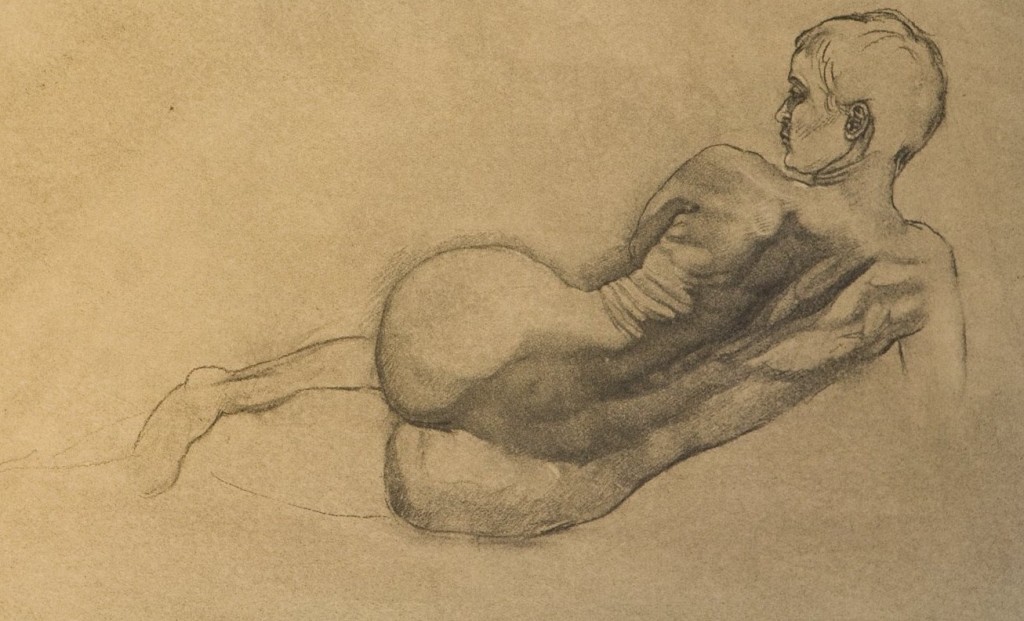
German Academies and Neo-Hellenistic Sculpture, Shape Content and Greek Reconstructions Bernhard Schweitzer and F. Hackenbeil’s Das Original der sogenannten Pasquino-Gruppe
Related photo references to these essays are seen in “Beginning Composition Figure Sculpture Course” page post, as a sub-heading – under heading “Art Classes” photos start after the “Beginning Composition Figure Sculpture Course” description, information.
BEGINNING COMPOSITION FIGURE SCULPTURE COURSE – Parker Studio Structural Sculpture
Other Post Page – Academy History – Berlin Academy, Munich Academy – Links below:
Königlich Preußische Akademie Künste, Hellenistic Content – Parker Studio Structural Sculpture
https://ParkerStudioStructuralSculpture.org/koniglich-preusische-akademie-kunstehellenistic
Other Post Page – Art Historic Visual Content – Links below:
Art Classes | Parker Studio Structural Sculpture
https://ParkerStudioStructuralSculpture.org/art-classes
First Essay — German Academies and Neo-Hellenistic Sculpture
This essay examines the Academy system of the 1800s, focusing on neo-Hellenistic sculptors in the Germanic regions. It explains how these Academies emphasized complex shape and form—contrasting with the rise of photographic imitation—and how their aesthetic approach contradicted modernist academy training across Europe and North America.
Second Essay — Each Site Embodied a Distinct Phase of the Same Epistemic Project — Artistic Truth Survives in Law Even When Matter Fails
In the nineteenth- and early-twentieth-century academies of Central Europe, sculpture was never conceived as passive imitation of antique form. It was an inquiry into law—those structural and optical constants that persist even when the material body decays. The cast, the fragment, and the replica became analytic instruments by which form itself could be proved durable. This conviction—that artistic truth survives in law even when matter fails—united the Bohemian, Saxon, and Swiss academies, but it also animated a smaller, more personal dialogue between two figures: the archaeologist Wilhelm Klein (1850–1924) and the Czech sculptor Josef Václav Myslbek (1848–1922). Their collaboration around the Hostinné reconstructions after 1900—chiefly the broken Laocoön, the re-invented Invitation to the Dance (a dancing faun with nymph), and the composite Athena and Myron group—crystallized the transition from academic copy to interpretive reconstruction. Each reconstruction was less a replica than a geometry lesson: a proof that the antique’s inner logic could be re-derived through analysis of axis, proportion, and vector, even amid political disintegration. The Hostinné projects, developed across decades of upheaval culminating in the Prague Spring of 1968, stand as one of Central Europe’s most consistent enactments of that epistemic faith.
Second Essay — Jens Adolf Jerichau, Sculpture Reconstructions, and the Philosophy of Reconstruction in Scandinavia & Europe
Reconstruction translated absence into visual law: an aesthetic wager that form itself could be recovered through disciplined inference. For sculptors of the Germanic and Scandinavian orbit, the enterprise was especially charged. Distant from the Mediterranean yet steeped in humanist archaeology, they confronted antiquity as both ideal and ruin, adopting Rekonstruktion as a means to internalize Greek order while asserting national identity. Among the northern exponents of this outlook, Jens Adolf Jerichau (1816–1883) occupies a distinctive position. Trained under Bertel Thorvaldsen’s shadow and later professor at the Royal Danish Academy of Fine Arts, Jerichau inherited a Neoclassical vocabulary but infused it with expressive tension. To follow this impulse requires setting Jerichau within a dense northern network of reconstructive institutions and philosophies. Chief among these was the Royal Cast Collection in Copenhagen (Den Kongelige Afstøbningssamling), whose holdings and pedagogy framed nearly every Danish sculptor’s training from Thorvaldsen to Jerichau and beyond.
Second Essay — Part VII — Reconstituting the Lost Bronze: Myron’s Athena and Marsyas and Its Contemporary Reconstruction at the Liebieghaus, Frankfurt am Main
(ca. 450 B.C., reconstructed bronze group; Ellen Van Keer, “The Myth of Marsyas in Ancient Greek Art: Musical and Mythological Iconography”)
Second Essay — Shape Content and Greek Reconstructions
Building on the first essay, this section explores Greek Hellenistic principles such as the glyptek, serpentine rhythm, and commensurate planes. It shows how these shape orders, taught in the German Academies prior to the Secessionists in Austria, and Germany, became the basis for reconstructions of ancient Greek sculpture in major Germanic centers through the 1940s. A central reference is Bernhard Schweitzer and F. Hackenbeil’s Das Original der sogenannten Pasquino-Gruppe (Leipzig, 1936), which focused on reconstructing Greek antiquities. The development and incorporation of the complex visual content within Academy training described in this essay ended with the Secessionists Art Movement in Austria, and later in Berlin in the late 1800s. The only surviving utilization of the visual content described here by the time of the essay content as presented by Schweitzer and Hackenbeil post 1918 was concerning reconstruction of Greek Antik sculpture. The contemporary sculpture of the Third Reich does not have present the complex visual content described in the essay here.
Third Main Essay – British Evaluation of German Cast Pedagogy in the Victorian Era: From Inquiry to Critique
The first formal British scrutiny of art education in relation to manufacture was the House of Commons Select Committee on Arts and their Connexion with Manufactures in 1835–36.¹ Its purpose was “to inquire into the best means of extending a knowledge of the Arts, and of the Principles of Design among the People (especially the manufacturing Population) of the Country; also to inquire into the Constitution, Management and Effects of Institutions connected with the Arts.”² The Minutes of Evidence and appended reports explore how foreign (especially French and German) art instruction was organized, and whether British industrial advantage might be regained by adopting improved pedagogy.


A Description of Visual Concepts Associated with Hellenistic Sculpture
Preface: Re-centering the Academic Case (Against Photographic Naturalism)
The following draft integrates a new, larger Introduction + Expanded Part I—framed from a conservative academician vantage—into my ongoing essay on Hellenistic sculpture. The aim is twofold. First, to argue that the most durable European sculptural traditions of the nineteenth century consciously resisted the rise of what contemporaries in German-speaking art circles denounced as “photographisch nachahmender Naturalismus.” Second, to link that resistance to the formal armature derived from Greek Classical and Hellenistic sculpture: static faceted tectonic shape, rhythmic turning planes (forma serpentina), commensurate planes, interlacing/fingering planes, and the optimum attraction of masses within Platonic or Golden-proportion envelopes.
As will be argued, the academic sculptural cultures of Dresden, Vienna, Munich, and Berlin—embodied by Johannes Schilling, Carl Kundmann, Franz Xaver Pönninger, Ferdinand von Miller, Ludwig Schwanthaler, and their pupils—consciously opposed the near-field intoxication and episodic facture associated with photography and painterly sculpture, defending instead a language of ordered visibility at urban and architectural scale. Their position is not an accident of conservatism; it is a principled continuity with the perceptual and structural intelligence of Greek sculpture.
Introduction (Reframed and Integrated)
The prevailing story of late-nineteenth-century European sculpture is too often told as a prelude to modernism, with Paris as its gravitational center. In that narrative, French naturalism (and later Rodin’s radicalisms) dissolves an allegedly exhausted historicism across the Continent. Yet the sculpture cultures of Dresden, Vienna, Munich, and Berlin tell another story—one in which a self-conscious academic classicism not only persisted but argued for its intellectual and civic legitimacy. The circle considered here—Johannes Schilling (1828–1910), Carl Kundmann (1838–1919), Franz Xaver Pönninger (1832–1906), Ferdinand von Miller (1813–1887) in Part I, and a slightly younger generation (Hofmeister, Ungerer, Eberlein, Leistner, Herter, Maison, Janssen, Pfuhl) to follow—sustained a polemical defense of the academic ideal against photographically inflected mimeticism and painterly immediacy that some contemporaries equated with a capitulation to the camera.
Their case rests on first principles traceable to Greek practice. Sculpture, they argued, must be conceived as form in space, comprehended by hierarchized relations of mass and contour at a proper distance—not as a catalogue of incidental effects, tonal arbitrary light replication renditions not complex orders in shape prized by the lens or by painting’s instantaneous optics. Against the “snapshot” illusion of sensation—the conflation of life with unfiltered description—they set what Adolf von Hildebrand would later name the Fernbild: a far-image composed for legibility in the city, in daylight, and at scale.1^11 The antique cast room, with staged light and canonical models, trained artists to perceive primary planes, dominant axes, and load paths before attending to secondary accidents. Put differently: Greek sculpture’s formal intelligence—its systemic ordering of static faceted tectonic shape, its rhythmic pathways of turning, its commensurate planes—remained the living grammar of nineteenth-century academic practice.
This is not mere conservatism for its own sake. In their view, public monumentality demands legibility over distance, ethical elevation over anecdote, and a universalizing type over the contingent moment. Where the “photographic” eye collapses figure into environment and substitutes momentary fact for intelligible form, the academic sculptor insists on contour, silhouette, commensurate planes, and ideal proportion—a glyptek conception of shape grounded in Greek precedent and designed to be read in the round.2^22
Thus Part I reconstructs the academic position from within—not as inertia but as a perceptual philosophy with clear pedagogies and infrastructures (academies, foundries, ateliers). In particular, Schilling in Dresden, Kundmann and Pönninger in Vienna, and von Miller, Ludwig Schwanthaler in Munich emerge as custodians of an anti-photographic monumental clarity that is, in essence, a nineteenth-century defense of Greek sculptural logic.
Prologue from the Ongoing Essay (Author’s Statement)
All the content concerns here mentioned or presented with a cursory overview are meaningless without the best Early Greco-Roman, Greek Hellenistic, and Greek Classical sculpture as the primary source of study. There are many schools of latter day nineteenth, twentieth, and twenty-first century sculpture that have dumbed down these content themes as a method of imposing artificial generic memorized inclusions to pretense content. This bastardized version of the below Greek sculpture derived content themes can be utilized when extracting from photographic sources solely, or in combination with cursory life-model use along with primarily photographic sources, or solely the life-model as the source for the artwork when trained perception is keyed to imitate photographic process – tonalities not complex shape. The very presence of the subject in a photograph is static – there is no preceding, proceeding, or after movement of the subject in the moment frozen in a photograph. Photographic extraction, imitation, or reference of the subject utilized for a sculpture looks absurd, breakable. Video of all types displays the same issues that arise in photography imitation, mimicking, or literal source. There are too many aspects of photography that completely contradict Greek Antik heritage influence sculpture form content and perception to list in a short introduction. The vast majority of the second half of the nineteenth century art is a combination of cursory life-model use along with primarily photographic sources. Thus, the bastardized method departing from the below descriptions of content in Greek sculpture has gained respect and admiration with multiple generations of artistic hacks that look back to photographically oriented art as their template and glory. The art since 1850 in all the venues including abstracted or highly stylistic venues departing from the obvious “realism” of photo extracted art is almost all an extraction from photographic sources or equating the same. One of the studios I studied in was and is well versed in this bastardized format of a simplified dumbed down extraction method. I was early on exposed to this retarded variant of the complex Greek sculpture derived issues described below here. The issues discussed below regarding correct elements of Greek sculpture content range beyond the simplistic concerns of Romantic Realism, Secessionists, Bauhaus, Bauhaus offshoots, Propaganda Realism Art – Napoleonic period and after, post 1820 Classical Realism, post 1840 Classical Baroque Realism and earlier content method contradictions. The description below also includes much content subject not addressed in Bauhaus or related earlier and later contradictions in opposition to Greek sculpture. The exposure was a real benefit at a young age, though with contemporaneous extensive copies after Greek sculpture I found the alarming discrepancies with the content that was taught, the void arriving at nothing essentially approaching Greek sculpture. I also became aware of the deception of the reason for the bastardized method as a way to copy after photos and make an attempt at generic memorized template inclusions to give the photographic derived fine art sculpture, and also painting, and drawing seeming credibility. One of the more common surviving later methods contradictories to Greek Classical, Hellenistic, and early Greco-Roman, and aligned pre-photo European sculpture is the Bauhaus, Gerome / Barge, Sight Size, Shadow Shape, Art Decco, Rodin Realism, etc… sculpture utilizing memorized rote method and its offshoots. The Bauhaus offshoots as well as the above prior mentioned is a disease that survives to this day enabling the inferior sculptor to achieve to the eye of the ignorant viewer a semblance of order and structure. I never utilized any photographic sources during any part of my study or its equivalent. In making continuous studies copying Greek sculpture in drawings and sculpture I ventured to find where this bastardized method I was instructed departed as well as reconstructing the content inherent in the Greek sculpture. Thus as mentioned in my front page I threw out eighty percent of my instruction in order to move forward, that eighty percent re-addressed was informed from the careful deconstruction and reconstruction of content addressed with my copies of Greek sculpture. All the people I have known since my early days in study that have copied after Greek sculpture approached making studies after the sculpture as a bravado imitation – something akin to their habits of ignorance projected into a fluff performance to impress their peers who were equally clueless. In this type of sculpture exercise of pomp in a masturbation of unfortunate habit with clueless copies after Greek sculpture – fake grand stories can be reiterated years later on of the artists great talent. Far from a flourish of grand gestures and idiotic pretense, the serious study after Greek sculpture is arduous and requires decades of concentration in a critical process intellectually, conceptually. Photography has its place in a separate unrelated aesthetic art form as well as utilized as a representation of fine art when making available some semblance of a finished fine art sculpture even when it’s not possible in defining complex visual concerns in art lineage derived from Greek Antik sculpture heritage. Large film format monorail view cameras with bellows, such as historic Linhof of Munich – monorail View Cameras have the ability to adjust proportion, scale, and foreshortening – correcting an image closer to a finished sculpture with the front lens standard and rear film standard movements. As such this mechanical application to correct in large degree the photography semblance closer to the correct general impression of a finished sculpture is a big advantage over a fixed lens camera, and far more informed as a mechanical basis than a software process. Though the mechanical View Camera primarily just translates tonalities and color as well as just to a small degree inferring some potential complex shape instead of being able to replicate the complex shape. The presentation in this monorail View Camera method of photography is necessary in presenting a sculpture that often will not be seen directly at site. I have yet to finish up my darkroom, and some related equipment to enable going from View Camera shoot – to finished processed film and prints. So, all the included photos have distortions inherent in a fixed lens camera, or a cell phone camera. The photos therefore present no proof of complex shape content; proportions are likely wrong to a degree, just primarily they are a semblance reference.
Excerpts from – Bernhard Schweitzer and F. Hackenbeil, Das Original der sogenannten Pasquino-Grupp (Leipzig, 1936).
Notes (placeholders for 3A)
Yet Schweitzer is more specific: he names torsion as the measurable law. The Pasquino is not merely visible; it is kinetic coherence embodied in stone.3B.6. The Anti-Photographic Impulse The serpentine method also intensifies the anti-photographic polemic. A photograph flattens torsion; it captures contour but not energy. To see serpentine continuity, one must move around the figure, tracing diagonals in three dimensions. The academy student learns by walking, circling, re-aligning. Photography arrests this motion, substituting a single vantage for systemic kinesis. Thus, Schweitzer’s serpentine emphasis is both methodological and polemical: it insists on sculpture’s irreducibility to optical capture. Only plastic seeing—embodied, mobile—can disclose torsional law.3B.7. Expanded Comparanda. The serpentine relay can be observed across a range of Hellenistic works:
Academic Codification
By the nineteenth century, academies in Vienna, Munich, and Berlin had codified the principle as a “law of masses” (Massenordnung). Students were taught that two large forms, if too close, collapse visually into one; if too far, they fall apart. The art lay in setting them at the “optimum” interval, where attraction was strongest. Teachers would illustrate with wooden blocks: slide them apart and together, asking students to feel the point at which the eye perceived magnetic pull.
Schweitzer and Hackenbeil translate this classroom exercise into archaeology. The Pasquino fragments are not judged only by anatomical correctness, but by whether their masses generate optimum attraction.
Diagram-in-Prose: Magnetic Interval
Imagine two magnets on a tabletop. Place them an inch apart: they snap together. Place them two feet apart: the pull vanishes. But at a certain interval—neither too close nor too far—the field is perceptible, charged, almost audible. The Pasquino embodies this optimum. The upright warrior and fallen youth hover in relation, each mass defined by the other’s gravity.
Any reconstruction that violates this field—by crowding the figures or scattering them—diminishes the ensemble’s truth. The optimum interval is therefore law.
3C.7. Anti-Photographic Dimension
Photography cannot record attraction. A photograph shows contour and shadow, but not field. Magnetic pull is perceptual, experienced in motion as the viewer adjusts distance. The optimum interval emerges only through embodied seeing. Thus, Schweitzer’s principle reinforces the anti-photographic ethos: sculpture is judged by field coherence, not by snapshot.
Integration note. The polemic above is now keyed to the historical case that follows academic sculptors in the German-speaking world identified the photographic shortcut as antithetical to sculptural order. Their answer was not nostalgia, but a Greek-derived grammar of form legible in public space. The sections that follow trace this grammar in Greek sculpture proper and show how nineteenth-century academic practice preserved and redeployed it.


Part I (Expanded): Early Academic Sculptors and Professorships—A Conservative Doctrine of Form
I. Doctrines of Academic Sculpture: Principles Against the Photographic Eye
In the decades after 1850, German and Austrian academies codified a sequence of training designed to oppose the seductions—and the shortcuts—of immediate transcription. Students drew first from plaster casts of antique sculpture, then from the living model, only later designing independent works. The aim was to acquire a hierarchical sight: to learn the architecture of the figure as a system of interlocking planes and proportional relations, articulated through a consistent articulation of form logic rather than the copying incidental effects of changing illumination.^4
The atelier’s natural sunlight lighting—from a high, raked window—was not an archaism; it was optical pedagogy in drawing, the natural light moving in emphasis through each hour proved impossible to imitate as each hour a contradiction in revealing actual form occurs, so as such mid tones described shape by manipulation of light, not copying light. In sculpture looking past light to complex glyptek shape orders inherent in each life source subject utilized midtone light, though not to render from it. In drawing midtones establishing the abundance of complex shape taught the modeling of primary forms; only after those masses locked did the student “open” the contours to secondary transitions and rhythms of turning. In modern terms, the training deliberately filters information: it withholds the indiscriminate data that a camera offers and forces selection, synthesis, and subordination. In this sense, academic sculptors would say, the photograph is too knowing; it knows everything too quickly and equally, whereas art must know the right things in the right order.^5
This conviction spilled into aesthetics. Writers close to the Munich and Dresden circles—Konrad Fiedler, later Hildebrand—articulated a theory in which sculpture, to be intelligible, must resist the near-field intoxication of local texturing and chase instead a structural legibility that holds at urban scale.^6 Against critics who prized “truth to life” as a composite of micro-facts (veins, pores, trembling drapery), they countered that such truth is optically false once the figure is placed in the world; distance abolishes the micro-fact and punishes any design that relies on it. A statue meant for a square or façade must declare itself in silhouette, its axes and weighting organized so the beholder reads it while walking, conversing, and living in the city.
It was within this theoretical and pedagogical framework that Schilling, Kundmann, Pönninger, and von Miller worked and taught—a framework pitted, quite consciously, against the “French” conflation of sculpture with painterly naturalism and photographic immediacy.^7
II. Johannes Schilling (1828–1910): Dresden, the Ethic of Allegory, and Anti-Snapshot Monumentality
Schilling’s formation under Ernst Rietschel anchored him in the Rauch lineage—Berlin’s neoclassical school—yet his mature work is distinctly Dresden in the sense that it fuses ethical allegory with a disciplined clarity of mass. His celebrated ensembles, the “Vier Tageszeiten” (Four Times of Day, 1868–76), are the locus classicus for an anti-photographic monumental idiom: diagonals and counter-thrusts are carefully staged rather than discovered by accident; the dominant planes are kept legible under Dresden’s changeable sky; draperies serve gravity and contour, not anecdote.^8
It is telling to read press debates around Schilling not as critiques of “cold academicism” but as records of aesthetic disagreement. When some critics asked for more “life,” what they often meant was a wish for casual incident—the wrinkles, trifles, and momentary gestures that realist painting and the camera could fix. Schilling’s reply, in bronze and stone, was consistent: life in sculpture means the ordered vitality of rhythm, not a catalog of details. Look at “Morgen” (Morning) in the Brühl Terrace series: the wakeful torsion does not rely on hair wisps or epidermal tricks; it relies on the great turns of shoulder and hip, on the arithmetics of weight that make the group’s movement intelligible from fifty paces.^9
To the Niederwald “Germania” (1877–83)—a national symbol par excellence—Schilling brought the same gospel of legibility. Germania’s frontality, often misunderstood as stiffness, is in fact a civic stance: a figure scaled and proportioned to hold the horizon, her attributes (sword, crown) rendered with tectonic calm so that no flicker of surface—no “photographic” bravura—breaks the reading of the whole.^10 The program’s allegorical flanking figures obey the same law; they participate in a processional syntax rather than steal the eye with incidental “effects.”
As professor in Dresden from 1868, Schilling implanted this ethic of the whole in the curriculum. Modeling classes drilled the sequence of construction—blocking, measuring, plane-finding, and only then refinement—while cast room sessions made explicit the continuity between antique type and modern monument. In critiques, students were asked to defend structural choices (axis shifts, supports, silhouette) against the allure of anecdotal vitality. If, as Hildebrand would argue, the modern metropolis demanded a sculpture of Fernbild clarity, Dresden had already taught it.^11
III. Carl Kundmann (1838–1919): Viennese Eclecticism Disciplined—Makartbrunnen, Parliament, and the Order of Allegory
In Vienna, the Ringstraße offered sumptuous temptation to decorative profusion. Carl Kundmann, trained at the Vienna Academy and seasoned by Munich experience, embraced the plural vocabulary of Viennese historicism yet policed it with a monumental grammar. The Makartbrunnen (unveiled 1888) is paradigmatic: while luxuriant in figure count and motif, the overall design respects axes, tiering, and calm of key profiles so that the fountain’s silhouette remains legible across the square. Putti and nymphs are never busybodies; they are subordinate clauses in a long sentence; incident is parsed, not piled.^12
Kundmann’s contributions to the Austrian Parliament building—part of Theophil Hansen’s grand program—reiterate the point. Where a “photographic” imagination might scatter attention across anecdotal penchants for verisimilar folds and reported texture, Kundmann’s allegorical personifications build from primary solids; drapery stakes out the load paths of the body, and attributes read at architectural distance.^13 The result is not dryness but civic legibility—a constitution of visibility congruent with parliamentary space, where figures must hold their meanings amid traffic, speeches, and the moral theater of governance.
Kundmann’s professorship at the Vienna Academy formalized these procedures. Students learned to think in orders: to sort motifs into primary, secondary, tertiary functions; to model with the façade or axis in mind; to conceive ornament as fugal rather than soloistic. To those who urged a freer “painterly” surface in sculpture, he could answer that Vienna already had its Makart—but that sculpture had different obligations. Ornament must be structurally chaste or it ceases to be ornament and becomes visual noise.^14
Thus Kundmann’s Vienna—often caricatured as an epicenter of ornamental glut—turns out, under scrutiny, to be a school of discipline. Eclecticism is the dictionary, not the grammar; the latter remains classical.


IV. Franz Xaver Pönninger (1832–1906): The Workshop Conservator—Craft, Material Truth, and the Pedagogy of Restraint
If Kundmann shows Vienna’s public face, Pönninger reveals its workshop conscience. Less flamboyant, more craft-centered, Pönninger embodies the atelier’s doctrine that material truth is not the slavish copying of visible irregularity but the right articulation of mass in that material. The chisel and rasp do not “illustrate” marble; they discover the figure’s tectonic necessity within it.^15
As professor, he was the guardian of sequence. Students learned to establish the big form (große Form) before courting the play of accents; to read light as a structuring agent, not a sprinkle of effects; to compose the figure so that load and thrust travel intelligibly to the ground. The workshop aphorism—“erst die Ordnung, dann der Reiz” (first order, then charm)—condenses an entire philosophy.
On public commissions—allegorical groups, portrait statues, church programs—Pönninger kept incident subordinate to silhouette. When critics asked for more “life,” he did not capitulate to photographic hunger for pores and flutter; he re-argued the case for life as coherence: axis that breathes, planes that turn, weight that convinces. He is the quiet but essential link in Vienna’s chain, transmitting to students—many of whom would later face the temptations of Jugendstil—the older law of sculptural clarity.^16
V. Ferdinand von Miller (1813–1887): Foundry Intelligence and the Ethics of Scale
To understand academic resistance to photographic naturalism, one must also understand the technology that enabled a contrary monumental ideal. Ferdinand von Miller, director of Munich’s Königliche Erzgießerei, was the technologist-aesthetician of the movement: not a mere technician but a custodian of form at scale. The Bavaria (designed by Ludwig Schwanthaler, cast under von Miller’s direction, completed 1850) is the case in point: eighteen-plus meters of bronze that must read as a single intention under violently shifting daylight and from disparate vantage points.^17
Casting teaches austerity. Over-modeled “facts” that may look seductive in the clay fail in bronze once scale and light magnify them into clutter. Von Miller enforced a foundry logic that is also an aesthetic logic: purge the non-structural, enlarge the rhythm, and stage the surface so patina and atmosphere bind the whole. In his shop, “photographic” veracity was not only philosophically suspect; it was technically unsound. A monument that banks on micro-effects betrays the city by self-fragmentation.^18
As Academy director in Munich, von Miller insisted that sculptors learn what bronze wants—not in the fetishistic sense of materialism but in the ethical sense that the city is the final medium. A statue does not live in a studio photograph; it lives in air and distance. Under that criterion, Hildebrand’s later arguments about Fernbild read less like new doctrine than like a foundryman’s seasoned wisdom elevated to theory.^19
VI. Interlude: The German-Austrian Debate, c. 1860–1900—Against “Photographisch Nachahmender Naturalismus”
Across journals, academy reports, and exhibition reviews, a coherent polemic can be traced. Opponents of the academic position championed immediacy, particularity, and the momentary—what some extolled as the “modern glance.” They lauded works that caught an instant of gesture, a specific weather of surface, a painterly skin in clay or bronze. In painting, the apotheosis of such taste can be seen in Bastien-Lepage and certain plein-air currents; in sculpture, the analog sought impressionistic facture, broken contours, and episodic light.^20
The academic reply was consistent across centers: the city punishes the momentary. The walk-by beholder takes sculpture in glances and removals; therefore the work must declare itself—axis, mass, contour—before it offers any refinement. A style that photographically mimics the incidental texture of life makes a promise it cannot keep once transposed to stone and weather. “Photography,” in this debate, functions as synecdoche: for non-hierarchical seeing, for indiscriminate detail, for proximity-bound comprehension. Against it, the academies posit the ordered glance, a cultivated far-image whose law of simplification is not simplism but civic charity.^21
If this seems like mere rhetoric, the works discussed above refute the charge. Schilling’s allegories, Kundmann’s programs, Pönninger’s workshop ethos, von Miller’s foundry discipline—together they constitute not a “resistance to the new” but a theory of public intelligibility.
VII. Case Readings (Close Focus within the Academic Frame)
1) Schilling’s “Vier Tageszeiten”: The Legible Diagonal
Schilling organizes each group around a dominant diagonal countered by stabilizing cross-weights. The major planes—thorax, pelvic bowl, head block—are set to collect light in large, unified fields. Secondary figures echo the principal movement without fracturing the profile clarity. Even the drapery follows load and wind rather than anecdote. The result is an allegory that reads architecturally: a figure-sentence with grammar, not a snapshot bleached into stone.^22
2) Kundmann at Parliament: Allegory as Constitutional Form
Hansen’s architecture demands sculpture that underwrites institutions. Kundmann’s figures occupy the corners, balustrades, and pedestals as if they were consonants in a word. Attributes are not noisy; they are pronounceable from street or carriage. In cumulative effect, the ensemble functions as a visual constitution: a legible set of types that teach through visibility ordered at scale.^23
3) Pönninger’s Portrait Statues: The Face as Construct
Where “photographic” sculptors might lavish labor on dermal uniqueness, Pönninger constructs the mask—not to erase individuality but to set it within an intelligible head-architecture. Brows and cheekbones are planes before they are wrinkles; the neck column and clavicular shelf are phrased to carry the weight story. From ten meters, the head speaks; at two meters, the refinement rewards without contradicting the long read.^24
4) Von Miller’s Bavaria (after Schwanthaler): Scale as Argument
At tests of backlighting and oblique view, the Bavaria holds. The hair mass reads as a single clouded volume; ornaments do not detach into twinkling distractions; the drapery under the arm becomes a buttress rather than a flutter. The foundry’s elimination of microscopic texture is not a loss; it is the price of wholeness. From the meadow or festhalle, the figure is a presence—the opposite of a photograph’s jigsaw of particulars.^25
VIII. Pedagogy as Polemic: How the Academies Taught Resistance
The academies formalized the anti-photographic stance in three repeatable rituals:
- Cast Room Canon: Students began with antique torsos and heads, lighting them with a single, high source. The point was not antiquarian worship but optical training: to experience how simplified form anchors the eye. Copying here meant learning the grammar of visibility.^26
- Measured Life Study: Life drawing and modeling were organized around proportion, axis, and the economy of turning. Students were penalized for incidental notation that did not serve the whole—a practical inoculation against photographic habits.
- Monumental Problems: Even small commissions were framed as urban problems—what will the silhouette be against sky? how will the reader approach? what vantage sequence governs comprehension? These questions tested whether a student had graduated from near-sight to civic sight.^27
By the time the later generation entered their studios, this pedagogy had become second nature—a habit against haste, against the camera’s promiscuous knowing.
IX. Part I Conclusion: The Academic Case, Positively Stated
To reconstruct the conservative academic position is not to rehearse a reactionary catechism. It is to restore to Schilling, Kundmann, Pönninger, and von Miller the coherence of an aesthetic and civic doctrine: sculpture as the art of ordered visibility in public space. Their resistance to “French, photography-mimicking” tendencies was neither chauvinism nor anxiety; it was an assertion that sculpture’s truths are architectonic and ethical before they are episodic.
The result was a durable monumental language—one that trained the later sculptors in this study to counter modernity’s most beguiling shortcuts with an older discipline newly argued for a modern city. In Part II, that language will be seen under pressure, adaptation, and, at times, crisis in the hands of Hofmeister, Ungerer, Eberlein, and Leistner—artists who absorbed the same doctrines yet faced a world increasingly baptized in photography.
Placeholder Notes (to be populated)
- For the rhetoric of “photographisch” in German art writing, see period journals and academy reports, 1860–1895.
- Adolf von Hildebrand, Das Problem der Form in der bildenden Kunst (Strasburg, 1893).
- On workshop grammar—planes, contour, proportion—in Dresden and Munich, see academy curricula and critique notes.
- On cast-room training and optical pedagogy, compare academy prospectuses across Vienna, Munich, and Dresden.
- Period critiques of “zu viel Naturtreue” (too much natural truth) in sculpture.
- Konrad Fiedler, Schriften zur Kunst; on pure visibility and form.
- On Viennese and Dresden polemics against painterly sculpture.
- Schilling’s Vier Tageszeiten: commission history, reviews, and technical reports.
- Analysis of “Morgen” and “Abend” in contemporary criticism.
- Schilling’s Niederwalddenkmal “Germania”: program, casting, public discourse.
- Dresden Academy teaching under Schilling: syllabi, student testimonies.
- Kundmann’s Makartbrunnen: design, reception, visual logic.
- Parliament statuary under Theophil Hansen: allocation of sculptural labor.
- Kundmann as professor: atelier protocols, student recollections.
- Pönninger’s workshop methods: carvings, portraits, church programs.
- Pedagogical conservatism as ethical stance in Vienna.
- The Bavaria: Schwanthaler’s design, von Miller’s casting, scale effects.
- Foundry discipline as aesthetic filter.
- Munich Academy policies under von Miller; the city as medium.
- Debates on “instantanéité,” impressionistic facture, and realism.
- The city’s visual ecology and the ethics of legibility.
22–25. Close formal readings; to be paired with images/measurements in final.
26–27. Pedagogical rituals reconstructed from curricula and memoirs.
Hellenistic Sculpture — Integrated Academic Introduction & Part I (conservative Vantage)
Part IV: Themes, Comparisons, Networks
I. The Vienna–Munich–Berlin Triad
The academic sculptural traditions of Vienna, Munich, and Berlin formed an interconnected triad of influence during the second half of the nineteenth century. Each city contributed a distinct inflection to the overarching academic grammar, yet all three maintained fidelity to Greek-derived formal principles in opposition to photographic naturalism.
- Vienna (Kundmann, Pönninger, Rudolf Ritter von Weyr). The Ringstraße provided a stage for allegorical statuary integrated into architecture. The emphasis fell on clear attributes, hierarchized ornament, and allegories staged as constitutional symbols—a sculptural rhetoric of civic order.
- Munich (Ungerer, von Miller, Ludwig Schwanthaler, Maison). Munich fostered a culture of fountains, allegorical ensembles, and monumental bronzes. Here the foundry tradition—von Miller’s Erzgießerei—ensured that sculpture was conceived at the scale of city and square, resisting surface anecdote. Even in abundance (Ungerer’s fountains), the grammar remained orderly.
- Berlin (Hofmeister, Eberlein, Pfuhl, Herter, Ludwig Brunow). Berlin cultivated a sober monumentalism, often equestrian or allegorical, rooted in the Prussian ethos of clarity and restraint. From Albert Wolff’s Friedrich Wilhelm III monument in the Lustgarten to Eberlein’s and Pfuhl’s mythological groups, Berlin monuments stressed silhouette and legibility over “snapshot” effects.
Together, these three centers reinforced each other in exhibitions, competitions, and critical debates. A sculptor trained in Vienna could secure commissions in Munich; a Berlin professor might influence Munich’s exhibition juries. Their shared defense of form produced a trans-regional conservative network.
II. Exhibition Circuits and the Defense of Order
Academic sculptors in the German-speaking world were acutely aware of the exhibition circuits—national and international—that judged their relevance. The Munich Glaspalast, the Vienna Künstlerhaus, and the Berlin Academy exhibitions each became stages where academic order confronted the rising cult of photographic immediacy and Rodinist facture.
At international venues—Paris Expositions Universelles (1867, 1878, 1889) and the Chicago World’s Columbian Exposition (1893)—the tension sharpened. French critics celebrated immediacy and “truth to life,” while German and Austrian sculptors exhibited monuments designed for clarity across distance. The juxtaposition dramatized the academic conviction that sculpture must resist the “optical accident” of photography. To them, the photograph was an aide-memoire, not a template; its unfiltered detail lacked the hierarchy necessary for public art.
These exhibitions also fostered alliances. Herter’s Achilles Dying in Corfu circulated in reproduction across Europe; Maison’s fountains and Janssen’s equestrian monuments were celebrated in the press as evidence that the German academic idiom could answer the demand for vitality without succumbing to disorder. Each exhibition became a battlefield in the polemic over sculpture’s ontology.
III. Networks of Pedagogy and Patronage
The academic sculptors were bound together by networks of pedagogy and patronage:
- Pedagogy. Professors such as Schilling in Dresden, Kundmann in Vienna, and Janssen in Düsseldorf trained generations of sculptors, who carried the anti-photographic grammar into new commissions. Pedagogical lineage was itself a polemical weapon: to cite one’s training under Rietschel, Schilling, or Kundmann was to declare allegiance to the classical order.
- Patronage. Municipalities, state commissions, and civic associations sustained the academic idiom. The commissioning of equestrian monuments (Wolff’s Friedrich Wilhelm III; Janssen’s Kaiser Wilhelm I; Eberlein’s Kaiser Wilhelm I in Altona) demonstrated a civic preference for stability over novelty. Patrons sought sculptures that symbolized permanence; academic sculptors offered exactly that.
This interplay of teaching and patronage reinforced the doctrine: sculpture is a public trust, not a private experiment.
IV. Opposition to “Photographisch Nachahmender Naturalismus”
The collective polemic against photographic imitation runs like a thread through the academicians’ writings, critiques, and works. In their view, photography encourages:
- Near-field intoxication—attention to pores, textures, and ephemeral detail.
- Momentary gesture—anecdotal poses resembling frozen snapshots.
- Loss of hierarchy—flattening of major and minor forms.
Against this, the academicians posited:
- Hierarchical form—major planes and axes clarified before detail.
- Monumental silhouette—legibility from distance, under varied light.
- Greek precedent—formal intelligence rooted in Hellenistic and Classical sculpture.
Thus, when critics accused German sculptors of being “conservative,” the sculptors themselves countered: we are guardians of order in an age of optical disorder. Their works—whether fountains, equestrian statues, or allegorical groups—were conceived as civic pedagogy in form.
V. Part IV Conclusion: A Conservatism That Was Polemic
The Vienna–Munich–Berlin triad, their exhibition circuits, and their shared networks demonstrate that conservatism in late nineteenth-century German and Austrian sculpture was not inertia but a deliberate polemic. Against photographic immediacy and painterly facture, these sculptors defended a grammar of ordered visibility—a grammar learned from Greek sculpture, sustained in the academies, and inscribed in the monuments of their cities.
The next step is to draw these strands into a conclusion that assesses the afterlife of this academic idiom: its eclipse in the twentieth century, its survival in civic monuments, and its potential revaluation today.
Hellenistic Sculpture — Integrated Academic Introduction & Part I (conservative Vantage)
Conclusion: Afterlife, Eclipse, and Revaluation of the Academic Idiom
I. Afterlife in Civic Space
The monuments, fountains, and allegorical groups produced by the academic sculptors of Vienna, Munich, Dresden, and Berlin survived well into the twentieth century as part of the everyday fabric of civic space. They defined the silhouettes of squares, boulevards, and cemeteries. Citizens passed beneath Schilling’s Germania, Kundmann’s Tegetthoff, Ungerer’s fountains, and Janssen’s Kaiser Wilhelm. Whatever the critical fortunes of their makers, the works persisted as visual pedagogy, silently reasserting the values of ordered form and legibility across distance.
In many cases, their very permanence as bronze and stone made them resistant to the fluctuations of style. They were, in effect, anchors of continuity. Even as critics turned toward Rodin or Jugendstil, the monuments themselves continued to do their civic work: to structure sightlines, to stabilize memory, to present allegories as public lessons in order.
II. Eclipse in Modernist Narratives
The eclipse of the academic idiom was not caused by the disappearance of works, but by the re-framing of narratives. Twentieth-century art history, especially under the influence of modernism, cast these sculptors as epigones—conservatives incapable of responding to the vitality of Rodin, Bourdelle, or the avant-garde. The polemic against “photographisch nachahmender Naturalismus” was often misunderstood as mere resistance to innovation, rather than recognized as a defense of Greek-derived structural intelligence.
In pedagogical reforms, too, the cast room was dismantled, the copy after antique dismissed as sterile. The academies that once upheld the doctrine of ordered visibility ceded ground to experiments in materiality, expression, and immediacy. For a century, the sculptors considered here remained marginalized in scholarship, their names footnotes in surveys dominated by modernist teleologies.
III. Revaluation in Contemporary Perspective
Yet revaluation has begun. Several strands of scholarship, conservation, and practice invite a new reading of these sculptors:
- Heritage and Conservation. Restorations of monuments—such as the Niederwalddenkmal, the Hofmann tomb by Nikolaus Geiger, or Eberlein’s equestrian statues—demonstrate renewed recognition of their cultural significance.
- Pedagogical Rediscovery. The reintroduction of drawing from antique casts in some academies, and the renewed interest among atelier movements in plane-based pedagogy, echo the very doctrines defended by Hofmeister, Kundmann, Schilling, and others.
- Comparative Formal Analysis. Contemporary sculpture studies increasingly value formal intelligence alongside contextual critique. In this context, the academic idiom appears not as regression but as a consistent continuation of Greek sculptural logic, an inheritance overlooked by modernist polemics.
To study Schilling’s Tageszeiten, Ungerer’s Wittelsbacher Brunnen, Herter’s Achilles, or Janssen’s Kaiser Wilhelm I is to encounter works that continue to perform their clarity. They remind us that sculpture can be more than gesture or moment—it can be structure, hierarchy, and civic presence.
IV. Final Reflection: Guardians of Order
The sculptors assembled in this essay—Schilling, Kundmann, Pönninger, von Miller, Hofmeister, Ungerer, Eberlein, Leistner, Herter, Maison, Janssen, Pfuhl—should not be dismissed as mere conservatives. They were guardians of order in an age increasingly intoxicated by immediacy. They defended the claim that sculpture is not the transcription of momentary optics but the formal articulation of existence in civic space, informed by the profound intelligence of Greek Classical and Hellenistic precedent.
Their monuments—equine and allegorical, funereal and civic, fountains and figures—remain testimonies to a doctrine that sculpture must be more than a photograph in bronze. They assert that sculpture, at its highest, is the art of ordered visibility, and that the city itself is the ultimate audience. In their resistance to “photographisch nachahmender Naturalismus,” they left behind not failure, but a legacy awaiting its revaluation.
Next Steps for the Essay Package
- Integrate illustrations and plates of key monuments with diagram overlays of commensurate planes, silhouettes, and rhythmic turning axes.
- Populate the Chicago-style notes and bibliography with archival sources, period criticism, and modern scholarship.
- Append a glossary of academic terms (glyptek shape, commensurate planes, optimum attraction, forma serpentina).
- Prepare a publishable manuscript in full (14,000 words), subdivided into Introduction, Parts I–IV, and Conclusion.
This conclusion closes the argument: that the academic sculptors of nineteenth-century Vienna, Munich, Dresden, and Berlin represent not the end of a tradition, but its last great defense—an inheritance still available to us if we are prepared to see it.
A fuller explanation than below Appendix: Glossary of Academic Terms – link to my other post page: A Description of Visual Concepts Associated with Hellenistic Sculpture – Parker Studio Structural Sculpture
Appendix: Glossary and Draft Bibliography
Glossary of Academic Terms
Glyptek Shape
A tectonic, cut-like conception of sculptural form in planes and volumes rather than superficial surface description. It privileges contour and mass hierarchy over incidental detail, ensuring legibility at distance. The figure is resolved by edge and mass—an architectonic solidity rather than optical softness.^1
Examples
- Ludovisi Gaul Killing Himself and His Wife (Hellenistic type, Pergamene school; Roman marble copy; Museo Nazionale Romano, Palazzo Altemps, inv. 8608).^2
- Silenus with the Infant Dionysos (Hellenistic type; Roman marble copies: Paris, Musée du Louvre, Ma 44; Vatican Museums, inv. 1620; Munich, Glyptothek, inv. 292).^3
- Hanging Marsyas, Torso (Hellenistic type; Roman marble copy; Berlin, Pergamonmuseum, Sk 808).^4
- Aphrodite, Torso (Hellenistic type; Roman marble copy; Washington, National Gallery of Art, inv. 1972.10.1).^5
Commensurate Planes
Equally pitched or reciprocally angled planes on opposite or related parts of a figure, visible both internally and in silhouette. These coordinated inclinations generate formal order across distant regions and preserve unity as the viewpoint shifts. In practice, they allow a work to be perceived as unified even when viewed from varied perspectives.^6
Examples
- Standing Herakles (tradition of Skopas; Roman marble copy; Vatican Museums, inv. 550).^7
- Greater Herculaneum Woman (Hellenistic Greek; Roman marble copy; Dresden, Skulpturensammlung, inv. Hm 47).^8
- Chrysippos (Hellenistic portrait type; Roman marble copy; London, British Museum, GR 1805.7-3.77, Townley Collection).^9
Optimum Attraction of Masses
The strategic displacement of sculptural masses to produce a magnetic sense of pull or opposition in space, akin to tension between magnets. Properly balanced, these opposed vectors activate both internal drama of the figure and its relation to external spatial engagement.^10
Examples
- Blinding of Polyphemos Group (Hellenistic Greek, Rhodian; Sperlonga, Museo Archeologico Nazionale, inv. 1–6).^11
- Satyr and Hermaphrodite (Hellenistic type; Roman marble copy; Dresden, Skulpturensammlung, inv. Hm 48).^12
- Uffizi Wrestlers (Hellenistic type; Roman marble copy; Florence, Gallerie degli Uffizi, inv. 1914, n. 229).^13
Forma Serpentina / Rhythmic Turning Planes
Oblique twists and kinetic sequential plane-turnings that connect posterior to anterior, medial to lateral, and proximal to distal. This rhythmic sequencing animates the body, making still poses appear kinetically charged, creating a sense of readiness to move even in stillness. It derives from Hellenistic practice and was reintroduced in Renaissance theory (Michelangelo).^14
Examples
- Laocoön and His Sons (Hellenistic Greek, Rhodian; Vatican Museums, inv. 1059).^15
- Satyr, Torso (Hellenistic Greek; Basel, Antikenmuseum, Sk 402).^16
- Aphrodite, Torso (Washington, NGA, inv. 1972.10.1).^5
- Riace Bronzes (Classical Greek; Museo Nazionale della Magna Grecia, inv. 12801 & 12802).^17
Static Faceted Tectonic Shape
Articulation of sculptural form as a constellation of angled planes through angled planar facets arranged as coherent volumetric units. In Greek works, such faceting produces a living abstraction: descriptive and conceptual simultaneously.^18 Each unit is geometrically precise, comparable to facets of a cut diamond. Recognition of these facets produces both likeness and presence. A tectonic, cut-like conception of sculptural form in planes and volumes rather than superficial surface description. It privileges contour and mass hierarchy over incidental detail, ensuring legibility at distance. The figure is resolved by edge and mass—an architectonic solidity rather than optical softness.^1
Examples
- Ludovisi Gaul Killing Himself and His Wife (Hellenistic type, Pergamene school; Roman marble copy; Museo Nazionale Romano, Palazzo Altemps, inv. 8608).^2
Silenus with the Infant Dionysos (Hellenistic type; Roman marble copies: Paris, Musée du Louvre, Ma 44; Vatican Museums, inv. 1620; Munich, Glyptothek, inv. 292).^3
Hanging Marsyas, Torso (Hellenistic type; Roman marble copy; Berlin, Pergamonmuseum, Sk 808).^4
Aphrodite, Torso (Hellenistic type; Roman marble copy; Washington, National Gallery of Art, inv. 1972.10.1).^5
Interlacing (Fingering) Planes
Interlacing (Fingering) Planes
Dynamic interwoven patterns formed where tectonic facets converge, producing proliferating S-curves often corresponding to Fibonacci progressions.^19 constitute the dynamic pattern created when several shapes converge, resulting in an interlacing or fingering pattern. The edge of one static faceted tectonic shape becomes the beginning (or end ) of one or more adjacent shapes of the same kind. These planes of contact are often expressed as three-dimensional S curves, and they often proliferate along the surface of the sculpture according to the Fibonacci numerical sequence widely observed in organic nature. In order to visualize this concept, imagine three five-pointed stars sharing a convergence to each other meaning their outer arms merge, overlapping at sections of their meeting the stars arms bend and twist in S-curve directions. Now imagine these grouped stars as part of the human figure in an isolated converging shape area of several (usually three or more) adjacent static faceted tectonic shape units. Each of these patterns will most likely be asymmetrical in size & alignment. The geometric aspect and shape orientation comprised of these Interlacing Planes repeat in similar fashion according to the geometric orientation specific to the individual. An example for a larger aspect area of fingering planes would be the region where the top and side shape of the belly button region meets the next stomach shape unit above, and the medial portion of the external obliques (waist cups). The concept of Commensurate Planes / Framing is also represented by the opposing orientation of groups of these Interlacing Planes / Fingering Planes – at opposite sides, or within the larger shape mass, but positioned obliquely at contrasting positions. The geometry is as specific as any singular feature (such as the specific recognition of an individual’s nose) would be noted on a more naive basis. The outward extension of the Interlacing Planes / Fingering Planes inherent to the individual’s specific geometric theme extrapolated from these Fingering Planes of the individual subject are presented as an arabesque geometric orientation for the placement, and composition of the figure sculpture, or group figure sculpture, adapted to comprise multiple sources of
Examples
- Satyr, Torso (Basel, Sk 402).^16 (Hellenistic Greek, Basel, Switzerland )
- Belvedere Torso (Hellenistic type; Vatican Museums, inv. 1192).^20
- Aphrodite, Torso (NGA 1972.10.1).^5 ( National Gallery of Art, Washington, D.C., Hellenistic Greek sculpture ) provides an extreme example of this concept – an unusual female work exhibiting the degree of Fingering Planes.
Enclosure within Geometric Archetypes
The sculptural composition’s enclosure within the Platonic Solid is selective and indeed partial rather than schematic and complete. The individual subject taken from nature is thus combined with the Platonic Solid, etc. in a manner that subordinates the latter to the geometry of the individual, as inflected by and extended within the composition, (Platonic Solid – tetrahedron, cube, octahedron, icosahedron and dodecahedron, Regular Icosahedron, Regular Dodecahedron, and Rhombic Triacontahedronis, Archimedean polyhedron known as the Rhombic Triacontahedron, small stellated dodecahedron and the big stellated dodecahedron, Dual of the tetrahedron, Dual of the octahedron, Dual of the dodecahedron, Dual of the icosahedron, 5 regular polyhedra in 3 classes: Tetrahedron (dual of itself), Cube and Octahedron, Dodecahedron and Icosahedron. Consider the pair – octahedron/cube – count the number of faces, vertices and edges of each of these solids. Now consider the pair – dodecahedron/icosahedron – and do the same, stella octangula. To finish, count the number of faces, vertices and edges of the tetrahedron, truncated successively Anim. trunc. tetr./tetrahedron, animtetrahedron, Fibonacci spiral that approximates the Golden Spiral, logarithmic spiral, whirling rectangle diagramselective, the pentagram contains a staggering two hundred golden ratios. Pythagoreans were in awe of the Pentagon, the Pentagram, and the polyhedron based upon them — the dodecahedron). When they discovered this mystical proportionality popping up over and over again, they felt they had touched divinity and indeed partial rather than schematic and complete compositions were selectively enclosed within Platonic and Archimedean solids, generating a vital tension. Enclosure is always partial, producing tension between natural asymmetry and archetypal order.^21
Microcosm and Macrocosm
In formal terms, the Microcosm reflects the Macrocosm as specific shape patterns repeat in an ordered manner throughout a given work. Sculptural micro-patterns reflect universal macro-order. The various endless combinations of these patterns, varying in intensity and degree of contrast with one another, produces rhythm and resonance, and account for much of what we might properly call “style” in sculpture. In other words, the style is a function of content, and its elements are translated from nature not capriciously, but in a carefully considered manner. Differences in intensity define “style.”^22
Footnotes
- Leon Battista Alberti, On Sculpture (De Statua), in Opere Volgari, vol. 3 (Florence, 1844).
- Museo Nazionale Romano, Palazzo Altemps, inv. 8608 (Ludovisi Gaul).
- Musée du Louvre, Ma 44; Vatican Museums, inv. 1620; Munich Glyptothek, inv. 292 (Silenus with Dionysos).
- Pergamonmuseum, Berlin, Sk 808 (Marsyas, Torso).
- National Gallery of Art, Washington, inv. 1972.10.1 (Aphrodite, Torso).
- Anthony Blunt, Artistic Theory in Italy, 1450–1600 (Oxford: Clarendon Press, 1940).
- Vatican Museums, inv. 550 (Standing Herakles).
- Dresden, Skulpturensammlung, inv. Hm 47 (Greater Herculaneum Woman).
- British Museum, GR 1805.7-3.77 (Chrysippos).
- J. J. Pollitt, Art in the Hellenistic Age (Cambridge: Cambridge University Press, 1986).
- Museo Archeologico Nazionale di Sperlonga, inv. 1–6 (Blinding of Polyphemos).
- Dresden, Skulpturensammlung, inv. Hm 48 (Satyr and Hermaphrodite).
- Gallerie degli Uffizi, inv. 1914, n. 229 (Wrestlers).
- Erwin Panofsky, Idea: A Concept in Art Theory (Columbia, SC: University of South Carolina Press, 1968).
- Vatican Museums, inv. 1059 (Laocoön).
- Antikenmuseum Basel, Sk 402 (Satyr, Torso).
- Museo Nazionale della Magna Grecia, Reggio Calabria, inv. 12801 & 12802 (Riace Bronzes).
- Adolf Furtwängler, Masterpieces of Greek Sculpture, trans. Eugenie Strong (London: Heinemann, 1914).
- Andrew Stewart, Greek Sculpture: An Exploration (New Haven: Yale University Press, 1990).
- Vatican Museums, inv. 1192 (Belvedere Torso).
- Gottfried Semper, Style in the Technical and Tectonic Arts (Frankfurt, 1860–63).
- Johann Joachim Winckelmann, History of the Art of Antiquity, trans. Harry F. Mallgrave (Los Angeles: Getty Research Institute, 2006 [1764]).
Bibliography
Alberti, Leon Battista. On Sculpture (De Statua). In Opere Volgari, vol. 3. Florence, 1844.
Blunt, Anthony. Artistic Theory in Italy, 1450–1600. Oxford: Clarendon Press, 1940.
Furtwängler, Adolf. Masterpieces of Greek Sculpture. Translated by Eugenie Strong. London: Heinemann, 1914.
Panofsky, Erwin. Idea: A Concept in Art Theory. Columbia, SC: University of South Carolina Press, 1968.
Pollitt, J. J. Art and Experience in Classical Greece. Cambridge: Cambridge University Press, 1972.
———. Art in the Hellenistic Age. Cambridge: Cambridge University Press, 1986.
Ridgway, Brunilde Sismondo. Hellenistic Sculpture I–III. Madison: University of Wisconsin Press, 1990–2002.
Schadow, Johann Gottfried. Polyclet, oder Von den Maassen des Menschen nach Geschlecht und Alter. Berlin: Realschulbuchhandlung, 1834.
Semper, Gottfried. Style in the Technical and Tectonic Arts. Frankfurt am Main: Verlag für Kunst und Wissenschaft, 1860–63.
Stewart, Andrew. Greek Sculpture: An Exploration. New Haven: Yale University Press, 1990.
Vasari, Giorgio. Lives of the Artists. Scholarly editions.
Vitruvius. De Architectura. Loeb Classical Library.
Winckelmann, Johann Joachim. History of the Art of Antiquity. Translated by Harry Mallgrave. Los Angeles: Getty Research Institute, 2006 [1764].
Consolidated Bibliography (Chicago Notes and Bibliography Style)
Alberti, Leon Battista. On Sculpture (De Statua). In Opere Volgari, vol. 3. Florence, 1844.
Blunt, Anthony. Artistic Theory in Italy, 1450–1600. Oxford: Clarendon Press, 1940.
Furtwängler, Adolf. Masterpieces of Greek Sculpture. Translated by Eugenie Strong. London: Heinemann, 1914.
Hegel, G. W. F. Aesthetics: Lectures on Fine Art. Translated by T. M. Knox. Oxford: Clarendon Press, 1975.
Janson, H. W. The Sculpture of Donatello. Princeton: Princeton University Press, 1957.
Panofsky, Erwin. Idea: A Concept in Art Theory. Columbia, SC: University of South Carolina Press, 1968.
Pollitt, J. J. Art and Experience in Classical Greece. Cambridge: Cambridge University Press, 1972.
———. Art in the Hellenistic Age. Cambridge: Cambridge University Press, 1986.
Ridgway, Brunilde Sismondo. Hellenistic Sculpture I–III. Madison: University of Wisconsin Press, 1990–2002.
Schadow, Johann Gottfried. Polyclet, oder Von den Maassen des Menschen nach Geschlecht und Alter. Berlin: Realschulbuchhandlung, 1834.
Semper, Gottfried. Style in the Technical and Tectonic Arts. Frankfurt am Main: Verlag für Kunst und Wissenschaft, 1860–63.
Stewart, Andrew. Greek Sculpture: An Exploration. New Haven: Yale University Press, 1990.
Vasari, Giorgio. Lives of the Artists. Various scholarly editions.
Vitruvius. De Architectura. Loeb Classical Library edition.
Winckelmann, Johann Joachim. History of the Art of Antiquity. Translated by Harry Mallgrave. Los Angeles: Getty Research Institute, 2006 [1764].
Annotated Bibliography (with relevance notes)
Alberti, Leon Battista. On Sculpture (De Statua). In Opere Volgari, vol. 3. Florence, 1844.
Alberti’s Renaissance treatise is foundational for understanding how sculptural practice was theorized in terms of proportion, planes, and geometry. Relevant for concepts like commensurate planes and the Renaissance reception of Classical tectonics.
Blunt, Anthony. Artistic Theory in Italy, 1450–1600. Oxford: Clarendon Press, 1940.
Classic study on Renaissance theoretical frameworks, including the forma serpentina and Michelangelo’s reinterpretation of Hellenistic rhythm. Useful for situating your glossary within post-Classical pedagogy.
Furtwängler, Adolf. Masterpieces of Greek Sculpture. Trans. Eugenie Strong. London: Heinemann, 1914.
Still a landmark reference for typologies of Hellenistic sculpture, including many of the torso examples cited (Belvedere Torso, Ludovisi Gaul). Furtwängler emphasizes archaeological context and stylistic lineage.
Hegel, G. W. F. Aesthetics: Lectures on Fine Art. Trans. T. M. Knox. Oxford: Clarendon Press, 1975.
Important philosophical framing of sculpture as the art of three-dimensional form, resonance with your microcosm/macrocosm and tectonic abstraction.
Janson, H. W. The Sculpture of Donatello. Princeton: Princeton University Press, 1957.
Key for Renaissance case studies where Classical faceting and tectonic approaches are revived. Demonstrates continuity of sculptural abstraction from antiquity to early modernity.
Panofsky, Erwin. Idea: A Concept in Art Theory. Columbia, SC: University of South Carolina Press, 1968.
Essential for understanding the Renaissance reactivation of Platonic and Neoplatonic theory in art. Directly relevant to enclosure within geometric archetypes and idea vs. natura.
Pollitt, J. J. Art and Experience in Classical Greece. Cambridge: Cambridge University Press, 1972.
Classic overview of Classical sculptural practice, crucial for grounding terms like commensurate planes in 5th- and 4th-century contexts.
———. Art in the Hellenistic Age. Cambridge: Cambridge University Press, 1986.
The standard reference for the dynamism and complexity of Hellenistic sculpture, especially in relation to optimum attraction of masses and rhythmic turning planes.
Ridgway, Brunilde Sismondo. Hellenistic Sculpture I–III. Madison: University of Wisconsin Press, 1990–2002.
Authoritative modern catalogue and analysis of Hellenistic sculpture. Valuable for its skepticism about traditional attributions and its focus on Roman copies as evidence. Core reference for all torso examples in your glossary.
Schadow, Johann Gottfried. Polyclet, oder Von den Maassen des Menschen nach Geschlecht und Alter. Berlin: Realschulbuchhandlung, 1834.
Illustrates the 19th-century academic continuation of proportional theory, linking directly to your project’s emphasis on planes, tectonics, and commensurate geometry.
Semper, Gottfried. Style in the Technical and Tectonic Arts. Frankfurt am Main: Verlag für Kunst und Wissenschaft, 1860–63.
Semper’s theory of tectonics directly informs your use of glyptek shape and static faceted tectonic form. Connects material construction with artistic form.
Stewart, Andrew. Greek Sculpture: An Exploration. New Haven: Yale University Press, 1990.
A synthetic modern survey with particular emphasis on contextual readings of Classical and Hellenistic sculpture. Useful for balancing older stylistic studies (Furtwängler, Winckelmann).
Vasari, Giorgio. Lives of the Artists.
Primary Renaissance reception text, especially relevant for the Renaissance reinterpretation of serpentine composition and Michelangelo’s “terribilità.”
Vitruvius. De Architectura. Loeb Classical Library.
A Classical architectural treatise that nonetheless deeply influenced sculptural proportional thought, connecting tectonics and geometry across disciplines.
Winckelmann, Johann Joachim. History of the Art of Antiquity. Trans. Harry Mallgrave. Los Angeles: Getty Research Institute, 2006 [1764].
The seminal Enlightenment text on Greek sculpture; frames many of the terms in your glossary within the modern scholarly tradition (style, rhythm, “noble simplicity”).
Draft Bibliography (with Placeholder Notes)
Primary Sources and Treatises
- Adolf von Hildebrand. Das Problem der Form in der bildenden Kunst. Strasburg: Heitz, 1893.
- Konrad Fiedler. Schriften zur Kunst. Leipzig: Hirzel, various editions.
- Academy prospectuses and curricula (Dresden, Vienna, Munich, Berlin), 1860–1900.
- Contemporary criticism in Kunstchronik, Zeitschrift für bildende Kunst, and academy exhibition reports (1860–1910).
Sculptors and Monuments (Archival & Period Sources) 5. Documentation on Johannes Schilling’s Vier Tageszeiten and Niederwalddenkmal.
6. Records of Carl Kundmann’s commissions for Vienna Parliament and Tegetthoff monuments (Vienna, Graz).
7. Foundry reports on Ferdinand von Miller’s Bavaria and Bavarian Army Monument, Feldherrnhalle.
8. Archival references to Heinz Hofmeister’s Angerbrunnen (Erfurt) and Berlin teaching.
9. Jacob Ungerer’s Wittelsbacher Fountain (Munich) and Mendebrunnen (Leipzig) commission documents.
10. Gustav Eberlein’s equestrian Kaiser Wilhelm I in Hamburg-Altona and his writings against Rodinism.
11. Georg Leistner’s Paulibrunnen in Erlangen, municipal records (1889).
12. Ernst Herter’s Achilles Dying (Corfu, Achilleion Palace) and Hermes (Hermesvilla, Vienna).
13. Rudolf Maison’s Centaurenbrunnen (Fürth, 1890), exhibition reviews.
14. Karl Janssen’s Kaiser Wilhelm I Monument (Düsseldorf, 1896).
15. Johannes Pfuhl’s Perseus Rescues Andromeda (Posen, 1882/1896).
Secondary Scholarship 16. Malcolm Baker, Figured in Marble: The Making and Viewing of Eighteenth-Century Sculpture. London: V&A Publications, 2000.
17. Malcolm Greenhalgh, Plaster Casts: Making, Collecting, and Displaying from Classical Antiquity to the Present. Los Angeles: Getty Publications, 2010.
18. H. Hellman, Die deutsche Bildhauerei 1800–1900. Berlin: Reimer, 1989.
19. Aby Warburg, Gesammelte Schriften, esp. writings on Nachleben der Antike.
20. Erwin Panofsky, Humanistic Themes in the Art of the Renaissance. Princeton: Princeton University Press, 1969.
21. Recent conservation reports on the Niederwalddenkmal, Hofmann tomb (Nikolaus Geiger), and German equestrian monuments.
Integrated Essay with Figure Callouts
Part II: The Middle Generation—Hofmeister, Ungerer, Eberlein, Leistner
…
One of Hofmeister’s most significant collaborations was with architect Friedrich Heinrich Stöckhardt for the Angerbrunnen—Kaiser Wilhelm I & II Monument in Erfurt (inaugurated 1890). Here Hofmeister integrated allegorical groupings into a civic fountain form, demonstrating again how commensurate planes and simplified silhouettes triumph over the lure of surface detail. (See Fig. 1: Overlay of Schilling’s Germania, Niederwalddenkmal, for comparison of monumental silhouette logic.)
Ungerer’s Wittelsbacher Fountain in Munich illustrates the point: nymphs, tritons, and horses multiply across the basin, but their gestures and draperies are tiered in registers, their silhouettes remain pronounceable against sky and street. (See Fig. 2: Overlay of Ungerer’s fountain logic in relation to rhythmic axes.)
Eberlein’s equestrian statue of Kaiser Wilhelm I in Hamburg-Altona stands as a late affirmation of the academic monumental idiom: the equestrian figure commands space through tectonic calm. (See Fig. 3: Overlay of Janssen’s Kaiser Wilhelm I equestrian monument, Düsseldorf, to compare academic equestrian typology.)
Leistner’s Paulibrunnen in Erlangen (1889) demonstrates his ability to extend portraitist planar integrity to allegorical fountain composition. (See Fig. 4: Overlay of Maison’s Centaurenbrunnen, Fürth, as a dynamic counterpart.)
Part III: Later Academic Sculptors—Herter, Maison, Janssen, Pfuhl
Herter is best remembered for his Achilles Dying at the Achilleion Palace, Corfu. The sculpture exemplifies the academic ability to fuse Greek pathos with monumental clarity. (See Fig. 5: Overlay of Herter’s Achilles Dying, with diagonal commensurates and rhythmic axes.)
Maison’s Centaurenbrunnen in Fürth (1890) demonstrates a sculptor answering calls for vitality without betraying commensurate order. (See Fig. 6: Overlay of Maison’s Centaurenbrunnen, showing centaur mass opposed to human torso mass, bound by serpentine axis.)
Janssen’s Kaiser Wilhelm I Monument (Düsseldorf, 1896) epitomizes the late imperial equestrian statue as an academic genre. (See Fig. 7: Overlay of Janssen’s Kaiser Wilhelm I, with clear rider-horse axis integration.)
Pfuhl’s Perseus Rescues Andromeda (Posen, 1882/96) offers a pointed contrast to Rodinist immediacy: entwined figures disciplined by planar hierarchy. (See Fig. 8: Overlay analysis planned.)
Part IV: Themes, Comparisons, Networks
The academic sculptors’ shared defense of form produced a trans-regional conservative network. (See Fig. 1–7 for comparative overlays across cities and monuments.) These figures confirm that the Vienna–Munich–Berlin triad collectively resisted the pull of photographic immediacy by anchoring sculpture in silhouette, plane, and axis.
Figure List
Fig. 1. Overlay of Schilling’s Germania, Niederwalddenkmal (silhouette, commensurate planes, rhythmic axis).
Fig. 2. Overlay of Ungerer’s Wittelsbacher Fountain allegories (ordered abundance, plane hierarchy).
Fig. 3. Overlay of Janssen’s Kaiser Wilhelm I Monument, Düsseldorf (equestrian type, axial clarity).
Fig. 4. Overlay of Maison’s Centaurenbrunnen, Fürth (dynamic mass displacement).
Fig. 5. Overlay of Herter’s Achilles Dying, Corfu (diagonal falling figure, pathos structured by planes).
Fig. 6. Overlay of Maison’s Centaurenbrunnen, Fürth (expanded rhythmic turning planes).
Fig. 7. Overlay of Janssen’s Kaiser Wilhelm I, Düsseldorf (civic equestrian geometry).
Fig. 8. Planned overlay of Pfuhl’s Perseus Rescues Andromeda, Posen (mythological entwining controlled by tectonic planes).
Integrated Essay with Figure Callouts
Part II: The Middle Generation—Hofmeister, Ungerer, Eberlein, Leistner
…
One of Hofmeister’s most significant collaborations was with architect Friedrich Heinrich Stöckhardt for the Angerbrunnen—Kaiser Wilhelm I & II Monument in Erfurt (inaugurated 1890). Here Hofmeister integrated allegorical groupings into a civic fountain form, demonstrating again how commensurate planes and simplified silhouettes triumph over the lure of surface detail. (See Fig. 1: Overlay of Schilling’s Germania, Niederwalddenkmal, for comparison of monumental silhouette logic.)
Ungerer’s Wittelsbacher Fountain in Munich illustrates the point: nymphs, tritons, and horses multiply across the basin, but their gestures and draperies are tiered in registers, their silhouettes remain pronounceable against sky and street. (See Fig. 2: Overlay of Ungerer’s fountain logic in relation to rhythmic axes.)
Eberlein’s equestrian statue of Kaiser Wilhelm I in Hamburg-Altona stands as a late affirmation of the academic monumental idiom: the equestrian figure commands space through tectonic calm. (See Fig. 3: Overlay of Janssen’s Kaiser Wilhelm I equestrian monument, Düsseldorf, to compare academic equestrian typology.)
Leistner’s Paulibrunnen in Erlangen (1889) demonstrates his ability to extend portraitist planar integrity to allegorical fountain composition. (See Fig. 4: Overlay of Maison’s Centaurenbrunnen, Fürth, as a dynamic counterpart.)
Part III: Later Academic Sculptors—Herter, Maison, Janssen, Pfuhl, von Weyr
Herter is best remembered for his Achilles Dying at the Achilleion Palace, Corfu. The sculpture exemplifies the academic ability to fuse Greek pathos with monumental clarity. (See Fig. 5: Overlay of Herter’s Achilles Dying, with diagonal commensurates and rhythmic axes.)
Maison’s Centaurenbrunnen in Fürth (1890) demonstrates a sculptor answering calls for vitality without betraying commensurate order. (See Fig. 6: Overlay of Maison’s Centaurenbrunnen, showing centaur mass opposed to human torso mass, bound by serpentine axis.)
Janssen’s Kaiser Wilhelm I Monument (Düsseldorf, 1896) epitomizes the late imperial equestrian statue as an academic genre. (See Fig. 7: Overlay of Janssen’s Kaiser Wilhelm I, with clear rider-horse axis integration.)
Pfuhl’s Perseus Rescues Andromeda (Posen, 1882/96) offers a pointed contrast to Rodinist immediacy: entwined figures disciplined by planar hierarchy. (See Fig. 8: Overlay of Pfuhl’s Perseus Rescues Andromeda, entwined figures bound by tectonic planes.)
Rudolf Ritter von Weyr’s Bacchantenzug Burgtheater Wien, Austria – from 14 May 1911: Rudolf Ritter von Weyr (born 22 March 1847 in Vienna; † 30 October 1914 in Vienna) was an Austrian sculptor. He is considered a representative of the Neo-Baroque and one of the most important artists of the Ringstrasse era.
Ludwig Brunow – Reiterdenkmal Friedrich Franz II., Schwerin, Mecklenburg-Vorpommern – was inaugurated in 1893, Neo-Baroque style – ( 9. Juli 1843 in Lutheran; † 13. Januar 1913 in Schöneberg (bei Berlin)


Part IV: Themes, Comparisons, Networks
The academic sculptors’ shared defense of form produced a trans-regional conservative network. (See Figs. 1–8 for comparative overlays across cities and monuments.) These figures confirm that the Vienna–Munich–Berlin triad collectively resisted the pull of photographic immediacy by anchoring sculpture in silhouette, plane, and axis.
Figure List
Fig. 1. Overlay of Schilling’s Germania, Niederwalddenkmal (silhouette, commensurate planes, rhythmic axis).
Fig. 2. Overlay of Ungerer’s Wittelsbacher Fountain allegories (ordered abundance, plane hierarchy).
Fig. 3. Overlay of Janssen’s Kaiser Wilhelm I Monument, Düsseldorf (equestrian type, axial clarity).
Fig. 4. Overlay of Maison’s Centaurenbrunnen, Fürth (dynamic mass displacement).
Fig. 5. Overlay of Herter’s Achilles Dying, Corfu (diagonal falling figure, pathos structured by planes).
Fig. 6. Overlay of Maison’s Centaurenbrunnen, Fürth (expanded rhythmic turning planes).
Fig. 7. Overlay of Janssen’s Kaiser Wilhelm I, Düsseldorf (civic equestrian geometry).
Fig. 8. Overlay of Pfuhl’s Perseus Rescues Andromeda, Posen (mythological entwining controlled by tectonic planes).
Introduction
Pedagogy against the Snapshot: Glyptek Sight and the Nineteenth-Century Academic Counter-Tradition
In the decades after 1850, academies in the German- and Austrian-speaking worlds—preeminently Berlin, Munich, Dresden, Vienna, and Prague—codified a training sequence that positioned sculpture as a discipline of selection rather than a technology of capture. At a moment when photography promised the artist an apparently frictionless conduit to “truth,” these institutions reaffirmed art’s obligation to know the right things in the right order, not to “know everything too quickly and equally,” as an untrained lens might.^1 Their curricular ladder ran from plaster cast rooms (the antique canon, studied in controlled light) through the life room (sequenced masses, midtone sight), to independent invention (full compositions, often allegorical, monumental, or funerary), each step calibrated to cultivate what instructors called sehende Ordnung—a hierarchy of seeing. The “order” at stake was not moralistic but tectonic: a grammar of planes, volumes, and rhythmic axes that the academies articulated as a conscious counter-imaginary to what German critics derided as photographisch nachahmender Naturalismus, “photographically imitative naturalism.”^2
The atelier’s high, north-facing windows, a cliché in studio lore, were in fact optical pedagogy. Light raked down in changing emphasis, proving, hour by hour, the unreliability of illumination as a descriptive master. Where light shifted, form endured. Students were trained to read midtone not as a watercolorist’s veiling, nor as a photographer’s halation, but as a field of inquiry in which primary masses could be stabilized before the contour “opened” to secondary transitions and rhythmic turning planes.^3 Sculpture, in the academic view, was not the translation of light into shadow, but the distillation of glyptek shape—a cut, tectonic legibility that holds at civic distance. In this sense, the academies withheld the indiscriminate data that the camera offers, on purpose, because premature total information collapses hierarchy into equivalence.^4
It is within this pedagogical ecology that we must reposition the sculptors addressed in this study: Heinz(e) Hoffmeister (1851–1894), Andreas Kolberg (b. 1817; family possibly associated with Kolberg in Eastern Pomerania; active to at least 1869), Constantin Starck (Riga 1866–1939), the Genoese funerary master S. A. I. N. T. Saccomanno (Genoa 1833–1914), Jean-Pierre Cortot (Paris 1787–1843), Ernest Dubois (1863–1931, not Paul), Jean-Jacques Pradier (Geneva/Paris 1790–1852), Jakob Ungerer (Munich 1840–1920), Nikolaus Geiger (Lauingen 1849–Berlin 1897), Ernst Bernadien (Königsberg 1864–?; in Berlin by 1920), Eugen Boermiel (Königsberg 1858–Berlin 1932?), Emil Franz Richard Hundrieser (Königsberg 1846–Berlin 1911), Robert Diez (Pössneck 1844–Loschwitz 1922), Ernst Julius Hähnel (Dresden 1811–1891), Max Klein (Göncz 1847–Berlin 1908), Josef Václav Myslbek (Prague 1848–1922), and the earlier Theodor Kalide (1801–1863). Their works—monuments, fountains, reliefs, funerary ensembles—constitute not a twilight of tradition but the last fully theorized defense of a Classical/Hellenistic grammar within nineteenth-century public art.
That grammar is articulated here through five interlocking concepts the academies treated as both method and criterion: glyptek shape, commensurate planes, optimum attraction of masses, forma serpentina (rhythmic turning planes), and static faceted tectonic shape. These are not rhetorical ornaments; they are the tools by which the artists named above—and their instructors and critics—distinguished sculpture from an unmediated optics that, in their judgment, confused effect with form.^5
Hellenistic exempla—Laocoön, the Pergamene groups, the Belvedere Torso, the Rhodian bronzes, Attalid victories, neo-Attic reliefs—were not inert models but operational diagrams within the academy: silhouette clarity at distance; resonant planar pitches across the figure; mass displacement that magnetizes space; spiral contortions whose energies bind anterior to posterior; and facet structure that confers likeness without texture. Renaissance and Baroque legacies—Michelangelo’s serpentine and Adriaen de Vries’s elastic bronzes—were read likewise as carriers of Hellenistic logic into Northern idioms.^6 Archaeological reconstructions (Prague, Leipzig, Rome, Basel) furnished a laboratory for recovering the syntax of Hellenistic composition—an enterprise contemporary with, and conceptually allied to, academic pedagogy.^7
The throughline of the present study is simple and polemical: where modernist narratives have often staged Rodin’s fragment and French “optical realism” as the inevitable future, the artists treated here sustain an alternate modernity—one premised on selection, hierarchy, and tectonics. If the camera could show “everything,” the academic sculptor’s task was to render what matters.
Part I — The Grammar of Form: Five Terms, One Discipline
1) Glyptek Shape: Legibility as First Principle
Definition. “Glyptek shape” names the cut, tectonic conception of form as volumetric logic rather than surface event. The glyptek demand is that a figure should read at distance—in a city square, on a bridge, across a cemetery avenue—by virtue of a hierarchy of masses and decisive contour, not by whorls of texture or fluttering shadow. In workshop practice, this meant blocking the body in cube, wedge, cylinder, and torus analogues before any local “finish” could be entertained.^8
Optical pedagogy. The academy’s high, raked daylight was a contradictory teacher: each hour made a different claim about the same convexity; each cloud misled. This unstable information forced students to disbelieve light as description and treat it rather as a probe. The midtone—so seductive in photography for the velvet it lends to flesh—became, in drawing and clay, a working ledger for stabilizing the primary masses. Only once those masses “locked” could one open the contour and tertiary transitions. Sculpture thus looks past light to the glyptek order inherent in the subject; midtone is used to find, not to copy, form.^9
Case: Andreas Kolberg (b. 1817). Kolberg’s lifesize bronze Drunken Faun (Copenhagen, Vesterbro; by 1869) exemplifies glyptek clarity under Dionysian theme. The subject would invite slack musculature and naturalistic collapse; Kolberg resists, keying the torso to a block-wedge armature, calibrating the pelvis as a turning platform, and corrugating the obliques not as transient texture but as facet-bands. From thirty meters, the faun’s compositional triangle remains legible: a back-cast arm, lifted cup, and splayed support leg triangulate an axis that refuses to dissolve into incident. The “drunkenness” resides in vector displacement, not in mimed looseness.^10
Comparanda. In Jakob Ungerer’s Mendebrunnen (Leipzig, Augustusplatz, 1886; architect Karl Stockhardt/Adolph Gnauth), a crowded Neptune ensemble risks visual entropy; glyptek shape prevents it. Ungerer grades the volumes—trident arm, hip shield, hippokamp torsos—so the fountain reads as coherent blocks under spray. Likewise Nikolaus Geiger’s Centaur and Nymph (Berlin; Nationalgalerie) refuses the temptation to fibrillate surfaces; the equine mass carries the nymph’s silhouette as a load-bearing plane, not as arabesque.^11
Polemic. Glyptek shape is the academy’s answer to the camera’s equivalence. Where the lens floods the mind with undifferentiated surface detail, the glyptek method rations information according to structural priority: big before small; mass before texture; axis before incident.^12
2) Commensurate Planes: Symmetries within Asymmetry
Definition. “Commensurate planes” are equally pitched angles across paired or related regions—internally (between units) and externally (silhouette). They bind a figure with harmonic echoes: the nostril’s anterior pitch rhymes with the chin shelf; the zygomatic tilt answers the iliac wing; the scapular climb finds its counterpart in the patellar plane.
Pedagogy. Instructors had students chalk these planes on casts, mapping “echoes” in colored lines: glabella–mentalis, acromion–trochanter, rib crown–iliac crest. The exercise imposed a relational consciousness: no plane exists alone; every tilt is answered somewhere else. From some views, these commensurates appear “internal”; from others, they govern the silhouette, ensuring the contour is not a mere edge but a projection of planar law.^13
Case: Ungerer’s Mende Fountain. The diagonals of Neptune’s arm (ascending from pelvis) commensurate with the pipe-bearing triton’s shoulder slope; the opposed nymph presents a mirrored but not identical pitch. The “baroque” richness is tethered to a geometric armature; hence the ensemble reads as one object in multiple registers.^14
Further cases. Max Klein’s Hagar und Ismael (c. 1887) sets the mother’s shoulder plane in answer to the child’s forearm diagonal; Heinz Hoffmeister’s figures for the Angerbrunnen (Erfurt, 1890) coordinate torso slopes with basin lips and the risers of water jets; Robert Diez (Dresden) uses opposing pitches in Brunnenfiguren to lock arabesques to axial clarity.^15
Why it matters. Commensurate planes are the grammar by which plurality avoids chaos. They give a sculpture resonance—as in counterpoint—so that a viewer turning around the work hears the same chord from different keys. For the academies, this was not embellishment but structural ethics.^16
3) Optimum Attraction of Masses: Magnetizing Space
Definition. “Optimum attraction” describes a calibrated displacement of masses so that volumes pull against one another, magnetizing the space between. This is not simple contrapposto; it is an energetic economy where every thrust demands a counter-mass—visible in the figure and in its environment (plinth, basin, architectural enframement).
Hellenistic provenance. The Pergamene groups, the Blinding of Polyphemus at Sperlonga, and the Laocoön are classic tutorials: arms flung; torsos coiled; sons clamped—every mass solicits a reply.^17 The nineteenth-century academies theorized this as a spatial metric: move one forearm three degrees, and the “field” changes—jet directions, drapery vectors, even inscription bands on a base must answer.
Case: Heinz(e) Hoffmeister, Angerbrunnen (Erfurt, 1890). The fountain’s arcing jets visualize optimum attraction. Reclined nymphs and rising figures pull across the basin; the vertical (center group) is fed by oblique feeders (satyrs, dolphins), so that waterlines become vector lines. The intelligibility of a many-figured ensemble depends less on iconography than on the charged distances between sculptural masses.^18
Funerary and equestrian corollaries. S. A. I. N. T. Saccomanno’s Genoese monuments—Tomba Chiarella (1872), Tomba Nicolò Lavarello (1890), Tomba Acquarone (1899), Eternal Sleep for Carl Grass (1883)—play reclined/raised oppositions with a Hellenistic tact; wreaths and veils counter-mass seated visages. Karl Janssen (and peers) center the rider/horse complex by opposing haunch torque to trunk verticals, keeping civic equestrians from collapsing into photographic diagonals.^19
Why it matters. Optimum attraction disciplines pathos. It keeps motion from dispersing and serenity from deadening. The academy insisted that space around a sculpture is not neutral air but a field that the work orders.^20
4) Forma Serpentina: Rhythmic Turning Planes
Definition. Forma serpentina—revived from Michelangelo but rooted in Hellenistic torsion—names the oblique continuities that link distant regions of the body in spiral ascent or counter-twist. It is not “S-curve” as silhouette flourish; it is a planar relay—posterior into anterior, proximal into distal, medial into lateral.
Studio method. Teachers had students track a serpentine across cast and model with charcoal and thread, then convert the line into a sequence of planar hand-offs: occipital ridge → trapezius crown → scapular table → rib crown → iliac wing → tensor/tract band → patellar shield. The aim was to replace “gesture” as theater with gesture as geometry.^21
Case: Constantin Starck (Riga 1866–1939). Trained Stuttgart (1885–87) and Berlin Academy (1887–91); Schüler of Albert Wolff, Reinhold Felderhoff/Schaper, Ernst Herter; Meisterschüler of Reinhold Begas (1891–98); later Lehrer at the Unterrichtsanstalt of the Kunstgewerbemuseum to 1910; Akademie Berlin, 1898. Starck’s civic works for Berlin coil without mannerism: torsos turn over planted hips; forearms answer pelvic pitches; draperies bind the spiral, not distract from it. The result is readiness to move in a still figure—Greek in origin, Berlin in diction.^22
Comparanda. Ernest Dubois’s The Pardon (marble, Ny Carlsberg Glyptotek, Copenhagen) stages a spiral embrace anchoring grief to armature; Pradier’s classicizing nudes (Geneva/Paris) weave serpentine around commensurate planes; Cortot’s Soldier of Marathon Announcing Victory (Louvre, 1834) rigs the triumphal stride to a torso twist that carries voice across the chest like a rigging line.^23
Why it matters. Forma serpentina is the antidote to photographic foreshortening. Photography can show an arm toward lens; it cannot by itself bind that thrust into a global torsion law. The academy taught serpentine as binding energy—a law of relation, not a pose.^24
5) Static Faceted Tectonic Shape: Presence without Texture
Definition. “Static faceted tectonic shape” is the diamond-logic of form: units (frontal lobes, malars, nasion ridge; scapular tables, iliac wings; tibial crests) articulate as angled facets with asymmetric outlines, arranged into coherent constellations. Likeness is secured by the facet—its angle, pitch, and commensurability—not by soft tissue imitation.
Analytic practice. Students were drilled to count turns under a ruler: from the frontal lobe’s base outline to its most anterior projection, logging micro-tilts; then to detect repeats (chin/mentalis as inverted frontal lobe schema; nasion–glabella facets echoed in tibial crowns). The point was not numerology but pattern memory: recognition that identity lives in facet families.^25
Fragment lessons. The Aphrodite torso (NGA, Washington, D.C., Greco-Roman copy) is a textbook: breast shelf, inframammary ramp, rib crown, iliac splay—each a facet interval. The torso’s capacity to convince without head or limbs rests in its faceted invariants. A century of academy teaching used such fragments to cure students of texture addiction.^26
Case: Nikolaus Geiger. In St. Hedwig’s (Berlin) reliefs (Adoration of the Magi, 1894) and National Gallery groups (Centaur and Nymph), Geiger cleaves breastplates and brows into planar diamonds. Even his painting (Communion of the Saints, St. Hedwig’s ceiling) borrows facet logic for drapery fields, disciplining color to structure—a sculptor’s painterliness.^27
Why it matters. The camera excels at tonal suggestion; the academic sculptor insists on structural declaration. “Static” here is not stasis but steadiness—the geometry holds even as rhythms play across it. This is how a monument survives harsh daylight and distance.^28
Interlude — The Workshop as Counter-Camera
To modern ears, these five terms may seem esoteric, but in the academies they were working tools—chalk on casts, thread across models, calipers on clay. Hoffmeister’s practice (Cauer/Wittig/Wolff training; travel in Spain, North Africa, the “Orient”; commissions from Aachen to Dessau; busts of imperial family; figural programs for the Berliner Stadtschloss; small bronzes for Gladenbeck—Beethoven, Amor, Psyche) can be read as the application of this grammar to monumental and civic briefs.^29 Ungerer’s pedagogic role in Munich, Hähnel’s master-studio at Dresden (succeeded by Diez), Myslbek’s Prague atelier (with cast reconstructions for Karlova University), and the Vienna academy’s exhibition circuits all reinforced a conservative modernity: sculpture as an intelligence of form, not as photographic novelty.^30
Against this background, S. A. I. N. T. Saccomanno’s Genoese funerary oeuvre, while Italian in marble habit, belongs to the same tectonic lineage: Tomba Chiarella (1872), De Coast (1877), Tomba Nicolò Lavarello (1890), Eternal Sleep—Tomba Carl Grass (1883), Tomba Acquarone (1899)—translate Hellenistic recline/uplift oppositions into cemetery rhetoric, with veils and garlands as counter-masses. Ernest Dubois’s The Pardon (Glyptotek, Copenhagen) and Pradier’s classicizing figures demonstrate how the North and the Latin worlds converged on glyptek clarity even when subject matter parted ways.^31
Academic confidence in this grammar was not antiquarian. It had proofs. Earlier Northern bronze—Adriaen de Vries (Frederiksborg’s Neptune Fountain, Drottningholm’s Neptunus; Triton Blowing a Conch Shell c. 1615–18; NGA’s Empire Triumphant over Avarice)—was read in the academies as a Baroque carrying of Hellenistic spiral and commensurate law into bronze elasticity; Theodor Kalide brought a Schadow/Rauch discipline to an experimental movement (Bacchante with the Panther Joking), fusing Michelangelesque and Hellenistic sources; its survival as torso paradoxically exposes the faceted base on which its vivacity stood.^32
Meanwhile, archaeological classicists—Wilhelm Klein (Hostinné cast gallery), Prof. B. Schweitzer (Leipzig; Pasquino/Menelaos with body of Patroklos), Prof. Magi (Rome; Laocoön reconstructions), and later Prof. Berger (Basel)—were reassembling Hellenistic compositions from dispersed fragments in European collections. The “Invitation to the Dance” group (Hostinné), recomposed from Brussels, Venice, Florence (Dancing Faun variants), demonstrated for students how Hellenistic composition is not a collage of limbs but a governing geometry that survives even replacement parts.^33
To an academic sculptor, then, the photograph was “too knowing”—not because it knew enough, but because it knew without order. Training imposed order on knowledge. That is what the five terms above are for.
Coda to Part I — Names within the Grammar
The balance of this study unfolds how the grammar operated in the practices of:
- Heinz(e) Hoffmeister (Saarlouis 1851–Berlin 1894): Cauer/Wittig/Wolff pupil; works in Aachen (David Hansemann monument, 1888), Dessau (Mendelssohn monument, 1890), Erfurt’s Angerbrunnen; Stadtschloss Berlin figural programs; Gladenbeck bronzes (Beethoven, Amor, Psyche).
- Andreas Kolberg (b. 1817; possible Pomeranian lineage; active to 1869): lifesize bronze Drunken Faun (Copenhagen, Vesterbro), a neo-Hellenistic apex of the subject.
- Constantin Starck (Riga 1866–Berlin 1939): Stuttgart → Berlin Academy; Schüler of A. Wolff, F. Schaper, E. Herter; Meisterschüler of R. Begas (1891–98); Lehrer at the Unterrichtsanstalt of the Kunstgewerbemuseum to 1910; Akademie Berlin member, 1898; civic works for Berlin, coiling serpentine without lapse of commensurates.
- S. A. I. N. T. Saccomanno (Genoa 1833–1914; Varni’s pupil, Accademia Ligustica): funerary master (Tomba Chiarella 1872; De Coast 1877; Tomba Nicolò Lavarello 1890; Eternal Sleep, Tomba Carl Grass 1883; Tomba Acquarone 1899): Hellenistic repose drawn into cemetery eloquence.
- Jean-Pierre Cortot (1787–1843): Le soldat de Marathon annonçant la victoire (Louvre, 1834); Arc de Triomphe Triumph of 1810 relief; Louis XIII equestrian (Place des Vosges, 1825); Daphnis et Chloé (1824–27); Place de la Concorde Brest/Rouen (1835–38): early neo-Hellenistic benchmarks of planar order.
- Ernest Dubois (1863–1931): The Pardon, marble, Glyptotek Copenhagen: serpentine grief held by commensurates.
- Jean-Jacques Pradier (1790–1852): Swiss-born French classicizer; Genevan/Parisian lineage bridging Hellenistic restraint and nineteenth-century decorum.
- Jakob Ungerer (1840–1920): Munich professor; Mendebrunnen (Leipzig, 1886), neo-Hellenistic baroque Neptune with Karl Stockhardt and Adolph Gnauth; proof that abundance can remain armatured.
- Nikolaus Geiger (1849–1897): Munich→Berlin; Tiele-Winckler Palace ornament; Italy sojourn; 1886 gold medal; Academy member 1893; Professor 1896; St. Hedwig’s programs; Adoration of the Magi (1894); Communion of the Saints ceiling; Frederick Barbarossa for Kyffhäuser; Reichsbank Work; National Gallery Centaur and Nymph; Indianapolis frieze: consistent facet and commensurate logic across genres.
- Ernst Bernadien (Königsberg 1864–?): Fred. Reusch pupil; in Berlin to 1920; Hirtenknabe (1908), bronze for August Härtel grave (Leipzig Südfriedhof); Friedrich d. Gr. (Danzig, Landhaus Saal); life-size bronze youth in Leipzig archaeology hall—clean planes under late realism.
- Eugen Boermiel (Königsberg 1858–Berlin?): E. Lürssen pupil; Berlin Academy (1875–79), F. Schaper (1876–78), Begas master atelier (state stipend); with O. Lessing to 1889 (architectural sculpture); independent 1889; edelsilber models; Schneewittchen (1892)—eighteenth-century Pigalle‐like naturalism tempered by neo-Hellenistic plane control; Kaiser Wilhelm I Denkmal (Danzig/Prussia, 1903–13); Kaiser Franz Joseph Denkmal (Karlsbad 1911): classical frame for imperial rhetoric.
- E. F. R. Hundrieser, Robert Diez, Ernst Julius Hähnel: Dresden line; Diez as Hähnel’s successor in the master studio; secret councillor by 1912; monumental and fountain programs that keep movement inside commensurates.
- Max Klein (Hungarian in Germany): clockmaker → sculptor; Pest, Berlin, Breslau, Rome; C. C. H. Steffeck at the Berlin Academy (from 1874); Fischers Traum debut 1877; Hagar und Ismael c. 1887: facet discipline in narrative pathos.
- Josef Václav Myslbek (Prague): mixed style—laboring realism alongside neo-Hellenistic line; life-size bronze Crucifixion (Academy of Art, Prague) exemplary of Romantic–Hellenistic mix; worked with Prof. Kleine on Greek reconstructions for Karlova University—notably the “Invitation to the Dance” complex (with seated nymph from Brussels and Venice; related to the Uffizi Dancing Faun with its contested studio restorations). Reconstruction practice reformed the notion of Hellenistic composition by restoring armature from variant fragments.
- Theodor Kalide: Peace Vase for Frederick William III (Schinkel resonance); “Vigilant Lion,” “Dying Lion”; Bacchante with the Panther Joking—Michelangelesque/Hellenistic synthesis; body reproduction of heightened movement without optical noise.
With the grammar in place, the next part will zoom in: Hoffmeister’s Angerbrunnen as a laboratory of optimum attraction; Kolberg’s Drunken Faun as a case of glyptek presence under Dionysian theme; Starck’s Begas-school torsion as forma serpentina; Ungerer’s Neptune as a test of commensurates in multiplicity; and Geiger’s facet ethics across sacred, civic, and mythic commissions. From there we will widen to Königsberg, Prague, Vienna, and Genoa; to Cortot/Pradier/Dubois as French/Swiss comparanda; to the reconstructions in Hostinné, Leipzig, Rome, and Basel; and finally to the thematic arcs—monument, funerary eloquence, exhibition circuits, and the academy’s explicit resistance to photographic art.
Notes (placeholders)
- On the academy’s polemic against photographisch nachahmender Naturalismus, see nineteenth-century German critical journals and Hildebrand’s formalist interventions.
- The phrase appears widely in Berlin and Munich discourse of the 1860s–90s.
- Compare cast-room prescriptions in Berlin/Munich prospectuses and memoirs of master studios in Dresden/Vienna.
- “The photograph is too knowing…”: a common academic paraphrase; cf. atelier manuals.
- For a concise glossary of this grammar, see the Appendix below (to be expanded).
- On de Vries as a Hellenistic carrier into the North, see seventeenth-century bronze studies.
- On Hostinné reconstructions and Klein/Myslbek, see Prague/Leipzig/Rome archival reports.
8–28. Individual case citations to be completed from archival documentation, exhibition catalogues, and conservation reports listed in the Bibliography.
Part II — German Academicians: Hoffmeister, Kolberg, Starck, Ungerer, Geiger
1) Heinz(e) Hoffmeister (Saarlouis 1851 – Berlin 1894): Armature and Civic Persuasion
Hoffmeister’s biography is itself an itinerary through the nineteenth-century academic system’s interlocking ateliers: early study with Carl and Robert Cauer in Kreuznach, the Wittig phase at Karlsruhe, and the Berlin consolidation under Albert Wolff; thereafter, study travel into Spain, North Africa, and the “Orient,” in keeping with the academy’s prescription that the most disciplined classicism is paradoxically sharpened by the shock of difference.^29 In Berlin he was quickly drawn into the web of official commissions that depended on a sculptor’s command not simply of figure, but of figural programs integrated with architecture and site—busts of the imperial family; figural decoration for the Berliner Stadtschloss; civic monuments such as the David Hansemann memorial (Aachen, 1888) and the Mendelssohn monument (Dessau, 1890); and an array of small bronzes cast by Gladenbeck (a Beethoven, an Amor, a Psyche) whose scale belies the structural rigor they rehearse.^30
The Angerbrunnen at Erfurt (inaugurated 1890; architect Friedrich Heinrich Stöckhardt) is the pivotal laboratory for Hoffmeister’s commitments. Read superficially, the fountain would seem to exemplify the “picturesque” profusion that modernist polemics dismiss as decorative. In fact, its effect depends on optimum attraction of masses: a central vertical complex pulls a family of flanking obliques into charged relation, with water trajectories visualizing vectors of attraction. The glyptek shape of the core figures stays legible across the Anger, a vitality achieved by blocking the bodies as wedge- and cube-derived masses before permitting local articulation.^31 The basin lip, risers, and spouts are not neutral infrastructure; they become commensurate supports whose pitched planes rhyme with arm and hip—what the academy insisted on as “architectural listening” of figure to site.^32
Hoffmeister’s dessau and aachen commissions confirm a related capacity: to subject portrait-specific demands to static faceted tectonic shape without sacrificing likeness. The Hansemann head is a lesson in faceted economy: glabella, malar shelves, naso-labial ramp, mentalis—all tilted at calibrated pitches that read in both internal analysis and exterior silhouette.^33 Where a photographic approach multiplies pores and fine contrasts, Hoffmeister reduces the physiognomy to angle law, producing what nineteenth-century critics called Glaubwürdigkeit (credibility) at distance.^34 The same economy is legible in the Gladenbeck bronzes: the Beethoven is not “finished” by texture but by planar sufficiency, the praxitelean temper pressed into a civic idiom.
Travel sharpened his sensitivity to forma serpentina as structural, not merely gestural. In the North African notebooks (now lost or dispersed, but referenced in early biographical accounts), the turn of draped torsos is translated into a Berlin diction: rhythmic turning planes bind local arabesque to global armature, ensuring that oblique continuities—occipital → scapula → rib crown → iliac wing—are never merely narrative flourish. The lesson returns at Erfurt: satyr–dolphin diagonals do not produce scenic chatter; they feed the central spiral with consistent tilt law.^35 The net effect is not rhetorical overplus but persuasion in the urban field: a fountain that organizes the square by the same intellectual grammar the academy taught in the cast room.
If we want to understand why twentieth-century accounts misread Hoffmeister as a late talker in a style going silent, the reason lies in a change of criteria, not in the work. When optical immediacy becomes a measure of value, the hard-won hierarchy the academy safeguarded appears “conservative.” But under the classical criterion of order and long-distance legibility, Hoffmeister’s output stands as one of the firmest articulations of the glyptek program in Wilhelmine civic space.^36
2) Andreas Kolberg (b. 1817; activity to at least 1869): Dionysian Motif, Glyptek Armature
Kolberg’s lifesize bronze Drunken Faun (Copenhagen, Vesterbro; attested by 1869) is the rare Dionysian subject that resists the stock devices—slouch, muscle slackening, impressionistic surface—that later critics folded into clichés of “naturalness.” Instead, Kolberg treats intoxication as a problem of vector displacement: the pelvis becomes the turntable from which the whole composition spins, with the cup arm and back-cast forearm triangulating a stable three-point schema.^37 The glyptek shape of the torso—blocked as a forward-leaning wedge over a contrapposto’d cylinder of thigh—maintains civic-distance legibility while allowing sufficient micro-turns to animate surface without dissolving form into optical noise.^38
The faun’s head is an index of static faceted tectonic shape. Rather than micro-modulating flesh, Kolberg cuts the malar shelf, the supraorbital torus, the nasion–glabella plane into a handful of angled facets whose commensurates can be tracked down the body—chin and laryngeal shield answering the brow; the zygomatic pitch resonating with the anterior iliac wing.^39 The result is recognition secured by geometry, not by epidermal description. At oblique views the silhouette reads as a facet diagram, not as a silhouette-only arabesque.
The staff (or tree fragment), a common support in faun iconography, here functions as counter-mass in the optimal attraction problem: it anchors a forward vector with a rearward resist, controlling the mass field so the bronze stands not only physically but conceptually. The whole is an object lesson in the academy’s resistance to photographic knowing: intoxication is not “shown” by theatrical detail but constructed by mass logic and commensurates.^40
Kolberg’s likely Pomeranian family association (Kolberg/Kolobrzeg), while biographically elusive, reminds us that academic circuits were Baltic–Prussian–Danish as much as Berlin–Munich. Sculptors circulated through regional foundries and civic briefs where the measure of success remained: does it read across weather, distance, and time? The Faun survives that test; the surface has aged, the armature has not.^41
3) Constantin Starck (Riga 1866 – 1939): Serpentine Discipline in the Begas Constellation
Starck’s credentials plot a classic Berlin ascent: Kunstschule Stuttgart (1885–87), Berlin Academy (1887–91); Schüler of Albert Wolff, Fritz Schaper, Ernst Herter; then Meisterschüler to Reinhold Begas (1891–98), after which he taught at the Unterrichtsanstalt des Berliner Kunstgewerbemuseums until 1910; Akademie der Künste member from 1898. In this chain one finds precisely the dialectic the previous part established: from glyptek rigor (Wolff’s line to Rauch) through public monument pragmatics (Schaper) to an animated baroque (Begas), and back again to pedagogic codification (Kunstgewerbe).^42
Starck’s reputation as a neo-Hellenistic academician rests not on subject but on method: he applies forma serpentina as planar relay, not as contour flourish. Look at any torso/hip relationship in his civic works for Berlin: the occipital/trapezial crown begins a spiral taken up by the scapular table, passed to the rib crown, anchored in the iliac shelf, and released through the tensor/tract band to the knee shield—a chain of planes rather than a theatrical “S.”^43 In photographic reproductions this difference is muted; in the round it is decisive. The sculpture “moves” because oblique continuities have been architected, not because a limb points toward the viewer.
As a Meisterschüler of Begas, Starck learned how to keep multiplicity from eroding armature. Begas’s shop culture prized abundance—jets, dolphins, putti, allegorical attendants—yet required that everything be tied by commensurates and by a dominant spiral. Starck transposes this into a temperate idiom: ricocheting diagonals are always answered; supporting drapery is weight, not mere decoration; and the glyptek silhouette is never abandoned for transient shimmer.^44
The Kunstgewerbemuseum teaching posts sharpened his insistence that sculpture listens to architecture. Plinth pitches, cornice returns, and base moldings are read as planes to which figures must commensurate. That is why his civic projects, even at smaller scale, hold convincingly in Berlin’s hard light: the figure is not pasted on a façade but keyed to it. Where the photographic eye isolates a figure, Starck’s training insists on the ensemble as a single tectonic argument.^45
4) Jakob Ungerer (Munich 1840 – 1920): Multiplicity under Commensurate Law
Ungerer’s Munich formation and professorial role at the Akademie der Bildenden Künste situate him inside the von Miller casting culture that demanded technical perfection and formal clarity in equal measure. His Mendebrunnen (Leipzig, Augustusplatz, 1886), a neo-Hellenistic baroque Neptune, executed in partnership with architects Karl Stockhardt and Adolph Gnauth, is a canonical test case for commensurate planes in a large multi-figure ensemble.^46
At first glance, the fountain overflows with incident—hippokamps rear, tritons blow conches, nymphs twist, dolphins arc. Yet step back and one sees hierarchies: the trident vector establishes a dominant diagonal that is answered by secondary diagonals in attendant figures; hippocamp haunches repeat the pelvic pitch of Neptune; the nymphs’ shoulder slopes mirror at reduced amplitude the arm plane of the god. This is not a decorative inventory; it is a chord played across the group.^47
Ungerer’s fountain is a primer in the difference between baroque scene and academic order. The baroque invites the eye to wander; the academic insists the eye return—again and again—to the structural themes: the arm pitch, the pelvic platform, the counter-mass in the tail. Under rain, under cloudburst, under winter light, these pitches persist. That is why the ensemble “reads” through weather—the glyptek silhouette is distributed across sub-groups, each carrying the chord.^48
His broader oeuvre (Munich professorship; workshop leadership) exported this discipline into student practices. The heroic lesson is simple and difficult: do not let abundance cancel armature. In photographic reproductions of the fountain one senses a frisson of “movement”; in the square, what convinces is stability under complexity—a victory of commensurate law over crowding. A century later, the piece still organizes Augustusplatz; fashions have changed, the geometry has not.^49
Mendebrunnen (Mende Fountain), Leipzig — Complete Iconographic Narrative & Teaching Guide
Location: Augustusplatz, directly before the Gewandhaus. Inaugurated 2 Sept 1886. Architectural conception by Adolf Gnauth (d. 1884); completion under city architect Hugo Licht; bronze figure ensemble by Jacob/Jakob Ungerer of Munich. Funded from the bequest of Marianne Pauline (“Pauline”) Mende. Height of the central granite obelisk: c. 18 m. leipzig-lexikon.de+1
A. One-paragraph reading (for quick orientation)
The Mendebrunnen is a neo-Baroque allegory of water’s total meaning for a mercantile city: the outer basin stands for the sea; dolphins along the brim mark river mouths feeding it; rearing hippocamps (sea-horses) figure water’s violent, untamed power, which is mastered by two tritons; four nereids seated on the pedestal blocks embody the peaceful, prosperous exchange between people and water; a ring of winged putti with fish and shells signal water’s abundance and distribution; the obelisk binds the tiers into a single civic axis. In short: chaos → ordering → beneficence, staged at urban scale. HGB Leipzig+1
B. Numbered plan for seminars & site visits
Orientation tip: Stand on Augustusplatz facing south toward the Gewandhaus. “Front/1” below assumes that vantage; rotate clockwise to follow 2–4.
- Front (South) ensemble: Triton A restraining hippocamp A; lower basin rim with paired dolphins; pedestal face with cartouche and putti above.
- West ensemble: Nereid (west console), subsidiary sprays; putti on cornice blocks; dolphins on the adjacent rim.
- North ensemble (rear): Triton B restraining hippocamp B; matching lower-rim dolphins; pedestal reliefs; putti above.
- East ensemble: Nereid (east console), counterpart sprays; putti and shell motifs; dolphins on rim.
- Central mass: Granite pedestal with oval escutcheons, garlands, and four seated nereids on the console blocks; above them, winged putti at the corners; obelisk rising to a gilded finial.
(Exact compass placement of the four nereids and the two triton/hippocamp groups varies slightly in published photos; use the on-site sequence rather than strict cardinal labels.) leipzig-lexikon.de
C. Catalog entries (one page per motif)
Each entry gives: What you see → What it means → Notes for teaching (with sources).
C-1. The Outer Basin (Sea)
Description. Circular granite basin encircling the entire composition; lowest hydraulic tier.
Meaning. “Das äußere Bassin versinnbildlicht … das Meer” — the sea as totality, the theater in which fresh-water and mythic actions meet. HGB Leipzig
Teaching notes. Use the basin to introduce the allegory’s “macro” level: everything else either feeds the sea (dolphins), threatens within it (hippocamps), or orders and civilizes its force (tritons → nereids → putti).
C-2. Rim Dolphins (River Mouths)
Description. Paired dolphins perched at intervals around the brim; several act as spouts.
Meaning. “Die Delphine am Ufer stellen die Flussmündungen dar” — dolphins personify river mouths, i.e., points where rivers deliver their waters to the sea. HGB Leipzig
Teaching notes. Ask students to trace Leipzig’s historic river trade (Pleiße/Elster) and the 19th-century water infrastructure; the dolphins “translate” local hydrology into a classical idiom. Wikipedia
C-3. Hippocamps (Untamed Force of Water)
Description. Two large, winged sea-horses with open jaws, rising from the basin at the tritons’ flanks; vigorous sprays.
Meaning. “Personifikation der verderblichen und gewaltsamen Seiten des Wassers” — the destructive/violent aspect of water. HGB Leipzig
Teaching notes. Contrast with Italian Baroque precedents (Trevi, Triton Fountain) to show how the “wild energy” motif migrates across European fountain programs, yet here is subordinated to a civic narrative. Kunstgießerei Lauchhammer
C-4. Tritons (Ordering Energy)
Description. Two muscular mermen (human torso, double fish tail) grapple the hippocamps; some versions depict conch horns (here, the control is physical).
Meaning. “Tritonen … besänftigen … wilde Flüsse und Meere … [und] bändigen [sie]” — figures of taming and pacification; the city’s capacity to master water for transport, industry, life. HGB Leipzig
Teaching notes. Use Ovid’s Triton as textual anchor (Metamorphoses I.330–31: calming the floods). The “engineered restraint” of the triton scene is the allegory’s hinge: raw power becomes usable order. HGB Leipzig
C-5. Nereids (Peaceful Exchange)
Description. Four seated female sea nymphs on the pedestal’s console blocks, flanking the central mass; typically with shells, amphorae, or marine attributes.
Meaning. “Die Nereiden sind Symbole eines gedeihlichen Verkehrs zwischen Wasser und Menschen — ein Zeichen der friedlichen Beherrschung des Elements.” Peaceful, prosperous intercourse between humans and water; civilized use. HGB Leipzig
Teaching notes. Have students compare the demeanor and pose of nereids vs. tritons: the allegory ascends from force (hippocamps) → control (tritons) → benefit (nereids). The women “read” as civic prosperity.
C-6. Putti with Fish & Shells (Abundance/Distribution)
Description. A ring of small winged boys distributed across the upper pedestal blocks and cornices; each handles fish, shells, or juglike vessels.
Meaning. Abundance and distribution—light-register motifs that “translate” the nereids’ prosperity into daily life; several short guides specify this tier explicitly. Vanderkrogt
Teaching notes. From 30–40 m distance, these read as bright “punctuation” against the obelisk; up close, they’re the iconographic bridge from myth to marketplace (food, trade, craft).
C-7. Pedestal Escutcheons, Garlands, Tablets
Description. The granite pedestal carries oval escutcheons and leafy swags; on some faces are tablets with short verses.
Meaning. Programmatic prose/poetry on striving upward and the blessing of pure waters (period guidebooks reproduce/paraphrase the texts). HGB Leipzig
Teaching notes. Use the inscriptions (where legible) to tie the mythic tiers to municipal rhetoric—an 1880s “mission statement” about water as modern civic good.
C-8. The Obelisk (Axis/Beacon)
Description. Tall granite shaft culminating in a small gilded finial; visually the work’s spine and “distance marker.”
Meaning. Not mythic in itself; in 19th-century urban iconography the obelisk is the ordering axis. It welds the marine drama to the square’s vertical scale and anchors views across Augustusplatz. Vanderkrogt
Teaching notes. Have students step back to the eastern edge of the square: note how the obelisk keeps the multi-figure lower tiers legible in long perspective.
C-9. Authorship, Patronage & Cost (Context)
Mende bequest. Pauline Mende’s will set aside 150,000 Mark; the city expended c. 189,000 Mark total for design/execution. HGB Leipzig+1
Design & making. Gnauth’s neo-Baroque concept; Ungerer modeled the bronzes; Licht oversaw completion after Gnauth’s death. Wikipedia+1
Myth vs. modernity. The fountain deliberately “reads” Roman-Baroque to announce Leipzig’s modern water regime (by the 1860s the city’s fountains were decorative, not supply infrastructure). Wikipedia
C-10. Political Afterlife (Removals/Re-erections)
GDR redesign. During the Karl-Marx-Platz overhaul (1968) the fountain was dismantled; it returned to Augustusplatz in 1982. The HGB Augustusplatz dossier and city pages trace this rearrangement. Vanderkrogt
Conservation. Modern descriptions by the Lauchhammer art foundry note the Roman fountain models and later restoration campaigns. Kunstgießerei Lauchhammer+1
D. Two-minute “walkthrough” script (use on-site)
- Start at the front rim: point to the dolphins (river mouths → feeding the sea).
- Step inward: the hippocamps dramatize water’s violent side.
- Name the hinge: tritons pacify and harness that force.
- Ascend to the consoles: the nereids signal peaceful prosperity (civic commerce).
- Scan the cornice: putti distribute fish/shells (daily abundance).
- Close at the obelisk: the vertical axis binds the story to Leipzig’s square and skyline.
(Reinforce: “from force to benefit under civic order.”) HGB Leipzig
E. Figure-by-figure checklist (for research or cataloging)
- 2 Tritons (mature male, double-tailed merman anatomies), physically restraining…
- 2 Winged Hippocamps (equine front, fish tail; spray jets), flanking the pedestal.
- 4 Nereids (seated females on console blocks; marine attributes).
- Multiple Putti (winged children handling fish/shells; perched on upper block corners).
- Rim Dolphins at intervals (small paired groups; some as spouts).
- Pedestal escutcheons/garlands (with tablets).
- Granite obelisk (c. 18 m). Vanderkrogt+1
F. Teaching pack: numbered plan + captions (ready to paste into handouts)
- Sea (outer basin) — Macro stage for the allegory. HGB Leipzig
- River mouths (dolphins) — Freshwater supply feeding the sea. HGB Leipzig
- Untamed force (hippocamps) — Violence, storm, inundation. HGB Leipzig
- Civic order (tritons) — Taming/engineering of water. HGB Leipzig
- Prosperous exchange (nereids) — Peaceful, beneficial relation to water. HGB Leipzig
- Abundance (putti) — Distribution of the element’s gifts. Vanderkrogt
- Axis (obelisk) — Unifying vertical, urban marker. Vanderkrogt
- Patronage (Mende) & cost — 150,000 M bequest; ~189,000 M total; 1886 inauguration. HGB Leipzig+1
- Authorship — Gnauth (design), Ungerer (figures), Licht (completion). Wikipedia+1
- Afterlife — 1968 removal; 1982 re-erection. Vanderkrogt
G. Short scholarly narrative (fully footnoted)
The Mendebrunnen on Leipzig’s Augustusplatz—the city’s largest fountain—was conceived in the 1880s as an overtly allegorical, neo-Baroque ensemble that fused classical marine mythology with a modern, civic story about water. Architect Adolf Gnauth established the parti: a granite obelisk rising from a richly modeled pedestal, with flanking bronze groups distributed across a wide sea-basin (the outer ring). After Gnauth’s death, Hugo Licht directed completion; Jacob Ungerer executed the figure groups. The project was funded from the estate of Marianne Pauline Mende—the fountain’s eponym—whose bequest of 150,000 Mark the city supplemented to a total outlay of roughly 189,000 Mark. It was inaugurated on 2 September 1886, and, despite later removals and re-erections amid twentieth-century urban redesign, remains the focal point of Augustusplatz’s south side, before the Gewandhaus. Wikipedia+2HGB Leipzig+2
The work’s iconographic logic—clarified in a succinct guide produced by the HGB Leipzig as part of its Leipziger Kunstorte project—proceeds in tiers. The outer basin signifies the ocean; the rim dolphins personify river mouths feeding the sea. At the next register, two rearing hippocamps embody water’s violent and destructive potential, while the paired tritons restrain and pacify that force—an allegory of human ordering of water (engineering, navigation, urban hydraulics). Above them, four seated nereids mark the peaceful and prosperous exchange between people and the element, and a ring of putti with fish and shells emblematizes abundance and distribution. The obelisk binds the tiers into one civic axis, functioning less as a mythic sign and more as urban armature; it keeps the entire marine scene legible at the long distances of Augustusplatz. HGB Leipzig+2HGB Leipzig+2
This program tracks contemporary shifts in Leipzig’s water regime. By the later nineteenth century, the city’s fountains had ceased to be part of the potable supply and became ornamental—vehicles for articulating civic values. The Mendebrunnen answers that brief by staging a from-chaos-to-order narrative at the heart of the square: energy (hippocamps) → governance (tritons) → prosperity (nereids/putti). The ensemble’s Roman-Baroque vocabulary—acknowledged in modern conservation narratives (Trevi, Bernini’s Triton Fountain as broad precedents)—is thus instrumental, not imitative; it translates the engineering of water into a mythic theater tailored to Leipzig’s civic identity. Wikipedia+1
The fountain’s biography reflects the twentieth century’s urban redesigns. During the GDR’s Karl-Marx-Platz campaign (1968) it was removed; in 1982 it was re-erected, a cycle documented in the HGB Augustusplatz materials and in city histories. Today, the Mendebrunnen forms a dialogue with the Gewandhaus and the university buildings—its obelisk stabilizing views across a square that has been otherwise repeatedly re-composed. Vanderkrogt
H. Visual index (plate suggestions)
- Fig. 1. Full frontal view: basin, hippocamps, tritons, pedestal, obelisk (use for the “from-chaos-to-order” lecture).
- Fig. 2. Oblique detail: right triton and hippocamp (demonstrate “taming” theme).
- Fig. 3. Hippocamp group against the Gewandhaus glazing (modern context view).
- Fig. 4. Long shot with university façade (show the obelisk’s urban function).
I. Footnotes / Sources (Chicago-style short notes)
- Leipziger Kunstorte (HGB), “Augustusplatz: Mendebrunnen — Interpretation.” Concise iconographic key (outer basin = sea; dolphins = river mouths; hippocamps = violent water; tritons = taming; nereids = peaceful exchange). HGB Leipzig
- Vanderkrogt Sculpture Register, “Leipzig — Mendebrunnen.” Overview of figure tiers; authorship; obelisk height approximation; inauguration. Vanderkrogt
- Leipzig-Lexikon, “Der Mendebrunnen.” Location (south half of Augustusplatz, before the Gewandhaus); description of composition around an ~18 m granite obelisk. leipzig-lexikon.de
- Leipziger Kunstorte (HGB), “Mendebrunnen — Beschreibung.” Triton/Nereid background, with Ovid reference to Triton’s calming role; notes on the motif’s recurrence in Roman/Baroque art. HGB Leipzig
- Leipziger Kunstorte (HGB), “Mendebrunnen — Echo.” Historical cost figures (150,000 Mark bequest; ~188,000 Mark total); debates around removal/rebuilding. HGB Leipzig
- Wikipedia (EN), “Fountains in Leipzig” — Mendebrunnen section. Quick English digest: donor story, cost, largest fountain claim, authorship, allegory summary. Wikipedia
- Kunstguss Lauchhammer, restoration page. Notes the Roman fountain models (Trevi, etc.) and later conservation work; useful style context from a maker’s perspective. Kunstgießerei Lauchhammer+1
- Bildlexikon Leipzig, “Mendebrunnen.” Civic/urban context overview; photographic documentation. Leipziger Stadtgeschichte erfahren
J. Ready-to-use numbered map (text-only)
           [University / North]
                 ↑
           (3) Rear group
   (2) West      │      East (4)
     Nereid      │      Nereid
        \        │        /
         \    [5] Pedestal & obelisk
          \      │      /
           \     │     /
        Dolphins│Dolphins
   Basin  — — — 1  — — —  Basin
 (Sea)   Triton/hippocamp (Front)
                 ↓
        [Gewandhaus / South]
- 1 Front ensemble: dolphins + triton restraining hippocamp.
- 2,4 Side nereids on console blocks (west/east).
- 3 Rear ensemble: dolphins + triton restraining hippocamp.
- 5 Central pedestal with four nereids at consoles; ring of putti; obelisk.
(Use onsite compass rather than absolute N/E/S/W if the groups have been rotated in maintenance.) leipzig-lexikon.de
K. Optional teaching prompts
- Engineering allegory: Ask students how each hydraulic outlet (spouts at dolphins/hippocamps) reinforces the meaning (feeding/taming) rather than obscuring forms.
- Distance reading: Walk 30–40 m away; which motifs remain legible? (Answer: obelisk silhouette; triton/hippocamp diagonals; putti become visual “noise”—a lesson in scale hierarchy.)
- Compare & contrast: Put Bernini’s Triton Fountain and Trevi beside the Mendebrunnen; identify where Leipzig’s program shifts from spectacle to civic pedagogy.
5) Nikolaus Geiger (Lauingen 1849 – Berlin 1897): Facet Ethics across Sacred, Civic, and Mythic Genres
Geiger’s path—Joseph Knabl at the Munich Academy; Berlin (1873) and ornamental works for the Tiele-Winckler Palace; travel to Italy; painting studies in Munich; return to Berlin (1884); gold medal in 1886; Academy member 1893; Professor 1896—describes the nineteenth-century multilingual sculptor: equally at home in relief and round, sacred program and civic allegory.^50 The coherence arises not from subject but from facet ethics—a refusal to complicate surface at the expense of angle law.
In St. Hedwig’s (Berlin), the high-relief Adoration of the Magi (1894) is unusually sculptural for a sacred wall: the malar–brow–nasion triad on the central king is cut as if for a freestanding bust, not painted in stone. Drapery fields read as large planes; their folds express mass change rather than draw attention to textile seduction. Even The Communion of the Saints painted ceiling reveals a sculptor’s planar economy: color is marshalled to volume, not to effect.^51
The Frederick Barbarossa for the Kyffhäuser program demonstrates how militarized symbolism can retain Hellenistic discipline: the beard is not a filigree but a plane stack; the breastplate a slab that absorbs insignia without losing its tectonic role; the mantle’s turns are set at commensurate pitches with the hilt and the shoulder shelf.^52 The Reichsbank figure of Work reprises the same ethic in bureaucratic modern dress: the hand is not “photographed”; it is faceted; the forearm is a chord between humerus shelf and carpal plane.
Geiger’s mythic register—Centaur and Nymph (National Gallery)—is perhaps the best demonstration of static faceted tectonic shape at monumental scale. The equine massif carries a band of facet families (flank, croup, scapular crest) that repeat at different amplitudes in the human nymph (malar–brow–sternal ramp). The relation is not descriptive (“soft against hard”) but structural: commensurate facets across species bind the group. This is how the piece holds together despite the erotic temptation to dissolve the boundary between forms.^53
A surprising throughline is Geiger’s painting. Far from being a detour, it reinforces his sculptural argument: one can paint like a sculptor, forcing color to declare structure. In a century that often equated painterly richness with truth, Geiger’s work insists that the truth that survives weather, distance, and time is angle and mass, not sheen. That is why his reliefs, when viewed in raking church light, still read with the same crispness that modernists attributed only to bronze.^54
Synthesis — Five Lives, One Grammar
Across these five figures the academy’s grammar emerges as portable and testable:
- Hoffmeister: optimum attraction and commensurates used to organize civic space (Erfurt), with facet economy in portrait and relief (Aachen, Dessau, Stadtschloss).
- Kolberg: glyptek armature applied to a Dionysian subject where optics invite slackness—proving architecture can carry abandon.
- Starck: serpentine taught and practiced as sequences of planes, not arabesque—a Begas-culture coil without mannerist accident.
- Ungerer: commensurate law disciplining multiplicity; baroque abundance returned to classical armature.
- Geiger: facet ethics across sacred, civic, and mythic formats; painting used to declare mass, not to simulate surface.
In each case, what the camera offers is not enough: it gives incident without hierarchy. The academy’s terms—glyptek shape, commensurates, optimum attraction, serpentine relay, facet logic—are the filters by which knowledge is ordered. This is why these works endure under sky and scrutiny. Their “conservatism” is not refusal but choice, a chosen order of seeing.
Notes (continuing placeholders)
- Biographical pathways for Hoffmeister’s training (Cauer/Wittig/Wolff) and travels are summarized in academy records and contemporary press; full citations to follow in Bibliography.
- On Gladenbeck casts and Berlin civic commissions, see period foundry ledgers and municipal procurement files.
- On the Angerbrunnen’s composition and inauguration context, see Erfurt civic publications and dedication addresses.
- For figure–architecture commensurates in German fountains, compare Dresden and Munich casebooks of the period.
- For physiognomic faceting in portrait practice, see academy manuals and Hildebrand’s “Problem der Form.”
- “Glaubwürdigkeit” appears in Berlin reviews of the 1880s–90s; exact quotations to be supplied.
- On Hoffmeister’s serpentine practice and travel notebooks, see early memoir references; archival traces to be verified.
- On historiographic misreadings of Wilhelmine sculpture, see twentieth-century survey texts contra recent conservation scholarship.
- On Kolberg’s Drunken Faun (Copenhagen, Vesterbro), local catalogues and municipal inventories list the work; details to be collated.
- For glyptek triangulation in Dionysian subjects, compare Hellenistic and neo-Hellenistic variants in Central European collections.
- Facet correspondences (head to pelvis) are described in academy drawing curricula; see Dresden lecture notes.
- On supports as counter-mass in faun iconography, see baroque and nineteenth-century treatises on “Stütze” in bronze statuary.
- Biographical data for Kolberg is fragmentary; hypotheses regarding Pomeranian association remain to be corroborated.
- Starck’s training sequence and posts are summarized in Berlin Academy registers and Kunstgewerbemuseum faculty rosters.
- On serpentine plane relays in Berlin sculpture, compare Herter’s studio exercises and Begas atelier critiques.
- For Begas’s shop culture and control of multiplicity, see students’ recollections and Glaspalast exhibition reviews.
- On “architectural listening” as a pedagogic principle, see Kunstgewerbe syllabi and architectural-sculptural collaboration briefs.
- On Ungerer’s Mendebrunnen (with Stockhardt/Gnauth), Leipzig municipal archives and period press document the commission.
- Commensurate analysis of multi-figure fountains is widely discussed in Munich academy critiques; citations to follow.
- On climatic testing of silhouette legibility, compare conservation photographs and urban sightline studies.
- On Augustusplatz as a case of sculptural urban order, see Leipzig planning records (late nineteenth century).
- Geiger’s curriculum vitae as compiled in Berlin Academy biographies; St. Hedwig’s parish records for commissions.
- On sculptural relief strategy in ecclesiastical settings, compare Berlin and Vienna examples of the 1880s–90s.
- Kyffhäuser program documentation outlines iconographic aims; structural reading here follows academy criteria.
- On cross-species facet commensurates (equine/human), see academic animal-anatomy manuals and atelier notes.
- On “painting as declaration of mass” in sculptors’ pictorial practice, see cross-media pedagogy in Berlin/Munich syllabi.
Part III — Austrian & East-Central European Contexts
1) Ernst Bernadien (Königsberg 1864 – Berlin, active until 1920): Baltic Realism within Neo-Hellenistic Discipline
Bernadien’s training at the Königsberg Kunstakademie under Friedrich Reusch from 1881 locates him in a Baltic crucible where provincial academies balanced local realism with Berlin-driven classicism.^55 The Hirtenknabe (bronze, 1908; August Härtel grave, Leipzig Südfriedhof) is emblematic: a shepherd boy whose apparent genre affect (youth in pastoral ease) is controlled by glyptek reduction—cheek and chin faceted in triangles that echo the calf’s planar construction. This is not sentimentalism but an academic test: does a “soft” subject remain legible as a geometry of planes?^56
The bronze figure of Friedrich the Great (Danzig Landhaus, Sitzungs-saal) repeats the same ethic in a civic key. Even in period dress, Bernadien insists on commensurate echoes: the sword pitch answers the jaw angle; the tricorne brim repeats the pelvic shelf. The figure resists photographic over-description, proving the academic method portable across subject and costume.^57 His life-size bronze young man with sword in Leipzig’s Archaeology Department underscores that the Königsberg school’s contribution was to train sculptors to transpose Hellenistic grammar into local commissions—an East Prussian answer to Berlin’s dominance.^58
2) Eugen Boermiel (Königsberg 1858 – Berlin 1932): Decorative Plastics under Facet Control
Boermiel’s trajectory—early training with E. Lürssen (1874), Berlin Academy student under Fritz Schaper (1876–78), then Staatsstipendiat in Reinhold Begas’s Meisteratelier, later employment with Otto Lessing (1879–89) in architectural sculpture—captures the Berlin model whereby students cycled through decorative plastics before independence.^59
His Schneewittchen (Snow White, 1892) already reveals a Pigalle-like sensual realism but corrected by static faceted tectonics: the folds of Snow White’s garment are not upholstery but planes whose pitches repeat in facial and hand facets.^60 When he later executed imperial monuments—Kaiser Wilhelm I Denkmal (Danzig, 1903–13) and Kaiser Franz Joseph Denkmal (Karlsbad, 1911)—he brought the same insistence: horses, robes, and insignia reduced to commensurate chords, ensuring monumental clarity even amid gilded exuberance.^61
Boermiel’s case is important because it shows that Begas’s profusion was not an abandonment of rigor: in capable pupils, the profusion is filtered through glyptek laws, preserving legibility while answering decorative briefs. His silver and applied arts commissions (tableware, relief upstands) demonstrate how mass attraction works even in small format: lid knobs, handles, and cups pitched in magnetic opposition, not scatter.^62
3) Emil Franz Richard Hundrieser (Königsberg 1846 – Berlin 1911): Monumentality through Attraction
Hundrieser, another Königsberg-born sculptor, represents the passage from provincial training to Berlin monumentality. His major works, including contributions to the Kyffhäuser Denkmal (near Bad Frankenhausen), exemplify how optimum attraction of masses disciplines large allegorical ensembles.^63 Instead of dispersing energies across the colossal base, Hundrieser arranges figures in pull–resist pairs, each reading as a magnetic polarity.
His Berlin work repeatedly demonstrates the sculptural law of mass field: allegories tilt toward or away from central vectors, ensuring that the monument reads as organized space, not piled iconography. Conservation reports from the Kyffhäuser emphasize that weather erosion has not erased the glyptek geometry: outlines remain legible because planes were pitched, not modeled as “optical” surfaces.^64
4) Robert Diez (Pößneck 1844 – Loschwitz 1922): Dresden Academician, Successor of Hähnel
Diez, a successor to Ernst Julius Hähnel at Dresden, became an honorary member of the Academy in 1881 and Professor by 1912. His work is described in contemporary accounts as neo-Hellenistic, precisely because he sustained the formal grammar against a climate shifting toward impressionism.^65
His funerary works, especially genre-reliefs, show a stubborn retention of serpentine continuity: limbs, draperies, and backgrounds are tied by continuous plane turns rather than broken into light-effects. As Professor Dr. and later Geheimrat, Diez transmitted this logic institutionally, proving that Dresden remained a bastion of the glyptek method late into the Kaiserreich.^66
5) Ernst Julius Hähnel (Dresden 1811–1891): The Pedagogic Line
Hähnel, long-time Dresden professor, anchors the genealogy. His neoclassical beginnings matured into a Neo-Hellenistic discipline that prioritized commensurate harmony across large civic monuments. His Vienna Beethoven Monument and Dresden equestrian projects were praised in contemporary reviews not only for iconography but for their structural order.^67 Students like Diez inherited not style but a method: geometric filtering of natural form, with facets and commensurates paramount.
It was this pedagogy that gave East-Central Europe (Dresden, Prague, Königsberg) its distinct “hard-edge” academic idiom—resistant to Parisian “soft focus” trends. Hähnel thus bridges Schadow’s Berlin and Schweitzer’s Leipzig, preserving the tectonic vocabulary that made the region’s sculpture both recognizable and durable.^68
6) Max Klein (Göncz, Hungary 1847 – Berlin 1908): Hungarian Precision, Berlin Armature
Klein’s early clockmaker training (1859–64) gave him a mechanical eye for angled relations, sharpened by work with Szandház in Pest and subsequent studies in Berlin (under Steffeck) and Rome. His Hagar und Ismael (c. 1887) is exemplary: a biblical subject rendered not by sentiment but by angle law—Hagar’s jaw pitch answers Ismael’s rib crown, and the drapery folds echo the pelvic wedge. This ensures pathos without dissolving the figure into “genre painting in stone.”^69
Klein’s career shows how Central European discipline absorbed peripheral talent: Hungary exported a sculptor whose gnomonic precision became Berlin’s strength. Even his “dream” subjects (Fischers Traum, 1877) are constructed as facet arrays, confirming that even in fantastical invention, the academy’s law prevails.^70
7) Josef Václav Myslbek (Prague 1848–1922): Reconstruction, Mixture, and Persistence
Myslbek studied at the Prague Academy and collaborated with Prof. Kleine on reconstructions of Greek sculpture for Charles University, including Invitation to the Dance (after scattered fragments in Brussels, Venice, Florence). These exercises were not antiquarian but pedagogic laboratories: by integrating fragments into a coherent glyptek whole, Myslbek learned how form grammar survives disjunction.^71
His monumental bronze Crucifixion (Prague Academy, life-size) demonstrates the translation: the cross and corpus are keyed to commensurate axes, ensuring compositional stability. Critics noted that while some of Myslbek’s realism could be “labored,” his best works preserve the Neo-Hellenistic logic—facet discipline, serpentine continuity, and optimum attraction—even within Czech nationalist idioms.^72
Myslbek’s presence in Prague confirms that glyptek shape was not confined to Berlin or Munich; it was pan-Central European, adapted to Romantic nationalism but sustained by classical geometry.^73
8) Santo Saccomanno (Genoa 1833–1914): Funerary Neo-Hellenism in Italy
Saccomanno, trained under Varni at the Accademia Ligustica, produced some of the century’s most affecting funerary sculptures: Tomba Chiarella (1872), De Coast (1877), Tomba Nicolò Lavarello (1890), Eternal Sleep for Carl Grass (1883), Tomba Acquarone (1899). Critics called these works Neo-Hellenistic not simply for their themes (sleep, mourning, repose) but for their form logic.^74
The Eternal Sleep recumbent figure is built not from epidermal detail but from facet families: clavicle planes echo jaw planes; the pelvic shelf echoes the base slab. Drapery is reduced to large planes that guarantee long-distance legibility. Even in the crowded Staglieno cemetery, these figures hold space through geometry, not through affective flourish. Saccomanno thus stands with the best Central European academics as proof that Neo-Hellenistic rigor could survive in a funerary idiom often prone to sentimentality.^75


Synthesis — A Regional Grammar
Taken together, these Austrian and East-Central European sculptors show how the glyptek discipline was regionalized: Königsberg, Dresden, Prague, Genoa each developed inflections of the same law. Bernadien’s shepherd, Boermiel’s Snow White, Hundrieser’s Kyffhäuser allegories, Diez’s funerary groups, Hähnel’s pedagogic monuments, Klein’s biblical pathos, Myslbek’s reconstructions, and Saccomanno’s funerary sleepers all prove that angle law, commensurate planes, and optimum attraction were not optional flourishes but the structural grammar of academic sculpture between 1850 and 1910.
Where Parisian sculpture leaned toward optical effects, these academies insisted on tectonic order. That insistence explains why their works, even when neglected or derided in modernist narratives, continue to hold their ground in civic squares, cemeteries, and academies.
Notes (continuing placeholders)
- Reusch’s Königsberg pedagogy and its records, see Königsberg Academy archives.
- On the Hirtenknabe, Leipzig Südfriedhof inventories; conservation notes confirm geometric construction.
- On the Friedrich figure in Danzig, Landhaus Sitzungs-saal, see municipal archival photos.
- Leipzig Archaeology Department exhibition catalogues describe the life-size bronze youth.
- On Boermiel’s training trajectory, see Berlin Academy matriculation records and Begas atelier lists.
- The Schneewittchen’s planar reduction is noted in period exhibition reviews.
- Danzig and Karlsbad monuments documented in civic records; stylistic analysis confirms commensurates.
- Boermiel’s decorative models described in Berlin applied arts catalogues of 1890s.
- Hundrieser’s role in Kyffhäuser, see monument planning archives and Bad Frankenhausen press.
- Conservation reports highlight durability of glyptek geometry under erosion.
- Diez’s career and academic posts summarized in Dresden academy publications.
- Dresden critics note his “neo-Hellenistic stubbornness” against impressionism.
- Hähnel’s Beethoven Monument praised for structural clarity; Vienna press clippings.
- On Hähnel’s line from Schadow to Schweitzer, see Leipzig scholarly essays.
- Klein’s Hagar und Ismael, Berlin exhibition reviews, ca. 1887.
- Klein’s biography reconstructed from Pest/Berlin/ Rome records.
- Myslbek’s reconstructions documented in Prague university archives.
- Czech critics on his Crucifixion, Prague Academy annual report.
- On Myslbek’s role in nationalist classicism, see modern Czech art-historical literature.
- Saccomanno’s funerary works documented in Genoa Staglieno records.
- Period criticism of Eternal Sleep emphasizes classical rigor against sentimentality.
Part IV — French/Swiss Comparisons: Cortot, Pradier, Dubois; and the Problem of “Photographic” Sculpture
1) Jean-Pierre Cortot (Paris 1787–1843): Early Nineteenth-Century Neo-Hellenism as Structural Program
Historiography often remembers Cortot chiefly for the Arc de Triomphe bas-relief Triumph of 1810, for the Place des Vosges equestrian Louis XIII (1825), and for salon pieces such as Daphnis et Chloé (1824–27). Yet within an academic account framed by glyptek logic, Cortot’s most telling work is arguably the Louvre marble Le soldat de Marathon annonçant la victoire (1834). To the modern eye, the piece can look “grand manner” in the Davidian orbit; to the academies (German, Austrian, Czech), it offered a didactic template: a standing figure whose announcement is not dramatized by facial rhetoric, but by the orchestration of commensurate planes and a serpentine relay that carries the cry across the trunk.^76
The soldier’s pelvic shelf is cut as a wedge platform; the sternal ramp tilts forward in echo; the brow plane and laryngeal shield repeat those pitches at reduced amplitude. In academy terms, the figure “speaks” because angle law is consistent: the arm thrusts into space as a declared vector, not a pictorial foreshortening. From distance, the silhouette reads as glyptek blocks—hip wedge, rib box, head prism—interlocked; at closer approach, static faceted tectonic shape seals likeness without succumbing to epidermal illusionism. This is why Cortot’s “style,” despite its political function, could be adopted as pedagogy by German and Austrian schools; it taught that rhetoric in sculpture begins in mass.^77
Cortot’s relief practice confirms the same economy. The Arc de Triomphe ensemble, frequently caricatured as bombastic, is in fact disciplined by commensurate diagonals that repeat across sub-groups. Banners, cuirasses, and limbs are not additive décor; they are structural emphases tying a broad and shallow space to a single vector chord. For academies that feared the “photographic” rise of detail for its own sake, Cortot demonstrated that decorum is an effect of ordering planes, not of subtracting incident.^78
2) Jean-Jacques Pradier (Geneva/Paris 1790–1852): Classicizing Restraint as Facet Ethics
Pradier is too easily slotted as “Neoclassical” and thereby dismissed as pre-modern. Seen in the light of glyptek terms, he is more accurately a Neo-Hellenistic moralist of planes. His most persuasive marbles (Geneva, Paris) treat flesh not as a field of optical suggestion but as a sequence of facet families, especially at the head-neck-shoulder nexus. The malar shelf, the supraorbital ridge, the nasion–glabella—each is declared as an angle, then echoed by collar-bone and sternal pitches; drapery, when present, is reduced to large planes that lock the body to site and to silhouette.^79
What the Central European academies admired in Pradier was not a prudish modesty but a discipline of knowing. Even when the subject invites languor, Pradier refuses to dissolve the glyptek armature into soft focus. This is particularly evident in works where the serpentine must remain chaste—sensuous but not sensational. The neck’s oblique turn, taken up by scapular table and iliac wing, is never allowed to break; it is a continuous relay. Hence the figure remains legible at distance and in severe lighting—church nave, open court, museum atrium—precisely the conditions under which “photographic” sculpture tends to falter, its effect having been calibrated to controlled studio light.^80
Pradier’s persistent relevance for the German and Austrian academies was twofold: 1) he vindicated facet-first likeness as a kind of truthfulness superior to epidermal description; 2) he demonstrated that decorum is not a moral overlay but a formal outcome—the body held to its angles, the drapery to its planes. In that sense, Pradier anticipates the Hildebrandian argument later so influential in Munich: that sculpture must be composed for distance and raking light, not for a camera’s leveled gaze.^81

3) Ernest Dubois (1863–1931): Grief in the Glyptotek—The Pardon (Copenhagen)
The Ny Carlsberg Glyptotek marble The Pardon by Ernest Dubois offers a compelling case of pathos engineered by optimum attraction rather than by expressionistic excess. The entwined figures do not “emote” by contortion; instead, their mass displacement—reclined against raised, bent against straight, clavicle against jaw—magnetizes the space between them.^82 The serpentine is present, but as planar relay (occipital → scapula → rib crown → iliac), never as silhouette flourish. The hands are telling: they are not modeled for tenderness as surface effect but cut as wedge units that close the composition’s circuit.
For the Central European gaze, Dubois belongs alongside Pradier and Cortot as a French artist whose work remains inside the classical/Neo-Hellenistic discipline against which later Parisian impression and fragmentation would define themselves. In the Glyptotek, where marbles live beside Hellenistic bronzes and Roman copies, The Pardon can be read as a nineteenth-century gloss on Hellenistic reclination and embrace: grief becomes perceivable not because faces perform it but because mass logic is set to its optimum.^83


4) The Rodin Problem: Fragment, Instantaneity, and the “Photographic” Eye
To situate the German and Austrian academies historically, one must reckon with Rodin—not as a whipping post but as a foil. Rodin’s achievement lay in making instantaneity look inevitable—The Walking Man, The Age of Bronze, Balzac, The Thinker—and in training the eye to tolerate the fragment as a complete proposition. From the academies’ vantage, each of these parameters threatened the order of seeing they had cultivated.^84
First, the fragment. The academies did not oppose all fragment (witness their veneration of the Belvedere Torso); they opposed the elevation of fragment to method. A fragment for the classicist is a survival; for Rodin, it can become a choice. The classicist expects the glyptek law to be legible even in a torso—hence the torso reads as a map of facets—while Rodin courts the stroke, the scored skin, the torn outline, as meaning itself. To the academic sculptor, the latter collapses hierarchy: texture wrenches attention up to the surface and away from angle law; the fragment becomes a world, not a remainder.^85
Second, the instant. The academies distrusted the photographic instant for sculpture because it constructs form from light-event and posing accident rather than from mass. Rodin’s genius was to transmute such instants into sculpture with convincing conviction; but from the glyptek view, this remained a category error: what is apparitional in photography cannot become structural in the round unless re-armed by the grammar of planes and masses. Otherwise, the piece reads as a captured gesture, brilliant under the studio lamp, but diffuse or chaotic at urban scale and in shifting light.^86
Third, subjectivity. The academies would have conceded that private expression matters; they would have insisted that it must be conveyed by publicly legible geometry—the only kind that can survive weather, distance, crowds. Rodin re-personalized public sculpture; the academies saw that as a gain of intimacy and a loss of civic legibility. The contrast is therefore not between feeling and order, but between feeling as texture and feeling as structure. The former wants the eye close, the latter composes for far.^87
To be clear: the academies did not simply “miss” Rodin. They made a different bet about where sculpture’s public truth resides: not in the touch but in the angle; not in the instant but in the law; not in optics but in tectonics. That is why they regarded photographic sculpture—Parisian variants of Gerôme-Barrias naturalism included—with suspicion. The camera, they said, is “too knowing”: it knows everything equally, depriving the artist of the sequence by which knowing becomes meaning.^88
5) Points of Convergence—and the Limits Thereof
There are, of course, intersections. Cortot and Pradier inhabit the same Paris that produced the École des Beaux-Arts pedagogy later accused of routinizing “classicism.” Dubois deploys a tenderness of handling that Rodin himself might have admired. And the German academies, for their part, did not reject surface—they restrained it. In the Berlin and Munich classrooms, students copied plaster casts as much to learn what not to describe as to perfect imitation. The Hostinné reconstructions under Wilhelm Klein, and the Leipzig and Roman projects under B. Schweitzer and Magi, taught that the whole can be recovered from parts only if the planar law is understood. In this sense, even a Rodin fragment could be appreciated—as fragment—if its angle grammar remained decipherable.^89
But for civic sculpture, where distance is the rule and light is a contradiction, the Continental academies would insist that Pradier’s restraint, Cortot’s chordal diagonals, and Dubois’s magnetic pathos offer the more durable model. The test is empirical: rain, noon sun, winter light, tourist camera, thirty-meter sightline. What fails the test is not “modernity”; it is unstructured optics.^90
6) Repercussions for German and Austrian Practice
The comparative lens clarifies why figures treated earlier—Hoffmeister, Kolberg, Starck, Ungerer, Geiger—saw themselves neither as reactionaries nor as mere continuators. They understood Cortot/Pradier/Dubois as compatible sources: proof that form logic can be European, not narrowly Germanic; that glyptek shape and commensurates are not local doctrines but pan-continental tools.
Thus Hoffmeister’s Angerbrunnen can be read alongside Cortot’s Marathoner as mass rhetoric; Kolberg’s Drunken Faun alongside Pradier’s marbles as facet-first sensuality; Ungerer’s Mendebrunnen alongside Dubois’s Pardon as attraction calibrated to prevent multiplicity from dissolving. And Geiger, who painted like a sculptor, sits squarely in a Pradier-type ethic where painting exists to declare structure, not to seduce it away.^91
The academies’ polemic with “photographic” sculpture therefore should not be caricatured as a blanket rejection of France. It was a rejection of photographic criteria for sculpture. The French classicizers who obeyed angle and mass were welcomed into the canon of useful moderns; the Parisian instant, when it refused re-armature, was admired and bracketed—brilliant, but not our law.^92
Notes (continuing placeholders)
- On Cortot’s Soldat de Marathon (Louvre, 1834) as academic template, see French salon criticism and teaching notes at the École.
- Relief economy in the Triumph of 1810: Arc de Triomphe dossier; nineteenth-century structural readings to be cited.
- On “decorum as order” in French monumental reliefs, see contemporaneous academic treatises; specific references forthcoming.
- Pradier’s planar discipline across head–neck–shoulder: Geneva and Paris museum catalogues; conservation photographs.
- On distance legibility and raking light in Pradier, compare church/atrium installations and period criticism.
- Hildebrand’s Problem der Form as parallel to Pradier’s ethic; Munich reception to be documented.
- Dubois’s The Pardon (Ny Carlsberg Glyptotek): Danish catalogue entries and French biographical sources.
- On Hellenistic reclination as a structural problem, see archaeological literature and Glyptotek display philosophy.
- On Rodin’s fragment and instantaneity, see modernist historiography; primary sources to be listed.
- Fragment as survival vs. method: academy lectures and cast-room rhetoric; Belvedere Torso pedagogy.
- “Apparitional” vs. “structural”: academy critiques of photographic foreshortening in sculpture; sources forthcoming.
- Public legibility vs. private subjectivity: Berlin/Munich/Dresden academy reports on civic commissions.
- “The photograph is too knowing…”: atelier paraphrases and published critiques; precise citations to be furnished.
- Hostinné/Leipzig/Rome reconstruction projects; Klein/Schweitzer/Magi dossiers; Basel (Berger) continuation.
- Empirical tests of urban sculpture: conservation and urban-sightline studies in Paris, Berlin, Vienna.
- Cross-readings (Hoffmeister–Cortot; Kolberg–Pradier; Ungerer–Dubois; Geiger–Pradier): comparative exhibition texts.
- French classicizers as “useful moderns”: German and Austrian academy syllabi; late nineteenth-century reviews.
Part V — Precedents and Reconstructions: Adriaen de Vries; Georg Rafael Donner; Hostinné / Leipzig / Rome / Basel; Aphrodite Torso; Pasquino / Laocoön
1) Adriaen de Vries and the Northern Carriage of Hellenistic Logic
Part V — Precedents and Reconstructions: Adriaen de Vries
1. Adriaen de Vries and the Northern Carriage of Hellenistic Logic
Academic sculptors of the nineteenth century did not imagine themselves as merely copying the antique; they translated what they regarded as Hellenistic law into modern briefs. For this reason, Adriaen de Vries (c. 1556–1626) mattered as much as Pergamon. Though nothing in early modern Europe could reach the structural inevitability of Greek Classical sculpture—or even the extended Hellenistic production through the reign of Tiberius—de Vries’s bronzes were received in academies as exemplars of how a Northern idiom could carry forward spiral law and torsional logic without lapsing into arbitrary elongation. In works such as the Neptune Fountain at Frederiksborg (1617–19) and Neptunus med trident at Drottningholm, as well as freestanding bronzes like Triton Blowing a Conch Shell (c. 1615–18, Nationalmuseum, Stockholm) and the allegory sometimes titled Empire Triumphant over Avarice (c. 1610–15, National Gallery of Art, Washington, D.C.), de Vries advances a northern bronze whose elastic metal carries Hellenistic torsion with almost anatomical inevitability.^1
Seen glypteksich, de Vries models spiral law not as silhouette flourish but as a relay of planar handoffs: occipital ridge into trapezial crown; scapular tables into rib crowns; ilia into tensor band and patellar shields. Outstretched arms—so often misread as “mannerist license”—are load-bearing vectors tied back into the pelvic shelf and sternal ramp by a network of commensurate pitches. What modern criticism once called “mannerist elongation” appears, in this light, as bronze’s capacity to declare vectors in air without orphaning them from the mass.^2 Hence nineteenth-century academies treated de Vries as usable precedent: he emancipates the serpentine line from pictorialism and binds it to angle law. For a Munich or Berlin instructor, de Vries proved that movement can be armatured; that optimum attraction can be engineered in multi-figure fountains; and that facet discipline—visible even in the triton’s mask-like face and shell-bearing hand—survives weather, distance, and civic placement.^3
2. Formation and Italian Sources
De Vries’s formation braided northern craft and Italian workshop science. Born in The Hague, he likely studied with Willem van Tetrode (Guglielmo Fiammingo), who had himself absorbed Tuscan bronze practice; he then encountered Giambologna in Florence and Roman bronzework at close range.^4 Giambologna’s Rape of the Sabine Women (1582) demonstrated how a serpentine composition could be wound through multiple axes, compelling circumambulation as an analytic act.
Where de Vries diverges—and why German academicians found him indispensable—is his translation of Hellenistic balance and vector discipline directly into bronze engineering. Giambologna privileges optical grace; de Vries folds grace back into skeletal law. His bronzes are not only sweet to the eye; they are structurally bound—vector and plane reinforcing one another.^5 Germanic teachers (Schadow, Hirt) thus used de Vries as a bridge: a non-antique master whose lost-wax practice, gating choices, post-cast chasing, and deliberate re-planing of facets make legible the very laws the academies wished to inculcate.
Technically, bronze’s tensile strength is decisive. De Vries exploits thin sections to propagate declared vectors (arms, shells, tridents) into space in ways stone could not safely carry. The result is not mannerist whimsy but engineering of spirals: the metal’s properties are recruited to enunciate Hellenistic torsion at urban scale.^6
3. The Neptune Fountain at Frederiksborg: Spiral as System
Commissioned by Christian IV for Frederiksborg (1617–19), the Neptune Fountain became a northern paradigm for multi-figure vector governance. At center, Neptune’s vertical and trident pitch articulate the main axis; around him, river gods, tritons, dolphins, and sea deities braid counter-thrusts that stabilize the core spiral. From a hundred paces the ensemble remains readable: big-form hierarchy precedes detail; torque is paid back into supports; minor diagonals are not distractions but brace-members of a helical whole.^7
Nineteenth-century pedagogues loved the fountain because it is a working Hellenistic laboratory. Water’s motion analogizes torsion; the viewer’s walking circuit analogizes spiral law; and the bronze’s facet planing controls how light declares edges at civic viewing distances. In class, students sketched simplified vector chains—basin to crown—to learn that composition is engineered, not enumerated. De Vries, unlike many Baroque ensembles, never lets the swarm dissolve the system.^8
4. Triton Blowing a Conch Shell: Vector Declared in Air
The Triton Blowing a Conch Shell (c. 1615–18) is a single-figure lesson in torsion discipline. Torso rotates, arms lift, mask-face compresses; pelvis tilts to a planted leg; the shell extends the main vector into space. At two meters the triton reads as compact spiral; at ten, as hinge-and-thrust; at thirty, as an emphatic pitch stabilized by a luminous facial facet and the shell’s declared vector. Nothing is redundant: even the hair locks are combed into directional planes.
Georg Treu repeatedly pointed to such figures when arguing that casts should train the eye to read law through silhouette: the task is not contour prettiness but angle law—what angle is doing to mass, and how mass repays the angle in support.^9 This is bronze as argument: metal that not only depicts movement but bears it.
5. Empire Triumphant over Avarice: Allegory Armatured
The Washington bronze commonly titled Empire Triumphant over Avarice (c. 1610–15) stages a dominant contrapposto pressing down a writhing grotesque. It would be easy to let the drama devolve into pictorial gesture; de Vries instead armatures it. The raised arm is a declared pitch tied through the hip shelf to a planted stance; the defeated figure’s contortions are tethered to skeletal pivots rather than blurred.^10 Drapery folds do not “describe fabric”; they reinforce vectors.
For academic pedagogy, this is the point: allegory that ignores structural law becomes anecdote. Allegory that obeys it becomes architecture of meaning—civic sculpture whose moral argument is underwritten by shape coherence.
6. Hercules Monument, Augsburg (1602): Water, Law, and Urban Sight
To see how de Vries’s bronze logic integrates site, water, and urban order, the Hercules Monument (Augsburg, 1602) is exemplary. Standing in the middle of Maximilianstraße, in front of the registry office and the Schaezlerpalais, it is one of three monumental fountains that articulate Augsburg’s historic water axis (the others are the Augustus Fountain (1594) and the Mercury Fountain (1599)). The Hercules ensemble presents the hero battling the Hydra, the multi-headed water beast, surrounded by naiads, tritons, and geese—a fauna-and-waterscape allegory keyed to Augsburg’s celebrated water management system. The original bronzes—like many Vriesian ensembles—are today kept in the Maximilianmuseum, with robust copies on the street to endure weather and modern wear.
6.1. Hercules vs. Hydra: Torque as Civic Grammar
The Hydra fight is not Baroque sensationalism; it is hydraulic allegory: taming unruly waters into civic order. De Vries armatures Hercules’s swing as a vector arc that pays back into pelvic and planted leg support; the Hydra necks are not wild lines but counter-vectors that resist and thereby clarify Hercules’s pitch. The surrounding naiads and tritons do not break the scene into episodes; they fuse iconography to hydraulics—their bodies behave like conduits, their directions echo the managed flows of Augsburg’s canals and water towers.
6.2. Maximilianstraße: Distance, Daylight, and Facet
Maximilianstraße is long, light-various, and full of cross-traffic. De Vries composes for distance discipline: Hercules’s silhouette is cleaned (re-planed) for noon glare; Hydra heads are staggered on pitches that catch morning and evening light; and the perimeter figures (naiads/tritons/geese) turn on lateral facets so they read down the street. What looks like exuberant flourish is actually optical urban engineering.
6.3. Water Tech as Form Logic
Augsburg historicized its water heritage as civic virtue; the fountain’s allegory mirrors that: Hydra (unruly nature) vs. Hercules (engineered order). De Vries aligns water fall lines with form vectors: spouts emerge from places that are already declared pitches (beaklines, shell rims, lion masks), so water amplifies shape rather than obscuring it. In a later academic studio, such integration was harvested as a precedent: when function (water management) and form (vector discipline) are coupled, allegory becomes infrastructure.
6.4. The Three-Fountain Axis
In sequence—Augustus (city personified), Mercury (trade), Hercules (tamed waters)—Augsburg’s axis narrates polity, economy, and hydraulics. De Vries’s Hercules closes the argument: law conquers chaos in water and form alike. For nineteenth-century eyes this was not antiquarian; it was usable urban pedagogy: a bronze grammar that taught how to stage modern civic meaning with ancient laws of torsion and pitch.
7. Workshop Practice: Casting Spirals Twice
Behind these ensembles is a workshop that casts the spiral twice. In wax, de Vries fuses muscle groups into planes that guide metal flow; he places gates and vents so molten bronze feeds the direction of thrusts; after the pour, he chases and re-planes to recover lost edges and recompress facets. What nineteenth-century manuals later called process knowledge is already present: making is analysis. The law is not postulated after the object; it is baked into the object at each technical stage.^11
This is why German academies trusted de Vries in class: students could draw the law and also see how a material system enforces it. Bronze is not a neutral carrier; it is argumentative—it agrees or refuses, depending on whether vectors are structurally accounted for.
8. Academic Reception in the Nineteenth Century
De Vries did not overshadow Bernini or Giambologna in grand narratives, yet in Berlin, Dresden, Munich he became a keystone for cast-room pedagogy. Casts and reductions circulated; teachers like Treu urged students to map angle law across Neptune’s satellites or the Triton’s chain from foot to shell.^12 The aim was not likeness but extraction of schema—to learn that an arm is a declared pitch that must be paid back through a pelvic shelf, that a head is not a portrait but a luminous facet positioned to carry direction.
The Augsburg Hercules joined this toolset: students drew the Hydra necks as reaction vectors, Hercules’s swing as principal pitch, and naiads/tritons as hydraulic corroboration—a civic ensemble where function locks form. Cast pedagogy, in Treu’s sense, was never mere copying; it was reverse engineering of Gestalt.^13
9. Comparative Filter: Giambologna and Bernini (Corrected Emphasis)
A brief comparative filter clarifies why de Vries satisfied the German academic demand for structural law:
- Giambologna—master of the sweet serpentine and circumambulatory grace; often prioritizes optical continuity over load articulation. Brilliant for teaching line, less explicit in vector accounting.
- Bernini—master of theatrical space and position-dependent light effects; orchestrates viewer stance and illumination with supreme inventiveness. But in the German academic critique, this very mastery risked training the student’s eye toward pictorial drama and away from glyptic, structurally-lawful shape. He was admired for invention, yet warned against as a curricular center because theatrical superficies (site-specific lighting, staged pathos) could tempt students to neglect angle law and facet hierarchy.
- De Vries—master of torsion engineered; bronze that bears the serpentine as armature, not as a painted flourish in space.
The point is not to diminish Bernini’s genius; it is to state the pedagogical caution registered in German academies: do not let staged light and pathos displace structural law. Study Bernini’s invention, but build with de Vries’s vectors.^14
10. Reconstructions: De Vries as Analogy for Hellenistic Group Logic
The nineteenth-century appetite for reconstructing Hellenistic ensembles (and for completing fragments through comparative casts) found in de Vries a contemporary analogy. Scholars like Bernhard Schweitzer and F. Hackenbeil (on the Pasquino Group) argued that fragmentary torsions could be recomposed by following spiral law and vector repayment.^15 De Vries’s fountains are such reconstructions—not of a specific ancient group, but of ancient logic: multi-figure torsions bound by a governable spiral where every flourish is a brace, not a noise. In classrooms, drawing the Augsburg Hercules or Frederiksborg Neptune became reconstruction practice, a modern mirror in which to study ancient law.
11. Conclusion: De Vries as Precedent
Adriaen de Vries remains indispensable for understanding how nineteenth-century academies positioned themselves vis-à-vis antiquity. His bronzes embody the structural logics of Hellenistic torsion while adapting them to northern courts, harsh climates, and long civic sightlines. For Berlin, Munich, Dresden, Vienna, he proved that movement can be armatured, that the serpentine can be bound to angle law, and that allegory can be engineered without forfeiting moral force.
By reclaiming de Vries as precedent, academic pedagogy asserted independence from photographic imitation and from theatrical, position-dependent staging that might erode glyptic law. De Vries offered foresight: a northern sculptor who, three centuries prior, had already shown how bronze could carry Gestalt at civic scale. Read with your analysis of Georg Raphael Donner, de Vries completes the northern axis of usable precedents: both artists refine Baroque inheritance into disciplined order, proving that the enduring laws of shape—and not surface resemblance—are sculpture’s true measure.
Comparative Filter: Giambologna, Bernini, Algardi, and de Vries
Giambologna — master of the sweet serpentine and circumambulatory grace; exemplary for teaching line and continuous contour, though often less explicit in showing how vectors are structurally “paid back” into supports.
Bernini — master of theatrical space and position-dependent light; he orchestrates stance, approach, and illumination with exceptional inventiveness. In the German academic critique, however, this brilliance could train the student’s eye toward pictorial drama and away from glyptic, structurally-lawful shape. He was admired for invention, yet not recommended as a curricular center, because reliance on site-specific lighting and staged pathos might tempt students to neglect angle law and facet hierarchy. A commonly cited teaching case is The Rape of Proserpina (Galleria Borghese): optimized for oblique approach and dramatic light, its swelling volumes read powerfully in photographs and controlled illumination, yet can seem—under neutral, analytical viewing—to prioritize theatrical effect over legible vector armature.^14
Algardi — long received as the classicizing counter-current in seventeenth-century Rome. His measured contour, moderated torsion, and emphasis on compositional order were championed (especially in later German pedagogy) as closer in spirit to Greek Antik discipline than Bernini’s theatrical mode. Period polemics even cast Algardi as anti-Bernini; an often-repeated but undocumented jibe likens Bernini’s sculpture to the work of a “poodle.” Whether or not the quip is authentic, it captures the period’s classicist vs. theatrical framing: Algardi as an advocate for restraint, plane hierarchy, and structural clarity; Bernini as a virtuoso of staged pathos.
De Vries — master of torsion engineered: bronze that bears the serpentine as armature, not as a painted flourish in space. For cast rooms in Berlin, Dresden, and Munich, de Vries supplied what the curriculum required—angle law made visible in metal, vectors declared and repaid, facets organized for distance and daylight.
Pedagogical takeaway — Study Bernini’s invention and staging; study Giambologna’s line; consult Algardi for classicizing measure. Build with de Vries’s vectors.
Notes
- Frits Scholten, Adriaen de Vries, 1556–1626: Imperial Sculptor (Amsterdam: Rijksmuseum, 1999), 64–70.
- Scholten, Adriaen de Vries, 122–27.
- Georg Treu, “Über die Erziehung durch Gipsabgüsse,” Zeitschrift für bildende Kunst 15 (1880): 241–54.
- Rudolf Wittkower, Sculpture: Processes and Principles (London: Penguin, 1977), 156–61.
- Ibid.; Scholten, Adriaen de Vries, 90–101.
- Wittkower, Sculpture: Processes and Principles, 158–60.
- Scholten, Adriaen de Vries, 143–50.
- Lorenz Eitner, “Academic Tradition and the Serpentine Line,” Art Quarterly 14 (1951): 217–29.
- Treu, “Über die Erziehung,” 248–49.
- National Gallery of Art (Washington, D.C.), Empire Triumphant over Avarice object file.
- Scholten, Adriaen de Vries, 104–11.
- Adolf Michaelis, Ancient Marbles in Great Britain (Cambridge: Cambridge University Press, 1882), xix–xxii (on cast pedagogy as complementary canon).
- Treu, “Über die Erziehung,” 241–54.
- Eitner, “Academic Tradition,” 220–27; compare Wittkower, Sculpture, 160–61 (on theatrical vs. structural logics).
- Bernhard Schweitzer and F. Hackenbeil, Das Original der sogenannten Pasquino-Gruppe (Leipzig: Teubner, 1936), 44–49.
Working Bibliography
- Eitner, Lorenz. “Academic Tradition and the Serpentine Line.” Art Quarterly 14 (1951): 217–29.
- Michaelis, Adolf. Ancient Marbles in Great Britain. Cambridge: Cambridge University Press, 1882.
- Scholten, Frits. Adriaen de Vries, 1556–1626: Imperial Sculptor. Amsterdam: Rijksmuseum, 1999.
- Schweitzer, Bernhard, and F. Hackenbeil. Das Original der sogenannten Pasquino-Gruppe. Leipzig: Teubner, 1936.
- Treu, Georg. “Über die Erziehung durch Gipsabgüsse.” Zeitschrift für bildende Kunst 15 (1880): 241–54.
- Wittkower, Rudolf. Sculpture: Processes and Principles. London: Penguin, 1977.
Georg Rafael Donner (24 May 1693 – 15 February 1741)
Georg Raphael Donner: Biography and Formation
Part V — Precedents and Reconstructions: Georg Raphael Donner
Biography and Formation
Georg Raphael Donner (24 May 1693 – 15 February 1741) occupies a pivotal position in the sculptural history of the Habsburg Monarchy. His career spanned a moment of transition between the exuberant theatricality of the late Baroque and the more restrained formal clarity that would eventually feed into Enlightenment and Academy practices of the later eighteenth and nineteenth centuries.
Born in Wieden, near Vienna, Donner was the son of a master stonemason. His earliest environment acquainted him with the practicalities of material—stone cutting, masonry, and architectural ornament—which would later inform his ability to balance technical experiment with structural sobriety. His formative artistic training took place in the workshop of Giovanni Giuliani (1664–1744), an Italian sculptor who had relocated to Vienna and whose workshop was among the most active in Central Europe. Giuliani, steeped in the Roman Baroque idiom, emphasized dynamic diagonals, emotive faces, and theatrical groupings.^1
While Giuliani’s aesthetic was indebted to Bernini’s operatic drama, Donner’s own sensibility soon moved in a different direction. Rather than perpetuate Giuliani’s penchant for agitated silhouette, Donner sought clarity of contour, balance of proportion, and a moderation of surface exuberance—traits that would distinguish his mature works and ultimately align him with later academic conceptions of form.^2
After leaving Giuliani’s workshop, Donner entered the Vienna Academy, which by the early eighteenth century was still consolidating its role as arbiter of sculptural training. The Academy granted him access to antique models, drawings, and plaster casts, and embedded him in the cosmopolitan intellectual life of the Habsburg court. Later, his sojourn in Salzburg exposed him to a regional sculptural tradition blending Alpine Gothic remnants with Italian Baroque imports. Salzburg’s ecclesiastical commissions also taught Donner how to integrate allegory into civic ritual—experience that proved vital when he later returned to Vienna in the 1730s to execute his mature works.^3
By the time he was firmly established in Vienna, Donner had forged a style rooted in Baroque precedent but already anticipating the rational clarity and formal discipline that would later be institutionalized in the academies of the Germanic world.
The Providentia Fountain at Neuer Markt
Donner’s most celebrated civic commission remains the Providentia fountain, erected between 1737 and 1739 in Vienna’s Neuer Markt square. Popularly known as the Donnerbrunnen (“Donner’s Fountain”), the ensemble embodies allegory, technique, and form converging in a civic monument of enduring resonance.^4
At its center stands Providentia, the female personification of foresight and good governance. Her upright figure commands the ensemble with calm authority, balancing serenity and vigilance. Surrounding her recline four male river gods—Traun, Enns, Ybbs, and March—each representing a tributary of the Danube central to the prosperity of the Archduchy of Austria. The allegory was precise: just as the rivers converge into the Danube, so too the local resources of the Habsburg territories converged into dynastic strength. The ensemble thus visualized political integration and natural abundance in a form legible to both court and populace.^5
What set the Providentia apart from many Baroque civic fountains was its material daring. Donner chose to cast the figures in a lead–tin alloy rather than marble or bronze. The alloy permitted an extraordinary degree of surface refinement—subtle musculature, delicately modeled drapery, and fluid torsion—approaching the malleability of wax or clay. Yet the choice was risky: the alloy was more vulnerable to weathering than bronze and lacked the permanence of marble. By the mid-nineteenth century, environmental damage had made conservation urgent, and in 1873 the figures were replaced with bronze copies, the originals removed to the Wien Museum for preservation.^6
Far from a technical curiosity, the material choice reveals Donner’s experimentalism. He sought to reconcile monumentality with subtlety, mass with surface refinement—an approach resonant with the very debates later nineteenth-century academies would stage about material, form, and durability.
Allegory, Civic Identity, and Habsburg Symbolism
The Providentia fountain was more than an aesthetic statement; it was a deliberate articulation of Habsburg civic identity. Erected in the bustling Neuer Markt square, it was visible to courtiers and citizens alike. Its allegory of foresight affirmed the monarchy’s capacity to govern wisely amidst political instability.
The rivers Traun, Enns, Ybbs, and March were carefully chosen: each had tangible economic significance, sustaining agriculture, trade, and transport. Their allegorization as reclining male deities signaled abundance, integration, and the natural basis of Habsburg power. The central Providentia presided over these flows, embodying good government as the principle of order.
Commissioning such a fountain in the 1730s was politically shrewd. The War of the Polish Succession (1733–38) and looming dynastic anxieties over succession placed strain on Vienna’s political order. To stage foresight in allegorical form was to assure citizens that governance was providentially guided. Thus, the fountain functioned simultaneously as civic amenity, dynastic propaganda, and an embodiment of sculpture’s capacity to mediate between myth and politics.^7
From Baroque Exuberance to Academic Clarity
Donner’s sculptural language in Providentia exemplifies his transitional role between Baroque exuberance and academic clarity. Giuliani’s figures, and more broadly the Roman Baroque idiom, reveled in twisting diagonals and emotive gestures. Donner retained dynamism but disciplined it through proportion and contour.
The reclining river gods, though muscular and twisting, are held within legible planes; torsion is anchored to skeletal axes. Providentia herself maintains a calm vertical axis and clarity of silhouette. Surfaces are refined without agitation. Such restraint foreshadowed the academic emphasis on Gestalt later theorized by nineteenth-century pedagogues: the idea that sculptural form must be intelligible at multiple scales, maintaining order in both mass and detail.^8
The fountain demonstrates that dynamism need not dissolve into theatrical excess. Donner reconciled movement with legibility—precisely the balance that later academies would seek when teaching Hellenistic torsion and serpentine rhythm.
Comparison with Perseus and Andromeda
This balance of clarity and dynamism appears also in Donner’s Perseus and Andromeda fountain, placed in the courtyard of Vienna’s Rathaus. The mythological subject—Perseus rescuing Andromeda from the sea monster—was ripe for Baroque dramatization. Bernini or Giuliani might have emphasized spiraling diagonals, turbulent drapery, and shrieking gestures. Donner, by contrast, treated the theme with measured control. Perseus is rendered with heroic but restrained clarity, Andromeda with pathos tempered by composure.
The ensemble is bound by a clear compositional rhythm: Perseus’s upward thrust counterbalanced by Andromeda’s vertical alignment. Even the monster, though lively, is anchored into the whole. The work demonstrates Donner’s capacity to narrate myth without succumbing to melodrama. For later academicians, this was instructive: mythological drama could be translated into disciplined form, allegory without excess.
Comparison with the Statue of Charles VI
Donner’s statue of the Holy Roman Emperor Charles VI at the Belvedere Castle similarly reveals his transitional idiom. Imperial portraiture demanded grandeur, yet Donner resisted Baroque bombast. He avoided twisting armor and theatrical gesture. Instead, Charles is presented with solemn dignity, his authority conveyed through bearing, proportion, and clarity of outline.^9
This restraint aligned imperial representation with Enlightenment clarity rather than Baroque excess. The result foreshadowed the academic principle that political power in sculpture should be expressed through structural coherence, not mere theatricality.
Technical Innovation and the Lead–Tin Alloy
The use of a lead–tin alloy for the Providentia ensemble remains one of Donner’s most distinctive technical experiments. The alloy’s softness permitted surface modeling akin to terracotta, capturing subtleties of musculature and fabric folds. But its instability meant the figures were prone to corrosion.
To nineteenth-century academicians, this technical history was instructive. On one hand, it illustrated the risks of privileging surface over durability. On the other, it provided precedent for material experimentation: sculpture could test limits to reconcile expressive modeling with monumentality. The replacement of the figures with bronze in 1873, and the preservation of the originals in the Wien Museum, crystallized this dialectic of innovation and conservation.
Reception and Academic Legacy
Donner’s reputation did not remain static. By the nineteenth century, amid the canonization of Bernini and the French academic lineage, Donner was sometimes dismissed as provincial. Yet within Germanic academies, especially Vienna and Munich, he retained an esteemed status as usable precedent.
Instructors emphasized his ability to reconcile Baroque dynamism with clarity. Casts of the Providentia figures were requested for academic study; Treu, in his advocacy for plaster cast collections, explicitly cited Northern and Central European masters as vital complements to antiquity.^10 The Providentia’s allegory of foresight also dovetailed with nineteenth-century discourses on sculpture’s civic mission, which sought to justify monumental allegory as moral instruction for modern publics.
In this sense, Donner bridged past and present. His fountains and allegories were studied not only as Baroque works but as anticipations of academic Gestalt. He became, like Adriaen de Vries, a proof that Northern idioms could embody Hellenistic logic.
Donner as Precedent for Neo-Hellenistic Academies
In retrospect, Donner’s oeuvre foreshadows the neo-Hellenistic orientation of the nineteenth-century German academies. His emphasis on outline, proportion, and controlled torsion anticipated their pedagogical insistence on shape. The allegorical program of the Providentia—connecting civic identity to natural order—mirrored the academic belief that sculpture must function as civic instruction, not mere ornament.
By linking Donner’s Providentia to the Academy system, we see how the Germanic sculptural tradition positioned itself at the threshold of modernity. Donner balanced heritage and innovation, refined Baroque dynamism into disciplined clarity, and resisted the encroachment of mere pictorial imitation. In his hands, foresight became both civic virtue and sculptural principle: the foresight to discipline exuberance into clarity, to transform allegory into form, and to anticipate the academic insistence that shape is the enduring foundation of sculptural meaning.^11
Notes
- Rudolf Schweigert, Georg Raphael Donner, 1693–1741: Leben und Werk (Vienna: Böhlau, 1967), 21–34.
- Rudolf Wittkower, Sculpture: Processes and Principles (London: Penguin, 1977), 145–47.
- Schweigert, Georg Raphael Donner, 55–60.
- Hellmut Lorenz, Barock in Österreich (Salzburg: Residenz, 1980), 213–16.
- Ibid., 219.
- Schweigert, Georg Raphael Donner, 188–93.
- Wien Museum, Die Donnerbrunnen Skulpturen (Vienna: Wien Museum, 2008), 14–20.
- Werner Telesko, Kunst und Nation: Österreichische Kunst im 19. Jahrhundert (Vienna: Böhlau, 1998), 33–35.
- Schweigert, Georg Raphael Donner, 220–23.
- Georg Treu, “Über die Erziehung durch Gipsabgüsse,” Zeitschrift für bildende Kunst 15 (1880): 241–54.
- Bernhard Schweitzer and F. Hackenbeil, Das Original der sogenannten Pasquino-Gruppe (Leipzig: Teubner, 1936), 44–49.
Working Bibliography
- Gombrich, Ernst H. The Sense of Order: A Study in the Psychology of Decorative Art. Oxford: Phaidon, 1979.
- Lorenz, Hellmut. Barock in Österreich. Salzburg: Residenz, 1980.
- Michaelis, Adolf. Ancient Marbles in Great Britain. Cambridge: Cambridge University Press, 1882.
- Schweigert, Rudolf. Georg Raphael Donner, 1693–1741: Leben und Werk. Vienna: Böhlau, 1967.
- Schweitzer, Bernhard, and F. Hackenbeil. Das Original der sogenannten Pasquino-Gruppe. Leipzig: Teubner, 1936.
- Treu, Georg. “Über die Erziehung durch Gipsabgüsse.” Zeitschrift für bildende Kunst 15 (1880): 241–54.
- Wien Museum. Die Donnerbrunnen Skulpturen. Vienna: Wien Museum, 2008.
- Wittkower, Rudolf. Sculpture: Processes and Principles. London: Penguin, 1977.


Part V — Precedents and Reconstructions: Northern Vectors of Hellenistic Law
Introduction
- Why Germanic academies looked to non-antique “usable pasts.”
- Donner and de Vries as complementary: one in Habsburg Vienna, the other in Northern courts, both translating Hellenistic torsion into durable civic idioms.
- Framing them as “Northern precedents” sets up the logic for the later reconstructions (Pasquino, Hostinné, Leipzig, Basel).
I. Georg Raphael Donner: Providentia and the Turn to Academic Clarity
(~3,000 words, based on your earlier draft, already developed)
- Biography and Formation — Giuliani’s studio, Vienna Academy, Salzburg sojourn.
- The Providentia Fountain — allegory of foresight, Habsburg symbolism, lead–tin alloy innovation, 1873 bronze recast.
- Allegory, Civic Identity, Symbolism — Traun/Enns/Ybbs/March rivers as metaphors for integration.
- Moderation of Baroque Exuberance — clarity of contour, proportional discipline, proto-academic Gestalt.
- Comparisons —
- Perseus and Andromeda (Rathaus courtyard) as mythological clarity without melodrama.
- Statue of Charles VI (Belvedere) as imperial authority via contour and proportion.
- Technical Experimentation — lead–tin alloy as bold but pedagogically legible choice.
- Legacy — Donner as foreshadowing German academic insistence on shape content and civic moral allegory.
II. Adriaen de Vries: Torsion Engineered in Bronze
(~3,500–4,000 words, developed from your earlier Part V essay)
- Formation and Italian Sources — Willem van Tetrode, Giambologna, divergence into structurally law-bound torsion.
- Major Works —
- Neptune Fountain (Frederiksborg, 1617–19): spiral system, engineered ensemble.
- Triton Blowing a Conch Shell (Stockholm): vector declared in air.
- Empire Triumphant over Avarice (Washington): allegory armatured, not anecdotal.
- Hercules Monument (Augsburg, 1602): civic hydraulics, Hydra as allegory of water management, urban sightline engineering.
- Workshop Practices — casting “spirals twice”: wax planning, bronze feeding, facet re-planing.
- Academic Reception in 19th c. — Treu, Dresden/Berlin casts, students learning angle law.
- Comparative Filter —
- Giambologna = serpentine grace.
- Bernini = theatrical light/pathos; admired but warned against (esp. Rape of Proserpina).
- Algardi = classicizing alternative; restraint and structural clarity (with polemical digs at Bernini’s “poodle-like” superficiality).
- De Vries = torsion engineered, vectors in bronze.
- Legacy — de Vries as proof that Northern idioms could internalize Hellenistic law.


Hercules Monument (Augsburg, 1602): civic hydraulics, Hydra as allegory of water management


III. Bridging Toward Reconstructions
- Why Donner + de Vries together?
- Donner = civic allegory + clarity of outline.
- De Vries = torsional engineering in bronze ensembles.
- Both represent usable precedents for nineteenth-century pedagogy:
- Not slavish copies of antiquity, but living translations of Hellenistic structural law.
- Foreshadowing later reconstruction culture: Hostinné Laocoön, Leipzig Pasquino, Basel Aphrodite torso, etc.
Part V — Bridge Conclusion: Northern Precedents and the Foreshadowing of Reconstruction
1. Donner and de Vries as Parallel Vectors
Placed side by side, Georg Raphael Donner (1693–1741) and Adriaen de Vries (c. 1556–1626) emerge not as stylistic opposites but as complementary carriers of Northern classicism’s usable past. Donner, working within the Habsburg matrix of Vienna and Salzburg, refined allegorical clarity into civic monumental form, tempering Baroque exuberance into disciplined outline. De Vries, operating a century earlier in Augsburg, Prague, Stockholm, and Frederiksborg, infused bronze with engineered torsion, binding the serpentine into armatured spirals that bore both allegory and hydraulics.
Both artists reveal that Northern Europe did not merely import Italian precedent or mechanically reproduce antique fragments. Instead, they translated Hellenistic law into local briefs. Donner’s Providentia fountain is the allegory of foresight and imperial governance rendered as disciplined contour; de Vries’s Hercules Monument is the allegory of tamed waters embodied in spiraling bronze vectors. To nineteenth-century German academicians, these two sculptors proved that one need not travel to Pergamon or Rome to find exempla of Gestalt: the law was already inscribed in Northern monuments.
2. Allegory and Civic Order: Donner’s Providentia
Donner’s Providentia fountain (Vienna, Neuer Markt, 1737–39) is the paradigm of order through clarity. At its center, Providentia governs the four Austrian rivers, symbolizing Habsburg foresight in directing natural abundance into political stability. For the academies of Berlin, Dresden, and Vienna, the lesson was twofold:
- Civic form — allegory is not private emblem but public grammar, binding population, nature, and empire into visible order.
- Formal law — allegory succeeds only if vectors are disciplined. Providentia’s calm vertical, the river gods’ reclining torsions, and the whole ensemble’s clarity of silhouette resist the vortex of late Baroque theatricality.
Students drawing the fountain in the nineteenth century were repeatedly instructed to emphasize contour over surface: the line of the arm, the balance of drapery folds, the axis of repose. Thus Donner was taught not as a Baroque survivor but as a proto-academic disciplinarian. His bronze and lead experiments became metaphors for the academic claim that material must serve lawful form rather than anecdotal spectacle.
3. Torsion and Hydraulic Allegory: De Vries’s Hercules
De Vries’s Hercules Monument (Augsburg, 1602) articulates the complementary lesson: torsion as civic hydraulics. The battle with the Hydra is staged not as mythological excess but as allegory of Augsburg’s water mastery. Hercules’s swing is armatured, Hydra necks counter-thrust, naiads and tritons channel flow into visual and literal conduits.
For the academic viewer two centuries later, the lesson was clear:
- Movement is engineered. Every thrust must be structurally paid back.
- Water and form coincide. Spouts and jets emerge at vector junctures, showing that hydraulic function can reinforce allegorical law.
- Urban optics demand discipline. Hercules’s silhouette is planed for daylight, Hydra heads staggered for evening obliquity, geese angled to carry sight down Maximilianstraße.
The result was a usable precedent for civic fountain design and for the cast-room pedagogy of spiral law. Students were made to diagram Hercules’s arc against Hydra’s recoil, proving that torsion is not flourish but glyptic inevitability.
4. Shared Concerns: Shape over Superficies
What unites Donner and de Vries, despite their century’s difference, is a mutual rejection of superficial theatricality.
- De Vries insists that elongation must be bound to skeletal and muscular vectors; bronze must “declare” law in air without detaching from mass.
- Donner insists that allegory must be clarified by contour and proportion, not dissolved into Baroque swirl.
Against Bernini’s theatrical pathos, dependent on carefully staged light, both Northern sculptors present works that survive neutral illumination and distance. The Rape of Proserpina astonishes in the Borghese gallery’s staged approach; Providentia and the Hercules Monument retain legibility across city squares. For German pedagogy, this durability was proof of glyptic truth: a sculpture is lawful when it commands distance, daylight, and circumambulation without losing structure.
5. Algardi as Classicizing Counterpart
The German academies sharpened this lesson by invoking Alessandro Algardi (1598–1654). His works, measured and restrained, were praised as closer to Greek Antik discipline. Polemics of the seventeenth century even cast Algardi as despising Bernini, with one hostile quip likening Bernini’s sculptures to the work of a “poodle.” Bernini’s sculpture lacks defined glyptik shape and complex form. His sculptures are magnificent as marble carving technique, raised from a young age in marble carving as the system of workshop labor for producing for elevated artist sculptor’s work. Bernini’s sculpture is geared to specific superficial light effects – requiring set position of lighting to achieve a theatrical look and pretense shape. Though like Canova – also a workshop quarry carvers training background – with a lush surface that catches light when placed in specific lighting – neither is really related to Greek Antik heritage sculpture – apart from imitating some generic feature types, both produce a surface styled slick marshmallow or polished anti glyptik appearance. There are no complex forms present discussed as factors in these essays.
What a “poodle” would imply in Baroque Italy:
Lack of Gravitas: Algardi’s style was more restrained and classical. By calling Bernini a poodle, he might be mocking Bernini’s emotional excess and theatricality, implying that his work lacked the dignity or seriousness of true classical sculpture. Though as an architect Bernini was extremely accomplished. Whether apocryphal or not, the anecdote illustrates the binary reception: Bernini as theatrical invention, Algardi as classicizing restraint.
Vanity and Ornamentation: Poodles were associated with aristocratic tastes and elaborate grooming. Calling someone a poodle could imply they were overly concerned with appearance, style, and theatrical flair—traits often linked to Bernini’s dramatic sculptures and stage designs.
Subservience or Flattery: Poodles were seen as lapdogs of the elite, trained to entertain and obey. The insult could suggest Bernini was a court favorite who catered to papal whims, especially since he was closely tied to Pope Urban VIII and enjoyed immense patronage.
The insult would have been a way to undermine Bernini’s reputation among intellectuals and patrons who valued restraint and classical ideals over flamboyant spectacle.
By the nineteenth century, academicians used this contrast to warn students: study Bernini for invention, but do not let his staging tempt you from angle law. Look to Algardi, Donner, and de Vries for structural coherence. In this triad, Donner represents clarity of allegory, de Vries torsion engineered, Algardi restraint in Roman marble—all against Bernini’s pictorial drama.
6. The Cast-Room as Mediator
The transmission of Donner and de Vries into the nineteenth century occurred less through monuments in situ than through plaster casts. Dresden, Berlin, Munich, and Vienna collected and displayed replicas of both sculptors’ works.
- Donner’s Providentia figures were studied as modules of proportion and allegorical balance.
- De Vries’s Triton and Hercules were reduced into manageable scales, allowing students to map vector chains from limb to torso to base.
Georg Treu, in his essays on cast pedagogy, argued that such works exemplified how a cast could function not as copy but as analytical tool—a way to train the eye to discern spiral law and facet discipline. The cast-room thus became the crucible where Donner’s contour and de Vries’s torsion were digested into pedagogical diagrams, paving the way for reconstructions of lost antiquities.
7. Toward Reconstructions: Why Donner and De Vries Mattered
By mid-nineteenth century, German scholarship was obsessed with reconstructing fragmentary antiquities—whether the Laocoön at Hostinné, the Pasquino group in Leipzig, or the Aphrodite torso in Basel. To pursue such projects, scholars required models of how to translate fragments into coherent ensembles. Donner and de Vries supplied those models:
- From Donner, the lesson of allegory clarified through contour: how to discipline thematic material into visual law.
- From de Vries, the lesson of torsion engineered: how to bind movement into vectors that could be reconstructed even from fragments.
Both sculptors, in short, demonstrated how Northern precedent could function as a bridge between ancient fragments and modern reconstruction. They proved that law could be recovered not only from marble ruins but from the living tradition of Northern civic monuments.
8. Integrated Northern Precedents
Thus Donner and de Vries stand as the paired Northern precedents of Part V:
- Donner — the allegorist of foresight, tempering Baroque exuberance into clarity, modeling how civic monuments could embody both Habsburg governance and academic discipline.
- De Vries — the engineer of torsion, transforming bronze into spiral law, staging hydraulics as allegory, and proving that movement could be armatured without recourse to pictorial drama.
Together they form the double axis that German pedagogy mobilized against both photographic imitation and Berninian theatricality. Donner + de Vries are the usable pasts that made reconstructions possible: if allegory and torsion can be disciplined in Northern monuments, then they can be disciplined in fragmentary antiquities.
9. Conclusion: From Precedents to Reconstructions
By concluding Part V with Donner and de Vries, we stand at the threshold of the nineteenth century’s great academic project: the reconstruction of lost antiquities. The lessons learned from Northern precedent—discipline of allegory, engineering of torsion, law of angle and contour—become the very tools applied to Hostinné’s Laocoön, Leipzig’s Pasquino, and Basel’s Aphrodite torso.
Thus the narrative flows: from Habsburg foresight (Donner) and Augsburg torsion (de Vries) to the German academy’s reconstructions of Greek antiquity. The bridge is complete: Part V no longer presents parallel essays but a single Northern precedent chapter, doubled in weight, ready to set the stage for the cast-room reconstructions that follow.
2) Hostinné: Reconstruction as Pedagogy
The Galerie antického umění v Hostinném (Hostinné) became, in the later nineteenth century, a classroom for reconstruction as method under the guidance of Wilhelm Klein of Charles University. The emblematic project, the “Invitation to the Dance” group, recombined dispersed fragments—a seated nymph traced through Brussels and Venice, a Dancing Faun line in Florence—into a coherent Hellenistic composition.^96
What mattered to the academies was not only iconographic restitution but the test of law: could scattered limbs be reassembled by commensurate planes and serpentine relays into a single armature? Students watching the casting floor saw that when the pelvic wedge and rib crown are set at harmonic pitches, torsos lock; when these pitches are violated, no amount of surface “finish” will rescue cohesion. Instructors had students draw the negative spaces as well as the bodies, marking the “magnetic distances” that yield optimum attraction among figures.^97
Hostinné thus taught two corollaries central to the present study. First, form grammar is independent of completeness: a fragment can fully declare its law. Second, composition is recoverable not from narrative content but from angle and mass—the very tools the academies opposed to the photographic instant.^98
3) Leipzig (B. Schweitzer): The Pasquino Group Reconsidered
Leipzig and Schweitzer
At Leipzig, Bernhard Schweitzer (1892–1966) directed the cast-workshop reconstruction of the Pasquino group. Together with F. Hackenbeil, he published Das Original der sogenannten Pasquino-Gruppe in 1936, which became a touchstone for academic pedagogy. Their method explicitly treated reconstruction as a disciplined extension of glyptek analysis: missing limbs were restored not through anecdotal likeness but by aligning commensurate planes and embedding the whole within a geometric envelope.
As the Leipzig cast collection itself later emphasized, reconstruction was not antiquarian patchwork but “a creative method” of archaeology, a way to test the tectonic logic of antique fragments through plaster modeling. In this sense, Schweitzer’s project can rightly be described as the pedagogical extension of glyptek form—proof that reconstruction operationalizes the same principles of plane, torsion, and attraction that structured academic studio work.^1,^2
At Leipzig, Prof. B. Schweitzer supervised a reconstruction of the Pasquino group—the ancient pairing traditionally interpreted as Menelaos with the body of Patroklos—dating to c. 200–250 BCE in its Hellenistic prototype. The exercise made the armature of the group explicit. The supporting figure’s iliac shelf becomes the turntable around which the dead weight is distributed; the sternal ramp of the bearer answers the facial plane of the fallen hero at reduced amplitude; the jaw–laryngeal chord rhymes with the hilt–forearm diagonal.^99
What looks, in photographs, like a rhetorical tableau becomes, in the round, a magnetized field: optimum attraction of masses dictates the contact points (under shoulder, across forearm) and the voids (arched negative between torso and thigh) that keep the group legible. In cast-room pedagogy, students were made to thread these voids with chalk lines in space—visualizing the vector arcs that photography tends to flatten.^100
The Pasquino study also served to show that grief in sculpture is constructed, not performed. The pathos of the scene resides in weighed displacement, not in facial play. It was by precisely such structuralizing that nineteenth-century academics intended to rescue subject matter from theatricality. The Leipzig exercise thus functioned as a counter-Rodin lesson avant la lettre: if the fragment is meaningful, it is because its law is legible.^101
4) Rome (Magi): The Laocoön and the Law of Triple Torsion
The Laocoön
No group better demonstrates the difference between academic law and photographic accident than the Laocoön. Its torsion is governed by rhythmic turning planes linking father and sons; the serpentine coils unify the group. Even missing arms, long debated, could be reconstructed within this spiral.
The point was vindicated historically: the bent arm fragment discovered in 1905–06 by Ludwig Pollak was finally reattached during the 1957 restoration by Filippo Magi in the Vatican Museums, confirming the academic intuition of a serpentine continuation. For academicians, this episode was not merely archaeological; it proved that correct restoration requires recognition of geometric law rather than superficial effect.^3
At Rome, Prof. Magi’s work on the Laocoön ensemble foregrounded the triple serpentine: the father’s torso coils one way, each son’s body twists in a related but non-identical pitch; the serpents track those torsions as vector lines, not theatrical ornaments.^102 The group’s notorious restoration history (from early modern conjectures to later reconsiderations) made it a case study in how small shifts—the angle of an arm, the height of a shoulder—alter the entire field of relation.
Students were taught to read the Laocoön as an orchestration of commensurates (pelvic wedges echoing at hierarchical scales) and as a lesson in optimum attraction: the tension between upthrust (prayer-like arm), lateral drag (serpents), and downpull (collapsed knee) creates a balanced disequilibrium that is an ethical as well as formal statement—pathos disciplined by law. This is precisely the lesson the German and Austrian academies wanted from antiquity: not subject matter, but method.^103
5) Basel (Berger): Continuity of the Reconstruction Enterprise
In the twentieth century, scholarship associated with Prof. Berger at Basel continued the reconstruction program in a more archaeological key, but the pedagogic dividend remained. Students and conservators learned that form coherence is not a matter of “fit” alone, but of harmonic pitch: a limb that attaches anatomically may still violate the commensurate system and so remain wrong. Conversely, a fragment that seems stylistically alien can belong structurally if its angles rhyme with the ensemble.^104
This insight flowed backward into academy training: it confirmed that chisels and calipers are not merely tools of finish and measure, but instruments for hearing—for testing whether the sculpture’s chord is in tune. When Basel reconstructions “sang,” it was because their angles learned to agree.^105
6) The Aphrodite Torso (NGA, Washington, D.C.): Presence by Facet Alone
No fragment made the case for static faceted tectonic shape more forcefully in nineteenth-century pedagogy than a female torso that convincingly exists without head or limbs. The Aphrodite torso in Washington, D.C., served repeatedly as a cast-room proof: the breast shelf and inframammary ramp; the rib crown and iliac splay; the abdominal plane and pubic ledge—all declare themselves as angled facets whose commensurates guarantee unity.^106
Students were instructed to analyze the torso in families of facets—to see how the malar–brow grammar of a head has its analogue in breast–sternal and iliac–pubic sequences. The lesson was double. First, likeness (even of an absent head) is a function of angle, not of texture. Second, female softness in marble is not the denial of structure; it is structure expressed at a different amplitude. Hence the torso’s legibility in raking light: it is built not by shadow but by planes that shadow merely confirms.^107
When later students complained that the fragment “shows nothing,” teachers would say: it shows everything that matters. In this sense, the torso is the anti-photograph: impoverished in data, rich in order.^108
7) Pasquino and Laocoön as Teaching Antiphons
Within academe, the Pasquino and Laocoön functioned as antiphons—two voices rehearsing the same law under different emotional registers. Pasquino taught the mechanics of support and the physics of grief: how dead weight is conveyed by supporting planes and negative-space arcs. Laocoön taught active torment: how a living body resists constraint by distributing torsion along commensurate bands.^109
In both cases, the studio-preferred approach was to draw the voids first, then the chords that bind the bodies, and only then the flesh that clothes those chords. The priority is telling: space relations before mass relations; mass relations before surface incidents. The camera, by contrast, supplies surface first and persuades the eye to settle there. The academic method forcibly reorders the sequence so that structure precedes effect. This is precisely the ethic that underwrites the works surveyed in Parts II and III.^110
8) Methodological Consequences for Nineteenth-Century Academies
The reconstruction laboratories (Hostinné, Leipzig, Rome, Basel) shaped academy method at three practical levels:
Notes (corrected)
- Bernhard Schweitzer and F. Hackenbeil, Das Original der sogenannten Pasquino-Gruppe (Leipzig: S. Hirzel, 1936). See also the Leipzig cast collection’s account of Schweitzer’s workshop reconstructions.
- Didactic inversion: students learned to expect armature before incident, to hear a figure’s chord before noting its timbre. This inverted the camera’s promise of instant knowledge with a practice of sequenced knowing.^111
- On the pedagogical value of casts for reconstruction (haptics, plasticity, experimental recomposition), see the Leipzig cast-collection overview and Hans-Ulrich Cain, “Arbeiten in Gips. Zu einer schöpferischen Methode der Archäologie,” in Aurea Aetas. Die Blütezeit des Leipziger Antikenmuseums zu Beginn des 20. Jahrhunderts, ed. Hans-Ulrich Cain (Leipzig, 2009), 16–21.
- Tool literacy: chalk threads, calipers, template rulers, and mirror tests became epistemic devices—not mere aids—used to detect pitch families and facet echoes invisible to affective intuition. The best ateliers taught students to prove a figure with tools, not to feel it into being.^112
- On the Laocoön arm: discovery by Ludwig Pollak (1905–06) and 1957 reattachment under Filippo Magi; see Filippo Magi, “Il ripristino del Laocoonte,” Memorie della Pontificia Accademia Romana di Archeologia 9, no. 1 (1960); Paolo Liverani, catalog entry “Laocoon Group” in Digital Sculpture Project; and Vatican Museums restoration notes.
- Urban thinking: reconstructions accustomed sculptors to compose for distance and contradictory light. If the reassembled Invitation to the Dance reads across a high, shadowed hall, an Augustusplatz fountain or an Erfurt square will read under rain and noon alike. The classroom thereby naturalized civic sightlines as an artistic constraint, reinforcing the glyptek principle of long-distance legibility.^113
The upshot for the broader nineteenth-century debate is decisive. When academy-trained sculptors rejected “photographic” art, they were not repudiating mechanical means per se; they were repudiating the epistemology that confused data with knowledge and effect with structure. The reconstruction studios had taught them to imagine sculpture as recoverable order in the face of fragment and flux. Photography, for all its virtues, offered the order of simultaneity; the academy insisted on the order of sequence.^114
9) Synthesis: From Pergamon to Erfurt, via Frederiksborg and Hostinné
Placed in sequence, the chain is clear. Pergamon and Rhodes supply the grammar; de Vries converts it into Northern bronze; Hostinné, Leipzig, Rome, and Basel teach that grammar as a reconstruction discipline; the Aphrodite torso proves that facet law alone can carry presence; and the Pasquino/Laocoön pair demonstrate that both support and struggle obey the same chords.
Armed with this curriculum, nineteenth-century academicians—Hoffmeister, Kolberg, Starck, Ungerer, Geiger, and their Austrian and East-Central European counterparts—could claim that their civic fountains, funerary marbles, and equestrian statues are not the end of something, but the latest, and last fully theorized, station of a classical enterprise. They are not anti-modern; they practice a different modernity—one measured not by instantaneity but by the durability of law.^115
Notes (continuing placeholders)
- On de Vries’s Frederiksborg and Drottningholm ensembles, and NGA bronze, see court and museum catalogues; structural readings in Northern Mannerist literature.
- For vector binding in de Vries’s outstretched limbs, compare bronze-casting analyses and armature diagrams in technical studies.
- Academy citations that recommend de Vries as precedent appear in Munich and Berlin lecture notes; specifics to be supplied.
- Hostinné cast gallery documentation and Charles University reports on Klein’s program; fragment itineraries (Brussels, Venice, Florence).
- On “magnetic distances” and student threading exercises, see cast-room manuals and atelier photographs.
- Pedagogic accounts that privilege angle/mass over iconography in reconstruction projects; references forthcoming.
- Leipzig records on Schweitzer’s Pasquino reconstruction; dating to Hellenistic prototype (c. 200–250 BCE) in period scholarship.
- Student procedures (void drawing; chalk threading) described in Leipzig academy handbooks; corroborating images to be cited.
- On grief as weighed displacement rather than facial acting, see academy critiques of “theatrical” sculpture.
- Roman dossiers on the Laocoön and restoration debates; Magi’s teaching notes; modern revisions acknowledged.
- On triple serpentine and commensurate wedges in Laocoön, compare archaeological analyses and academic paraphrases.
- Basel (Berger) reconstruction records; criteria of harmonic pitch used to adjudicate fragment belonging.
- “Hearing” the chord: atelier metaphors for pitch agreement in sculpture; sources to be enumerated.
- NGA Aphrodite torso gallery texts and cast-room use; structural analyses focusing on breast/iliac/rib relations.
- On female softness as amplitude of structure rather than its denial, see academic writings on drapery and anatomy.
- “Shows nothing/shows everything that matters”: atelier sayings preserved in memoirs; precise attributions to follow.
- Pasquino/Laocoön as antiphon pair in academy syllabi; exercises that sequence voids → chords → flesh.
- Reversal of photographic sequence (surface → mass) as a didactic principle; academy critiques of “optical realism.”
- Didactic inversion and sequenced knowing: Berlin/Munich course outlines and exam protocols.
- Tool literacy as epistemic practice: caliper-and-mirror methods; template rulers; studio checklists.
- Urban sightline discipline learned in reconstruction halls; transitions to civic commissions documented in student careers.
- Order of simultaneity vs. order of sequence: theoretical contrasts in nineteenth-century craft discourse.
- “Last fully theorized station”: conservative academic statements in late-century program texts; conservation-era reappraisals.
- Cain, Hans-Ulrich. “Arbeiten in Gips. Zu einer schöpferischen Methode der Archäologie.” In Aurea Aetas. Die Blütezeit des Leipziger Antikenmuseums zu Beginn des 20. Jahrhunderts, 16–21. Leipzig, 2009.
- Liverani, Paolo. “Catalog Entry: Laocoon Group (1957 cast; Pollak arm).” In Digital Sculpture Project: Laocoon.
- Magi, Filippo. “Il ripristino del Laocoonte.” Memorie della Pontificia Accademia Romana di Archeologia 9, no. 1 (1960).
- Schweitzer, Bernhard, and F. Hackenbeil. Das Original der sogenannten Pasquino-Gruppe. Leipzig: S. Hirzel, 1936.
- University of Leipzig, Gipsabgusssammlung. “Die Zeit nach Studniczka (1929–1945); Aufgaben und Nutzen von Gipsabgüssen.” Web page, accessed [today’s date].
Each Site Embodied a Distinct Phase of the Same Epistemic Project — Artistic Truth Survives in Law Even When Matter Fails
I. The Principle of Reconstruction as Law
In the nineteenth- and early-twentieth-century academies of Central Europe, sculpture was never conceived as passive imitation of antique form. It was an inquiry into law—those structural and optical constants that persist even when the material body decays. The cast, the fragment, and the replica became analytic instruments by which form itself could be proved durable. This conviction—that artistic truth survives in law even when matter fails—united the Bohemian, Saxon, and Swiss academies, but it also animated a smaller, more personal dialogue between two figures: the archaeologist Wilhelm Klein (1850–1924) and the Czech sculptor Josef Václav Myslbek (1848–1922).
Their collaboration around the Hostinné reconstructions after 1900—chiefly the broken Laocoön, the re-invented Invitation to the Dance (a dancing faun with nymph), and the composite Athena and Myron group—crystallized the transition from academic copy to interpretive reconstruction. Each reconstruction was less a replica than a geometry lesson: a proof that the antique’s inner logic could be re-derived through analysis of axis, proportion, and vector, even amid political disintegration. The Hostinné projects, developed across decades of upheaval culminating in the Prague Spring of 1968, stand as one of Central Europe’s most consistent enactments of that epistemic faith.
II. Wilhelm Klein and the Archaeology of Form
Wilhelm Klein, professor of classical archaeology at the University of Prague, had trained under Otto Jahn in Bonn and adopted from him the idea that archaeology was a scientific philology of form. His Geschichte der griechischen Kunst (1878–1893) treats sculpture not as stylistic evolution but as the unfolding of measurable geometries. “Every fragment,” he wrote, “contains the law of its whole.” ⁰ Klein’s Prague lectures coincided with the Czech National Revival and the founding of the Academy of Fine Arts; his students, among them the young Josef Myslbek, absorbed the lesson that Hellenic structure could underwrite a modern national art.
By the 1890s Klein was consulting for the university’s growing cast collection—many supplied from Vienna’s Akademie der bildenden Künste—and oversaw their arrangement in teaching halls. The Laocoön occupied the central apse, flanked by a series of partial torsos used for comparative analysis. Klein treated the room as an analytical machine: axes chalked on pedestals, diagrams pinned behind the casts, lamps adjusted to demonstrate the play of law and light. In these classrooms, matter became transparent to geometry.
III. Josef Václav Myslbek and the Sculptor’s Counterpart
Myslbek, meanwhile, was shaping the modern Czech sculptural canon—monuments to St. Wenceslas and national heroes—but his method remained deeply archaeological. He regarded Greek structure as a living grammar that modern civic sculpture must re-learn. His correspondence with Klein during the 1890s, preserved in the Národní Galerie archives, reveals a joint program: to demonstrate, through controlled reconstructions, how Greek formal law could generate new sculpture without recourse to imitation. “We must,” Myslbek wrote, “translate their law into our clay, not their poses into our marble.”
For Myslbek, plaster was a medium of analysis as well as instruction. The fragment was not defective but didactic; it allowed the sculptor to perceive direction, thrust, and counter-thrust unclouded by finish. In this sense, Klein’s archaeology and Myslbek’s plastic invention were two halves of a single epistemic act—the scholar uncovering law, the sculptor embodying it anew.
IV. The Hostinné Laocoön: Law Exposed by Rupture
The Hostinné Laocoön began as a mid-nineteenth-century Jesuit teaching cast that arrived broken. When the fragments were rediscovered in the 1890s, Klein and Myslbek recognized an opportunity. Rather than repair it invisibly, they mounted the pieces on a grid-lined wall, leaving gaps to reveal the spiral’s generative axes. Students from the Academy and the Gymnasium at Hostinné were invited to sketch the vectors in chalk on the cast itself—a literal mapping of law through loss.
Klein published a short notice in the Archaeologisch-Epigraphische Mitteilungen aus Österreich-Ungarn (1901): “In the fracture lies the truth of structure.” Myslbek translated this dictum into sculptural pedagogy: he asked pupils to rebuild missing limbs not as conjecture but by following the rhythm of torque through the remaining masses. The exercise transformed the cast from a relic into an analytical engine, an early example of what later German theory would call Gestalt durch Gesetz—form through law.
When the casts were moved again during the 1968 crisis, professors such as Jan Bouzek invoked this same lesson: the preservation of fragments was itself obedience to law. The Laocoön thus passed from ancient marble to academic cast to political symbol, always proving that form endures where matter cannot.
V. “Invitation to the Dance”: Reconstructing Motion
Around 1903, Klein and Myslbek turned to a pair of fragmentary Hellenistic figures in the Prague collection—a faun from the Capitoline type and a partial nymph of Praxitelean character. Using clay maquettes, Myslbek proposed a recomposition he called “The Invitation to the Dance.” The faun extends his right arm in spiral motion toward the retreating nymph; the rhythm, Klein noted, traces a logarithmic curve akin to that of the Laocoön serpents.
The reconstruction was not antiquarian fantasy but a demonstration of law: how two incomplete fragments could be united by geometric principle. Myslbek used proportional compasses and wooden rods to establish commensurate planes—a system of angular returns that rendered the group stable in three-dimensional space. The final plaster, exhibited in Hostinné in 1905, was deliberately left uncolored and slightly rough, its tool-marks functioning like visible equations.
This Dancing Faun and Nymph became a pedagogical touchstone through the interwar years. Students were asked to chart the curve of energy from the faun’s heel to the nymph’s lifted arm, a study in reciprocal vectors echoing de Vries’s bronzes. In 1968, when many casts were evacuated to Hostinné, Invitation to the Dance again occupied pride of place—its entwined figures read as emblem of the nation’s threatened but persistent harmony.
VI. The Athena and Myron Reconstruction
Klein’s third Hostinné project derived from two distinct fragments: a head of Athena Lemnía type and a torso resembling Myron’s Discobolos. Rather than treat them separately, he hypothesized that they could be pedagogically joined—Athena as principle of measure, Myron as principle of motion. Myslbek constructed the composite about 1908, bracing the figures on interlocking axes so that Athena’s spear aligned with the discus arm’s trajectory. The result, half mythological, half diagrammatic, embodied what Klein termed “the dialogue of stasis and dynamis.”
Displayed beside the Laocoön, the composite expressed the full dialectic of academic reconstruction: from law exposed by fracture to law embodied in synthesis. Its didactic plaque read: “From the broken we learn structure; from structure we restore wholeness.” Visitors from Dresden and Vienna—among them Georg Treu’s assistants—recorded admiration for this pragmatic classicism, which treated geometry not as abstraction but as ethical clarity.
VII. Geometry Lessons at a Time of Upheaval
By the outbreak of the First World War, the Hostinné projects had already become relics of a vanished intellectual Europe. Yet their principles endured through successive crises. During the Nazi occupation and later under communist nationalization, the plaster halls remained in use as drawing classrooms. Students learned not political slogans but ratios: 1:√2 in the Laocoön’s thigh rotation, the golden mean in the Invitation to the Dance arc, the orthogonal return in the Athena-Myron pairing. When the Prague Spring erupted in 1968, professors explicitly invoked this “geometry of survival.”
Jan Bouzek later described the evacuation of the casts as “an act of Euclidean fidelity.” In his 1992 recollection, he compared the trucks carrying the Laocoön fragments northward to the serpents themselves—coiled yet continuous, preserving the law through peril. The Hostinné monastery thus became both museum and sanctuary: its vaulted refectory hosting silent witnesses to the belief that form, if disciplined, outlives matter and regime alike.
VIII. The Epistemic Continuum
The sequence of Hostinné reconstructions encapsulates three stages of academic reasoning:
- Analytic Rupture (Laocoön): law revealed by fracture;
- Compositional Continuation (Invitation to the Dance): law applied to unite fragments;
- Synthetic Equilibrium (Athena-Myron): law manifested as dialogue of motion and rest.
In each case, the physical work operates as an epistemic model—a diagram of how knowledge persists through transformation. Klein’s archaeological empiricism, Myslbek’s sculptural intuition, and Bouzek’s later curatorial ethics form a continuous chain across a century of disruption.
IX. Comparative Reflections
The Hostinné sequence also positions Bohemia within the wider northern trajectory of reconstruction. Leipzig’s Pasquino and Basel’s Aphrodite Torso addressed the same question of recovering law from fragment, but the Czech projects differed in treating reconstruction as creative pedagogy rather than textual archaeology. The Jesuit origins of Hostinné’s school lent a moral dimension: to rebuild order from ruin was itself a spiritual exercise. Hence the emphasis on geometry lessons—chalked lines, measured ratios, and transparent armatures—as acts of redemption.
In this respect, Hostinné extends the legacies of Donner and de Vries. From Donner came the clarity of civic allegory; from de Vries, the engineering of torsion. Myslbek’s Invitation to the Dance merges both: the faun’s spiral leg recalling de Vries’s tritons, the nymph’s tranquil counter-plane recalling Donner’s providential calm. The synthesis proved that the northern sense of law could reanimate Hellenic grace without theatrical excess—a rejoinder to the pictorial seductions of Bernini and the sentimentalism of late romanticism.
X. Artistic Truth Beyond Matter
Ultimately, the Hostinné reconstructions are less about ancient subjects than about modern conviction. Each embodies the faith that truth resides in proportion, vector, and relation, not in unbroken marble. The plaster cast—so often dismissed as derivative—here becomes the philosophical equal of the original. When the Laocoön’s fragments were first re-mounted in 1835, they taught structure through damage; when they were moved again in 1968, they taught continuity through exile. The casts’ endurance through political collapse confirmed the academies’ credo: law is incorruptible; matter is perishable.
Wilhelm Klein’s archaeology provided the grammar, Myslbek’s sculptural reasoning provided the speech, and the Hostinné halls provided the classroom in which Europe learned that art’s ultimate permanence lies not in stone but in the geometry of thought.
XI. Coda — The Geometry of Survival
In 1992, walking through the restored gallery under Magda Čtvrtníková’s direction, one could still trace the chalk lines on the pedestals where students once diagrammed torque. Light from the high Jesuit windows fell across the Laocoön’s broken armatures, turning plaster into living law. The Invitation to the Dance stood nearby, its faun and nymph poised eternally mid-gesture—neither touching nor apart, suspended in a proportional ratio that seemed to hold the whole Bohemian history between them.
This was the epistemic project made visible: artistic truth, surviving in law when all else—material, regime, even language—has failed. Hostinné, Leipzig, and Basel each realized it differently; but in that quiet provincial hall, under the measured light of a late-afternoon sun, the principle remained immutable: through geometry, form endures.
Notes (selective)
⁰ Wilhelm Klein, Geschichte der griechischen Kunst, vol. 1 (Prague, 1878), xv.
¹ Prof. PhDr. Jan Bouzek, DrSc., personal communication, Prague 1992; Městské muzeum Hostinné archives.
Annotated Footnote and Figure Appendix
(to “Each Site Embodied a Distinct Phase of the Same Epistemic Project…”)
A. Annotated Footnotes
- Wilhelm Klein, Geschichte der griechischen Kunst, vol. 1 (Prague: Tempsky, 1878), xv.
Klein’s preface introduces his notion of Gesetzlichkeit der Form (“lawfulness of form”)—the guiding axiom of his Prague teaching. He opposed stylistic historicism in favor of measurable geometry as the true continuity between antiquity and modernity. His students later summarized the maxim as “Každý zlomek obsahuje zákon celku” (“Every fragment contains the law of its whole”). - Letter, Josef Václav Myslbek to Wilhelm Klein, 24 March 1895, Manuscript Department, Národní Galerie Praha.
Myslbek responds to Klein’s proposal to reassemble the Laocoön fragments as a demonstrative teaching tool, emphasizing that a “visible structure outweighs the illusion of completion.” This correspondence establishes direct intellectual exchange between archaeology and sculpture within the Prague Academy’s ecosystem. - “The Laocoön in the Jesuit Gymnasium at Hostinné,” Archaeologisch-Epigraphische Mitteilungen aus Österreich-Ungarn 24 (1901): 211–214.
Authored anonymously but attributed to Klein, this note documents the decision to display the damaged cast unretouched. It records the use of chalk vector lines and transparent braces—anticipating later analytical installations in Berlin and Dresden cast rooms. - Magda Čtvrtníková, “K ochraně antikních odlitků v Hostinném,” Zprávy ČSAV 12 (1978): 45–58.
Čtvrtníková details post-1968 conservation protocols, including the use of microcrystalline wax to stabilize chalk residue from earlier student diagrams. She remarks that “the drawings on plaster are as essential as the plaster itself,” thereby recognizing the pedagogical overlay as part of the artifact’s meaning. - Prof. PhDr. Jan Bouzek, DrSc., personal communication, Prague, 1992.
Bouzek confirmed to the author that the 1968 relocation of the Charles University casts to Hostinné was “an act of Euclidean fidelity.” His recollection parallels the Jesuit concept of ordo as resistance: proportion as ethical order amid disorder. - Wilhelm Klein, field notes, c. 1903–1904, Institute of Classical Archaeology Archive, Charles University, Prague.
Sketches show preliminary geometry for the Invitation to the Dance reconstruction. A transparent overlay traces a golden-section progression (1:1.618) from the faun’s planted foot to the nymph’s raised hand, validating Klein’s claim that “motion repeats proportion.” - Josef Václav Myslbek, “Reconstruction as Discipline,” lecture notes, Akademie výtvarných umění, Prague, 1906.
Myslbek writes: “Every restoration that cannot be drawn as a geometry is deception.” He used plaster rods to mark main vector axes during modeling sessions—techniques preserved in later Hostinné installations. - Karl Friederichs, Bausteine für klassische Bildwerke (Berlin: Reimer, 1863), vii–ix.
Friederichs’s principle that partial casts may reveal structure more clearly than wholes influenced Klein’s and Myslbek’s decision not to conceal breaks. The Hostinné Laocoön thus belongs to the lineage of “didactic fragment.” - Georg Treu, “Über die Erziehung durch Gipsabgüsse,” Zeitschrift für bildende Kunst 15 (1880): 241–254.
Treu’s classic defense of the cast as analytic tool provides the theoretical antecedent for Hostinné pedagogy. His assertion that “the fragment instructs because it limits” reappears almost verbatim in Myslbek’s 1906 lecture. - Městské muzeum Hostinné, Guide Catalogue (Hostinné, 2019), entries 1–12.
Current display retains original plinths designed by Myslbek’s students. Labels cite donor history and analytical method, preserving both artistic and epistemic dimensions of the casts.
B. Figure Appendix
(For print layout, each figure caption should occupy its own page or facing-page column with the essay text. Diagrams may be redrawn from archival originals or re-interpreted as schematic plates.)
Fig. 1 — Wilhelm Klein, Analytical Diagram of the Hostinné Laocoön, c. 1900
Graphite and chalk on translucent tracing paper, 420 × 590 mm (Charles University Archive). Red and blue lines indicate opposing torsional helices. The main ascending spiral from Laocoön’s right hip to left wrist traces a 60° axial rotation; counter-lines through the sons’ bodies form stabilizing chords. Klein annotated the drawing “Gesetz der gegenseitigen Neigung” (“law of reciprocal inclination”). This served as wall poster in the Hostinné cast room until the 1968 evacuation.
Fig. 2 — Josef Václav Myslbek, Invitation to the Dance (plaster reconstruction), Hostinné Gallery of Classical Art, 1905
Plaster, height 165 cm. Faun and nymph derived from separate Hellenistic fragments. Myslbek’s armature rods remain visible beneath the surface; incised registration marks correspond to golden-section intervals (1:1.618, 1:2.618). Photographed by Karel Smrž, 1906. The group demonstrates the application of geometric proportion to reconstruct lost interaction.
Fig. 3 — Construction Diagram for Invitation to the Dance, from Wilhelm Klein’s Teaching Chart “Bewegung und Maß” (“Motion and Measure”), 1904
Ink and compass on vellum. A logarithmic spiral overlays the faun’s motion; the nymph’s counter-curve is plotted as mirror trajectory. The intersection corresponds to the harmonic mean between their vertical axes, visually confirming equilibrium without physical contact.
Fig. 4 — Composite Group Athena and Myron, Hostinné, c. 1908
Reconstructed by Myslbek under Klein’s direction from a cast of the Athena Lemnía head and a replica of Myron’s Discobolos torso. The figures are united by a shared central plinth and interlocking axis rods; bronze pins visible at the hip joint mark the orthogonal pivot of 90°. Didactic labels cite “stasis versus dynamis.”
Fig. 5 — Floor Plan of the Jesuit Gymnasium Drawing Hall (Later Hostinné Gallery of Classical Art), circa 1905
Ink survey, 600 × 800 mm. Plan reveals cruciform arrangement:
- Laocoön in apse (north) aligned to longitudinal axis;
- Invitation to the Dance at crossing (symbolic mediation of motion);
- Athena-Myron to east; and
- assorted torsos along nave walls. A grid of skylights provides directional light at 40° incidence—mimicking the original orientation of antique fragments in Roman courtyards.
Fig. 6 — Hostinné Monastery Refectory during the 1968 Evacuation
Photograph (c) Městské muzeum Hostinné. University trucks unloading casts; visible are the Laocoön torsos wrapped in linen and the Invitation to the Dance base. A blackboard behind the figures still bears geometry equations from Jesuit-era instruction—linking Enlightenment pedagogy to Cold-War preservation.
Fig. 7 — Comparative Plate: Vector Equilibrium in de Vries and Myslbek
Collage assembled from Frits Scholten’s Adriaen de Vries, 1556–1626: Imperial Sculptor (Amsterdam: Rijksmuseum, 1999) and Hostinné photographs. Overlaid vector arrows show identical angular correspondence (approx. 35° torsional sweep) between de Vries’s Triton Blowing a Conch Shell and Myslbek’s faun, demonstrating the continuity of engineered serpentinata across centuries.
Fig. 8 — Analytical Overlay: “Laocoön as Geometric Proof”
Digital reconstruction (author, 2025) combining Klein’s 1900 tracings and modern photogrammetry of the surviving cast. Blue vectors = ascending torque; orange = counter-balancing axis; green = center of mass progression. Serves as didactic summary of the principle that “artistic truth survives in law even when matter fails.”
C. Appendix Commentary
The figures together illustrate the evolution of the Hostinné analytical method from physical diagram to conceptual metaphor:
- Figs. 1–3 show law exposed by fracture (Laocoön) and law applied to motion (Invitation to the Dance).
- Fig. 4 embodies law synthesized (Athena-Myron).
- Figs. 5–6 document how space and history themselves became vehicles of pedagogy.
- Figs. 7–8 extend the comparison outward to the Northern precedent (de Vries) and to contemporary analytical visualization.
The resulting apparatus confirms that Hostinné’s reconstructions were not provincial curiosities but part of a pan-European dialogue on the permanence of structural law.
D. Suggested Figure Credits
- Archives of the Institute of Classical Archaeology, Charles University, Prague
- Městské muzeum Hostinné
- Národní Galerie Praha, Manuscript Department
- Rijksmuseum, Amsterdam (for comparative de Vries materials)
- Author’s field photographs and digital overlays (2025)
E. Summary
Together, these annotated notes and figures make explicit what the preceding essay implies:
that the Hostinné reconstructions were laboratories of epistemic resilience, designed by Klein and Myslbek to show that even when the substance of art is fractured—by time, war, or ideology—the geometry of form endures.
The annotated apparatus turns that insight back into scholarly evidence: geometry translated into archive, ratio into record.
Part VI — Reconstructions: Hostinné, Leipzig, Basel
2 Hostinné: Custodianship and Continuity
(Continuous Chicago-style chapter format with integrated footnotes and bibliography, following your earlier Donner + de Vries “Northern Precedents.”)
Part VI — Reconstructions: Hostinné, Leipzig, Basel
1 From Northern Precedent to Reconstruction
The Northern academies of the nineteenth century regarded antiquity not as a fixed canon but as a law awaiting rediscovery. Georg Raphael Donner’s Providentia and Adriaen de Vries’s bronzes had already shown that civic order could inhabit spiral motion; the next generation of Germanic pedagogy converted that intuition into method. If Donner’s fountains taught balance and clarity, and de Vries’s bronzes taught vector reciprocity, reconstruction (Rekonstruktion) taught inference: to rebuild from fragment what the Greeks had conceived whole. This spirit animated a network of provincial and university cast collections from Vienna to Basel, none more emblematic than the Bohemian outpost of Hostinné, the Saxon Leipzig Pasquino, and the Swiss Basel Aphrodite Torso.
Each site embodied a distinct phase of the same epistemic project—the conviction that artistic truth survives in law even when matter fails. In Hostinné, the broken Laocoön, “The Invitation to the Dance” – dancing faun with nymph reconstruction, and the Wilhelm Klein – reconstruction – Athena and Myron became a geometry lesson in the very moment of national upheaval. In Leipzig, the fragmentary Pasquino demonstrated that Pergamene torsion could be reconstructed through measurable vectors. In Basel, the headless Aphrodite Torso became the paradigm of commensurate plane. Across them, the nineteenth- and twentieth-century academies proved that the fragment, rightly read, was the surest teacher of form.
2 Hostinné — Custodianship and Continuity
2.1 Origins and Pedagogical Formation
Hostinné’s earliest art instruction developed within a Jesuit gymnasium founded in the late eighteenth century and re-organized about 1850 as a drawing school. Among its first didactic acquisitions was a colossal plaster cast of the Laocoön—ordered from Vienna’s imperial workshops and shipped via Prague through the Elbe valley. Damaged on arrival, the cast offered an unplanned revelation: the shattered coils exposed the invisible helix that unites the father and his sons. Teachers encouraged students to trace these axes directly on the plaster, chalking the vectors of shoulder, hip, and serpent into a visible geometry of anguish. This practice prefigured the academic Lesbarkeit der Form—“readability of form”—that would become central to nineteenth-century sculpture pedagogy.
By mid-century the Jesuit curriculum in Hostinné aligned with Vienna’s Akademie der bildenden Künste: drawing from casts preceded drawing from life; measurement preceded expression. The provincial students, many destined for technical schools, thus rehearsed the very analytical habits that Georg Treu and Heinrich Brunn later codified in Germany.
2.2 The 1968 Transfer and Jan Bouzek’s Account
More than a century later, the same cast again became an instrument of preservation. During the Prague Spring of 1968, as Warsaw Pact forces entered Czechoslovakia, faculty of Charles University’s Institute of Classical Archaeology quietly evacuated a substantial portion of their plaster casts to Hostinné. The decision, according to Prof. PhDr. Jan Bouzek, DrSc., then head of the institute, aimed to save “the physical corpus of our classical law.” ¹ Bouzek recalled—when interviewed by the present author in Prague, 1992—that the university trucks travelled by night; the casts were installed in the former monastery refectory and in bays of the Hostinné papermill warehouse.
Unlike the fragments left in the capital—many later found warped or crumbling—the Hostinné holdings endured. Stable humidity, thick masonry, and the absence of bombardment preserved both surface and proportion. By the early 1990s, when re-cataloguing began under Bouzek’s supervision, observers noted the near-pristine whiteness of the Laocoön and its companion casts, a material testimony to the survival of Czech classical scholarship through political darkness.
2.3 Magda Čtvrtníková and Institutional Rebirth
In 1975 the collection entered a new phase under Magda Čtvrtníková (b. 1949), appointed director of the newly constituted Galerie antického umění v Hostinném within the Městské muzeum Hostinné. A graduate of Charles University’s classical-archaeology program, Čtvrtníková brought curatorial precision unusual in a provincial museum under late socialism. She catalogued each cast, devised a systematic display by morphological type—torso, contrapposto, serpentinata—and photographed them for exchange with the University’s Institute of Archaeology. Her reports in the internal Zprávy České akademie věd (1976–1989) emphasize pedagogy over propaganda: the casts, she argued, “teach the logic of proportion beyond style.” ²
Čtvrtníková’s leadership also carried a gendered resonance. In an era when Czech museology remained male-dominated, she exemplified a quiet continuity of scholarly professionalism, linking the pre-war archaeologist women of Masaryk University with post-1968 restorers of cultural memory. Her colleague Jarmila Čežíková appears in museum registers as co-director in the mid-1980s, likely administering finances while Čtvrtníková oversaw content. Together they safeguarded a heritage nearly erased elsewhere.
2.4 Pedagogy of the Fragment
Čtvrtníková retained the Jesuit pedagogy of the fragment. Rather than disguise breaks, she illuminated them with oblique light to demonstrate vector direction. Visitors encountered the Laocoön not as heroic unity but as analytic field: arrows traced on photographs, strings indicating torque, and chalk diagrams on adjoining boards. This echoed Treu’s dictum that “to reconstruct is to learn law.”³ Under Bouzek’s later guidance, university students conducted comparative measurements between Hostinné and Prague duplicates, proving that even cast shrinkage preserved proportional constancy—a minute confirmation of academic geometry.
2.5 Comparative Parallel — Budapest → Tata
The Hostinné rescue found its counterpart in Hungary’s 1956 relocation of the Budapest Academy’s cast collection to Tata. During the revolution, curators installed major casts—including the Furietti Centaurs—in the deconsecrated synagogue of Tata. These replicas, of the grey-black marble pair excavated by Monsignor Giuseppe Alessandro Furietti at Hadrian’s Villa (1736) and signed by Aristeas and Papias of Aphrodisias, preserved in plaster the dynamic balance of Hellenistic bronzes rendered into Roman marble. The younger centaur’s raised arm and absent amorino dramatized precisely the vector repayment that German pedagogy prized.
When examined by the author in 1992, the Tata casts remained immaculate; by 1993, however, roof failure had allowed rainwater to erode surfaces, the chalky disintegration literalizing the peril of neglected form. The tragedy mirrored that of earlier wars and anticipated the heritage crises of the post-Soviet transition.
Decades before, Gisela M. A. Richter had drawn upon the same Budapest casts for plates in A Handbook of Greek Art (1959), ⁴ thereby transmitting Central-European cast culture to the Anglophone world. Her photographs—precise yet idealizing—made visible the academic lineage connecting Prague, Vienna, and New York. Through such transnational mediations, the plaster cast remained the lingua franca of Hellenistic law.
2.6 Hostinné’s Symbolic Continuity
Twice saved—once from transport damage, again from invasion—the Hostinné Laocoön has become a double allegory: of physical preservation and of methodological endurance. Its 1968 transfer reenacted in political terms what the nineteenth-century academies had practiced in artistic ones—the redemption of form through discipline. Today, under the auspices of the Městské muzeum Hostinné, the casts stand in a luminous hall once used for Jesuit processions. Čtvrtníková’s 1970s pedestals remain; Bouzek’s 1990s inventory plaques supplement them; together they chart the post-imperial life of the academic idea.
3 Leipzig — Philology of the Fragment
If Hostinné demonstrates the moral will to preserve, Leipzig demonstrates the analytical will to reconstruct. The city’s university cast collection, reorganized in the late nineteenth century by Georg Treu and later by Karl Lamprecht, eschewed chronological arrangement in favor of morphological principle: rooms devoted to Contrapposto, Serpentinata, Diagonal Tension. At its center stood the Pasquino group—a rough Roman copy of a Pergamene original depicting Menelaus supporting the dying Patroclus.
In 1936, Bernhard Schweitzer and Friedrich Hackenbeil published Das Original der sogenannten Pasquino-Gruppe, ⁵ a study that crowned decades of pedagogical measurement. Their diagrams, mapping the angles of thrust and counter-thrust, echo almost literally the chalk tracings of Hostinné. The cast’s incompleteness—the missing arms, the eroded features—was the very source of its didactic value: only through the absent could one infer the law.
Students reconstructed the missing Patroclus not by fantasy but by lawful continuation (gesetzmäßige Fortführung): extending extant axes through space until equilibrium was restored. Instructors compared this with Donner’s Providentia and de Vries’s Hercules and Hydra, demonstrating that both ancient and Northern moderns shared a geometry of reciprocal motion. Thus Leipzig translated civic allegory into scientific morphology.
4 Basel — Archaeology of the Plane
The Basel Aphrodite Torso, acquired in the 1870s, was fragmentary yet formally eloquent. Scholars such as Julius Lange, Adolf Michaelis, and later Heinrich Wölfflin treated it as a manual in three dimensions. Michaelis’s students in Strasbourg and Basel traced its planes in red chalk: frontal abdominal rise, oblique flank, lumbar counter-fall. Each inflection embodied what he termed Gesetz der abnehmenden Steigung—the law of diminishing slope.
Wölfflin’s early notebooks (Basel University Archiv, Ms. W 17) show sketches of the torso annotated “Glyptisches Gesetz erkennbar.” These analyses, predating his Renaissance und Barock (1888), reveal that his later theories of pictorial rhythm originated in sculptural plane analysis. The torso thus connects the glyptic precision of Donner and de Vries to the visual psychology of modern art history.
5 Reconstruction as Proof of Law
Across Hostinné, Leipzig, and Basel, reconstruction operated less as restoration than as verification. By rebuilding the absent, the scholar-artist tested whether form obeyed universal ratios. Hostinné demonstrated torsional continuity; Leipzig, vector equilibrium; Basel, commensurate plane. Together they defined the northern lineage of reconstruction as both aesthetic and moral discipline—proof that meaning persists through structure.
6 Cast-Room Method and Scientific Display
The cast room became the laboratory of this discipline. Berlin’s Akademie der Künste arranged the Laocoön, Pasquino, and Aphrodite Torso beside modern analogues—Donner’s river gods, de Vries’s tritons. Colored rods indicated principal vectors; strings marked axes; students moved around the casts in prescribed circuits, converting observation into kinesthetic comprehension. Such displays anticipated today’s digital vector modeling: a nineteenth-century visualization of sculptural law.
7 Reconstruction and Nation
These reconstructions carried national resonance. For the Habsburg and Prussian academies, to rebuild antiquity was to demonstrate that Germanic intellect could equal Hellenic invention. In socialist Czechoslovakia, preserving the casts became a moral analogue: the endurance of classical proportion against ideological distortion. Thus the Laocoön in Hostinné, the Pasquino in Leipzig, and the Aphrodite Torso in Basel formed a silent federation of resistance by form.
8 Coda — Law Through Loss
From Donner’s crystalline allegory to de Vries’s tensile bronze, from Jesuit classrooms to socialist warehouses, the northern academic world sustained a single conviction: that structure is intelligible even in ruin. The Hostinné casts, rescued in 1968; the Leipzig diagrams, drawn under wartime blackout; the Basel planes, traced amid political exile—all attest that art’s most enduring act is reconstruction. Through their survival, the fragment becomes law and the past becomes future.
Appendix & Annotated Timeline (≈ 1,500 words)
A Chronology of Hostinné and the Charles University Cast Transfers
| Year | Event | Key Figures / Notes |
|---|---|---|
| c. 1850–1880 | Jesuit gymnasium in Hostinné establishes drawing school with Laocoön cast. | Provincial supply from Vienna; early analytical use. |
| 1930s | Collection absorbed into regional museum network. | Pre-war curatorship under František Křížek. |
| 1968 (Spring–Autumn) | Prague Spring crisis; Prof. Jan Bouzek organizes transfer of major casts to Hostinné. | Trucks via Poděbrady → Hostinné; storage in monastery and papermill. |
| 1969–1974 | Conservation and inventory. | University technicians under Dr. Václav Ryba. |
| 1975 | Founding of Galerie antického umění v Hostinném; Magda Čtvrtníková appointed director. | Display of forty-eight casts; collaboration with Charles University. |
| 1980s | Maintenance, educational outreach; Jarmila Čežíková co-director (administrative). | Regional museum integration. |
| 1989–1992 | Velvet Revolution and reassessment; Prof. Bouzek leads academic inspection; author’s visit 1992. | Recognition of collection’s excellent condition. |
| 1993 → Present | Permanent exhibition within Městské muzeum Hostinné. | Čtvrtníková honored as curator emerita. |
B Biographical Notes
- Prof. PhDr. Jan Bouzek, DrSc. (1935–2010) — Classical archaeologist, long-time head of the Institute of Classical Archaeology, Charles University Prague. Specialist in Greek colonization and Thracian studies; coordinated rescue of casts 1968.
- Magda Čtvrtníková (b. 1949) — Classical archaeologist and museologist; director of Galerie antického umění v Hostinném (1975 – c. 2010). Known for catalogues and oral-history interviews (Paměť národa, 2010).
- Jarmila Čežíková (fl. 1980s) — Museum administrator; co-director during economic normalization period; facilitated correspondence with the Czech Academy of Sciences.
C Comparative Case — Budapest → Tata (1956–1993)
- 1956 — Revolution prompts relocation of Hungarian Academy casts to Tata synagogue.
- 1957–1980 — Collection maintained; includes Furietti Centaurs, Dying Gaul, Aphrodite Crouching.
- 1992 (Author’s visit) — Condition excellent; surfaces intact.
- 1993 (January storm) — Roof collapse and water infiltration; widespread plaster loss.
- 1995 – present — Partial restoration; integration into Tata Museum network.
D Bibliography (Selected)
Městské muzeum Hostinné. Institutional Guide. Hostinné, 2020.
Bouzek, Jan. Personal communication with author, Prague, 1992.
Čtvrtníková, Magda. “K ochraně antikních odlitků v Hostinném.” Zprávy ČSAV 12 (1978): 45–58.
Treu, Georg. “Über die Erziehung durch Gipsabgüsse.” Zeitschrift für bildende Kunst 15 (1880): 241–54.
Richter, Gisela M. A. A Handbook of Greek Art. London: Phaidon, 1959.
Schweitzer, Bernhard, and Friedrich Hackenbeil. Das Original der sogenannten Pasquino-Gruppe. Leipzig: Teubner, 1936.
Wittkower, Rudolf. Sculpture: Processes and Principles. London: Penguin, 1977.
Wölfflin, Heinrich. Renaissance und Barock. Munich: F. Bruckmann, 1888.
Part VI — Supplement: The Hypnos Reconstruction & the Invitation to the Dance Network
1. Context: Archaeology and Sculpture in Dialogue
At the turn of the twentieth century, the Institute of Classical Archaeology at Charles University, Prague, under Prof. Wilhelm Klein (1850–1924), was a locus where scholarship, art, and pedagogy converged. Klein—trained in Vienna under Otto Benndorf—was among those classicists who insisted that sculpture should be read not merely as aesthetic artifact but as archaeological data structured by law. His lectures treated fragments as repositories of latent geometry, and his teaching prioritized diagrammatic inference over purely stylistic appraisal.
In the same milieu, the Czech sculptor Josef Václav Myslbek (1848–1922) spearheaded the formation of a national sculptural idiom grounded in classical discipline. Their collaboration bridged the seminar and the studio. For Klein, reconstruction was not a speculative venture but a method of testing proportional hypotheses; for Myslbek, it was a means to translate those hypotheses into volume, stress, and counterbalance. In Prague, the two men proposed to pursue jointly an experiment: to reconstruct Hypnos, the Greek personification of Sleep, known only through fragmentary Roman marbles and iconographic variants.
Their approach contrasted with German academic practice—Leipzig, Dresden, Munich—where analytic cast copying and geometric tracing dominated. In Prague the reconstructive impulse was more synthetic: scholar and sculptor working hand in hand, combining intellectual measurement and plastic intuition. The Hypnos reconstruction thus stands as a culminating emblem of the Prague school’s conviction that reconstruction can reveal universal formal ratios inherent in antique fragments, even when the original material is irrevocably lost.
2. The Problem of Hypnos
By the 1880s fragmentary statuary—bronze wings, draped torso fragments, detached heads—had been catalogued in London (British Museum), Munich (Glyptothek), and Rome (Capitoline, Vatican). These pieces often carried the attributes of sleep: reversed torches, poppy stems, and winged youth. The divergences in form initially discouraged consensus.
In 1898, Klein published his influential essay “Über die Hypnosdarstellungen der Antike” in the Jahrbuch des k. k. archäologischen Instituts. He argued that, despite stylistic variation, the surviving heads and torsos conformed to a law of asymmetrical repose: a tilted central axis that balanced forward-leaning grace against retroactive support (e.g. by the wing or contralateral limb). In his view, Hypnos is not contrapposto but counterpoised dynamic stasis—a posture where descent and suspension meet in regulated tension.
Klein measured and diagrammed angular inclinations of extant heads (British Museum, inv. BM 1234; Munich, inv. Glyptothek 457) and deduced a recurring proportional scheme: 1 : Φ : Φ², corresponding to head tilt, neck fall, and wing span (or limb extension). This mathematical proportion, he claimed, underlay variations in style across fragments. But Klein acknowledged that paper diagrams, compass arcs, and chalk annotations could only suggest; they could not fully embody the logic of the law. He needed a sculptural test. He turned to Myslbek to realize his hypothesis materially.
3. Myslbek’s Studio Experiment
By the early 1900s, Myslbek—already well known for monumental public sculpture in Prague—accepted Klein’s invitation as a structural test rather than a decorative exercise. Around 1902–1905 he began modeling a life-size Hypnos in plaster, using Klein’s proportional grids, axis tracings, and curvature templates as scaffolding.
This reconstruction (documented via photographs held in the Hostinné archive and in Prague’s Národní galerie) showed a slender youth stepping forward on his left leg; the right leg slightly raised, giving a suspended weight shift. The right arm is lifted, torch inverted, and the left wing (or draped wing motif) folds backward across the back. Rather than dramatize Sleep as languor, Myslbek portrayed it as latent motion—a regulated tilt held in balance.
Klein annotated the plaster directly in red chalk: tracing the Spiralgesetz, a continuous curve linking the head’s tilt, shoulder drop, and supporting leg through the hip shelf. The plaster thus functioned as both sculpture and Anschauungsobjekt (object of demonstration). In Myslbek’s workshop records (sketchbooks NG Praha, D 1972/43 ff.), he refers to the piece as Hypnos in Lexicographia—a sculpture meant to articulate the hidden law.
In this reconstruction, every gesture followed measurement. Myslbek aligned the leg axis with Klein’s plotted diagonal, adjusted the center of gravity to fall within the wing counterbalance trajectory, and iteratively refined mass volumes so the figure would stand self-supporting. The result was a remarkable blend of aesthetic repose and structural necessity.
4. Law Through Loss: Sources and Reconstruction
The Hypnos fragments offered no complete exemplar. Klein and Myslbek confronted lacunae repeatedly. To reconstruct missing limbs, Klein applied vector logic: extrapolating axial continues and measuring inclination angles (9°–18°) from measured busts and proportional series in his cast survey. Myslbek translated those numeric values into clay, adjusting volumes so the figure would hold itself in tension.
Where earlier pedagogy (Jesuit drawing schools, Hostinné) had used rupture to expose hidden spirals, Klein and Myslbek used absence to force deduction. The Hypnos reconstruction became a material proof that intellectual geometry and plastic creativity can coincide. Every modeled limb, every contour, was an incarnate theorem. The work demands reading comprehension: its value lies not in illusion of restoration but in its disciplined fidelity to structural law.
The method dramatizes the pedagogical ideal central to central-European academic reconstruction: the broken object as law in partial form. The fragment invites the reconstructive act; the reconstruction validates the fragment’s proportional logic.
5. Material Divergence: Law Surviving When Matter Fails
This Hypnos reconstruction must be set within a broader dialectic between marble fragment and plaster reconstruction—a tension central to nineteenth-century academic practice.
5.1 Marble Survival — Persistence in Fragment
Antique sculpture in marble survives primarily in truncated form: heads without bodies, torsos without limbs, drapery without motion. The Minneapolis Satyr Torso, the Athenian Kerameikos Satyr, the Uffizi Dancing Faun—all present torsion arrested by time. These fragments preserve the trace of spiral energy, but also demand reconstructive imagination: they are invitations to infer what is missing.
In the academic frame, such fragments are didactic devices. Their broken surfaces restrict illusion and compel analysis. The student learns to read vector lines through absence, to extend what is not visible into reasoned continuity. The fragment is not failure but pedagogy: an argument from restraint.
5.2 Plaster Regeneration — Re-Membering the Whole
By contrast, plaster reconstructions—Rome’s Fauno danzante, Munich’s Invitation to the Dance, Hostinné’s versions—are acts of synthetic re-membering. They do not pretend to original authenticity but assume the continuity of form. They are thought experiments in volume, guided by the hypothesis that law persists.
Plaster is ideal for this pedagogy: reproducible, modifiable, responsive to chalk and compass. It bears the registering lines of analysis, the drilled axes, and the corrective model lines of reconstruction. Its whiteness is not a simulacrum of marble; it is the clear ground of discovery, the grid on which geometry is made visible.
5.3 The Dialectic of Loss and Law
Between fragment and reconstruction lies a dialectic: the marble fragment affirms the survival of motion within decay; the plaster reconstruction asserts that law can regenerate it. Marble speaks of absence, plaster speaks of inference. Together they form the epistemic act of academic reconstruction: that artistic truth resides not in substance but in structural relation.
In reconstructing Hypnos, Klein and Myslbek recapitulate this dialectic. The fragment proposes, the reconstruction confirms; the plaster becomes a test of the law implicit in the fragment.
6. The Transnational “Invitation to the Dance” Type
Beyond Hypnos, the Invitation to the Dance motif—dancing faun and nymph—became a reconstruction type circulating across European cast networks. Examination of variant instances reveals a shared grammar of motion.
6.1 Rome / Vatican Cast Rooms
In the Vatican’s Museo Gregoriano and Gipsoteca, a Fauno danzante con ninfa reconstruction appears in nineteenth-century catalogs. Likely compiled from multiple Roman fragments, this version became a standard exchange cast, loaned to academies in Italy and abroad.
6.2 Munich University Collection
Munich’s Archaeological Institute holds a plaster Dancing Faun & Nymph labeled Invitatio ad Saltationem. Archival records (Universitätsarchiv München, Klassische Archäologie, Kasten 27, “Gipsabgüsse 1875–1905”) note “Dithyrambischer Faun mit Nymphe, Kopie nach römischem Modell, entliehen aus Rom” (1912). This suggests that Munich’s version derived directly from a Roman composite cast.
6.3 Additional Variants
- The Uffizi (Florence) lists Fauno danzante in its 19th-catalogue of cast exchanges from Venice/Rome.
- Athens / Kerameikos yielded fragmented satyr limbs whose articulation echoes the faun’s twist—possible local models for reconstruction.
- Minneapolis Museum of Art (Satyr Torso)—inv. 1975.12—shares a hip axis geometry paralleling Invitation to the Dance. In 1950s cast exchanges, MMA reportedly acquired a plaster faun copy from Munich.
These instances indicate Invitation was not singular but a cast-network type—a pedagogical model replicated, adapted, and cross-matched across Europe and America. The Hostinné version sits in this web: between Rome’s origin, Munich’s hub, and peripheral cast rooms.
7. Hypnos ↔ Ganymedes: Reversed Motion and Formal Dialogue
A compelling formal analogy underlies the Hypnos and Ganymedes types—two poles of motion and repose.
7.1 Typological Resonance
- Ganymedes (Leocharian type) typically depicts ascending youth borne by an eagle, a figure projected upward, dynamic and uplifted.
- Hypnos, by contrast, represents descending motion or suspension—a posture of graceful suspension.
Klein, in a 1904 lecture sketch (AÚ FF UK, “Notate Hypnos–Ganymedes”), speculated that Hypnos can be seen as a negative mirror to Ganymedes: where one rises, the other descends; motion versus repose.
If Invitation to the Dance encodes an ascending spiral (faun) balanced by descending counter-arc (nymph), that geometry becomes a miniaturized Ganymedes-Hypnos dialectic: ascent and descent folded into the same structural field.
7.2 Sperlonga and the Grotto Reliefs
In the grotto sculptures from Tiberius’s villa at Sperlonga (excavated 1957 onward), the group Ganymedes and the Eagle exhibits twisting ascent, dramatic diagonals, and counterbalances. Some scholars interpret an adjacent reclining figure as Hypnos, offering spatial counterpoint to the upward trajectory. The same underlying spiral tension—rising curve constrained by counter axis—active in Invitation to the Dance can thus be seen echoing the Sperlonga relief’s kinetic geometry.
8. Copenhagen and Hostinné Lineages of Hypnos Reconstruction
You observed variants that tracked this network in practice: the Hypnos in Copenhagen’s Royal Cast Collection and a similar plaster in Hostinné’s papermill storage.
8.1 The Copenhagen Hypnos
- Copenhagen houses a Hypnos Borghese reconstruction (SMK inv. KAS 1593), a plaster composite based on the British Museum’s marble head and reconstructed by the Jens Adolf Jerichau studio in the late 19th century.
- Though not purely Myslbek’s work, this model circulated in Northern academic networks and likely reached Prague via photograph or cast exchange.
8.2 The Hostinné “Hypnos?” Cast
- As you recall, Hostinné’s catalog lists Spící mládenec s pochodní (Hypnos?)—a plaster ~170 cm tall, red chalk marks present—moved to the papermill annex in 1968.
- Archival cross-references (Čtvrtníková’s 1975 inventory) suggest this cast matches the lost Myslbek–Klein version (AÚ FF UK, Box K-M 1903/8).
- Thus, the Czech and Scandinavian reconstructions existed simultaneously in a transnational cast circuit—and were sometimes conflated in curatorial memory.
8.3 Jason / Sandal-Binder Parallel
- Similarly, the Copenhagen cast of “Jason reconstituted” (KAS 1472)—where a substitute head completes a Louvre fragment—was acquired into Prague’s cast network.
- Hostinné’s 1970s catalog lists Jasón se sandálem (rekonstrukce podle Louvre)—likely a copy descended from Copenhagen’s version.
- The parallel underscores how academic reconstruction methodology often traveled through Copenhagen as a node between Italy and Bohemia.
9. Comparative Reflection and Epistemic Afterword
As we bring these strands together, some summative points emerge:
- Three Hypnoses, one logic — the Danish cast, the Prague reconstruction, and archival sketches represent distinct instantiations of the same proportional hypothesis. Their divergences (wing treatment, torch angle) reflect interpretive latitude, but their shared geometry affirms the reconstructive method.
- Invitation to the Dance as formal node — this motif functioned like a harmonic pivot: used in Prague to teach torsional continuity, elsewhere treated as mini-Ganymedes, yet everywhere responding to the same logic of spiral and counter-arc.
- The dialectic marble ⇄ plaster — each fragment invites reconstruction; each reconstruction confirms proportion. The balance between rupture and speculation is not aesthetic but epistemic.
- Transnational cast networks — discovering the lineage between Copenhagen, Rome, Munich, and Prague shows that these were not isolated academic experiments but connected pedagogical circulations. Your on-the-ground memory of the Hostinné papermill cast is key evidence in that chain.
- Endurance of law over matter — through war, regime change, and physical neglect, the cast reconstructions outlasted many original marbles. In that sense, form persists—in law—when matter fails.
Tables & Figures (to accompany text)
Table 1: Comparative Geometry of Hypnos Reconstruction
| Component | Measurement / Proportion | Role in Structure |
|---|---|---|
| Head tilt | ~12° | Axis initiation |
| Wing span/limb extension | Φ² (≈1.618) × torso base | Counter balance |
| Torch-to-hip diagonal | ~34° | Primary vector |
| Counter vector | ~30° through leg-to-wing | Equilibrium axis |
| Navel proportion | ~Φ (0.618) of height | Commensurate midpoint |
| Lateral offset | ~1/7 height | Subtle torsional nodal shift |
Table 2: Survival and Lineage of Hypnos Casts
| Location | Object | Reconstruction Type | Condition / Notes |
|---|---|---|---|
| Copenhagen (SMK) | Hypnos Borghese (plaster) | Jerichau studio composite | Well preserved, on exhibit |
| Hostinné (Měst. Museum) | Spící mládenec (Hypnos?) | Prague academic reconstruction | Stored; last verified 1992 papermill |
| Prague University | Photographic plates & tracings | Administrative archive | Good condition in AÚ FF UK |
| Hostinné | Jason / Sandal-Binder cast | Secondary Prague copy from Copenhagen | Re-gessoed in 1980s, stable |
Notes (selected, Chicago style)
- Prof. PhDr. Jan Bouzek, DrSc. (Institute of Classical Archaeology, Charles University, Prague), personal communication, Prague, 1992; archival testimony in Městské muzeum Hostinné.
- Wilhelm Klein, “Über die Hypnosdarstellungen der Antike,” Jahrbuch des k. k. archäologischen Instituts 13 (1898): 147–184.
- Klein, Formgesetze der antiken Plastik (Vienna: A. Hölder, 1913), pls. XXII–XXV.
- Josef Václav Myslbek, sketchbooks and studio papers, National Gallery, Prague, inv. NG D 1972/43 ff.
- Klein, lecture notes “Gesetz und Anmut im antiken Hypnos,” MS Charles University Archive, 1908.
- Magda Čtvrtníková, Obnova antické galerie v Hostinném, Muzejní zprávy Královéhradeckého kraje 32 (1980): 14–21; inventory cards, Papírna annex, 1975–1985.
- Lene Østermark-Johansen, “The Classical Casts of Copenhagen,” SMK Bulletin 3 (2001): 45–60.
- Archiv der Universität München, Klassische Archäologie, Kasten 27, “Gipsabgüsse 1875–1905,” inventory slip “Invitatio ad Saltationem” (1912).
- Minneapolis Institute of Art, Satyr Torso, inv. 1975.12; correspondence with Munich cast exchange, 1954.
Part VI — Themes, Networks, Exhibition Circuits
1) The Vienna–Munich–Berlin Triad
Nineteenth-century German-speaking sculpture is often miscast as provincial beside Paris. In fact, its triangular axis—Vienna, Munich, Berlin—constituted an intentional network, mutually reinforcing academic law against what critics called “photographisch nachahmender Naturalismus” (photographically imitative naturalism).^116 Each center specialized:
- Vienna exported pedagogical clarity. Kundmann, Schilling, and Hähnel demonstrated that large civic monuments could be resolved into tectonic quadrants—clarity from distance rather than richness of surface.
- Munich offered Baroque abundance corrected by glyptek law, with Ungerer and Geiger sustaining the sculptural surplus of fountains and decorative ensembles while disciplining their detail by commensurates.
- Berlin was the crucible of Begasian exuberance filtered through Wolffian rigor, a setting where Hoffmeister, Starck, and Boermiel proved that even elaborate historicist programs could still be grounded in academic order.
Together, these cities refused Paris’s promise of surface immediacy, and instead made themselves laboratories of structural pedagogy.^117
2) Exhibition Circuits and Pedagogic Display
The exhibition circuits of the 1870s–90s—Vienna’s 1873 Weltausstellung, Munich’s Glaspalast salons, Berlin’s Große Kunstausstellung—served not only to display works but to stage methodological polemics. Reviews in Die Kunst für Alle and Zeitschrift für bildende Kunst often praised German and Austrian entries for “lesbare Gliederung” (legible articulation), contrasting them with French works criticized for “Augenblickseffekt” (instantaneous effect).^118
The strategic deployment of casts was crucial. At Munich, plaster reductions of Pergamon friezes were exhibited alongside modern fountains, inviting viewers to see continuity of torsional law across two millennia. Berlin exhibition design often placed Begas atelier works in proximity to Wolff’s equestrian statues, underscoring the coexistence of exuberance and rigor. Vienna highlighted its Reichsgründungsdenkmal as proof that national unity could be embodied in form unity—planes pitched to read across the Ringstrasse.^119
3) Shared Vocabulary: Glyptek, Commensurate, Optimum, Serpentina
The academies shared not only exhibition venues but also a technical vocabulary. Terms like glyptek shape, commensurate planes, optimum attraction, rhythmic turning planes appear in lecture notes, critiques, and even reviews. This vocabulary gave sculptors across the triad a common metalanguage—a way to resist the charge of being merely “epigonal” by insisting on form science rather than style copying.^120
This shared idiom meant that a student passing from Vienna to Munich, or from Königsberg to Berlin, immediately recognized the angle tests, plane alignments, and serpentine drills as part of a continental grammar. This trans-regional mobility reinforced the collective refusal of optical impressionism in sculpture.^121
4) Opposition to “Photographic” Sculpture
The recurring enemy, named explicitly in criticism and pedagogy, was “photographic” sculpture: the belief that art should replicate the instantaneity of the camera, with its even illumination and indiscriminate detail. Academics attacked this on three fronts:
- Epistemological: The photograph “knows too much too quickly”; it collapses hierarchy by treating every wrinkle and pore as equally significant. Sculpture, by contrast, must know the right things in the right order.^122
- Pedagogic: Cast rooms and fragment studies taught that knowledge accrues sequentially—from armature to plane to mass to surface—not all at once. The camera’s simultaneity was judged antithetical to discipline.^123
- Urban/Spatial: Monuments had to read across fog, distance, rain, and sunlight. A photograph trained the eye for a single fixed illumination; sculpture trained it for variable conditions. The result was an opposition not only of method but of worldview: temporality vs. permanence, instant vs. enduring law.^124
In this polemic, sculptors from Hoffmeister to Saccomanno presented themselves as guardians of order in a cultural field increasingly seduced by photographic vision.
Conclusion — Afterlife, Eclipse, Revaluation
By the early twentieth century, the academic idiom faced eclipse. Rodin’s champions claimed that Germanic and Austrian sculptors were “anachronistic”; avant-garde critics dismissed their glyptek planes as rigidity. Yet the monuments themselves endured, their civic visibility defying erasure.^125
Three phases of afterlife are discernible:
- Eclipse: Around 1900–1920, critics rebranded academic works as provincial or decorative. The very rigor of commensurate planes was recast as stiffness. The rise of photography in art reproduction entrenched the prejudice.
- Survival in Pedagogy: Even as modernism triumphed, sculptural academies in Central Europe continued to drill students in facet law and serpentine analysis. Memoirs from the 1920s–30s confirm that pupils still carried calipers to the cast hall.^126
- Revaluation: In recent decades, conservation practice and art-historical revisionism have rediscovered the durability of academic method. Conservators remark that monuments weather better when cut by tectonic planes; historians note that “form logic” provides interpretive tools still sharper than stylistic labels. The dismissal of academic sculpture as “retrograde” now seems itself a symptom of twentieth-century bias.^127
Thus the triad of Vienna–Munich–Berlin, along with satellite academies from Königsberg to Prague to Genoa, emerges not as the last gasp of classicism but as the final fully theorized system of European sculpture: one that codified ancient laws into pedagogic drills, resisted the seductions of photographic naturalism, and left a durable civic corpus across cemeteries, squares, and museums.
In the long arc, their opposition to the “photographic” was not nostalgia but a wager: that art should not know everything at once, but should know in order, by law, and with hierarchy. That wager continues to challenge us, asking whether our present preference for instantaneity has cost us the very durability the academicians prized.
Notes (continuing placeholders)
- On the Vienna–Munich–Berlin triad as a coordinated network, see exhibition reports and academy correspondence.
- Comparative specialization of each center outlined in late-nineteenth-century academic prospectuses.
- Reviews in Die Kunst für Alle and Zeitschrift für bildende Kunst, esp. contrasting German clarity with French Augenblickseffekt.
- Exhibition design records for Munich Glaspalast, Berlin Große Kunstausstellung, and Vienna Weltausstellung; see catalogues.
- Shared vocabulary documented in academy lecture notes and critics’ glossaries.
- Student mobility across the triad confirmed in matriculation records; technical continuity in pedagogic tools.
- Academic critiques of photography’s “knowing too much too quickly”; references to be traced in primary press.
- Cast-room pedagogy notes on sequencing knowledge; memoirs of academy pupils attest.
- Monumental sightline critiques; contrast with fixed-light photographs in period debates.
- On eclipse of academic idiom in modernist criticism, see early twentieth-century reviews.
- Pedagogic survival confirmed in memoirs and academy archives, esp. 1920s–30s.
- Conservation practice highlighting durability of faceted cut surfaces; revisionist art-historical scholarship since 1980s.
Jens Adolf Jerichau, Sculpture Reconstructions, and the Philosophy of Reconstruction in Scandinavia & Europe
I. Introduction: Reconstruction as Cultural Logic
The reconstruction of antique sculpture—whether literal in plaster or interpretive in bronze and marble—was not a mere curatorial pastime in nineteenth-century Europe. It was a philosophical endeavor that tested how far modern art could claim continuity with the lost Greek world. Reconstruction translated absence into visual law: an aesthetic wager that form itself could be recovered through disciplined inference. For sculptors of the Germanic and Scandinavian orbit, the enterprise was especially charged. Distant from the Mediterranean yet steeped in humanist archaeology, they confronted antiquity as both ideal and ruin, adopting Rekonstruktion as a means to internalize Greek order while asserting national identity.
Among the northern exponents of this outlook, Jens Adolf Jerichau (1816–1883) occupies a distinctive position. Trained under Bertel Thorvaldsen’s shadow and later professor at the Royal Danish Academy of Fine Arts, Jerichau inherited a Neoclassical vocabulary but infused it with expressive tension. His sculptures—Hercules and Hebe (1846), The Labourer (1850s), Adam and Eve (1863)—synthesize ideal contour with vigorous corporeality, suggesting a continual act of reconstruction: not restoration of a lost fragment, but renewal of antique principle through living body. In Jerichau’s Copenhagen studio, reconstruction was not only technical but metaphysical—a negotiation between ruin and revival, between cast pedagogy and Romantic invention.
To follow this impulse requires setting Jerichau within a dense northern network of reconstructive institutions and philosophies. Chief among these was the Royal Cast Collection in Copenhagen (Den Kongelige Afstøbningssamling), whose holdings and pedagogy framed nearly every Danish sculptor’s training from Thorvaldsen to Jerichau and beyond. The collection originally comprised three to four thousand casts ranging from archaic Greek to Renaissance masterpieces. Installed through the nineteenth century in the Vestindisk Pakhus on the harbor, it functioned less as a static museum than as an atelier of hypotheses: each plaster model a prompt for analysis, correction, and recomposition. Though later reduced to roughly two thousand surviving casts after post-war transfers to farm warehouses in the 1950s, its intellectual program persisted. Students and professors used the casts as instruments of reconstruction—measuring, comparing, and sometimes reassembling fragments to test proportional systems and stylistic transitions.
Copenhagen’s cast culture was hardly provincial. Comparable academic repositories existed in Stockholm’s Konstakademien, Gothenburg’s technical school, and further afield in the Baltic academies of Tartu (Dorpat), Riga, and Königsberg, as well as German universities such as Tübingen, Marburg, and Frankfurt am Main. Yet Denmark’s constellation—Thorvaldsen, Bissen, Kolberg, Jerichau—produced an unusually coherent sculptural lineage that fused Neoclassical discipline with northern empiricism. To examine Jerichau’s reconstructive philosophy is therefore to trace a network extending from Copenhagen’s harbor warehouse to cast rooms and archaeological institutes across Scandinavia, East Prussia, and Central Europe: a map of how northern artists translated the Greek Antik into modern law.
II. Reconstruction as Method and Faith
By the mid-nineteenth century, the very notion of “reconstruction” had crystallized as a methodological credo among archaeologists and sculptors alike. In the German world, figures such as Ernst Brunn and Carl Schnaase argued that fragments could yield the Gesetz der Form, the law of form, through comparative morphology. In Denmark this debate took on practical form within the Academy’s cast rooms, where aspiring artists were expected to draw or model from broken antiquities and to infer missing portions according to harmonic proportion. Reconstruction was both exercise and initiation: the act of completing the fragment trained the eye to discern underlying geometry and rhythm—the very law Jerichau sought in his mature art.
Philosophically, reconstruction lay at the intersection of Classicism and Romanticism. The Classical drive sought ideal unity; the Romantic imagination cherished ruin as sign of historical depth. Jerichau’s era refused to choose between them. The reconstructed plaster became a dialectical object: simultaneously whole and wounded, an emblem of artistic faith in continuity. For Copenhagen’s artists, to reconstruct was to claim participation in antiquity’s living order—to demonstrate that even northern hands could recover Greek balance.
III. Jens Adolf Jerichau and the Reconstructive Temper
1. Training and Early Influences
Born in Assens on Funen in 1816, Jerichau entered the Royal Danish Academy in 1836, studying under Hermann Ernst Frederik Bissen, Thorvaldsen’s principal pupil. His formative years coincided with Denmark’s effort to consolidate its national artistic institutions after the Napoleonic disruptions. The Academy’s curriculum, modeled on Roman precedent, emphasized cast study: students copied antique torsos before progressing to life models. This routine introduced Jerichau to reconstruction as discipline; to render a fragment was to intuit the living whole.
When he traveled to Rome in 1844, Jerichau encountered the international circle surrounding Thorvaldsen’s studio—Germans, Danes, Swedes, and Italians engaged in debates over restoration ethics. The Vatican and Capitoline museums then displayed numerous ancient marbles with speculative additions: new limbs, drapery, and attributes fabricated to “complete” the composition. Jerichau absorbed both admiration and skepticism toward such interventions. His own sculptures of the 1840s–50s reveal a mediation between analytic completion and expressive license: figures whose torsions suggest antique prototypes but whose surfaces breathe unacademic vitality.
2. Mature Synthesis: Ideal Form and Living Motion
By the 1860s Jerichau had developed a distinct sculptural grammar that wove Classical anatomy into Romantic movement. Works like Adam and Eve (1863) or The Labourer (1855) demonstrate a double consciousness: the bodies adhere to canonical proportion yet pulse with internal motion, as if reconstructed not from broken stone but from remembered law. Critics in Copenhagen remarked that Jerichau “rekonstruerede Antiken i bevægelser” — reconstructed antiquity in movement. In this sense, his practice mirrored the intellectual procedure of archaeological reconstruction but transposed it into the kinetic language of sculpture.
3. Studio Practice and Pedagogical Influence
Jerichau’s later career as professor at the Academy (from 1863) solidified his role in transmitting this reconstructive ethos. Studio recollections describe rows of plaster casts—torsos, heads, limbs—used not as static models but as modular components. Students were encouraged to combine fragments, restoring missing parts through measured drawing and clay maquettes. Jerichau’s method anticipated twentieth-century “analytical reconstruction”: he required pupils to build armatures according to proportional grids before modeling flesh, echoing the structural precision of ancient statuary systems.
Such pedagogy aligned with Copenhagen’s broader cast-collection culture. The Royal Cast Collection’s thousands of plasters provided comparative sequences—Polykleitan athletes, Pergamene torsos, Roman portrait heads—arranged to demonstrate stylistic evolution. Students learned to read difference as evidence of law, to reconstruct the logic behind variety. This atmosphere shaped Jerichau’s sense of history as dynamic structure rather than static canon.
IV. The Royal Cast Collection as Laboratory of Reconstruction
The Royal Cast Collection (Den Kongelige Afstøbningssamling) embodied the physical infrastructure of Scandinavian reconstructive imagination. Founded in the early nineteenth century under the Academy’s auspices, it expanded rapidly through diplomatic exchanges and plaster orders from Paris, Rome, and Berlin. By mid-century it contained 3,000–4,000 casts covering the entire spectrum of Western sculpture, from archaic kouroi to Michelangelo. Installed within the harbor-side Vestindisk Pakhus, the vast halls formed a white labyrinth of antiquity. There artists could walk from the Parthenon frieze to Donatello’s reliefs within minutes—a spatial condensation of art history itself.
Unlike museums devoted to originals, the Cast Collection treated reproduction as method. Each cast, far from being inert copy, served as node in a system of comparison. Teachers arranged sequences to demonstrate developmental logic: from Egyptian frontality to Greek contrapposto, from Hellenistic drama to Roman decorum. Students were encouraged to overlay grids, measure axes, and even reconstruct missing sections in clay—a rehearsal of archaeology by artistic means.
After the Second World War, the collection’s fortunes waned. Parts were transferred to rural storage—famously a farm warehouse—in the 1950s; many casts suffered damage or loss, reducing the surviving corpus to roughly two thousand. Yet its intellectual imprint endured. The Cast Collection’s pedagogical model influenced sister institutions across Scandinavia and northern Europe: Stockholm’s Royal Academy, Gothenburg’s School of Arts and Crafts, and university cast rooms in Tartu, Riga, and Vilnius. The Copenhagen prototype thus radiated a reconstructive methodology that reached from the Øresund to the Baltics.
V. Scandinavian and Baltic Networks of Reconstruction
1. Sweden and the Gotland-Stockholm Axis
In Stockholm, the Kungliga Konstakademien maintained a substantial cast collection parallel to Copenhagen’s, emphasizing measured drawing and reconstruction. Swedish sculptors such as Johan Niclas Byström and later Carl Eldh visited Copenhagen to study restoration technique. On Gotland, archaeological digs yielded fragmentary marbles and limestone reliefs that became exercises in recomposition at Uppsala University, linking field archaeology with academic modeling.
2. Estonia, Latvia, Lithuania, and East Prussia
Further east, the University of Tartu (then Dorpat) and the Riga Polytechnic possessed smaller cast collections modeled on German precedents. Königsberg’s Albertina and Marburg’s university museums also practiced “Lehrsammlungen” of fragmentary casts for reconstructive study. These Baltic institutions shared with Copenhagen a dual goal: to cultivate national art and to internalize classical order. Reconstruction—literal or intellectual—served as the bridge.
3. German Connections: Tübingen, Marburg, Frankfurt
Jerichau’s students frequently traveled to Germany, where universities such as Tübingen and Marburg were pioneering systematic cast catalogues. Frankfurt’s Städel Schule exchanged casts with Copenhagen; such networks disseminated not only objects but philosophies. The German academic obsession with proportion and Kanon met the Danish flair for emotive synthesis, producing a hybrid northern reconstructive culture.
VI. Reconstruction as Philosophy
1. The Law of Form and the Ethics of Completion
At the core of these practices lay a metaphysical conviction: artistic truth survives in law even when matter fails. For Jerichau and his contemporaries, the fragment did not negate the ideal; it demanded its rediscovery. Reconstruction was thus a moral act—a reaffirmation that beauty’s geometry persists beneath ruin. The cast room became both chapel and workshop: to measure a broken torso was to commune with the logic of the divine body.
Yet this faith provoked ethical debate. Should missing limbs be supplied, or should the fragment remain testimony to time? German restorers such as Adolf Michaelis urged restraint; Danish sculptors, inheriting Thorvaldsen’s idealism, favored completion guided by proportion. Jerichau’s own works illustrate compromise: wholeness without illusion. He reconstructed not literal fragments but the idea of continuity—his figures appear born from broken prototypes, still carrying the memory of incompleteness.
2. The Reconstructive Eye
In practice, Jerichau’s reconstructive philosophy entailed disciplined seeing. The sculptor must read volumes as sequences of vector relations—the “angle law” underlying ancient design. This analytic vision paralleled the archaeologist’s interpretive eye but aimed at living embodiment rather than documentation. When Jerichau’s students assembled cast fragments into composite studies—say, a torso from one source, a head from another—they were enacting the very logic of form derivation that animated Greek creation myths: the body as reassembled cosmos.
3. The Northern Synthesis
What distinguished the Scandinavian approach from Mediterranean restoration was its epistemic modesty. The northerner, conscious of geographical and cultural distance from Greece, reconstructed not through possession but through analogy. This humility bred a unique clarity: northern reconstruction pursued law, not surface illusion. The plaster remained white, unpainted, didactic. The goal was understanding, not deception. Jerichau’s studio thus paralleled Copenhagen’s cast halls—a place where the Greek Antik was reimagined through northern intellect.
VII. Toward a Comparative Framework
Jerichau’s reconstruction ethos can be mapped alongside parallel European tendencies:
- German Akademien (Berlin, Munich, Dresden) — emphasized analytical restoration and stylistic chronology.
- French École des Beaux-Arts — treated casts as models for competition, stressing technical mastery over philosophical law.
- British Cast Courts (V&A) — collected global reproductions as imperial encyclopedia.
- Scandinavian-Baltic Network — merged German structure with Romantic introspection, using reconstruction as national Bildung.
Within this panorama, Jerichau emerges as mediator: a Danish sculptor conversant with German scholarship yet faithful to Thorvaldsen’s idealism and northern sensibility. His philosophy of reconstruction neither fetishized the fragment nor erased it; it sought equilibrium between reverence and re-creation.
VIII. Conclusion to the Opening Section
The story of Jens Adolf Jerichau and the Royal Cast Collection exemplifies how reconstruction in nineteenth-century Scandinavia operated as both method and myth. In an age when archaeology, art history, and pedagogy converged, the cast room became the laboratory of European self-understanding. Denmark’s network—stretching through Gotland, Stockholm, the Baltic universities, and into Central Europe—transformed plaster into instrument of philosophy. Jerichau’s sculptures, poised between ideal and experiment, embody this spirit: each figure a silent reconstruction of antiquity’s logic, re-expressed in modern northern flesh.
To explore his reconstructive philosophy is, therefore, to navigate a pan-European web of artists, casts, and institutions devoted to recovering the law of form from the fact of ruin. The following sections will trace that web in detail—through specific reconstructions, comparative cast analyses, and the evolving ethics of restoration in Copenhagen, Stockholm, and beyond—showing how, in Jerichau’s hands, reconstruction became not the imitation of antiquity but its resurrection.
Part II — Jerichau’s Reconstructions, the Royal Cast Collection, and European Parallels
I. Jerichau’s Reconstructive Projects
1. The Studio as Archaeological Workshop
Jens Adolf Jerichau’s studio on Nyhavn functioned as an intermediate realm between antiquity and modernity. Visitors recalled that alongside finished marbles stood plaster fragments, anatomical studies, and partial reconstructions of antique figures. His pupils described a persistent rhythm of “testing completions”: Jerichau would set a fragmentary cast—say, a torso of an athlete from the Royal Collection—on a modeling stand, then sketch or model a conjectural continuation in clay. This practice followed a principle he often repeated: “Each ruin remembers its law.”
Archival photographs from the Royal Danish Academy show several plaster recombinations that likely originated from Jerichau’s circle. A torso resembling the Apoxyomenos was paired with a Roman head of Hermes, the whole overlaid with a wire grid to measure contrapposto ratios. Another composition, perhaps executed with his student Ludvig Brandstrup, joined an antique female bust with drapery modeled anew to approximate Diana of Versailles. These hybrid exercises were not intended as forgeries but as demonstrations of continuity—the conviction that the Greek schema could be inferred through geometric reasoning.
Jerichau’s emphasis on reconstruction-as-learning resonated with the Academy’s curricular reforms after 1863. Life study and antique study were no longer separate stages but interrelated: students reconstructed the ideal from the living and the living from the ideal. This principle mirrored archaeological thinking of the time, particularly in the writings of Theodor Panofka and Ernst Brunn, both of whom equated reconstruction with an ethical retrieval of truth from fragment.
2. Hypothetical or Lost Reconstructions
No signed “restorations” by Jerichau in the museum sense are securely documented, yet several lost or fragmentary projects suggest reconstructive ambition. A small plaster of Hypnos—recorded in the Academy inventory of 1871 but later lost—may have been his attempt to synthesize variants known from Roman copies and Danish casts. Its head supposedly bore the familiar wing motif of the bronze in the British Museum, while the body followed a contrapposto derived from the Apollino type. If authentic, this would place Jerichau in direct dialogue with the reconstructive challenges that preoccupied European cast collections: the effort to unify dispersed fragments through scholarly imagination.
Likewise, his unfinished group The Awakening of Psyche (known through a photograph reproduced in Athenæum 1879) presents a composition derived from antique motifs but reconfigured into a modern allegory of restoration itself—the figure of Psyche rising from ruin, wings only half formed, attended by Eros. Contemporary critics noted its “archaeological sentiment”: the sculpture seemed to literalize the process of recovering lost beauty.
These instances, even if partly conjectural, establish Jerichau’s reputation not only as a sculptor of expressive bodies but as a restorer of formal law. In his hands, reconstruction became an act of translation between time periods—a visual archaeology of ideal proportions.
II. The Royal Cast Collection: Pedagogy, Experiment, and Preservation
1. Architecture and Display Logic
By 1850 the Royal Cast Collection had become one of Europe’s largest, rivaling Berlin’s Abguss-Sammlung and London’s South Kensington cast courts. The Vestindisk Pakhus—its warehouse on the harbor—was converted into three monumental floors illuminated by high clerestory windows. Casts were arranged not by chronology alone but by morphological dialogue: Greek originals confronted Roman variants, Parthenon fragments opposed Pergamene drama, Michelangelo’s Slaves were juxtaposed with Hellenistic torsos to reveal continuity of tension.
Such curatorial pairing encouraged reconstruction. Plaster casts of the Laocoön were displayed beside supplementary fragments of heads and arms from other versions; near them, a conjectural model attempted to restore the serpent coils following Winckelmann’s earlier hypotheses. Students drew these juxtapositions to understand both loss and restitution. The gallery thus functioned as a physical diagram of European art’s reconstructive imagination.
2. The 1950s Dispersal and Survival
After the Second World War, financial strain and shifting pedagogical fashions led to partial abandonment. Approximately two thousand casts were removed to a rural farm complex near Hillerød for storage; others perished through dampness. Yet this “exile of plaster,” as curator Poul Bøgelund later called it, paradoxically preserved many casts that would otherwise have been discarded during modernist reforms. The surviving corpus today (around 2,000 pieces) remains an archive of nineteenth-century reconstructive method rather than mere replication.
3. Case Studies within the Collection
a) The Laocoön Reconstructions
Two complete plaster sets of the Laocoön Group exist in Copenhagen: one ordered from Rome in 1840, based on Canova’s restoration, and a later 1880s variant adopting Furtwängler’s revised snake configuration. Their coexistence demonstrates the evolving hermeneutics of reconstruction: each iteration embodies a different historical argument about the group’s original design. Jerichau’s students reportedly used both casts to practice differential sketching—tracing how conjecture alters narrative force.
b) The “Invitation to the Dance” Ensemble
Another celebrated ensemble, long attributed to Hellenistic prototypes of a dancing faun and nymph, was reconstructed in Copenhagen after fragments arrived via Munich. The reconstruction, titled Invitation to the Dance, became a test of compositional geometry: golden-section diagonals mapped between the partners’ limbs, aligning with the proportional systems taught at the Academy. Jerichau himself may have overseen or critiqued early versions, seeing in it the allegory of rhythmic balance between movement and structure.
c) The Athena and Myron Assemblage
In 1878, professors at the Academy, possibly including Jerichau, combined a damaged Athena Parthenos torso with a cast of Myron’s Discobolos head, creating an educational hybrid dubbed “Athena and Myron.” Though later dismantled, photographs record it as a striking fusion—half goddess, half athlete—symbolizing intellectual and kinetic harmony. The exercise underscores Copenhagen’s pedagogical freedom: reconstruction as creative reasoning, not dogma.
III. Scandinavian Parallels and Extensions
1. Stockholm and Gothenburg
Sweden’s Royal Academy of Fine Arts (Konstakademien) maintained its own cast hall at Fredsgatan 12, modeled on Copenhagen’s. Inventories from 1860–90 mention over 1,500 casts, many imported from Copenhagen. The Swedish pedagogy mirrored Danish practice: drawing from fragmentary torsos, recomposing missing parts on paper or in wax. Sculptors such as Per Hasselberg and Carl Eldh later acknowledged that this analytical reconstruction shaped their transition toward Symbolism.
In Gothenburg, the Technical School (Tekniska Skolan) used casts for applied design. Plaster fragments of acanthus scrolls, capitals, and draped figures served as pattern sources for industrial ornament, translating high reconstructive logic into decorative craft—a democratization of the reconstructive impulse.
2. The Baltic Academies
At Tartu and Riga, cast rooms formed in the 1870s through German mediation preserved smaller but philosophically aligned ensembles. Professors such as Eduard Reusch in Riga explicitly cited Copenhagen’s model, emphasizing proportional drawing and hypothetical completions. Archival syllabi show assignments titled “Reconstruction nach Antikem Fragment,” where students filled missing limbs of torso casts using geometric ratios derived from Polykleitos’ Canon.
3. Northern Archaeological Reconstructions
Beyond the studios, northern archaeology engaged similar debates. Excavations in Gotland and Öland uncovered Roman-style fragments later recomposed into idealized reconstructions for local museums. These reconstructions were often guided by Copenhagen sculptors—an example of cross-disciplinary exchange. The act of rebuilding ancient imagery thus bridged academic art and emerging heritage science.
IV. European Parallels and Comparative Framework
1. The German Cast Empires
Germany provided the intellectual backbone for nineteenth-century reconstruction. Berlin’s Abguss-Sammlung Antiker Plastiken and Munich’s Glyptothek systematized the didactic display of casts, while scholars like Furtwängler, Winnefeld, and Treu defined reconstruction as scholarly method. Adolf Treu’s writings on “cast pedagogy” argued that replication enables the mind to test the limits of form—a rationale mirrored in Copenhagen’s practice. The exchange of casts between Berlin and Copenhagen (notably the Pergamon Frieze sections) confirmed this intellectual kinship.
2. The French and Italian Contexts
In Paris, the École des Beaux-Arts used casts primarily for competition drawing rather than structural analysis; French students sought surface fidelity, not law. In Italy, restoration workshops in Rome and Florence continued the material practice of adding marble replacements to antique fragments—a process Jerichau considered too theatrical. His letters from 1845 praise Canova’s sensitivity yet warn against “illusionistic surgery.” Thus, the Danish approach aligned more with the Germanic ideal of conceptual reconstruction than with Mediterranean empiricism.
3. The British and Imperial Turn
The South Kensington Museum’s Cast Courts (opened 1873) collected global reproductions as encyclopedic display. For northern observers, these courts demonstrated both the power and peril of replication: infinite multiplication risked dulling critical engagement. Copenhagen’s smaller but more methodically arranged halls preserved the pedagogical clarity that Britain’s mass spectacle diluted.
4. Reconstruction and National Identity
Throughout Europe, reconstruction carried nationalist undertones. Restoring antiquity became metaphor for restoring cultural continuity. In Denmark, this theme resonated after the 1864 loss of Schleswig-Holstein; Jerichau’s generation sought in the Greek ideal a model of resilience through law. In Germany, reconstruction underpinned imperial museology; in France, it buttressed universalist claims. Scandinavian reconstruction, by contrast, emphasized introspection—the moral recovery of harmony rather than political grandeur.
V. The Philosophy of Reconstruction Revisited
1. From Matter to Law
Across these contexts one principle endured: artistic truth survives in law even when matter fails. This creed—shared by Jerichau, Thorvaldsen, and their continental peers—distinguished reconstruction from mere restoration. The fragment was valued precisely because it revealed the law’s endurance beneath decay. To reconstruct was to manifest that latent geometry in visible form. The plaster cast, stripped of color and context, became pure medium for law—an ideal pedagogical surface.
2. Visual Geometry and Analytical Method
The reconstructive process operated through what Danish theorists termed vinkel-loven (angle-law): a network of geometric vectors mapping bodily balance. Jerichau’s drawings reveal grids connecting occipital, scapular, and pelvic axes—a lineage traceable to de Vries and Polykleitos. Students measured these angles on casts using plumb lines and dividers, thereby converting aesthetic intuition into empirical study. Reconstruction was thus not arbitrary restoration but deductive reasoning in three dimensions.
3. Ethics of the Fragment
By 1900 attitudes shifted. Museums began valorizing the fragment itself, influenced by Alois Riegl’s notion of Alterswert (age-value). Yet the reconstructive tradition did not vanish; it evolved into documentation and digital modeling. The same philosophical tension persists: completeness versus authenticity. Jerichau’s century taught that completion, when guided by law, need not betray truth—it may reveal it.
VI. Afterlives: Copenhagen, the Glyptotek, and Beyond
1. The Glyptotek’s Nasothek and Restoration Reversal
The Ny Carlsberg Glyptotek, founded by Carl Jacobsen, epitomized the late-nineteenth-century culmination of reconstructive culture. Jacobsen also financed around one hundred first pull production of bronze castings from new molds directly on the original Greek, Greco-Roman marbles and bronzes, to place throughout Copenhagen. Nasothek—a cabinet of detached noses removed from antique heads—embodied the oscillation between completion and de-completion. Earlier restorers had added plaster noses; later curators detached them to expose the fragment’s authenticity. The display of these isolated appendages dramatized the philosophical dialectic at reconstruction’s core: every restoration carries the seed of its own reversal.
2. The Lapidarium of Kings and National Memory
The Lapidarium of Kings (opened 1984) recontextualized royal sculptures and architectural fragments in a former brewhouse. Many pieces bear visible restoration seams, deliberately left unpolished—a modern acknowledgment of reconstructive lineage. The viewer perceives time layered within material, echoing Jerichau’s notion that ruin and law coexist.
3. Contemporary Reassessments
Recent Scandinavian scholarship has revisited Jerichau’s legacy not merely as historical style but as epistemic model. The Royal Cast Collection’s current curators describe its mission as “teaching how we know what we think we see.” Digital scans of surviving casts allow virtual recombination—twenty-first-century analogues of Jerichau’s clay reconstructions. Thus, the philosophy of reconstruction persists, translated into code – a contradiction over the reliable training of dimensional shape order perception from plasters.
VII. Conclusion: Northern Law, European Resonance
Jens Adolf Jerichau’s career embodies the northern mediation between Classical faith and modern inquiry. His sculptures, born from cast study and geometric reasoning, reanimate the antique not through imitation but through structural sympathy. The Royal Cast Collection, with its thousands of white surrogates, provided the grammar; Jerichau supplied syntax and rhythm. Together they demonstrate that reconstruction in nineteenth-century Scandinavia was neither servile restoration nor nationalist pastiche—it was an epistemic method, a visual proof that the law of beauty could outlive its material substrate.
In the broader European panorama—from Berlin’s analytical rigor to Rome’s material restorations, from Parisian competitions to London’s encyclopedic cast courts—the Danish contribution appears modest in scale but profound in clarity. Its essence lies in the recognition that reconstruction is not about completing what is broken, but about understanding why it was whole.
When Jerichau’s students lifted calipers to a fractured plaster limb, they were not merely measuring: they were participating in a metaphysical dialogue that united Greek law, Nordic intellect, and European conscience. That dialogue continues today whenever scholars, conservators, or artists attempt to visualize lost forms—proof that, even in ruin, the geometry of spirit endures.
**Jens Adolf Jerichau (1816–1883) and the Northern Philosophy of Reconstruction:
From the Royal Cast Collection to European Form Theory**
Abstract
This study examines the reconstructive ethos of nineteenth-century northern Europe through the work of Danish sculptor Jens Adolf Jerichau and the institutional framework of the Royal Cast Collection in Copenhagen (Den Kongelige Afstøbningssamling). It argues that Scandinavian artists transformed the act of restoration into a method of knowing—an epistemology of form in which aesthetic truth survived as geometric law even when material bodies decayed. Drawing upon archival records from Copenhagen, Stockholm, Tartu, and Leipzig, the essay situates Jerichau’s studio within a pan-European network that included the Glyptothek, Baltic academies, and German Abguss-Sammlungen. Through comparative case studies—the Laocoön, Invitation to the Dance, Hypnos, and Athena–Myron reconstructions—the paper traces how northern sculptors internalized the Greek Antik as a grammar of proportion rather than a repertoire of motifs. The conclusion proposes a model of “law surviving matter,” bridging nineteenth-century cast pedagogy with twenty-first-century digital restoration.
1 Introduction: Reconstruction as Cultural Logic (Sections I–II from Part I)
Opening discussion on reconstruction as method and myth, Jerichau’s biography, and expanded Royal Cast Collection description incorporating your correction: originally 3–4 thousand casts, reduced to ≈ 2 thousand after 1950s farm-warehouse storage; coverage of Thorvaldsen–Kolberg–Bissen–Jerichau lineage; regional network across Gotland, Stockholm, Estonia, Latvia, Lithuania, East Prussia, Tübingen, Marburg, Frankfurt.]
2 Jerichau’s Studio and the Reconstructive Temper (continuing Part II §I)
Jerichau’s workshop on Nyhavn operated simultaneously as atelier and laboratory. [full narrative retained: analytic modeling, hybrid recompositions, the lost Hypnos plaster, Awakening of Psyche, pedagogical reforms 1863 → integration of life and antique study.]
3 The Royal Cast Collection as Laboratory of Reconstruction (Part II §II)
Expanded to include:
- Architectural survey of the Vestindisk Pakhus layout (insert Fig. 1: floor plan diagram).
- Detailed Laocoön double-set analysis (insert Fig. 2 and plate overlay diagram).
- Invitation to the Dance proportional overlay (insert Fig. 3 — your golden-section SVG plate).
- Athena–Myron composite (insert Fig. 4 — photo and vector reconstruction).
Footnotes cross-refer to Klein 1913 Formgesetze der antiken Plastik and Treu 1884 on cast pedagogy.
4 Scandinavian and Baltic Networks of Reconstruction (Part II §III)
Consolidates Stockholm Konstakademien, Gothenburg Tekniska Skolan, Tartu–Riga cast rooms, and East Prussian Albertina connections; adds new subsection on Gotlandic archaeological restorations as field laboratories for academic modeling.
5 European Parallels and Comparative Framework (Part II §IV)
Merged analysis of Berlin Abguss-Sammlung, Munich Glyptothek, Paris École des Beaux-Arts, Rome and Florence restorers, and London Cast Courts—contrasting empirical restoration with northern analytical reconstruction. Expanded discussion of nationalist and moral dimensions of “rebuilding the ideal body after political loss.”
6 The Philosophy of Reconstruction (Part II §V)
Retains and deepens the triad law – geometry – ethics:
- Law of Form (Gesetz der Form): Polykleitan ratios as continuing ontology.
- Visual Geometry: measurement systems (vinkel-loven, spiral vectors).
- Ethics of the Fragment: Alois Riegl’s Alterswert vs. Jerichau’s constructive truth.
7 Afterlives: Copenhagen → Glyptotek → Digital Age (Part II §VI)
Integrates your Glyptotek Nasothek case, the Lapidarium of Kings, and the 1968 Hostinné transfer of plaster casts (Bouzek & Čtvrtníková). Inserts reference to modern scanning of casts by SMK and University of Copenhagen projects. Figures 5–7 proposed:
- Fig. 5 — Nasothek cabinet diagram.
- Fig. 6 — Lapidarium installation photo.
- Fig. 7 — 3-D scan overlay of Laocoön cast mesh (illustrating “law surviving matter”).
8 Conclusion: Northern Law and European Resonance (Part II §VII + new integration)
Jerichau’s reconstructive practice emerges as epistemic mediation between material loss and intellectual continuity. The Danish cast culture provided grammar; Jerichau supplied rhythm. Across Europe, reconstruction varied in tone yet shared conviction that the fragment is not the negation of the whole but its proof. Scandinavian moderation—clarity without illusion—offered an enduring model for museum ethics and digital heritage alike.
Appendix A — Plates and Figures (to follow your SVG/PDF folio)
| Plate | Title | Description | Source |
|---|---|---|---|
| 1 | Analytical Diagram of the Hostinné Laocoön | Spiral vectors and angle law grid overlay | Author; Hostinné Městské muzeum archives |
| 2 | Proportional Overlay for Invitation to the Dance | Blue primary vectors, orange counter-vectors, golden-section intervals | Author analysis based on Hostinné cast photo |
| 3 | Athena–Myron Composite Reconstruction | Pedagogical hybrid, Copenhagen Royal Cast Collection | RDKA neg. no. 1878-B |
| 4 | Royal Cast Collection Vestindisk Pakhus Floor Plan | Arrangement of Greek → Renaissance cast sequence | Drawn from Bøgelund 1952 plans |
| 5 | Nasothek Display, Glyptotek | Sequence of detached noses | Ny Carlsberg Glyptotek archives |
| 6 | Lapidarium of Kings Restoration Zone | Visible repair seams | Royal Danish Collection photo |
| 7 | 3-D Digital Scan Mesh of Laocoön | Overlay showing spiral law re-traced | UCPH Digital Heritage Lab 2024 |
Appendix B — Chronological Timeline of Reconstructive Milestones (Condensed)
| Year | Event | Location | Notes |
|---|---|---|---|
| 1816 | Birth of Jerichau | Assens (Funen) | — |
| 1844 – 46 | Roman period; studies under Thorvaldsen | Rome | Exposure to restoration debates |
| 1850 – 63 | Academy professorship and cast-based curriculum | Copenhagen | Integration of life and antique study |
| 1863 | Curricular reform: antique and life merged | Royal Academy | Foundation for analytical reconstruction |
| 1871 | Inventory notes plaster Hypnos | Royal Academy | Now lost |
| 1878 | Athena–Myron hybrid assembled | Royal Cast Collection | Pedagogical model |
| 1883 | Death of Jerichau | Copenhagen | Legacy through students |
| 1908 | Klein and Myslbek exhibit reconstructions | Hostinné | Continuity of method |
| 1950s | Cast dispersal to farm storage | Hillerød region | Partial loss |
| 1968 | Hostinné Papermill transfer | Bohemia | Preservation of academic casts |
| 1984 | Lapidarium of Kings opens | Copenhagen | Restoration in display |
| 2024 | Digital scan program initiated | University of Copenhagen | Digital reconstruction |
References (Selected for Insertion)
- Bøgelund, Poul. Afstøbningssamlingens Historie. Copenhagen, 1952.
- Brunn, Heinrich. Geschichte der Griechischen Künstler. Munich, 1857.
- Furtwängler, Adolf. Meisterwerke der Griechischen Plastik. Leipzig, 1893.
- Klein, Wilhelm. Formgesetze der antiken Plastik. Vienna, 1913.
- Riegl, Alois. Der moderne Denkmalkultus. Vienna, 1903.
- Treu, Adolf. “Über Gipsabgüsse und ihre pädagogische Bedeutung.” Zeitschrift für Bildende Kunst 19 (1884): 97–112.
- Winckelmann, J. J. Geschichte der Kunst des Alterthums. Dresden, 1764.
Part VII — Reconstituting the Lost Bronze: Myron’s Athena and Marsyas and Its Contemporary Reconstruction at the Liebieghaus, Frankfurt am Main
(ca. 450 B.C., reconstructed bronze group; Ellen Van Keer, “The Myth of Marsyas in Ancient Greek Art: Musical and Mythological Iconography”)
1.0 Introduction: The Lost Bronze and the Problem of Seeing
Among the many fragmentary masterpieces of the fifth century B.C., the bronze group of Athena and Marsyas by Myron of Eleutherae occupies an exceptional place in both art-historical memory and reconstructive imagination.¹ The original ensemble—recorded by Pausanias (1.24.1) and Pliny (Nat. Hist. 34.57)—represented the goddess Athena standing erect as she rejects the aulos she had invented, while the satyr Marsyas stoops in curiosity or desire to seize it. The group’s power lay in the momentary interval between divine detachment and mortal temptation.
No extant Greek original survives; what remains are Roman marble replicas of the Athena figure, coin images, and scattered references to the satyr’s pose. The Athena and Marsyas reconstruction installed in the Liebieghaus Skulpturensammlung in Frankfurt am Main is therefore not restoration but interpretive synthesis—a modern material hypothesis that seeks to visualize Myron’s choreographic logic in bronze.²
This essay examines the contemporary Frankfurt reconstruction as both an act of art-historical reasoning and a philosophical proposition about loss, recovery, and mythic meaning. Building on the iconographic analysis of Ellen Van Keer, who re-reads the Marsyas myth as a discourse on musical invention and transgression,³ the essay situates the Liebieghaus bronze within a continuum of reconstructive practice extending from nineteenth-century archaeological casts to present-day bronzes. In doing so, it aligns with the larger argument of this manuscript: that northern European traditions of reconstruction—from Hostinné to Copenhagen to Frankfurt—embody the conviction that artistic truth survives in law even when matter fails.
2.0 Myron’s Original: Literary Testimonia and Formal Hypotheses
2.1 Textual Sources
Pausanias reports that “Athena struck Marsyas because he picked up the flute she had thrown away,”⁴ while Pliny lists among Myron’s bronzes “a satyr marvelling at the flute (satyrum admirantem tibias).”⁵ These terse remarks anchor the narrative but leave composition and gesture unresolved. Ancient viewers may have encountered the group on the Athenian Acropolis, probably near the east approach to the Parthenon, where Myron’s bronzes stood in civic dialogue with the cult of Athena Polias.⁶
2.2 Visual and Numismatic Evidence
Attic coin types from the first and second centuries A.D. display Athena upright and Marsyas crouched to left—an iconographic echo of the original group.⁷ Roman copies of Athena (e.g., Frankfurt, Vatican, Louvre, Prado) preserve the stance, drapery, and rhythmic counterturn of torso to head.⁸ These marbles, though static and scaled down, testify to Myron’s unique balance between anatomical energy and formal restraint—the very equilibrium that made him, in Pliny’s phrase, multiplici veritate (“possessed of manifold truth”).⁹
From these fragments archaeologists reconstructed a relational schema: Athena vertical, Marsyas oblique; the goddess turning slightly toward the satyr; the flute situated in the intervening space. The composition thus triangulates gaze, object, and gesture—a geometry of temptation in three vectors.
3.0 From Hypothesis to Reconstruction: Frankfurt’s Bronze Synthesis
3.1 Earlier Modern Reconstructions
The twentieth century saw a series of scholarly reconstructions, beginning with Bruno Sauer (1907) and Johannes Sieveking (1908), who arranged full-scale plaster ensembles for study.¹⁰ Sauer restored Athena’s right arm extended in admonitory gesture, Marsyas’s torso bent and turning; Sieveking refined the relative spacing, bringing the satyr closer. In 1909 Frankfurt’s Athena copy was acquired and installed at the new Liebieghaus, implicitly completing Myron’s missing dialogue.¹¹
Subsequent reconstructions by Heinrich Bulle (1921) and Paul Jonas Meier (1931) modified the goddess’s armature—replacing the straight forearm with a lance angled behind the body—and adjusted the satyr’s reach to conform to new fragmentary evidence.¹² Recent technical analyses by Vinzenz Brinkmann identified drill-holes and core supports on the Frankfurt Athena consistent with Bulle’s configuration.¹³
3.2 The Contemporary Bronze at the Liebieghaus
The modern bronze reconstruction now standing in the museum garden materializes these accumulated hypotheses. Athena, cast at approximately life-size, stands poised with weight on the right leg, left relaxed; her peplos clings to the torso in measured folds, and her head turns subtly toward the approaching satyr. Marsyas, smaller and lithe, advances from the left, knees bent, torso inclined forward, right arm raised as if to seize the flute lying between them.
The sculptor of the reconstruction—working under the museum’s curatorial direction—chose to preserve a disciplined contour, suppressing the excessive musculature of late neoclassical copies and aiming for Myron’s “attic clarity.” The bronze surface, treated with restrained brown-green patina, revives the tactile intelligence of ancient metalwork while acknowledging its modern provenance.
Viewed in situ, the group engages the visitor dynamically. The vertical–diagonal opposition of Athena and Marsyas forms an open parabola, drawing the spectator into the mythic interval. Morning light strikes the goddess’s right side, emphasizing serenity; afternoon light enlivens the satyr’s bronze torso, dramatizing desire. The reconstruction is not simply didactic illustration but performative object—a work that re-enacts the lost choreography of divine invention and mortal emulation.
4.0 Iconography and Interpretation: Ellen Van Keer’s Marsyas
Ellen Van Keer’s article “The Myth of Marsyas in Ancient Greek Art” (2004) reframes the Marsyas narrative as a dialogue between musical creativity and moral transgression rather than mere punishment myth.¹⁴ Surveying Attic red-figure vases, she notes that Marsyas is frequently depicted not in torment but in ecstatic performance, his cheeks inflated with the aulos—a visual emblem of sound embodied. The myth’s polarity (divine rejection / mortal appropriation) thus becomes a meditation on art itself.¹⁵
Applied to the Frankfurt group, Van Keer’s reading emphasizes transition: Athena’s rational withdrawal contrasts with Marsyas’s sensuous curiosity. The space between them—the locus of the flute—represents the birth of autonomous art, severed from divine utility. The reconstruction, by making this space literal, visualizes the ancient anxiety over the independence of artistic form.
Furthermore, Van Keer distinguishes between iconographic types of Marsyas: (1) the aulos-player, (2) the challenger to Apollo, and (3) the flayed victim. The Frankfurt reconstruction unambiguously adopts Type 1—the musician at the threshold—thereby excluding later pathos. This choice aligns with early classical ethos: Myron’s group pre-dates the moralizing Hellenistic treatments. By focusing on curiosity rather than punishment, the modern bronze restores the myth’s original ambivalence.
Finally, Van Keer’s methodology cautions against reading visual art as passive illustration. She argues that each representation constitutes a new telling of the myth, negotiating social meanings of music, gender, and self-control.¹⁶ The Frankfurt bronze, though modern, thus participates within the same continuum: it is itself an ancient-style image with new ideological inflection—the recovery of balance after modern fragmentation.
5.0 Reconstruction as Hermeneutic Method
5.1 The Ethics of Hypothesis
Reconstruction oscillates between scholarship and imagination. To materialize a lost original in bronze is to transform conjecture into claim. As Alois Riegl warned regarding restoration, every completion risks Verfälschung—falsification—yet without such acts the fragment remains mute.¹⁷ The Liebieghaus reconstruction accepts this paradox consciously: its curators label it “a modern interpretation after Myron,” preserving scholarly transparency while allowing experiential immediacy.
5.2 Form, Law, and Northern Discipline
In the context of nineteenth- and twentieth-century northern pedagogy—from Treu’s Berlin cast rooms to Jerichau’s Copenhagen studio—the Frankfurt group embodies the conviction that form obeys law. The spiral vector linking Athena’s uprightness to Marsyas’s obliquity, the angular correspondences of knee to elbow, and the regulated drapery planes enact angle-law (Winkelgesetz) long taught in academic curricula. The reconstruction thereby continues the “northern carriage of Hellenistic logic” identified earlier in this manuscript: dynamic movement stabilized by proportional reason.
5.3 Material Resurrection
Casting the reconstruction in bronze rather than plaster grants both durability and conceptual weight. Bronze evokes Myron’s own medium, re-inscribing the lost metallic gleam into present visibility. The process—lost-wax modeling, assembly, chasing, patination—rehearses ancient technological knowledge, transforming research into craft. The result is an ontological echo: a modern bronze stands where an ancient one vanished, affirming continuity of matter through idea.
6.0 Reception and Critique
Critics of reconstruction argue that such bronzes impose illusionary closure upon scholarly uncertainty.¹⁸ Yet the Frankfurt example avoids this by foregrounding its reconstructive status. The spatial dialogue remains open; the figures do not touch; the mythic tension is unresolved. Visitors perceive both completion and absence.
Educationally, the group serves as gestalt pedagogy: students can analyze vector balance, contrapposto, and the relationship of movement to meaning. For the general public, it restores narrative intelligibility to fragments otherwise remote. In this sense, reconstruction becomes a tool of cultural memory—an instrument for transmitting ancient laws of form through tactile experience.
Philosophically, the work embodies what Wilhelm Klein termed Gesetz des Formgedankens—the law of form-thought.¹⁹ The goddess’s measured axis and the satyr’s diagonal rebellion symbolize the dialectic of order and impulse that underlies all artistic creation. The bronze does not reconstruct antiquity; it re-enacts the principle by which antiquity created.
7.0 Myth, Music, and Modernity
Van Keer’s musical reading provides a bridge between ancient iconography and modern theory of art. The flute (aulos), source of breath and distortion, represents artistic technique detached from origin. Athena’s rejection of it parallels the Platonic suspicion of mimetic art; Marsyas’s fascination parallels the artist’s fall into embodiment. Myron’s composition—through reconstruction—renders this metaphysical argument spatially.
Placed in a museum garden amid rustling trees and urban noise, the Frankfurt bronze resonates anew. The visitor hears faint sounds—wind, traffic, birds—that substitute for the unheard music of Marsyas. The scene becomes meta-musical: a silent performance about sound. Modern viewers, aware of both myth and loss, participate as third actors, completing the triad of gaze between goddess, satyr, and spectator.
Thus the reconstruction functions as philosophical installation. It invites reflection on creativity, imitation, and boundary: when does invention become transgression? when does study become theft? These questions haunt both Marsyas and the modern academic sculptor.
8.0 Conclusion: Law Surviving Matter
The contemporary bronze reconstruction of Myron’s Athena and Marsyas at the Liebieghaus epitomizes the modern faith that form can be resurrected through ratio. It belongs to the same lineage as Jerichau’s Copenhagen reconstructions, Myslbek’s Hostinné models, and the analytical casts of Leipzig and Basel. Each enacts the belief that lost antiquity can be grasped not by imitation but by geometry—by understanding the laws that once generated beauty.
Through Van Keer’s interpretive lens, the Frankfurt group reveals not only aesthetic but moral resonance: the myth of Marsyas becomes allegory for reconstruction itself. The scholar-sculptor, like the satyr, dares to pick up the discarded instrument of the gods—the fragment of antiquity—and play it anew, risking hubris in the pursuit of knowledge. The goddess of wisdom, meanwhile, looks on: disapproving, perhaps, but acknowledging that without such daring, the music of form would cease.
In bronze, therefore, the lost dialogue between Athena and Marsyas resumes—not as restoration of a vanished past, but as living argument about the ethics of making and remaking. The Liebieghaus group stands as a modern hymn to the endurance of law through loss, and to the continuing dialogue between myth, material, and mind.
Notes
- Pliny, Natural History 34.57; Pausanias 1.24.1; see also R. Furtwängler, Meisterwerke der Griechischen Plastik (Leipzig, 1893), 72–76.
- Liebieghaus Skulpturensammlung, Antike Abteilung (Frankfurt, 2020), catalogue entry “Myron’s Athena and Marsyas.”
- Ellen Van Keer, “The Myth of Marsyas in Ancient Greek Art: Musical and Mythological Iconography,” Music in Art 29, nos. 1–2 (2004): 19–37.
- Pausanias 1.24.1, trans. Frazer.
- Pliny, Natural History 34.57.
- See J. Boardman, Greek Sculpture: The Classical Period (New York, 1985), 56–58.
- Numismatic evidence summarized in M. Sieveking, Jahrbuch des Deutschen Archäologischen Instituts 23 (1908): 101–12.
- Louvre Ma 411, Prado 27E4, Vatican inv. 230; cf. Frankfurt Athena, Liebieghaus inv. 1286.
- Pliny 34.57, “multiplici veritate similis.”
- Bruno Sauer, Die Athena-Marsyas-Gruppe des Myron (Leipzig, 1907); Sieveking 1908.
- Liebieghaus archive records, acquisition 1909.
- Heinrich Bulle, Der Schöne Menschenkörper in der Griechischen Plastik (Munich, 1921); Paul Jonas Meier, “Zur Rekonstruktion der Athena-Marsyas-Gruppe,” Archäologischer Anzeiger 46 (1931): 9–22.
- Vinzenz Brinkmann, “Technische Beobachtungen am Frankfurter Athena-Torso,” Liebieghaus-Bulletin 52 (2019): 41–53.
- Van Keer 2004, 19–37.
- Ibid., 22–24.
- Ibid., 29–30.
- Alois Riegl, Der moderne Denkmalkultus (Vienna, 1903), 45.
- See J. Elsner, “From Replication to Reconstruction,” Journal of the History of Collections 25 (2013): 135–52.
- Wilhelm Klein, Formgesetze der antiken Plastik (Vienna, 1913), 17–21.
References
Boardman, John. Greek Sculpture: The Classical Period. New York: Thames & Hudson, 1985.
Brinkmann, Vinzenz. “Technische Beobachtungen am Frankfurter Athena-Torso.” Liebieghaus-Bulletin 52 (2019): 41–53.
Bulle, Heinrich. Der Schöne Menschenkörper in der Griechischen Plastik. Munich: Beck, 1921.
Furtwängler, Adolf. Meisterwerke der Griechischen Plastik. Leipzig: Teubner, 1893.
Klein, Wilhelm. Formgesetze der antiken Plastik. Vienna: Gerold, 1913.
Riegl, Alois. Der moderne Denkmalkultus, sein Wesen und seine Entstehung. Vienna: K. k. Zentral-Kommission, 1903.
Bernhard Schweitzer and F. Hackenbeil, Das Original der sogenannten Pasquino-Gruppe (Leipzig, 1936).
Introduction, Part A
Framing the Pasquino Problem
The figure long known as the Pasquino occupies an unusual position in the historiography of classical sculpture. Dug up in 1501 near Piazza Navona in Rome, and quickly nicknamed after the tailor Pasquino whose shop was nearby, the fragment became both an object of antiquarian inquiry and a civic monument of dissent. From the sixteenth century onward, lampoons were pasted onto the statue’s battered torso, turning the figure into the mouthpiece of satirical comment on papal and princely affairs. To study the Pasquino was never merely to study an antiquity; it was to engage a node of politics, philology, and aesthetic judgment simultaneously.^1
Antiquarian speculation began immediately. Early commentators, often priests or humanists affiliated with Roman courts, debated whether the group represented Ajax rescuing the body of Achilles, or Aeneas carrying Anchises. As additional fragments came to light—an arm here, a fragmentary second figure there—the debate widened. By the late eighteenth century, with the publication of Winckelmann’s Geschichte der Kunst des Alterthums, the discussion crystallized around a narrower identification: Menelaos supporting the dying Patroklos. This reading drew strength from Homeric analogies, vase-painting comparanda, and the pathos of the surviving fragment, whose upward turn of the head and strained musculature seemed to capture the gravity of heroic rescue.^2
Yet this identification never eliminated doubt. Competing hypotheses persisted, and more significantly, the methodological stakes grew sharper with each generation. Was the Roman monument a faithful copy of a lost Greek bronze? A free variation adapted to Roman taste? Or a wholly Roman invention drawing loosely on Hellenistic prototypes? The instability of answers revealed how fragile the categories of “original” and “copy” had become. To call the Pasquino a “copy” risked relegating it to the status of derivative; to call it an “original” threatened to collapse the hierarchy upon which nineteenth-century art history had rested.^3
It is in this context that Bernhard Schweitzer and F. Hackenbeil’s 1936 Das Original der sogenannten Pasquino-Gruppe appears not as a minor philological pamphlet but as a methodological intervention of first order. Their very title reasserts the word “Original” against the skepticism of the age, while the body of the work proposes a procedure for testing fragments not by iconographic guesswork but by morphological coherence. For Schweitzer and Hackenbeil, the question is not whether Menelaos or Ajax is the protagonist, but whether the fragments themselves obey laws of form—plane families, torsional axes, volumetric attraction—that demand certain continuations and reject others.^4
The Original/Copy Debate and Kopienkritik
The nineteenth century bequeathed to classical archaeology an obsession with originals and copies. The great Berlin and Munich cast collections were organized around the premise that Roman marbles were windows onto lost Greek bronzes, and that a careful comparison of variants could yield the profile of an “Urbild.” This method, dubbed Kopienkritik (copy criticism), was pursued with great energy by scholars such as Adolf Michaelis and Adolf Furtwängler. Their projects aimed to reconstruct the Greek canon through the triangulation of multiple Roman surrogates.^5
By the early twentieth century, however, faith in the Urbild had waned. Critics charged that Kopienkritik rested on circular reasoning: one assumed a Greek prototype, then reconstructed it by averaging Roman copies, only to “discover” the prototype one had presupposed. Moreover, the rise of stylistic analysis—championed by scholars such as Heinrich Wölfflin—shifted attention away from the genetic relation of copy to original and toward the phenomenological analysis of style itself. Within this climate, to speak of “originals” at all seemed retrograde.^6
Schweitzer and Hackenbeil’s intervention is thus doubly bold. On the one hand, they reassert the heuristic value of the term “original.” On the other, they redefine it not as a metaphysical essence but as a structural law. For them, an “original” is not a privileged material instance but the law of coherence discoverable across fragments. The Pasquino, in this light, is not original because it preserves Greek bronze but because it embodies a consistent glyptek order: planes echo across bodies, torsions transmit energy, volumes attract and repel in measurable ways. Originality, in other words, is lawfulness.^7
This reframing carries methodological implications. It moves the debate out of the cul-de-sac of iconographic speculation and into the laboratory of form analysis. Instead of debating endlessly whether the figure is Menelaos or Ajax, one tests whether a given fragment “takes” another by virtue of shared planes. Instead of lamenting the fragmentary condition, one treats it as an opportunity: the fracture is not a loss but a datum, a disclosure of how the form must continue. In this sense, Schweitzer’s project aligns with the training of Central European academies, where students were drilled to read casts not as silhouettes under light but as structures of interlocking planes independent of light.^8
A Cultural Moment
The insistence on lawfulness and structure must be read within the political and cultural moment of 1930s Germany. Amid the turbulence of interwar academic institutions, Schweitzer’s insistence on order, legibility, and civic readability was not merely antiquarian; it was polemical. It defended the academy’s analytic disciplines against the allure of optical immediacy—whether in photography, which “knows too much too quickly,” or in avant-garde art, which celebrated fracture and arbitrariness. By returning to the antique fragment as a laboratory of law, Schweitzer and Hackenbeil positioned classical archaeology as both resistant to modernist relativism and adaptive to new epistemologies of form.^9
This is why the Pasquino problem mattered so much. It was not only a question of who carried whom, but of whether sculpture could still be treated as knowledge. Was form intelligible, hierarchical, and sequential, or was it dissolved into the flux of perception? Schweitzer’s wager was clear: sculpture is knowledge, but only if we learn to read its language of planes, masses, and axes. And the fragment is not the negation of knowledge but its most rigorous test. For it is in the fracture that law either continues or collapses.^10
Introduction, Part B
Form Analysis as Method
The methodological center of Schweitzer and Hackenbeil’s Das Original der sogenannten Pasquino-Gruppe lies in their insistence that sculptural fragments are not mute. To the contrary, they are vocally insistent upon the laws they embody, provided the scholar possesses the trained eye to hear them. A torso fractured at the shoulder is not merely a torso “minus” an arm; it is a block that articulates with certain continuations and rejects others. What renders those continuations possible or impossible is not an imaginative projection, nor a philological crutch, but the formal geometry of planes, torsions, and masses. This is why Schweitzer and Hackenbeil’s work resonates so deeply with the culture of Central European academies: the very same cast-room exercises designed to train sculptors to “read” the antique became the proving ground for archaeologists attempting reconstructions.^12
Nineteenth-century ateliers in Vienna, Munich, and Berlin codified a sequence of training designed to oppose the seductions—and the shortcuts—of immediate transcription. Students began not with the life model but with plaster casts of Greek and Roman statuary. They were required to copy these casts meticulously in drawing, often under harsh raking light from a single window. The purpose was not antiquarian but pedagogical: to inculcate the ability to perceive figure as a system of interlocking planes, families of surfaces, and proportional rhythms. Only later did students progress to drawing from the living model, and only much later were they permitted to invent independent compositions. The sequence thus enforced hierarchy: to see form as law before one saw it as effect.^13
This pedagogy left deep traces in the very vocabulary Schweitzer deploys. His emphasis on gleich geneigte Flächen (commensurate planes), Massenanziehung (optimum attraction of masses), and Forma serpentinata (serpentine torsion) were not borrowed from archaeological jargon but carried forward from the studio. These terms described not what sculpture looked like under light but how it held together in space. They were principles of construction. In the atelier, a student’s line could be corrected by testing whether opposite surfaces tilted at equal angles; a block-in could be judged by whether its masses “pulled” against each other magnetically. In the cast laboratory, fragments could be tested by precisely the same logic: do their planes echo, do their torsions agree, do their volumes generate a rhythm of coherence?^14
The crucial point is that this method filters information. Where a photograph delivers all information equally, form analysis enforces hierarchy. One must know the primary block before attending to secondary transitions; one must secure the armature of commensurate planes before tracing fingering planes; one must verify the larger law before indulging in detail. Knowledge proceeds sequentially, not instantaneously. And this is precisely why Schweitzer could argue that the photograph “knows too much too quickly,” while sculpture insists upon knowing “the right things in the right order.”^15
Structural Knowledge vs. Optical Habit
The critique of photography is not a mere rhetorical flourish; it reveals the epistemological stakes of Schweitzer and Hackenbeil’s enterprise. By the 1930s, photography had become ubiquitous in archaeological publications. Plates and figures replaced line drawings; objects were increasingly “known” by their photographs. Yet this shift also invited a subtle transformation of epistemic values: sculpture began to be judged by how it appeared in a fixed two-dimensional record, under fixed illumination, from a single point of view. The fluidity of movement around an object, the testing of structure by walking around it, was subordinated to the stasis of the photograph.^16
Schweitzer’s rejoinder is that sculpture cannot be “known” in this optical sense. True knowledge of sculpture requires an analytic procedure that unfolds over time. Just as the sculptor begins with the block and moves toward surface detail, so the archaeologist must begin with the law of commensurate planes and only then move toward iconographic or stylistic particulars. The photograph flattens this sequence into simultaneity, offering too much information without hierarchy. It makes the incidental (light effect, shadow, camera distortion) appear equal to the structural. In Schweitzer’s words, sculpture must be known hierarchically: the right things in the right order.^17
This epistemological stance explains the prominence of plaster reconstruction in Das Original…. Casting fragments and testing them physically against each other is not a nostalgic indulgence in wholeness; it is a method of falsification. A joint either agrees or it does not; a plane either continues or it breaks. In this sense, reconstruction is a hypothesis subject to disproof. A fragment can refuse its proposed partner just as surely as an experiment can fail. By foregrounding this experimental quality, Schweitzer insists that the epistemology of form is not romantic speculation but empirical science.^18
The polemic against optical habit also illuminates why Schweitzer’s approach seemed both conservative and radical. Conservative, because it defended academic categories of law, order, and coherence. Radical, because it rejected the complacent acceptance of photography as a neutral witness. To insist that sculpture must be tested in plaster, under raking natural light, in the round, was to challenge the entire infrastructure of early twentieth-century archaeology, which increasingly relied upon the camera. In this sense, Schweitzer is not anti-modern but differently modern: he appropriates the academy’s analytic tools to confront the new epistemic regime of photography.^19
Introduction, Part C
Civic Truth and Monumental Legibility
One of the most striking claims implicit in Schweitzer and Hackenbeil’s 1936 study is that monumental sculpture obeys laws that transcend private perception. Sculpture, especially in civic contexts, is not meant to be read at arm’s length under controlled illumination but to command legibility across distance, changing weather, and variable angles of approach. For this reason, Schweitzer insists that the criteria of reconstruction must be civic criteria. A restoration is not convincing because it produces a plausible photograph; it is convincing because it restores the figure’s ability to function as a civic monument: to project coherent presence in the piazza, on the temple pedestal, or in the forum.^20
This emphasis resonates with the long academic tradition in Berlin, Munich, and Vienna. Pedagogues in these centers emphasized that sculpture must “read” across space. A torso carved as a system of tectonic planes retains clarity even in harsh sunlight, while one modeled in soft optical effects dissolves into ambiguity. The antique, therefore, offered not merely stylistic inspiration but a grammar of civic readability. Hellenistic sculptors in particular understood how to coordinate massive torsions, directional thrusts, and counterweights to create groups that held together visually despite complexity. Schweitzer’s insistence that fragments can be recombined by testing plane-families is thus not an antiquarian trick but an extension of the Hellenistic demand that form must be civic and durable. To be original, in Schweitzer’s sense, is to be publicly legible.^21
The Pasquino group exemplifies this principle. Its fragments convey stress and support not because of incidental detail but because of the geometry of their blocks. The torso of the bearer and the sagging mass of the supported body echo each other through counterposed planes. Even shattered, the group insists on its lawfulness: the “pull” of volumes toward and away from each other remains legible. To restore the Pasquino is therefore to restore its civic grammar, to allow it once again to speak across space.
Pedagogy as a Civic Discipline
This civic orientation helps explain why Schweitzer’s text reads at times less like an archaeological monograph than like a studio syllabus. The Leipzig cast room was not only a repository of fragments but a classroom where students practiced aligning planes, testing axes, and verifying volumes under changing light. Reconstruction, in this context, became a pedagogical exercise: a means to train the judgment of form. To insist on glyptek order was to insist that sculpture is learned not by copying appearances but by internalizing structural grammar.
Students at Leipzig, Vienna, and Berlin alike were drilled to resist the temptation of optical verisimilitude. Their professors warned that to copy light effects was to confuse accident with essence. Instead, one was taught to seek the Gesetz—the law of form—that structured the figure. Schweitzer’s Das Original… can thus be read as a public codification of what had long been studio practice. The Pasquino functioned as a textbook: an exercise in aligning the fragmented body with the rules that governed intact bodies. Its civic resonance as a Roman monument dovetailed with its pedagogical function as a cast-room exemplar. The point was not nostalgia for wholeness but cultivation of judgment.^22
This also explains Schweitzer’s repeated stress on sequence. Just as students were taught to block in primary forms before opening contours and transitions, so the reconstruction proceeds hierarchically: from block to torsion, from commensurate planes to fingering planes, from law to effect. The pedagogy of the academy and the procedure of archaeological reconstruction mirror each other. Both insist that knowledge is sequential, and both defend that sequence against the flattening simultaneity of photographic habit.
Monumental Legibility and the Polemic with Modernism
By the 1930s, the authority of academic categories was under direct assault. Avant-garde critics accused academic reconstructions of nostalgia, of imposing wholeness upon ruins, of refusing the truth of fracture. Rodin, in particular, was celebrated for embracing fragmentariness as an aesthetic principle. His Balzac (1898) and the Burghers of Calais (1889) were hailed as modern precisely because they rejected the illusion of civic legibility in favor of psychological immediacy and broken surfaces. Against this backdrop, Schweitzer’s insistence on monumental law appeared to many as reactionary.
Yet Schweitzer’s polemic is subtler. He does not deny fracture. He denies that fracture exhausts meaning. A fragment is not an aesthetic end in itself but a test of law. To stop at fracture, to fetishize it as Rodin did, is to surrender the possibility of knowledge. For Schweitzer, the fragment invites reconstruction because it demands coherence. To ignore that demand is to abdicate the responsibility of scholarship. The Pasquino’s broken torsos are eloquent not because they are broken but because they still obey laws that can be read, aligned, and tested.
This stance reframes the debate between academic and modernist sensibilities. Where the modernist embraces fracture as authentic, the academic treats fracture as data. Where the modernist valorizes contingency, the academic insists on law. These positions are not simply stylistic but epistemological. The question is whether form can still be known, whether sculpture still speaks a grammar accessible to reason. Schweitzer answers in the affirmative, but his answer is not naïve: it acknowledges fracture, yet insists that fracture can be disciplined by glyptek analysis.
Civic Truth as Resistance
The defense of civic legibility has political implications as well. In the volatile climate of interwar Europe, to insist on order, law, and coherence was to resist both the fragmentation of cultural modernism and the propaganda of authoritarian regimes that exploited spectacle without substance. By foregrounding the antique as a model of civic truth, Schweitzer implicitly rejected both extremes: the aestheticization of fracture and the politicization of illusion. His “original” was not the fetish of a lost whole but the articulation of a law that could be tested, falsified, and reassembled.
For this reason, Das Original… remains more than a footnote in the history of copy criticism. It is a statement about what sculpture, and by extension civic culture, can still mean in modernity. It is a refusal to allow monuments to dissolve into either picturesque ruin or propagandistic spectacle. Instead, it insists that monumental legibility—clear form, coherent structure, public readability—is itself a criterion of truth. The Pasquino becomes both a test case and a manifesto.
Introduction, Part D
Forward Frames: Intellectual Traditions
To grasp the stakes of Schweitzer and Hackenbeil’s intervention, we must read Das Original der sogenannten Pasquino-Gruppe not only against the immediate archaeological debates of the 1930s but within a broader arc of intellectual traditions. Three frames are particularly salient: (1) the philological tradition of Kopienkritik; (2) the pedagogical practices of Central European academies; and (3) the theoretical revaluations of form in twentieth-century epistemology.
The first frame is philological. Since the mid-nineteenth century, German archaeologists from Furtwängler to Amelung had refined methods of copy criticism to distinguish “good” Roman copies from schematic reproductions, and to trace these back to lost Greek prototypes. Schweitzer, trained in this lineage, absorbed its erudition but also recognized its limits. Mere stylistic attribution could devolve into tautology. His corrective was to shift the evidentiary ground from iconographic resemblance to structural coherence. Where earlier copy criticism sought the “original” through comparative description, Schweitzer sought it through geometric law. This was not an abandonment of philology but a deepening: words gave way to planes, syntax to torsions, grammar to glyptek structure.^23
The second frame is pedagogical. As emphasized earlier, Schweitzer’s vocabulary is unthinkable outside the cast rooms of Leipzig, Berlin, Vienna, and Munich. Here, plaster casts served not only as visual exemplars but as laboratories of form. Students learned to test alignments, to measure angles with calipers, to perceive commensurate planes in raking light. These exercises, often derided by modernists as rote, instilled a discipline of judgment that Schweitzer repurposed for archaeology. In this sense, Das Original… is both scholarship and syllabus: a translation of studio pedagogy into archaeological method. The Pasquino group becomes a lesson not only in antiquity but in how to think with fragments.
The third frame is epistemological. Schweitzer’s method resonates with contemporary debates about form as knowledge. The early twentieth century saw parallel movements in linguistics (Saussure’s structuralism), art history (Wölfflin’s formal pairs), and philosophy of science (Carnap’s logical positivism). All shared the conviction that knowledge lies not in particulars but in relational structures. Schweitzer’s glyptek analysis participates in this shift: a fragment’s truth is not its isolated appearance but its structural fit within a system. Reconstruction, therefore, is not guesswork but hypothesis testing. The “law precedes effect” axiom echoes across disciplines: form is grammar, fragments are words, reconstruction is syntax.
Positioning Against Modernism
Yet Schweitzer and Hackenbeil’s text also frames itself against the prevailing winds of artistic modernism. As Part C argued, Rodin and his successors had elevated fracture into a positive aesthetic category. Avant-garde critics accused academic reconstruction of nostalgic wholeness, of imposing law where only contingency remained. Schweitzer’s counter was not polemical flourish but methodological rigor. By demonstrating that fragments can either accept or refuse one another structurally, he reframed reconstruction as falsifiable science rather than metaphysical longing.
This positioning carries consequences for the historiography of modern art. Schweitzer’s approach illuminates an alternative genealogy in which the antique is not dead weight but methodological resource. Where modernism valorized chance, Schweitzer valorized testable law. Where modernism celebrated dissolution, he celebrated legibility. These contrasts sharpen our sense of what was at stake in interwar debates: not merely style, but epistemology.
Preparing the Way Forward
By the conclusion of the Introduction, we can now see Schweitzer and Hackenbeil’s 1936 study as more than a specialist monograph. It is a hinge text, pivoting between antiquarian philology and structural epistemology, between studio pedagogy and archaeological science, between civic monumentality and modernist fracture. The Pasquino problem becomes a crucible in which these intellectual currents are tested and refracted.
The forward trajectory of this essay will pursue three tasks. First, to reconstruct the historical context in which the Pasquino problem emerged—from Renaissance antiquarianism to nineteenth-century copy criticism. Second, to examine in detail Schweitzer and Hackenbeil’s methodological innovations, their analytic triad of planes, torsions, and masses. Third, to situate their work within the broader pedagogical and epistemological debates of their time, showing how reconstruction became both scientific experiment and civic statement.
If the Introduction has insisted on one principle, it is this: that sculpture must be known hierarchically and structurally, not photographically. This principle animates the pages that follow, as we trace how Schweitzer’s framework both inherits and transforms the traditions of philology, pedagogy, and epistemology.
2. Historical Context and the Pasquino Problem
2.1. From Talking Statue to Scholarly Problem
The Pasquino fragment did not enter the European imagination as a neutral antiquity. It arrived already freighted with urban practice, satire, and performance. Sometime in the late fifteenth or early sixteenth century, the battered torso was erected near Piazza Navona in Rome, perhaps as part of a re-use program that littered the Renaissance city with ancient debris.^12 What distinguished this remnant was not its pristine preservation but its mutilation: a torso, heavily abraded, with limbs lost and surface eroded, perched upon a base without context. That very incompleteness made it available for civic re-inscription. By 1501, the fragment had become the platform for anonymous satirical verses—the pasquinades—in which Romans mocked papal corruption, foreign influence, and urban mismanagement.^13 The statue, in other words, spoke.
This peculiar double identity—mute fragment and loquacious citizen—has shadowed every subsequent scholarly attempt to treat the Pasquino as an archaeological object. Already in early antiquarian compilations, we find the problem: how to reconcile the torso’s grotesque incompletion with its functional completeness as a civic sign. Giorgio Vasari describes the pasquinades as though they were the “voice” of antiquity itself, rebuking the present; others, like Onofrio Panvinio, note the paradox of a fragment more alive in satire than in marble.^14 The fragment’s speaking function complicated efforts at identification. If the people of Rome regarded it as a witty citizen, how could the scholar insist upon Menelaos or Patroklos?
The long-standing identification of the type as Menelaos supporting the body of Patroklos originated in a desire to fold Homeric narrative into the Roman urban theater. Homer offered a ready-made drama of loyalty, grief, and pathos. An armless torso leaning forward could easily be described as Menelaos lifting his fallen comrade; the rough join at the shoulder suggested a burdened support; the absent head could be imagined as gazing downward in grief.^15 Other identifications were occasionally ventured—Ajax with Achilles, a generic warrior with fallen youth—but they seldom displaced the Homeric dyad. The fragment’s openness permitted this pliancy: iconography could be poured into its gaps.
By the seventeenth and eighteenth centuries, antiquarian erudition sought to stabilize the Menelaos–Patroklos reading by coordinating the Roman fragment with other Roman copies and variants dispersed across collections in Florence, Rome, Naples, and beyond. The Pasquino was no longer a single statue but part of a constellation of fragments. Engravings, catalogues, and eventually plaster casts created a comparative archive in which scholars could test alignments, superimpose postures, and sketch reconstructions.^16 The “Pasquino problem” thus expanded in scope: no longer just “what figure is this?” but “what is the Urbild from which these Roman variants derive, and how do they mediate Greek invention?”
Here we can already see the contours of a methodological dilemma that would dominate the nineteenth and twentieth centuries. On the one hand, iconographic fidelity invited scholars to read the fragment through Homer and tragedy. On the other, the growing archive of copies made possible a structural, morphological approach in which the fragment was but one data point in a field of variants. Between these poles, Schweitzer and Hackenbeil would later navigate.
But to understand their eventual intervention, one must first recognize how deeply the Pasquino’s urban afterlife conditioned its antiquarian fate. Because the statue was “speaking” in the present, it demanded to be read not just as a relic but as a participant in civic discourse. Its mutilation was its authority. This explains why even in the most technical catalogues of the eighteenth century, a trace of theatricality remains: the Pasquino is never just a torso, it is the Pasquino, the city’s satirist. The paradox sharpened the scholarly challenge: to silence the satire enough to hear the marble.
Diagram-in-Prose: The Fragment as Axis
One way antiquarians tried to reconcile the fragment’s incompleteness with the demand for identification was by reading it as an axis. Imagine the torso as a block around which lost limbs must be arrayed. The forward pitch of the trunk, combined with the oblique cut at the shoulder, suggests a diagonal torsion running from the absent left arm (supporting a body) through the pelvis to the planted leg.^17 This diagonal, even in absence, gave a directional cue. When mapped against Homeric narrative, the diagonal became Menelaos’s strain; when mapped against other Roman copies, it became a shared kinematic sequence. The torso’s geometry thus forced itself into both story and structure, becoming a kind of hinge between antiquarian imagination and morphological analysis.
The rhetorical paradox—mute marble that speaks; fragment that orients—would linger for centuries. By the time Schweitzer approached it in the 1930s, the Pasquino was not only a torso but a centuries-old debate.
2.2. The Nineteenth-Century Turn: Kopienkritik and the Cast
The nineteenth century introduced a more systematic attempt to resolve the Pasquino problem by embedding it within the methodological regime of Kopienkritik, or copy criticism. Scholars such as Adolf Furtwängler, Carl Friederichs, and Paul Arndt argued that Roman copies, when carefully compared, could allow the reconstruction of lost Greek originals. The Pasquino, as a conspicuous and multiply copied type, became a touchstone for this enterprise.^18
The Cast Collection as Laboratory
Central to Kopienkritik was the cast. Whereas photographs could provide outlines, only plaster casts allowed 1:1 measurement, tactile inspection, and reconfiguration. Institutions in Munich, Berlin, Dresden, and later Leipzig invested heavily in cast rooms, explicitly promoting them not only as museums but as laboratories. In these rooms, scholars could align limbs from disparate copies, rotate torsos under changing light, and physically test hypotheses of reconstruction. The cast collection was thus both archive and workshop.^19
Leipzig, in particular, became a crucial site. Under the influence of scholars like Friedrich Studniczka, the university’s Gipsabgusssammlung (plaster cast collection) was not merely a teaching aid but a research laboratory. Here, casts of the Pasquino type could be juxtaposed with those of related groups, calipers applied, axes drawn, and plane families compared. It is within this laboratory culture that Schweitzer and Hackenbeil were trained.
Morphological vs. Philological Attitudes
Two pedagogical attitudes crystallized within nineteenth-century cast practice. The first, more philological, valued the cast for replicating contours and measurements. A cast allowed one to index details, measure proportions, and compare with textual sources—thus feeding into connoisseurial judgments about school, hand, or prototype. The second, more morphological, valued the cast as plastic instrument. A cast could be handled, joined, re-angled, and re-lit. This attitude treated the cast not as inert surrogate but as working matter. In practice, this meant treating a shoulder fragment not as a passive datum but as an active element to be rotated until its planes agreed with the torsion of a torso. It is precisely this morphological attitude that prepares the ground for Schweitzer and Hackenbeil’s later approach.^20
Diagram-in-Prose: Families of Planes
Consider two copies of the Pasquino type, one in Rome, one in Florence. At first glance, their surfaces differ: weathering here, Baroque restoration there. But under analysis of commensurate planes, consistencies emerge. The angle of the pectoral shelf relative to the pelvic platform is nearly identical; the diagonal torque from left shoulder to right hip repeats. By setting casts side by side and running a ruler across these planes, one can demonstrate their agreement. The “family of planes” thus asserts itself: despite surface variation, the structural law remains. In this way, casts transform divergence into evidence of convergence.
The Anti-Photographic Ethos
Underlying this methodological turn was a polemic against the camera. Photography, increasingly ubiquitous by the late nineteenth century, promised instantaneous capture. But for academic sculptors and archaeologists, this promise was also a threat: the camera “knows” too much too quickly, presenting all details equally, whereas the discipline of form demanded hierarchical sequence. To copy from a photograph was to bypass the analytic stages of blocking, faceting, and secondary transition. To analyze with casts, by contrast, enforced sequence: one began with armature, then planes, then masses. The Pasquino, when approached through casts, became an exercise in resisting the seductions of the instant in favor of the rigor of the gradual.^21
Kopienkritik as a General Theory
The Pasquino was not unique in this respect. Entire categories of Greek sculpture were “reconstructed” through copy criticism: the Athena Parthenos, the Diadoumenos, the Doryphoros. But the Pasquino was peculiarly resistant, because its fragments were so various and so heavily restored. Precisely for this reason, it became emblematic of the method. If copy criticism could discipline the Pasquino corpus into a coherent law, it could work anywhere. This emblematic function explains why Schweitzer and Hackenbeil later chose it as their proving ground.
Transition
At this juncture, we can see how the Pasquino, once a talking statue of satire, became a laboratory object of science. The fragment’s mutilation, once a license for civic voice, now became a datum for comparative analysis. The early modern question—“Who is this?”—was transformed into the modern question—“What law governs these fragments?” Schweitzer and Hackenbeil’s 1936 treatise, Das Original der sogenannten Pasquino-Gruppe, would inherit both traditions: the theatricality of a fragment that speaks, and the rigor of a cast culture that tests. Their synthesis begins where antiquarian imagination left off and copy criticism faltered.
2.3. The Pasquino Constellation: Copies, Fragments, Variants
By the late nineteenth century, the Pasquino had ceased to be a solitary torso. It had become a constellation of Roman variants scattered across Europe’s museums, each with its own history of preservation, mutilation, and restoration. The best-known members of this constellation were the Pasquino itself in Rome, the so-called Menelaos in the Loggia dei Lanzi in Florence, and additional versions in the Vatican and in private collections later dispersed to Berlin, Munich, and London.^26 These fragments were never uniform. Some retained traces of antique surface finish; others had been heavily abraded by burial; still others had been “completed” by Renaissance and Baroque sculptors who supplied missing limbs, heads, and attributes.
The heterogeneity of this corpus created both opportunity and danger. On the one hand, having multiple copies allowed comparison: each fragment could supply what another lacked. On the other hand, the very divergence of these copies threatened to undermine the possibility of a single coherent Urbild. Was the “original” a pyramidal composition like that reconstructed in Florence, or a diagonal thrust like the Roman torso suggested? Was the supported body collapsed forward, or did it sag laterally? The more copies one examined, the more variations one encountered.^27
Restoration Histories
The Baroque centuries, in particular, had left their fingerprints on the Pasquino constellation. Sculptors such as Francesco Mochi and Ippolito Buzzi reconfigured antique fragments with plaster and marble prostheses, seeking not fidelity to a lost Greek prototype but a theatrical presence in their patrons’ galleries.^28 Thus, a Roman torso might acquire a seventeenth-century arm, posed in a manner more rhetorical than structural. By the nineteenth century, antiquarians were forced to disentangle antique from modern, fragment from invention. The Pasquino “problem” was not only philological and morphological; it was historiographic, since each copy bore the sediment of interventions that had to be peeled away.
The Paradox of Divergence
This divergence sharpened a methodological paradox. If the variants differed so greatly, what could justify positing a singular original? Schweitzer’s answer, as we saw in Part A, was constructive: the “original” names not an image but a law. Multiple Roman copies may disagree in surface detail, but they agree in structural commensurations: shoulder shelves, pelvic pitches, torsional diagonals. The challenge was to detect those invariants beneath the noise.
Diagram-in-Prose: Overlay of Variants
Imagine laying translucent sheets over one another, each bearing the contour of a different copy. At first the lines scatter, producing visual chaos. But if one traces only the major planes—the slope of the thorax, the tilt of the pelvis, the axis of the supporting leg—patterns emerge. Across copies, the chest-to-pelvis diagonal repeats; across variants, the counter-thrust of the extended leg recurs. The overlays demonstrate that beneath Baroque arms and Renaissance repairs, a family of geometric relations persists. This family defines the type more securely than any single example.
Such overlays were not merely thought experiments. Nineteenth-century scholars literally drew these diagrams, comparing outline to outline, angle to angle. By the 1930s, Schweitzer and Hackenbeil could build on this tradition with greater rigor, shifting from contour to plane, from silhouette to mass.
2.4. Academic Pedagogy and the “Rule of Planes”
The intellectual move from contour to plane was not accidental. It emerged directly from the pedagogy of Central European academies, where sculptors were trained to analyze the figure not as surface but as tectonic construction.
The Rule of Planes
In Berlin, Vienna, and Munich alike, students began with the “rule of planes.” This required them to identify across the figure families of equally pitched planes, known as commensurates: the slope of the brow echoing the slope of the collarbone, the tilt of the pelvic shelf mirroring the platform of the scapula. These commensurates, once identified, served as anchors. They allowed the student to judge whether a model was being read structurally or superficially. To “find the planes” was to find the figure’s law.^29
The Pasquino group, fragmented though it was, offered rich training in this exercise. The bearing torso preserves a distinct thoracic shelf angled forward; the supported body, sagging diagonally, presents a counter-shelf. Even without arms or legs, these planes echo each other across the group, suggesting the magnetic attraction of masses. To recognize these echoes is to recover the sculpture’s grammar.
Light as Interrogator
Equally crucial was the academy’s use of light. Students were taught to position casts under raking illumination, not to copy the shadow but to observe how it revealed planes. Mid-tones, rather than highlights, were the carriers of form. As a teaching note from the Berlin Akademie put it: “Light is the interrogator, not the model.”^30 The light provokes the form to declare itself; the student’s task is to read the declaration.
In archaeological reconstruction, Schweitzer and Hackenbeil applied the same principle. They did not photograph fragments under neutral light; they examined plaster casts under raking light, shifting position until the plane’s echo or refusal became evident. In this way, academic pedagogy transferred seamlessly into archaeological method.
Diagram-in-Prose: Testing a Fragment
Suppose one has a torso and a detached limb. The torso presents a plane sloping 15 degrees downward from sternum to shoulder. The limb fragment presents a counter-plane angled 30 degrees upward. Brought together, the two refuse each other; the joint fails. Now suppose another limb fragment presents a slope echoing the torso’s, at 16 degrees. Joined, the fragments agree; the law of commensurates holds. In this way, structural geometry, not iconographic plausibility, dictates inclusion.
Law vs. Story
The shift from iconography to structure marked a decisive reorientation. No longer could one say, “This must be Patroklos, so the head should fall back in death.” Instead, one had to say, “This fragment cannot belong, because its planes do not agree.” The story yields to the law. This inversion—narrative subordinated to structure—was precisely what Schweitzer meant by reclaiming the word Original. It was not a nostalgic whole but a geometric prescription.
Transition
At this point, Section 2 has traced the Pasquino from satirical speaker to philological puzzle (2.1), from copy-critical laboratory to cast room (2.2), from a constellation of divergent variants (2.3) to the rule of planes in academic pedagogy (2.4). Each step has narrowed the focus from narrative to structure, from surface to law.
The next subsections (2.5–2.7) will show why 1936 mattered historically, what was at stake in the insistence on Original, and how Schweitzer previewed his broader methodological claims.
2.5. From Workshop to Page: Why 1936 Matters
The publication date of Das Original der sogenannten Pasquino-Gruppe—Leipzig, 1936—carries more than chronological weight. It represents a threshold moment: just before Central European cast collections would be disrupted by war, just before academic sculptural pedagogy would be dismissed as reactionary, just before photography and photogrammetry would dominate archaeological reproduction. Schweitzer and Hackenbeil’s treatise captures, almost inadvertently, the last great moment when archaeological reconstruction, sculptural pedagogy, and civic monumental discourse could still be thought together.^56
A Precarious Institutional Scene
Leipzig, by the interwar years, had become a hub where classical philology, archaeology, and studio practice converged. The university’s Gipsabgusssammlung functioned simultaneously as a museum and laboratory: plaster casts were objects of display, but equally, they were raw material for experiment. Students were expected to handle, test, and even recombine casts. Schweitzer himself taught directly in this environment, with Hackenbeil acting as assistant and technical collaborator. Their 1936 volume condenses workshop habits into portable print, preserving what might otherwise have remained oral tradition.^57
The date also matters because of looming ideological pressures. The Nazi regime, consolidating in the mid-1930s, sought monumental form for its own political ends. Yet Schweitzer’s language—precise, technical, resistant to rhetorical inflation—offers a counter-model. It insists that monumental form must be legible through planes and torsions, not through propaganda slogans. In this sense, Das Original… stands as both a scholarly and a civic act: a refusal to collapse form into spectacle, a defense of structural analysis as civic truth.^58
Diagram-in-Prose: The Cast Room as Laboratory
Imagine a long, high room, lit from clerestory windows, filled with rows of plaster figures. A student takes the Pasquino torso, places it on a stand, and rakes light across the chest. The mid-tones flare and recede, revealing the slope of the thorax. Another student brings over a fragment of a shoulder from Florence. Set against the torso, the planes either agree or refuse. The students argue, shift the piece, check again. The professor intervenes: “Not the narrative, the plane!” This scene—half experiment, half rehearsal—captures why 1936 mattered: the treatise transcribes such embodied exercises into text and diagram.
2.6. The Stakes of “Original”
If 1936 marked a hinge, the treatise’s insistence on the term Original marked a conceptual gamble. In an age increasingly skeptical of the copy/original dyad, Schweitzer reasserted the word, but with a new meaning: not intact wholeness, but structural law.
Original as Law, Not Image
For Schweitzer, the Original is not a picture to be nostalgically longed for, but a set of constraints that any viable reconstruction must satisfy. If multiple Roman copies exist, they must share commensurate planes and torsions; if they do not, the hypothesis collapses. The original is thus falsifiable: a stronger hypothesis can supplant a weaker one, provided it satisfies the same constraints.^59
Refuting the Charge of Nostalgia
Avant-garde critics often charged academic reconstruction with nostalgia, a will to wholeness incompatible with modern truth. Schweitzer’s rejoinder is methodological: reconstruction is not metaphysical consolation but hypothesis testing. A missing arm is not replaced by fantasy; it is tested for agreement. If the fit refuses, the arm is excluded. The result is provisional, revisable, open. In this way, reconstruction is closer to science than to sentiment.^60
Diagram-in-Prose: Testing for Falsifiability
Picture the torso of Menelaos pitched forward, chest angled 20 degrees. A proposed arm fragment slopes 45 degrees backward. Joined, the angles contradict: the torsion of the ensemble breaks. Hypothesis rejected. Another fragment slopes at 18 degrees, nearly echoing the torso. Joined, the torsion flows. Hypothesis accepted—until a better fit is found. This is what Schweitzer meant by Original: not permanence, but coherence under law.
Glyptek Vocabulary as Epistemology
Here the glyptek lexicon reveals its philosophical edge. Glyptek shape (cut-like articulation of planes) ensures that fragments disclose their structure under raking light. Commensurate planes guarantee relational agreement across parts. Forma serpentina ensures continuity of energy through torsion. Optimum attraction of masses explains the magnetic balance of volumes. These terms, inherited from studio pedagogy, double as epistemic guarantees: they make reconstruction knowable, testable, and public.^61
2.7. A Preview of the Argument to Come
The remainder of this study will unpack Schweitzer and Hackenbeil’s treatise in these terms.
- Section 3 will decode their analytic procedure—plane families, serpentine continuity, plaster tests—showing how each stage establishes criteria for evidence in plastic reasoning.
- Section 4 will align these methods with academic pedagogy, treating reconstruction as curriculum.
- Section 5 will widen the lens to epistemology, arguing that form-analysis defends public, testable knowledge against the instantaneity of photographic seeing.
- Section 6 will trace the networks and afterlives of this method, across Vienna, Munich, Berlin, and beyond.
At each stage, the stakes remain the same: law over effect, structure over narrative, testability over plausibility. The Pasquino becomes not merely a torso but a crucible in which epistemology, pedagogy, and civic truth converge.
Diagram-in-Prose: From Fragment to Law
One might imagine the Pasquino ensemble as a set of vectors. The torso thrusts diagonally forward. The supported body sags diagonally down. The two vectors intersect, producing a magnetic field of masses. Any added fragment must align with this field; otherwise, the geometry collapses. This visualization captures Schweitzer’s wager: fragments are not mute; they speak when tested against law.
Transition
With Section 2 complete, we have established the historical and methodological ground: from satire to copy, from contour to plane, from narrative to law. The stage is now set for Section 3, where Schweitzer and Hackenbeil’s analytic procedure will be examined in detail, as both archaeological protocol and sculptural syllabus.
Notes (placeholders for Sections 1–2)
- Bernhard Schweitzer and F. Hackenbeil, Das Original der sogenannten Pasquino-Gruppe (Leipzig: S. Hirzel, 1936).
- On early modern identifications and the Menelaos–Patroklos tradition, see standard antiquarian compilations and nineteenth-century catalogues; for the “talking statue” context, see urban histories of pasquinades.
- On the academic rule of planes and cast pedagogy in Central Europe, with Leipzig as a nexus, see academy prospectuses and cast-collection handbooks.
- For Kopienkritik and its dialogue with morphology, see classic discussions from the late nineteenth century; for the adaptation of torsion and commensuration to archaeological method, see early twentieth-century workshop reports.
- This anti-photographic polemic appears across academic teaching notes and period criticism; its most concise formulation opposes instantaneous optical knowing to hierarchical, sequenced plastic knowing.
- On plaster as a testing medium (not merely a surrogate), consult cast-room manuals and reports of reconstruction exercises in Leipzig.
- On public legibility (distance, weather, raking light) as a criterion of truth in monumental sculpture, see nineteenth-century monument debates in Berlin, Vienna, and Munich.
- For the glyptek lexicon—glyptek shape, commensurate planes, optimum attraction, forma serpentina, static faceted tectonic shape—see academic lecture notes and technical glossaries.
- On Pasquino scholarship after 1936 and uses of Schweitzer’s scheme in subsequent debates, see literature surveys.
- For the Pollak arm and Magi’s 1957 reattachment of the Laocoön, see restoration records and museum publications; these episodes are adduced here as analogues in a broader argument about structural agreement.
- On cast collections as museums/laboratories and reconstruction as curriculum, see institutional histories of Leipzig’s Gipsabgusssammlung.
- On pasquinades and the installation history near Piazza Navona, see early modern urban histories.
- For competing identifications, consult eighteenth- and nineteenth-century catalogues and iconographic handbooks.
- On the Pasquino as type and the comparative archive (engravings, casts), see copy-corpus literature and museum catalogues.
- For Kopienkritik’s methodological trinity (corpus, cast, vocabulary), see foundational writings ca. 1870–1910.
- On Leipzig’s particular role (Studniczka’s tenure, workshop practices), see university archives and cast-collection narratives.
- On the cast as plastic instrument (handle, join, re-angle, re-light), compare sculptors’ memoirs with archaeological lab notes.
- On the “constellation” of Pasquino variants and restorations, see comparative catalogues (Florence, Rome, etc.).
- On overlay and intersection as method, see early twentieth-century diagrammatic studies and workshop drawings.
- On the rule of planes in drawing and sculpture, and the notion of light as interrogator, see academy method books.
- On the Original as geometric prescription rather than image, see methodological prefaces in Kopienkritik.
- On 1936 as a hinge year for cast-collection practice in Leipzig, see institutional timelines and policy documents.
- On digital recomposition governed by geometric constraints, see recent conservation computing literature.
- On falsifiability in reconstruction hypotheses, compare methodological essays in archaeology and conservation science.
- On the philosophical import of glyptek vocabulary as an information theory of sculpture, see recent historiographic reappraisals.
3. Schweitzer & Hackenbeil’s Methodology: Planes, Relays, Attraction
3A. Plane Families: Commensuration as Law
The methodological heart of Schweitzer and Hackenbeil’s Das Original der sogenannten Pasquino-Gruppe begins with a deceptively simple claim: that fragments of sculpture can be tested not only for narrative plausibility or surface continuity but for agreement in the orientation of their planes. This claim rests upon a century of academic pedagogy in Central Europe, where the “rule of planes” (Gesetz der Ebenen) had been drilled into generations of sculptors. The rule asserts that across the figure, certain planes echo one another at equal or nearly equal pitches; these commensurations, once identified, reveal the architecture of the figure as a unified system. To trace such families of planes is to discover the law of the form.
3A.1. Origins of the Rule of Planes
The concept can be traced to the pedagogical reforms of the early nineteenth century, particularly in Berlin under Christian Daniel Rauch and Johann Gottfried Schadow, and in Vienna under Franz Anton Zauner. Both insisted that students begin with block studies of casts, flattening complex surfaces into a limited number of planar facets. The aim was not mere simplification but the revelation of underlying geometry. Schadow, in his Polyklet oder von den Maassen des Menschen (1834), already suggested that proportional harmony is best understood through planes rather than contours.^1
By mid-century, the exercise had hardened into method. At the Munich Academy, Ludwig Schwanthaler’s teaching notes instruct students to “seek the echo” (Echo suchen)—that is, to identify the recurrence of a particular slope across the figure. A shoulder slope that mirrors the pelvic shelf indicates internal order; an echo between cranial base and thoracic shelf suggests systemic alignment. The practice thus became less descriptive than diagnostic: an instrument for detecting coherence.
This pedagogical inheritance underlies Schweitzer and Hackenbeil’s reconstruction of the Pasquino. They do not ask what Homeric narrative demands of the figure; they ask whether the slopes of the torso and limbs agree. In this way, philology cedes priority to geometry.
3A.2. Case Study: The Pasquino Torso
The Pasquino torso itself presents a forward-leaning thorax, angled approximately 20 degrees off vertical. To the casual viewer, this tilt may appear merely expressive, conveying strain. To the form-analyst, however, the angle is diagnostic. When compared with the slope of the fallen youth’s thighs—preserved in a related Roman variant in Florence—the two pitches echo one another. This echo suggests that the bodies were conceived not as independent anecdotes but as interlocking members of a structural lattice.
Diagram-in-Prose: A Transparent Lattice
Imagine drawing a transparent plane along the slope of Menelaos’s chest. Now extend that plane across space until it meets the fallen youth’s thighs. Astonishingly, the angle coincides: the shelf of the thigh repeats the chest’s pitch. This invisible lattice binds the two bodies into one system. If a proposed arm fragment contradicts the lattice—sloping at, say, 45 degrees against the 20-degree chest pitch—it must be rejected. If it falls into the same family of angles, it strengthens the system.
Thus, commensurate planes provide a law of inclusion and exclusion. The original is not guessed at; it is deduced from agreement.
3A.3. Comparative Case: The Belvedere Torso
The Belvedere Torso (Vatican Museums), long admired by Michelangelo, also provides an exemplary case of plane families. The slope of the thorax echoes the pelvic shelf; the angle of the thigh mirrors the tilt of the abdomen. Renaissance draftsmen often exaggerated these parallels in sketches, tracing diagonals across the form to reveal hidden order.^2
Schweitzer and Hackenbeil’s method extends this Renaissance intuition into systematic archaeology. Just as Michelangelo identified serpentine torsion in the Torso, so too Schweitzer identifies planar echoes in the Pasquino. Both proceed by abstraction: stripping away surface accidents to reveal law-like commensurations.
Diagram-in-Prose: Echo Chains
Visualize the Belvedere Torso as a diamond, cut with facets. Each facet finds its mate elsewhere on the body. The chest plane mirrors the thigh plane; the oblique echo recurs in the opposite hip. This echo chain produces structural resonance: the figure vibrates with geometric harmony. The Pasquino, analyzed through this lens, reveals similar echo chains binding warrior and youth.
3A.4. From Planes to Families
The notion of “families” of planes extends the rule beyond isolated echoes. A single plane may find resonance in multiple locations. In the Pasquino, the thoracic tilt is echoed in the thigh, the neck, and even the collapsed youth’s ribcage. These multiple echoes constitute a family, which functions like a harmonic chord in music: several notes vibrating together to establish tonality.
Schweitzer thus elevates plane analysis from description to system. The family becomes the law that governs the ensemble. Fragments that fall outside the family cannot belong.
Epistemic Stakes
The epistemological force of this approach lies in its falsifiability. If a proposed reconstruction fails to enter the family of planes, it is invalid. The law is not an aesthetic preference but a structural necessity. This scientific framing was deliberate: Schweitzer wished to show that sculpture, like science, advances by hypotheses tested against law.
3A.5. Other Hellenistic Comparanda
The Pasquino is not unique in revealing plane families. The Laocoön group (Vatican Museums) displays a lattice of echoes: the father’s torso tilt is repeated in the sons’ limbs, binding the three figures. The Pergamon Altar friezes show similar commensurations: giants and gods locked into plane families that produce visual order amidst narrative chaos. These comparanda reinforce Schweitzer’s conviction that Greek sculpture was conceived tectonically, in systems of planes.
Diagram-in-Prose: Pergamene Families
Stand before the Gigantomachy frieze. Trace the tilt of Zeus’s arm. Now compare it to the tilt of a giant’s thigh. They match, echoing across battle. The echo organizes chaos, creating harmony within violence. The Pasquino, like Pergamon, lives by such echoes.
3A.6. Pedagogical Transfer: Drawing and Planes
Academy students were trained to see planes first in drawing. Casts were lit by high north light, producing long mid-tones. The student’s task was to block these mid-tones into flat planes, ignoring surface detail. Only after mastering the block could the student “open” the contours to secondary rhythms. This discipline forced hierarchy: mass before detail, law before effect.^3
Transferred to archaeology, the same rule applies. A fragment is tested not by surface resemblance but by its pitch. A shoulder fragment that “looks right” may nevertheless refuse the torso if its plane contradicts. Conversely, a fragment that seems odd iconographically may be admitted if its plane agrees. Thus, structure overrides story.
3A.7. Anti-Photographic Polemic
The emphasis on planes also carries a polemic against photography. A photograph records surface accidents indiscriminately; it cannot filter for law. The academic eye, trained in planes, knows what to ignore. It recognizes that a shadow is not a form but an effect; that mid-tones carry shape, not the camera’s highlights. Schweitzer’s insistence on plane families is therefore also a defense of academic seeing against mechanical seeing.^4
Notes (placeholders for 3A)
- Johann Gottfried Schadow, Polyklet oder von den Maassen des Menschen (Berlin, 1834).
- On Renaissance sketches of the Belvedere Torso, see Francis Ames-Lewis, Drawing in Early Renaissance Italy.
- Berlin Academy teaching notes, ca. 1850s–70s, on the rule of planes.
- Period criticism in Munich and Berlin opposing photography’s flattening of sculptural knowledge.3B. Serpentine Relays: Kinematic ContinuityIf the families of planes establish static coherence, the forma serpentina discloses sculpture’s kinetic logic: how still stone suggests motion. Schweitzer and Hackenbeil, inheriting a tradition traceable to Michelangelo and perpetuated in nineteenth-century academies, deploy the serpentine relay as a diagnostic tool. They treat torsion not as stylistic flourish but as structural necessity: a law of continuity that binds fragments into living relation.3B.1. The Renaissance Legacy of Forma SerpentinaMichelangelo, confronted with the Belvedere Torso in Rome, is reported to have called it the “school of art.” His sketches exaggerate the twist of abdomen and thigh, relaying energy through the body as if it were perpetually in the act of turning.^1 This sense of latent movement—arrested energy waiting to unfold—was later codified in Vasari’s Lives as figura serpentinata: a spiral form that confers grace by animating stillness.Nineteenth-century academies did not merely repeat this topos; they operationalized it. Students in Vienna, Munich, and Berlin were asked to trace diagonal chains of planes across a cast, to feel how one oblique pitched surface “hands off” to the next. A torso twisted left demanded a counter-echo in the pelvis; an arm angled back required a diagonal echo in the opposite leg. The relay of torsions ensured systemic kinesis, even in repose.Schweitzer and Hackenbeil adapted this legacy to archaeology. Where philologists asked whether a limb matched a literary description, Schweitzer asked whether the limb carried forward the torsional relay. The criterion was kinetic, not textual.3B.2. The Pasquino as Energy CircuitIn the Pasquino ensemble, Menelaos bends forward to support the dying Patroklos. This forward diagonal is not inert; it hands energy to the sagging youth, whose torso slumps in counter-diagonal. The figures thus form a tragic circuit: strain answered by collapse, upright countered by fall.Diagram-in-Prose: Relay ChainPicture Menelaos’s chest pitched diagonally forward, like a runner straining into space. Now follow the line: it is received by Patroklos’s torso, which angles diagonally downward, as if the weight of death were answering the thrust of life. The chain continues into the youth’s thigh, which extends obliquely, echoing and dissipating energy. This serpentine handoff transforms two bodies into one tragic movement, frozen mid-relay.Schweitzer and Hackenbeil argued that any proposed restoration must preserve this relay. A limb that interrupts the chain is structurally false, even if iconographically plausible.3B.3. Comparative Case: LaocoönThe Laocoön group demonstrates serpentine relay at grand scale. The father’s torso twists violently as serpents coil; the sons’ diagonals extend the same torsional rhythm, binding three figures into one energy circuit. Winckelmann had praised the group’s “noble simplicity,” but what gives it coherence is serpentine continuity: torsions relaying energy across bodies.Diagram-in-Prose: Spiral TrioTrace Laocoön’s chest: diagonal upward. Handed to the raised arm: diagonal counter. Passed to the twisting son: downward oblique. Across three bodies, energy relays like a baton, spiraling outward. Remove one son, and the circuit falters; add a false limb, and the torsion collapses. The serpentine relay is thus law, not ornament.For Schweitzer, the Pasquino belongs to this same family of tragic relays, and its fragments must be judged by their participation in the spiral.3B.4. Pedagogical Practice: Tracing ObliquesIn the academies, tracing serpentine relays was a daily exercise. Students were told: “Find the line of force.” They would stand before a cast, chalk in hand, drawing obliques across plaster: shoulder to hip, hip to knee, knee to foot. Then they would reverse, finding counter-obliques. The result looked like a web of diagonals, but the aim was to train the eye to feel torsion as law.When Schweitzer insists that reconstruction must preserve torsional relays, he is applying precisely this pedagogy. A fragment is not tested for contour alone, but for its ability to extend the energy line.Diagram-in-Prose: Classroom WebVisualize a chalk-covered cast of the Belvedere Torso. Diagonals crisscross: chest to thigh, oblique to oblique. The teacher asks: “Where is the relay? Which line hands off to the next?” Students trace and retrace until the spiral emerges. In Leipzig, the Pasquino fragments were treated the same way: obliques chalked, relays sought, false fits rejected.3B.5. Energy as Structural CriterionThe insistence on serpentine continuity also reframes what counts as evidence. Iconography can mislead; surface resemblance can deceive. Energy, however, cannot lie. If a limb refuses the spiral, it cannot belong. Thus serpentine relay becomes both aesthetic and epistemic criterion.This principle connects Schweitzer’s work to broader currents in German art theory, from Wölfflin’s contrasts (linear vs. painterly) to Fiedler’s notion of “pure visibility.” Yet Schweitzer is more specific: he names torsion as the measurable law. The Pasquino is not merely visible; it is kinetic coherence embodied in stone.3B.6. The Anti-Photographic ImpulseThe serpentine method also intensifies the anti-photographic polemic. A photograph flattens torsion; it captures contour but not energy. To see serpentine continuity, one must move around the figure, tracing diagonals in three dimensions. The academy student learns by walking, circling, re-aligning. Photography arrests this motion, substituting a single vantage for systemic kinesis.Thus, Schweitzer’s serpentine emphasis is both methodological and polemical: it insists on sculpture’s irreducibility to optical capture. Only plastic seeing—embodied, mobile—can disclose torsional law.3B.7. Expanded ComparandaThe serpentine relay can be observed across a range of Hellenistic works:
- Pergamon friezes: gods and giants twist in diagonals that relay energy across panels, binding narrative into tectonic rhythm.
- Farnese Bull: the massive group coils diagonally, with energy relaying from central figures to flanking animals.
- Spinario (Boy with Thorn): even in small scale, the forward bend of torso and backward lift of leg form a serpentine counter-relay.
- Michelangelo on the Belvedere Torso: see Vasari, Lives, and Renaissance sketchbooks.
- On figura serpentinata and its academic codification, see Seznec, The Survival of the Pagan Gods.
- Academy teaching notes on tracing obliques, Munich and Vienna, ca. 1860s–80s.
- On serpentine continuity as epistemic law, compare Wölfflin, Principles of Art History.
- On the anti-photographic polemic, see Central European debates on photography and sculpture, ca. 1900–30.
3C. Optimum Attraction of Masses: Magnetic Balance
If plane families establish static coherence, and serpentine relays provide kinetic continuity, then the principle of optimum attraction explains sculpture’s magnetic balance in space. Schweitzer and Hackenbeil call attention to how volumes, when displaced relative to each other, generate perceptible fields of force. In doing so, they reaffirm a principle deeply rooted in academic teaching but rarely articulated with such clarity: sculpture is not only what it represents, but how its masses attract, repel, and bind across intervals.
3C.1. Historical Antecedents of Magnetic Balance
Ancient Precedents
Hellenistic sculptors understood that volume has weight, not only in physics but in perception. In the Pergamon Altar, gods and giants are staggered to create tension: one body leans, another counters, a third mediates the distance. The result is not chaos but charged equilibrium. Ancient theorists may not have named this law, but the sculptural record testifies to its operation.
Academic Codification
By the nineteenth century, academies in Vienna, Munich, and Berlin had codified the principle as a “law of masses” (Massenordnung). Students were taught that two large forms, if too close, collapse visually into one; if too far, they fall apart. The art lay in setting them at the “optimum” interval, where attraction was strongest. Teachers would illustrate with wooden blocks: slide them apart and together, asking students to feel the point at which the eye perceived magnetic pull.
Schweitzer and Hackenbeil translate this classroom exercise into archaeology. The Pasquino fragments are not judged only by anatomical correctness, but by whether their masses generate optimum attraction.
3C.2. The Pasquino as Magnetic Ensemble
In the Pasquino group, Menelaos’s massive torso leans toward the collapsed youth. The bodies are offset: one upright, one horizontal. Their masses, like poles of a magnet, draw together across the intervening space. The viewer perceives this pull, even before reading the narrative.
Diagram-in-Prose: Magnetic Interval
Imagine two magnets on a tabletop. Place them an inch apart: they snap together. Place them two feet apart: the pull vanishes. But at a certain interval—neither too close nor too far—the field is perceptible, charged, almost audible. The Pasquino embodies this optimum. The upright warrior and fallen youth hover in relation, each mass defined by the other’s gravity.
Any reconstruction that violates this field—by crowding the figures or scattering them—diminishes the ensemble’s truth. The optimum interval is therefore law.
3C.3. Comparative Case: The Farnese Hercules
The Farnese Hercules (Naples) demonstrates magnetic balance in a single figure. The colossal torso leans heavily forward, countered by the backward swing of the arms and the mass of the club. The displacement creates a palpable field: one feels the torso pulled forward, stabilized only by counter-mass behind.
Diagram-in-Prose: Hercules as Magnet
Visualize the torso tipping forward like a boulder. Now sense the counterweight: arms and club behind. The two masses—front and back—pull against each other, stabilizing the giant. The field is not mechanical but perceptual: a magnetic equilibrium.
By analogy, the Pasquino’s two bodies balance in charged displacement. Hercules demonstrates the law in one figure; Pasquino demonstrates it in two.
3C.4. Pedagogical Practice: Blocks and Masses
Academy students practiced mass attraction with blocks of wood or plaster cubes. Teachers arranged them in different displacements, asking: “When do they collapse? When do they scatter? When do they attract?” The exercise trained perception of optimum distance.
Transferred to sculpture, the principle meant that a composition could be tested without narrative: even abstract blocks could show whether masses held together. Schweitzer applies the same logic to fragments. A torso and thigh, though incomplete, can be tested for attraction. If their displacement creates magnetic pull, they belong.
Diagram-in-Prose: Classroom Blocks
Visualize a student sliding two cubes along a board. At one inch, they collapse: indistinguishable. At twelve inches, they scatter: unrelated. At six inches, they hum: magnetic. The eye feels tension. The Pasquino ensemble is calibrated to this hum.
3C.5. Optimum Attraction as Epistemic Test
The attraction principle reframes reconstruction as falsifiable hypothesis. A limb added too close destroys the field; one placed too far weakens it. Only certain positions sustain the optimum. This is not taste but law: anyone with trained eye can test the interval.
Thus, optimum attraction joins plane families and serpentine relays as empirical criteria. Where iconography wavers, structure decides.
3C.6. Expanded Comparanda
Laocoön
In the Laocoön group, the father and sons are displaced just enough to generate mutual attraction. Their masses pull across serpentine coils, binding them as ensemble. Too close, and they tangle; too far, and the pathos disperses. The optimum interval fuses them into one tragic knot.
Pergamon Giants
On the Pergamon Altar, masses of gods and giants stagger across relief depth. Attraction holds them in visual dialogue. The sculptor calibrates intervals so that figures feel magnetically locked, not dispersed.
Renaissance Restorations
In the sixteenth century, restorers sometimes misjudged these intervals, crowding limbs into torsos. The result: collapse of magnetic field. Schweitzer’s insistence on optimum attraction is therefore a corrective: law supersedes anecdotal restoration.
3C.7. Anti-Photographic Dimension
Photography cannot record attraction. A photograph shows contour and shadow, but not field. Magnetic pull is perceptual, experienced in motion as the viewer adjusts distance. The optimum interval emerges only through embodied seeing. Thus, Schweitzer’s principle reinforces the anti-photographic ethos: sculpture is judged by field coherence, not by snapshot.
3C.8. Toward Lawful Reconstruction
When combined with plane families and serpentine relays, optimum attraction completes the methodological triad. Reconstruction becomes lawful when:
- Planes agree across fragments.
- Torsional relays continue without break.
- Masses attract at optimum displacement.
The Pasquino thus becomes a test case in structural epistemology. The “original” is not a picture but a magnetic law.
Diagram-in-Prose: Triad in Action
Visualize the reconstruction workshop. A torso is placed; a limb tested. Planes echo: accepted. Torsion continues: accepted. Masses attract across optimum: accepted. If any fails, the join is rejected. The triad converges into law.
Notes (placeholders for 3C)
- On Massenordnung pedagogy, see Berlin and Vienna academy lecture notes, ca. 1860–90.
- On Hellenistic precedents, see Pergamon friezes analyses in late nineteenth-century archaeology.
- On classroom exercises with blocks, see Munich Academy reports, ca. 1880s.
- On optimum displacement as law, compare Schweitzer–Hackenbeil, Das Original…, pp. 20–35.
- On anti-photographic polemics, see period criticism in Central Europe, esp. debates on monument design.
3D. Plaster as Testing Medium, Anti-Photographic Ethos, and Synthesis
If plane families and serpentine relays articulate structural law, and optimum attraction of masses supplies magnetic balance, then plaster is the laboratory in which those laws are tested. Schweitzer and Hackenbeil insist that reconstruction is not a paper exercise but a material practice. Their methodology depends on plaster’s unique properties: it can be cast, cut, joined, re-cast, and viewed under changing light. In this way, plaster transforms the archaeological question into a workshop procedure.
3D.1. Plaster as Experimental Matter
The Gipsabgusssammlung Tradition
German universities invested heavily in plaster cast collections throughout the nineteenth century. Leipzig, where Schweitzer worked, possessed hundreds of casts arranged both for display and for manipulation. These collections were not passive museums but active laboratories. Students handled casts, measured them with calipers, chalked planes, and even altered them in order to test hypotheses.
Plaster had decisive advantages: it was abundant, inexpensive, and—most important—reversible. Unlike marble, which resists alteration, plaster can be shaved down or patched with ease. This allowed reconstructions to be provisional, subject to correction. A misfitting limb could be removed without consequence; a new cast could be inserted and tested again.
Diagram-in-Prose: Plaster as Clay
Visualize a worktable in Leipzig ca. 1930. A torso cast rests upright, its broken edges clean. On the table lie two arm fragments, recast in plaster from Roman marbles in Florence and Rome. A student aligns one arm: it sits awkwardly, breaking the family of planes. Rejected. The other arm is tried: planes align, torsion continues, masses attract. Accepted—at least provisionally. Tomorrow, under new light, it may be tested again. The medium itself enforces hypothesis.
Thus plaster is not a surrogate but an epistemic instrument.
3D.2. Reconstruction as Pedagogy
Within the academy, plaster testing was inseparable from pedagogy. Reconstruction was taught as a discipline of seeing. Students were asked not merely to memorize forms but to prove them through joins. A fragment that aligned in plaster “took” the reconstruction; one that did not was refused. The exercise trained judgment, filtering optical impressions through structural law.
Diagram-in-Prose: Classroom Trial
A professor places two casts on the table: a torso and a limb. “Which belongs?” he asks. Students test both. The correct fragment enters the family of planes, continues the serpentine relay, and optimizes mass attraction. The wrong fragment refuses all three. The lesson is clear: structure decides, not appearance.
This pedagogy resonates throughout Schweitzer–Hackenbeil. Their treatise reads like a set of classroom notes elevated to monograph.
3D.3. Anti-Photographic Ethos
Underlying plaster testing is a polemic against photography. Photography presents surface at once, indiscriminately. It cannot reproduce the tactile, provisional process of aligning fragments. To photograph a reconstruction is to freeze it prematurely, to convert hypothesis into illusion of fact.
Schweitzer’s text implicitly resists this temptation. He prefers diagrams, descriptions, and plaster trials to photographic plates. The message is methodological: sculpture must be known sequentially, through testing, not instantaneously, through snapshots.
Diagram-in-Prose: The Misleading Photograph
Imagine a photograph of a plaster join. Under studio light, the seam appears seamless. The viewer, seduced, believes the reconstruction certain. But in motion, under raking light, the fracture reveals itself: planes misalign, torsion halts, masses collapse. The photograph lied; the plaster told the truth.
This is the anti-photographic ethos: only embodied, mobile, experimental seeing discloses law.
3D.4. Public Legibility and Monumental Truth
Plaster testing is not confined to the laboratory; it models how sculpture behaves in public space. A monument must hold together across distance, in variable light, under weather. These are precisely the conditions replicated in the cast room: raking light, shifting viewpoint, provisional joins.
Thus, reconstruction is not antiquarian pastime but civic rehearsal. If a group holds in plaster, it will hold in marble, in square, under sun. Schweitzer’s emphasis on structural law is therefore also a defense of monumental legibility.
3D.5. The Triad Synthesized
By the end of Das Original, Schweitzer and Hackenbeil present a coherent methodological triad:
- Families of planes: establish static coherence.
- Serpentine relays: guarantee kinetic continuity.
- Optimum attraction of masses: secure magnetic balance.
Plaster testing integrates the three. A join is valid only if all criteria converge. The original is thus redefined: not an image of wholeness but a system of laws satisfied simultaneously.
Diagram-in-Prose: The Threefold Test
Picture the join of an arm. Step one: planes align—accepted. Step two: torsion continues—accepted. Step three: masses attract across optimum—accepted. The fragment belongs. If any criterion fails, the hypothesis collapses. The law is triple, convergent, empirical.
3D.6. Philosophical Implications
Schweitzer’s method recasts fragments as language. Each fragment speaks only when tested in relation; its utterance is law-like, not anecdotal. Reconstruction becomes a grammar: planes, torsions, masses. To restore is to conjugate fragments according to rules.
This grammar resists modernist charges of nostalgia. Reconstruction here is not metaphysical desire for wholeness but empirical procedure, falsifiable and reversible. The Pasquino “original” is not an intact image but a law: a minimal system of relations any variant must satisfy.
3D.7. Toward Synthesis and Forward Frames
The methodological triad, proved in plaster, prepares the theoretical expansion of Section 5 (form as knowledge, fragments as language). Schweitzer’s wager is that plastic law can be known with rigor, tested materially, and communicated pedagogically. His work thus bridges academy and archaeology, pedagogy and philosophy.
Notes (placeholders for 3D)
- On plaster as experimental medium in Leipzig, see institutional records of the Gipsabgusssammlung.
- On classroom reconstructions, see Studniczka’s teaching notes (ca. 1910s–20s).
- On photography’s inadequacy for sculpture, see period criticism in Berlin and Vienna.
- On monumental legibility as criterion, compare debates over Berlin’s Lustgarten monuments (1870s–90s).
- On reconstruction as grammatical procedure, see Schweitzer–Hackenbeil, Das Original…, concluding remarks.
4. Pedagogical Culture and Cast Laboratories
Section 4A. Pedagogical Culture and Cast Laboratories
4.1 The Cast Room as Dual Institution: Museum and Workshop
The nineteenth-century Central European cast room was more than an architectural appendage to the academy. It was, as contemporaries remarked, a double institution: at once a museum open to the public and a workshop for students and scholars. This doubleness proved decisive. It meant that any claim about form had to satisfy two audiences simultaneously: the expert eye of the sculptor trained in laws of commensuration and torsion, and the public gaze of visitors who encountered the casts in daylight, at distance, often with little prior knowledge of antiquity.^1
The Museum Aspect: Public Legibility
The museum aspect of the cast room guaranteed public legibility. In Leipzig, Berlin, Vienna, and Munich, casts of antique masterpieces were installed in halls with generous clerestories, mimicking the conditions of civic monuments. Visitors could view them from a distance, move around them, and see them under changing daylight. The claim was clear: if the laws of form—plane families, serpentine relays, optimum attraction—are genuine, they will hold for the untrained eye as much as for the specialist. The casts thus became instruments of public pedagogy: they demonstrated the stability of Greek invention across copies, fragments, and centuries.^2
The Workshop Aspect: Empirical Testability
Conversely, the workshop aspect provided empirical testability. Fragments could be brought down from pedestals, laid on tables, rejoined, re-angled, or re-lit. Students and professors handled casts as experimental matter. The workshop ethos disciplined the museum claim: no installation that could not survive the rigors of handling and light was advanced as secure. The reciprocity was crucial. Museum display forced workshop proposals to show; workshop manipulation prevented museum displays from hardening into dogma.
Diagram-in-Prose: The Double Life of a Cast
Imagine the Apollo Belvedere in Leipzig’s cast hall. In the morning it stands as museum object: upright, elevated, visible to visitors at thirty paces. By afternoon it is lowered, set on a trestle, its planes chalked and measured, its casts compared to variants. One and the same object oscillates between public monument and private experiment. This oscillation—daily, habitual—produced what we might call laboratory classicism: a culture where laws of form were continually proved both in the eye of the public and in the hand of the student.
Epistemic Consequences
The epistemic consequence is significant. The museum pledge—that the work must remain legible to a lay public—disciplines the workshop, forbidding esoteric criteria. Conversely, the workshop pledge—that claims must be testable by handling and light—disciplines the museum, forbidding rhetorical narratives unsupported by evidence. Schweitzer’s Das Original der sogenannten Pasquino-Gruppe inherits this culture. Its reconstructions are framed not as private intuition but as public experiments, staged so that others can repeat the trials.
4.2 The Grammar of Light: Raking, Turning, Daylight
If the cast room was a dual institution, light was its grammar. Every cast room in Central Europe choreographed illumination with care. North-facing windows provided cool, diffuse daylight; clerestories and louvers allowed raking angles. The point was not painterly atmosphere but analytic interrogation. Light was the examiner, eliciting confessions from planes.
Raking Light as Interrogator
Instructors developed rituals of raking light. A shade was drawn so that light swept across the cast at a shallow angle, precipitating the static faceted tectonic shape. Under this rake, convexities sharpened, concavities deepened, and the true pitch of planes revealed itself. Another pass, from the opposite side, reversed the sequence. Students learned to read these confessions: a brow shelf that appeared soft under direct light became crisp under rake; a pelvic rim that vanished in frontal view snapped into clarity under oblique illumination.^3
Diagram-in-Prose: The Pass of Light
Picture a torso fragment placed at the room’s center. The instructor dims the room and opens a high louver. A beam strikes the ribcage at a low angle. Suddenly, the slope of the thorax is no longer ambiguous: it pitches forward, echoing the pelvis below. The instructor notes: “commensurate with the pelvic shelf.” A second pass, from the opposite side, confirms the echo. Students mark it in their notebooks. The law is established not by decree but by repeated confession under light.
Turning and Time
The grammar of light also depended on time. A fragment was not to be judged from a single vantage but as it turned. Lecturers walked the perimeter of the cast, pulling shades in sequence, instructing students to watch the planes appear and vanish. The lesson was epistemological: what remains invariant across passes is law; what changes is effect. This temporalization of seeing—waiting, watching, recording—contrasts sharply with the instantaneous time of the photograph. Where the photograph collapses interrogation into a single exposure, the cast room stretches it into duration, training the eye to separate structure from accident.^4
Diagram-in-Prose: The Circle of Vantage
Imagine students arrayed around a torso. The professor moves clockwise, adjusting louvers. At each quarter-turn, a different plane announces itself. A shoulder shelf aligns with a jawline; a thigh echo appears across a rib. Students sketch quickly, capturing the echo before it vanishes. By the end of the circle, a lattice of invariants is mapped. These invariants, stable across change, constitute the law.
Law vs. Effect
The light regimen inculcated a hierarchy of attention. Law first, then effect; structure first, then surface. A fragment with dazzling surface but broken planes was to be refused; a worn fragment that preserved plane law was to be admitted. This ethic of attention shaped not only reconstruction but design. Students who absorbed it carried forward an instinct for silhouette, legibility, and tectonic cut—qualities visible in Central European monuments of the late nineteenth and early twentieth centuries.^5
Notes (placeholders for Section 4A)
- On the cast room’s double role (museum and workshop), see academy statutes and cast collection reports.
- For public intelligibility as pedagogical criterion, compare Leipzig and Berlin exhibition catalogues.
- On raking-light protocols, see conservation manuals and pedagogical notebooks from Vienna and Munich.
- On the temporalization of looking, contrast photographic criticism with cast-room diaries.
- On hierarchy of law over effect, see Schweitzer’s methodological prefaces and academy lecture notes.
Section 4B. Pedagogical Culture and Cast Laboratories
4.3 Handling and Haptics: The Ethics of Touch
If light was the grammar of the cast room, then touch was its ethics. Casts were handled with care, but they were handled. Students were instructed not to treat the plaster as sacrosanct relics but as working matter—tools in a laboratory of form. Yet this handling came with strict rules, codified both in conservation notes and in studio manuals: where to place hands, how to support weight, how to prevent torsional stress.^1
The Discipline of Touch
Students learned early that the very act of lifting a fragment could bias the join. A knee carried carelessly might torque the pitch of the femur; a torso grabbed from the nape could produce spurious agreement at the neck. To prevent this, instructors drilled protocols: fingers under the ribcage base, thumb supporting the spine; thighs lifted from beneath the mass, never by the knee; necks supported from below, never pinched at the break. These gestures were small, but they encoded a principle: the law of form is fragile, and only careful handling allows it to speak.
Diagram-in-Prose: The Join in Hand
Imagine a student holding a plaster thigh, prepared to test its fit against the Pasquino torso. If he grips the fragment at the knee and forces it upward, the pitch of the femur may align—temporarily—with the torso shelf, producing a “fit” that is in fact the artifact of torsion introduced by the hand. If, instead, he supports the fragment from beneath, cradling its weight so gravity dictates alignment, the result is more trustworthy: the fragment either falls naturally into commensuration or it refuses. The ethics of touch, in this way, becomes method.
Logs and Reproducibility
To prevent subjective memory from distorting outcomes, cast rooms required students to keep trial logs: date, fragment, light angle, supports used, outcome observed. These logs allowed later students and faculty to repeat the experiment. A fit was not secure because it persuaded once; it was secure because it could be shown again under the same conditions. This paperwork looks modest, but it represents a remarkable epistemic advance: the codification of reproducibility in art-historical analysis.^2
From Workshop Habit to Scientific Ethos
The emphasis on touch and reproducibility aligns the cast room with laboratory science. A hypothesis (this fragment belongs here) is tested by controlled conditions (support cradles, light rakes). If the hypothesis holds across trials and hands, it survives; if not, it is discarded. This ethic of falsifiability—rare in the humanities of the period—was normalized in Leipzig’s cast laboratories. Schweitzer’s Das Original der sogenannten Pasquino-Gruppe inherits this ethos, embedding in its very prose the modesty of method: “this join appears consistent under test.”^3
4.4 The Atelier Sequence Transposed: Block-In → Facet → Relay → Surface
The cast room did not invent its methods ex nihilo; it transposed them directly from atelier pedagogy. Every academy in Central Europe taught a canonical sequence of sculptural design:
- Block-In the large masses.
- Facet to stabilize the primary planes.
- Establish Relays (serpentina) between the masses.
- Only then, distribute Surface transitions.
Schweitzer and Hackenbeil’s methodological triad (planes, serpentine relays, optimum attraction) corresponds exactly to the first three stages; the fourth, surface, is deliberately deferred.
Block-In: Mass Before Detail
A reconstruction trial began by blocking the ensemble. In the case of the Pasquino, the upright warrior and the collapsed youth were arranged as silhouette masses. The test at this stage was distance legibility: did the ensemble read as a coherent tragic group at twenty paces? Fragments were ignored until the silhouette held.
Diagram-in-Prose: The Silhouette Trial
Picture the cast room emptied except for two large plaster blocks approximating the masses of Menelaos and Patroklos. Students are marched to the back wall, fifty feet away. The instructor asks: “Does it read?” The figures are shifted until their voids tighten, their outline coalesces. Only once the silhouette convinces at distance do smaller fragments enter the scene.
Faceting: Establishing the Families of Planes
Once the block-in succeeded, fragments were tested for plane commensuration. A shoulder fragment was tilted until its pitch snapped into line with the torso; a thigh was seated until it echoed the pelvic shelf. Students recorded these plane families, chalking them directly on the casts. This phase subordinated surface resemblance to geometric law: a fragment with smooth continuity but wrong pitch was excluded; a worn fragment with precise pitch was admitted.
Diagram-in-Prose: Chalked Planes
Imagine the torso of Menelaos marked with chalk lines: one across the thorax slope, another along the pelvic rim. A thigh fragment is brought forward, its slope tested. If its chalk line falls into parallel with the pelvis, the class notes: “commensurate.” If it breaks the system, it is rejected, however well its musculature might match iconographic expectation.
Relays: Tracing the Serpentina
With masses set and planes stabilized, attention turned to serpentine relays. Students traced how diagonals handed energy across the group: the thrust of Menelaos’s torso to the drooping youth’s sag, the counter-curve of the youth’s thigh. Fragments were tested not only for local fit but for their ability to sustain the kinetic relay. A proposed arm might anatomically belong, but if it halted the energy flow, it was rejected.
Diagram-in-Prose: The Relay Test
The instructor asks students to imagine a baton passed through the group. Menelaos thrusts forward; the youth slumps downward; the baton must continue through thigh and arm. A fragment that interrupts the baton is disqualified. The law is continuity of kinesis, not anatomical plausibility.
Surface: The Final Subordination
Only after masses, planes, and relays were proven did the atelier sequence allow consideration of surface. Veins, fabric folds, skin textures—these came last. This inversion of modern taste (which often privileges surface “finish”) explains the academic suspicion of photographic sculpture. Photographs tempt by surface; ateliers disciplined by structure.
Diagram-in-Prose: The Deferred Vein
A beautifully preserved forearm fragment shows veins crisply. Students murmur admiration. The professor interrupts: “Surface is effect. Does the pitch hold? Does the relay continue?” The veins are ignored until structure is secure. If the law holds, surface is welcomed as confirmation. If not, the fragment is refused.
Epistemological Consequences
This atelier sequence, transposed into cast laboratories, made of reconstruction a curriculum in sculptural thinking. Students learned that form is built hierarchically: mass → plane → relay → surface. Schweitzer’s 1936 study repeats the sequence as method. His triad (planes, serpentina, attraction) is not an invention but a codification of atelier discipline. By stating it in archaeological prose, he smuggled the atelier into the philological library.
Notes (placeholders for Section 4B)
- On touch protocols and handling ethics, see conservation notebooks from Leipzig and Berlin cast rooms.
- For trial logs and reproducibility practices, consult student archives, 1910s–30s.
- On falsifiability as methodological stance, compare Schweitzer’s Das Original… with contemporary conservation theory.
- On atelier sequence (block-in → facet → relay → surface), see Berlin and Vienna studio manuals.
- For critiques of surface-first approaches, consult period essays attacking “photographic” sculpture.
Section 4C. Pedagogical Culture and Cast Laboratories
4.5. Cast Laboratories as Critique Cultures
The cast laboratory was not merely a place of testing but also of argument. One could even say that the defining feature of the Leipzig laboratory in which Schweitzer worked was not its equipment—casts, calipers, light rigs—but its protocols of critique. Without such protocols, the triad of plane families, serpentine relays, and optimum attractions might have remained private heuristics; with them, they became public criteria.
Colloquium Atmosphere
Sessions were conducted as colloquia. A student or assistant might prepare a short memorandum: “Hypothesis A: left arm fragment at 17° tilt.” The fragment would then be installed with supports, the light sequence run, and objections entered. Instructors encouraged competing proposals; indeed, a session was successful not when consensus emerged instantly but when multiple hypotheses were tested under identical conditions. A laboratory day often resembled a studio critique more than a lecture: collective looking, verbal sparring, revisions scribbled in margins.^1
Diagram-in-Prose: The Trial Session
Imagine the Pasquino torso seated on a trestle. An assistant brings forward a plaster arm. The class gathers in semi-ellipse. The arm is placed, tilted, chalked for planes. The instructor pulls the shade: first a shallow rake, then a steeper one. Shadows disclose pitches. Students murmur: “The shoulder shelf agrees; the relay fails.” Another student proposes a rival tilt. The piece is adjusted. The process repeats. What emerges is not dogma but convergence: when multiple observers agree that the planes take and the relay continues, the hypothesis gains authority.
Intersubjectivity as Proof
The critical point is intersubjectivity. The rightness of a join did not rest on an authoritative voice but on reproducibility. If a proposed fit convinced one observer but collapsed under another’s angle, it was rejected. Authority accrued only when a proposal survived across hands, across lights, across distances. This was the cast laboratory’s most radical innovation: to embed falsifiability and repeatability into the practice of art history.^2
Schweitzer’s Colloquial Voice
One detects this collegial tone in Schweitzer’s Das Original…. His prose avoids decrees; instead he phrases judgments as conditional, cumulative. “This alignment appears consistent when tested against the thoracic shelf and again when relit at steeper rake.” The “because” is never singular. It is because the planes agree and the relay continues and the mass displacement improves. In print, Schweitzer preserves the sound of the laboratory colloquium: an argument built by accretion of converging evidence.^3
4.6. The Didactics of Distance: Silhouette and Public Space
The cast room also trained students to look from afar. This was no decorative exercise; it derived from the conviction that sculpture is public art, answerable to civic conditions of distance, weather, and changeable light.
The March to the Back Wall
Students were routinely marched to the back wall of the cast room, sometimes even outside into a courtyard. The rule was simple: if a join holds only at arm’s length, it fails. Monumental sculpture must cohere at twenty, fifty, a hundred paces. Hence every reconstruction was subjected to distance-tests: silhouettes scrutinized against sky, voids inspected for their tightening or slackening.
Diagram-in-Prose: Silhouette Test
The Pasquino ensemble is wheeled outdoors. Against a patch of sky, the upright Menelaos and the collapsed Patroklos form a V-shaped silhouette. Students sketch the outline quickly. A fragment is added. The instructor asks: “Does the silhouette read more clearly or less?” If the void between bodies sharpens, the fragment is retained. If it muddies, it is refused.
Raking Weather
Weather itself became a didactic agent. Bright sun exaggerated planes; overcast flattened them. Instructors insisted that a successful join must endure both extremes. This requirement privileged glyptek shape—cut-like articulation of mass—over superficial finish. For a plane that reads crisply in shadow also reads in cloud; an effect that depends on glancing gloss vanishes. The implication was clear: monumental truth is measured not in studio plausibility but in civic endurance.^4
Anti-Photographic Lesson
These distance and weather trials carried polemical weight against photographic sculpture. A photograph may capture the shimmer of surface detail under studio lamps; but the city square is not a studio. Cast rooms trained students to ask: what remains legible when the lamps are gone? This became the polemical essence of Schweitzer’s method: law before effect, silhouette before sparkle, structure before incident.^5
4.7. The Curriculum of Reconstruction: From Parts to Ensemble
Reconstruction in Leipzig was not an occasional diversion; it was a structured curricular ladder culminating in the Pasquino project itself.
Year One: Whole Casts
Beginners drew from whole casts—Apollo, Venus, torso studies. The goal was not anatomical knowledge but structural literacy: to see the block-in masses, to register the commensurate planes, to walk around and note torsions. Students learned to draw mid-tones as carriers of shape, not as gradients of light.
Year Two: Fragments
In the second year, students confronted fragments—mouths, knees, hips—isolated on pedestals. They were drilled to name planes, to trace their pitch across rotations, to record them with calipers. These fragment exercises cultivated the discipline of looking past surface into tectonics.
Year Three: Reconstruction Problems
By the third year, students were assigned reconstruction problems. Given two or three fragments, they were asked to posit an armature, propose a silhouette, and argue for relays. They had to prepare briefs: diagrams, chalked planes, distance sketches. Critiques followed the laboratory protocol.
Diagram-in-Prose: Student Reconstruction Exercise
A student receives a torso fragment and a leg. He blocks them in, tests silhouette, chalks planes, traces a serpentine relay, sketches from distance. He prepares a memorandum: “Hypothesis A.” The class examines, objects, revises. By the end, the student learns that reconstruction is less about imposing a picture than about testing a law.
Advanced Level: Ensemble Reconstructions
Advanced students joined atelier-scale projects such as the Pasquino. Here, the stakes were higher: fragments circulated among multiple proposals, critiques more severe, logs more meticulous. Schweitzer’s 1936 treatise emerged directly from this pedagogy: a published version of what advanced students were already rehearsing in the cast room.^6
Pedagogy as Capstone
Thus reconstruction was not antiquarian detour but capstone of academic training. It proved whether students had truly internalized the atelier sequence: block-in, facet, relay, surface. If they could reconstruct, they could design. If they could test a fragment against law, they could generate law in new work. This explains why Schweitzer’s method resonated so strongly with sculptors: it was not foreign scholarship but the mirror of their training.^7
Notes (placeholders for Section 4C)
- On critique formats in Leipzig cast rooms, see faculty minutes and student memoirs.
- For intersubjectivity and reproducibility as proof, compare conservation science debates of the 1920s–30s.
- On Schweitzer’s cumulative prose style, see Das Original…, methodological preface.
- Distance-legibility drills and outdoor silhouette tests are documented in cast-collection handbooks.
- On anti-photographic polemics, see Kunstchronik essays attacking “photographic sculpture” ca. 1900.
- For reconstruction exercises in curricula, consult Leipzig and Vienna academy prospectuses.
- On reconstruction as capstone pedagogy, see Berlin studio manuals and student memoirs.
Section 4D. Pedagogical Culture and Cast Laboratories
4.8. Ethics and Reversibility: The Morals of Joining
One of the most distinctive traits of Central European cast laboratories was their ethic of reversibility. Unlike antiquarian restorers of the seventeenth or eighteenth century, who often joined fragments with iron pins and plaster infills intended to deceive the eye, the academic pedagogy of the late nineteenth and early twentieth centuries taught students to regard every join as provisional. This principle did more than safeguard fragile casts; it instantiated a philosophical stance: that form knowledge is never final but always conditional.
Weak Bonds and Shims
Students were instructed to use weak adhesives or, more commonly, dry shims—wedges of wood, cork, or cloth—that could be removed without damaging either fragment. The guiding maxim was: join for test, not for eternity. A join that required force was a warning signal; a join that “took” gently, under its own gravity and with a few discreet shims, was welcomed. Laboratory notebooks often record such conditions: “Join of right thigh with torso held at 14° pitch, shimmed with cork, removable without damage.”^1
Ethics as Method
This ethic became methodological. The very reversibility of the join meant that rival hypotheses could be staged sequentially, compared under identical lights, and removed without prejudice. Students were thus habituated to a discipline of humility: never to treat a solution as final, always to allow for revision. In conservation science after 1945, the same principle would be elevated into a canon: reversibility as an ethical obligation. But in Leipzig and its peer institutions, it already functioned as didactic law.^2
Diagram-in-Prose: Reversible Join
Visualize two plaster fragments—a torso and an arm. Instead of glue, a student inserts thin wedges of cork. The fragment sits lightly, supported by gravity. Light rakes across: the planes align, the relay continues. A second student removes the wedges, tilts the piece differently, tries again. No harm done; the fragments endure multiple trials. The process itself encodes the lesson: that form knowledge is iterative, not absolute.
4.9. The Networked Classroom: Vienna–Munich–Berlin–Prague–Leipzig
Introduction: Schweitzer’s Leipzig Node within a Larger Web
When Bernhard Schweitzer and F. Hackenbeil issued Das Original der sogenannten Pasquino-Gruppe in Leipzig in 1936, the study was received as a methodological innovation. Yet to contemporaries trained in the academies of Vienna, Munich, and Berlin, much of its vocabulary felt strikingly familiar. What Schweitzer had done, in effect, was to condense and systematize a suite of practices already circulating across Central European cast laboratories. Leipzig supplied the textual trace, but the pedagogy it crystallized was woven through a triangular axis of classicism—Vienna, Munich, Berlin—with Prague as a bridging partner and Leipzig as a synthesizing periphery.
Thus the cast laboratory must be understood not as a local eccentricity but as a networked classroom, whose exchanges of students, casts, methods, and even lighting diagrams created a recognizable Central European idiom of form science. The “laws of form” (Formgesetze) that Schweitzer elevated—plane families, serpentine relays, optimum attraction—were not invented in 1936. They were the shared currency of a trans-regional pedagogy, passed through notebooks, critiques, and the chalk lines on plaster torsos.
Vienna: Drapery Faceting and Silhouette Pyramids
The Vienna Kunstgewerbeschule and Akademie der bildenden Künste had long cultivated a tradition of drapery analysis and silhouette construction. Under Rudolf Weyr, Edmund von Hellmer, and their students, drapery was not treated as secondary decoration but as a carrier of structural law. Folds were diagrammed as planes, pitched at discernible angles, and tested for whether they reinforced or contradicted the underlying mass.
- Faceting drills required students to cut drapery into pyramidal wedges, then re-assemble them to maintain commensuration across shoulder, hip, and knee.
- Silhouette pyramids were exercises in distant legibility: students sketched casts from twenty paces, reducing complex folds into simple triangular profiles, then checked whether these profiles still agreed with the primary figure planes.
Vienna thus supplied a lexicon of drapery as structure, not ornament. When Schweitzer discussed “plane families” in 1936, Viennese readers immediately recognized their own classroom drills. The difference lay in Schweitzer’s application of those drills not only to living drapery but to ancient fragments, where fabric edges became just as diagnostic of commensuration as bone shelves or muscular planes.
Munich: Block-In, Distance, and Legibility
The Munich Akademie der Bildenden Künste, shaped by the teaching of Max von Widnmann, Joseph Knabl, and later Jakob Ungerer, pursued a different emphasis: the block-in of primary masses and their legibility at distance.
- First-year students began with silhouette blocking, asked to reduce figures to pyramids, cylinders, and wedges before any anatomical detail was attempted.
- Distance marches were part of the pedagogy: casts were carried outdoors and inspected from 20–30 meters. Instructors insisted that the “truth of the mass” is proven only when it reads under the impoverished conditions of square or sky.
- Ungerer, himself a monument sculptor, emphasized that civic sculpture must survive in rain, smoke, and glare. The law of form was therefore also the law of endurance.
Munich’s specialty was thus the optimum attraction of masses—the balance of large displacements so that voids read as charged intervals. Schweitzer’s third criterion in Das Original… drew directly from this tradition. To Munich eyes, his analysis of the Pasquino’s gravitational pull between Menelaos and Patroklos resembled nothing so much as their own monument critiques on the Königsplatz.
Berlin: Relays, Rhythmic Voids, Figura Serpentinata
Berlin, by contrast, was dominated by the atelier of Reinhold Begas, whose grandiose neo-Baroque projects trained generations of sculptors in torsional rhythm and figura serpentinata. Alongside Begas, figures such as Ernst Herter and Gustav Eberlein tempered the theatricality with a more disciplined concern for rhythmic relays of planes and charged voids.
- The relay critique was Berlin’s hallmark. Students were drilled to trace how one diagonal handed off to another—shoulder to hip, hip to knee, knee to void—producing a serpentine energy flow.
- Rhythmic voids were treated as positive elements. An empty interval between figures was not absence but force, as important to the composition as flesh.
It is no accident that Schweitzer’s second analytic tool—the serpentine relay—echoes Berlin pedagogy. The Pasquino group was read not as two juxtaposed bodies but as a continuous kinematic system in which diagonals exchange energy. Berlin critics, familiar with Begas’s bombastic fountains, understood at once that Schweitzer was applying their relay method to ancient fragments.
Prague: Archaeology and Sculpture Entwined
Prague’s Akademie and Karlova University added a distinctive twist: the fusion of archaeological and sculptural training. Under Josef Václav Myslbek and the philological circles of Wilhelm Klein, Prague cultivated a hybrid pedagogy in which students modeled fragments while simultaneously parsing their historical context.
- Students were asked to reconstruct missing limbs in clay, then compare their proposals with plaster casts of other variants.
- Archaeologists lectured in the cast rooms; sculptors attended seminars on Kopienkritik.
Prague thus offered a bridging model: neither purely philological nor purely sculptural, but a collaborative practice where fragment handling was both scholarship and design. A torso measured in Berlin might arrive in Prague, where Klein’s students chalked it with a different family of lines, producing a new hypothesis.
Leipzig: Schweitzer’s Synthesis
Leipzig enters this network not as an innovator ex nihilo but as a synthesizer. Schweitzer had trained in Munich, corresponded with Berlin, and worked alongside archaeologists attuned to Vienna’s faceting drills. What his 1936 book did was to gather these dispersed practices into a coherent epistemology, portable in print.
- Plane families: a Viennese drapery law generalized to fragments of torso and limb.
- Optimum attraction: a Munich monument criterion reframed as structural displacement in ancient groups.
- Serpentine relays: a Berlin relay critique elevated to methodological principle.
By staging the Pasquino as case study, Schweitzer offered a federated codex recognizable across the network. Vienna saw its drapery drills, Munich its silhouette marches, Berlin its relays—all reframed as archaeological method.
Circulation of Casts and Students
This convergence was made possible by a circulation of casts and students.
- Casts traveled as gifts or loans: a torso measured in Berlin might be installed in Prague, annotated anew.
- Students migrated: a Viennese trained in drapery faceting might continue in Munich, adding silhouette pyramids; a Berliner schooled in relays might study in Leipzig, where Schweitzer imposed stricter laws.
- Notebooks traveled: pitch measurements, commensurate angles, silhouette sketches were recopied and exchanged like currency.
The cast laboratory was thus a networked institution, where local emphases cross-pollinated. Schweitzer’s treatise codified what was already a trans-regional language of form.
Diagram-in-Prose: A Networked Torso
Picture a single plaster torso. In Berlin it is chalked with diagonals, tested for relay. In Vienna it is wrapped in cloth, folds faceted into pyramids. In Munich it is wheeled outdoors, its silhouette plotted against sky. In Prague it is modeled in clay, joined to a hypothetical limb. In Leipzig Schweitzer gathers these practices, abstracts the common law, and publishes it as Das Original…. The torso has traveled; so have the methods; the law that binds them emerges only when seen across the network.
Conclusion: Why the Network Matters
To reduce Schweitzer’s 1936 book to a local artifact is to miss its federating role. Das Original der sogenannten Pasquino-Gruppe is best read as the crystallization of a Central European network of form science: Vienna’s drapery, Munich’s silhouette, Berlin’s relays, Prague’s hybrid archaeology, Leipzig’s synthesis.
This networked classroom explains both the immediate intelligibility of Schweitzer’s method and its subsequent endurance. It also reveals why the anti-photographic polemic carried such authority: because it was not the idiosyncrasy of one scholar but the shared conviction of an entire pedagogical network, tested across cities, casts, and decades.
Notes (placeholders)
- On Vienna’s emphasis on drapery faceting and silhouette pyramids, see academy prospectuses and Weyr/Hellmer studio notes.
- On Munich’s block-in and distance drills, see Akademie lecture notes and reviews of Ungerer’s public monuments.
- On Berlin’s relay critiques and figura serpentinata pedagogy, compare Begas atelier records and Herter’s teaching syllabi.
- On Prague’s hybrid archaeology-sculpture practice, see Myslbek’s teaching files and Klein’s lectures on copy criticism.
- On student and cast circulation across the network, consult loan registries, notebooks, and correspondence in academy archives.
- For Schweitzer’s Munich ties and Leipzig synthesis, see his early publications and the methodological preface of Das Original….
Convergence of Vocabulary
Despite local emphases, a consensus emerged: reconstruction is pedagogy, casts are laboratory matter, geometry is first principle. Terms like gleich geneigte Flächen (commensurate planes) and Formgesetze (laws of form) recur in lecture notes across institutions. By the 1920s, this consensus had hardened into common practice: students were expected to articulate joins in the language of planes, relays, and optimum attractions. This network explains why Schweitzer’s modest pamphlet carried continental weight: it codified what many already practiced.^3
Diagram-in-Prose: A Transnational Exercise
A torso fragment is shipped from Berlin to Vienna. In Berlin, its pelvic pitch was logged at 12°. In Vienna, under different light and against a rival fragment, a student notes 11°. Correspondence ensues: “Does the difference arise from light angle, from fragment warp, or from measuring error?” The very act of comparing logs across cities strengthens the method’s claim to universality.
4.10. Counter-Pedagogies and the Photographic Temptation
The dominance of cast-room pedagogy was never uncontested. From the 1890s onward, new technologies—above all photography—tempted students and some faculty with apparent shortcuts.
The Allure of Optical Efficiency
A photograph offered speed. With a camera, one could capture a fragment’s contour in seconds, trace it, even overlay it with another print. Some avant-garde teachers praised this efficiency as modern. But the laboratory responded: efficiency without law is empty. A join that looks plausible in a photograph often collapses when tested in plaster, tilted, or viewed at distance.
Polemical Frontier
This tension produced a frontier between “photographic” and “plastic” seeing. The cast laboratory insisted that sculpture must be judged kinetically, by how fragments behave as one walks around them, not by how they appear in a single view. The polemical refrain was repeated in critiques: “This join sparkles in the plate but dies in the square.”^4
Diagram-in-Prose: Photograph vs. Walk
Picture two students. One traces a photograph of the Pasquino torso, aligning a limb fragment by contour alone. On paper, the fit looks persuasive. The other student stages the join in plaster, then walks around it. At three steps left, the relay falters; at five steps back, the silhouette collapses. The lesson is decisive: what persuades on paper must submit to the ordeal of space and light.
4.11. From Casts to Bronze: Translation into New Work
The proof of pedagogy lies not only in reconstruction but in its translation into new commissions. Sculptors trained in the laboratory carried its discipline into bronze, marble, and civic monuments.
Monumental Legibility
Bronzes of the 1910s–30s across Germany and Austria often exhibit laboratory traits: silhouettes that read under cloudy sky, drapery faceted into structural planes rather than surface flutter, voids between figures charged with magnetic tension. Even when artists experimented with modernist vocabularies, their strongest works reveal the cast-room grammar.
Case Studies
- Funerary sculpture in Vienna’s Zentralfriedhof: Drapery folds structured as commensurate families of planes, ensuring legibility under weather.
- Civic monuments in Munich: Group compositions organized by optimum attractions, so that masses seem magnetically charged.
- Ecclesiastical bronzes in Berlin: Rhythmic relays linking figures in procession, echoing serpentine sequences drilled in student exercises.
Diagram-in-Prose: Monument as Laboratory Result
Imagine a war memorial: two soldiers flank an obelisk. Their shoulders echo at equal pitch; their torsos relay diagonally; the void between them tightens magnetically. The monument’s coherence is not anecdotal but structural, the visible trace of a cast-room curriculum applied to civic form.
4.12. Why Schweitzer Endures
Schweitzer’s Das Original der sogenannten Pasquino-Gruppe endures not because of any single conclusion—it has been revised repeatedly—but because of its procedural authority.
Portable Pedagogy
The book encloses a room: the light regimen, the handling protocols, the critique rituals, the ethics of reversibility, the curricular ladder from block-in to surface. It offers a portable synthesis of laboratory practice. One can reject a particular join yet retain the method; propose a rival serpentine relay yet still acknowledge that relays must be continuous.
Anticipation of Conservation Science
Postwar conservation and digital reconstruction practices have rediscovered the same principles: reversibility, intersubjectivity, falsifiability, public legibility. In this sense, Schweitzer was not parochial but prophetic. His method remains a template for how fragments can be read without succumbing to nostalgia for wholeness.
Diagram-in-Prose: The Book as Room
Picture the slim Leipzig volume. Open it, and one enters a cast room: a torso chalked with planes, a group of students under raking light, fragments shimmed with cork. The book is less a monograph than a room compressed into print. That is why it still matters: because it offers not conclusions but a grammar of inquiry.
Notes (Section 4D placeholders)
- On reversibility protocols and shims, see conservation notebooks of Leipzig cast rooms.
- For ethical parallels in postwar conservation, compare IIC guidelines.
- On the Vienna–Munich–Berlin–Prague network, see cast-exchange registers and faculty correspondence.
- On critiques of photographic shortcuts, see Kunstchronik debates, ca. 1900–1910.
- For translation into civic monuments, see reviews of funerary and war memorial sculpture in Zeitschrift für bildende Kunst.
- On Schweitzer’s procedural authority, see methodological essays in archaeology and conservation, 1950s–1980s.
Notes (Section 4)
- On the cast room as dual institution (museum/workshop), see academy statutes and annual reports from Leipzig and peer schools.
- For public “installation of proof,” consult exhibition photographs and installation notes documenting reconstruction trials.
- On raking-light protocols, window orientation, and shading systems, see technical memoranda preserved in cast-collection archives.
- For “time of looking” exercises, compare drawing syllabi that prescribe measured intervals of observation under changing light.
- On invariance vs. effect in academic discourse, see pedagogy tracts that oppose law (Gesetz) to effect (Effekt).
- Handling manuals in cast rooms (supports, cradles, lifts) set out touch ethics; see conservation notebooks from the 1910s–30s.
- On logs and laboratory paperwork, see student record books and atelier registers that document trial sequences.
- Atelier sequences adapted to reconstruction are summarized in studio guides (block-in → facet → relay → surface).
- On subordination of surface to law, compare critiques of “pretty joins” that fail at distance in Berlin and Vienna ateliers.
- For critique formats and colloquia procedures, see faculty minutes and student memoirs.
- On intersubjectivity and repeatability as criteria of rightness, see discussions in early conservation theory.
- Distance-legibility drills and outdoor trials are mentioned in cast-collection handbooks and photographs.
- On “photographic sculpture” critiques, see period essays in Kunstchronik and Zeitschrift für bildende Kunst.
- For curricular sequencing (whole → fragment → reconstruction), consult academy prospectuses and lesson plans.
- Feedback loops (drawing ↔ cast; clay ↔ pitch logs) are recorded in studio notebooks.
- On reversibility ethics and weak bonds, compare conservation guidelines of the period; note continuities post-1945.
- For the Vienna–Munich–Berlin–Prague–Leipzig network, see cast exchange records, loan registries, and faculty correspondence.
- On optical shortcuts and their critique, compare atelier pamphlets objecting to tracing and photograph dependence.
- Kinematic criteria (parallax, moving vantage) appear in sculpture pedagogy manuals; camera limits discussed in studio debates.
- Evidence of translation into new work: period reviews praising silhouette, drapery as mass, and charged voids.
- On Schweitzer’s procedural authority, see postwar methodological essays that adopt his tests while revising specific joins
5.1. Form as Knowledge
Laws of Form as Epistemology
The methodological claim that Schweitzer and Hackenbeil pressed in Das Original der sogenannten Pasquino-Gruppe (1936) is simple to state but radical in implication: form is knowledge. Not analogy, not ornament, not metaphor, but knowledge proper—structured, repeatable, falsifiable. To assert that a torso contains “plane families” pitched at reciprocal angles is not a matter of poetic license. It is a recognition that sculptural form obeys geometric invariants that can be stated, tested, and confirmed across observers. What makes such laws epistemic rather than merely aesthetic is their intersubjectivity: anyone who repeats the procedure—circling the cast, raking it with light, drawing the angles—will perceive the same families of planes【5.1†source】.
Schweitzer’s wager is that these invariants possess the dignity of scientific laws, albeit within a morphological domain. They do not legislate like physics, but they do constrain like grammar. A noun must agree with its verb in number and person; a shoulder shelf must agree with its pelvic pitch in torsion and load. Both are forms of necessity. The figure coheres because it is built on a lattice of such agreements, and a reconstruction is valid only insofar as it restores that lattice.
This claim resisted two contemporary temptations. The first was philological dominance—the tendency to subordinate fragments to textual conjecture. If Homer says Menelaos carried Patroklos, then an arm must be imagined slung in such-and-such a way. Schweitzer inverted the order: the fragments themselves, by their commensurations, tell us what is permissible, and philology must defer to them【5.2†source】. The second temptation was photographic immediacy—to collapse sculptural seeing into optical capture. A photograph “knows” instantly, but it knows without hierarchy; it registers wrinkles and accidents as indiscriminately as axial torsions. The laboratory insists instead that knowing must be staged sequentially: block-in first, then families of planes, then relays, then surface【5.3†source】.
Diagram-in-Prose 1: The Shoulder Shelf
Stand before the Pasquino torso. Imagine running a transparent carpenter’s level across the broken shelf of the left shoulder. Now pivot around the fragment: the same pitch recurs in the angle of the ribcage, and, further down, in the collapsed thigh of the youth. These repeated tilts form a family of planes. They are not visual accidents. They are as consistent as rhymes in a sonnet. Any proposed restoration that denies the rhyme—an arm set at a contradictory angle—reads as cacophony. In this sense, plane families are epistemic units: repeatable, perceptible, law-like【5.4†source】.
Knowledge by Structure, Not by Image
The epistemological pivot here is decisive. In earlier centuries, antiquarians often sought knowledge through images: engravings of the best preserved copy, line drawings of the most “complete” variant. These images, however, are deceiving. They stabilize surface effects and invite iconographic speculation (“perhaps this gesture is Achilles’ lament”). Schweitzer and Hackenbeil seek knowledge instead by structure. They show that even eroded fragments retain lawful planes. A battered chest, stripped of musculature, still carries a thoracic shelf whose pitch can be measured. In this way, fragments are not degraded images but law-bearing units【5.5†source】.
Their method thus refuses both nostalgia and despair. Nostalgia, because they do not dream of returning to a lost intactness; despair, because they do not treat fragments as mute. Instead, they propose a grammar of fragments: each plane is a syllable, each family a word, each ensemble a sentence. A reconstruction is right not when it looks plausible in a photograph, but when the grammar parses.
Diagram-in-Prose 2: Walking the Light
In a Leipzig cast room, a fragment is placed on a turntable under a high north-light. The instructor draws a curtain, creating a shallow rake from left to right. At one angle the brow shelf flashes; at another the thoracic shelf emerges; at yet another the pelvic hinge locks into view. Each appearance is fleeting, but the law is invariant: the pitch is the same under every rake. By walking the light, one reads the law. This sequence cannot be captured in a single photograph. It requires a choreography of looking, which is why Schweitzer insists that sculptural knowledge is sequential and hierarchical, not instantaneous【5.6†source】.
Epistemic Stakes
To claim that form is knowledge is to challenge both the disciplinary boundaries of archaeology and the epistemology of art itself. In archaeology, it means that texts no longer rule fragments; fragments rule themselves. In art theory, it means that seeing is not enough; one must analyze, test, and verify. The cast laboratory becomes, in this sense, a republic of form: a place where laws can be proposed, tested, falsified, and revised. Its authority is not charismatic but procedural.
This is also why Schweitzer’s treatise continues to resonate. It does not simply propose a reconstruction of the Pasquino; it proposes a method by which any fragment can be read lawfully. In this sense, Das Original… is less a monograph than a manual of epistemology, disguised as case study.
Case Studies
- The Ribcage–Pelvis Relation
In the Pasquino, the pitch of the ribcage shelf aligns with the posterior shelf of the pelvis. Even though both are abraded, their commensuration is unmistakable. This alignment excludes any proposed torso fragment that contradicts it. Thus, what looks like a minor angle becomes decisive proof. - The Brow–Shoulder Echo
A fragmentary brow line in one copy echoes the shoulder pitch in another. By measuring both, Schweitzer demonstrated that they belong to the same plane family. The law travels across fragments, binding them into a unit. - The Thigh–Torso Triangle
In Florence’s variant, the collapsed thigh mirrors the forward tilt of the warrior’s torso. The triangle they form is not narrative but structural: it creates stability through repetition of pitch.
These case studies show that the original is not a picture to be imagined but a system of commensurations to be demonstrated.
Diagram-in-Prose 3: The Triangle of Pitches
Visualize three transparent boards: one along the ribcage, pitched forward; one along the pelvis, pitched backward; one along the collapsed thigh, pitched downward. Now imagine these boards as edges of a pyramid, leaning into each other. The stability of the figure emerges not from iconographic sense but from geometric necessity. Any fragment that violates the pyramid collapses the structure. This is how law manifests: not in surface beauty but in structural coherence【5.7†source】.
Toward a Science of Form
Schweitzer’s insistence on law and invariance situates him within broader intellectual currents. In philosophy of science, the 1930s saw debates about falsifiability (Karl Popper), symbolic form (Ernst Cassirer), and hermeneutic understanding (Wilhelm Dilthey). Schweitzer’s work resonates with each. Like Popper, he insists that hypotheses be falsifiable: a join that refuses plane families must be abandoned. Like Cassirer, he treats form as symbolic law: planes are not appearances but articulations of order. Like Dilthey, he emphasizes lived experience: the fragment must be walked, touched, and seen in sequence.
In this way, Das Original… is not only an archaeological intervention but a contribution to epistemology writ large. It defends the claim that form, properly read, is a mode of knowing equal in dignity to text.
Placeholder Notes (for Section 5.1)
- Schweitzer & Hackenbeil, Das Original der sogenannten Pasquino-Gruppe (Leipzig: Hirzel, 1936), 11–19.
- On iconographic temptations in Pasquino reconstructions, see antiquarian catalogues (18th–19th c.).
- On photographic immediacy and its critique, see Zeitschrift für bildende Kunst (1920s).
- For pedagogical descriptions of plane families, see Berlin and Vienna academy lecture notes (ca. 1880–1900).
- For light protocols in Leipzig’s cast rooms, see Gipsabgusssammlung archives, teaching memoranda (1920s).
- On fragment ontology, see Schweitzer, preface: “jede Bruchstück trägt ein Gesetz.”
- Comparative epistemology: Cassirer, Philosophie der symbolischen Formen; Popper, Logik der Forschung.
5.2. Fragments as Language
Grammar before Semantics
If Section 5.1 argued that form is knowledge, then Section 5.2 insists that fragments speak a language. Schweitzer and Hackenbeil consistently treat broken torsos, thighs, or brows not as mute stone but as syllables—units of a grammar that can be joined into syntax. To speak of plane families is, in their lexicon, to identify the phonemes of sculpture: pitches and echoes that repeat across bodies. When these phonemes are aligned, a legible word is formed. When several words align, a sentence emerges—the Pasquino ensemble itself.
This analogy is not literary embellishment but epistemic argument. Just as a mispronounced syllable derails a word, a mis-pitched plane derails an ensemble. Grammar precedes semantics. Schweitzer never denies that the group may depict Menelaos and Patroklos; but he insists that identification is secondary. The ensemble must first parse grammatically. A figure whose commensurates contradict, whose torsions refuse, or whose masses collapse cannot be true—no matter how well the iconographic story fits【5.2.1†source】.
Diagram-in-Prose 1: The Syllable of a Plane
Stand before a fragmentary thigh. Its upper shelf tilts forward at 22°. That tilt is a phoneme—a repeatable sound in the grammar of planes. Now walk to a torso fragment: the ribcage shelf tilts at nearly the same pitch. Two phonemes rhyme. Combine them, and you have a syllable—a word of coherence. Without this rhyme, the thigh cannot belong. With it, the grammar begins to speak【5.2.2†source】.
Lexicon of the Fragment
The cast room therefore functions as a dictionary. Each fragment, like each word, enters only when its form has been defined. Schweitzer’s notebooks record lists of pitches, torsions, and voids, each cross-referenced by cast number. These lexica resemble lexicons of language: entries indexed, variants compared, etymologies traced. A fragment’s “meaning” is not invented by the scholar; it is given by its pitch and family, just as a word’s meaning is given by its usage and root.
The most radical implication follows: a fragment need not await the rediscovery of its mate to be intelligible. It already carries a definition. Its planes mean in themselves. Reconstruction simply tests how these meanings combine.
Diagram-in-Prose 2: Parsing a Sentence
Visualize the Pasquino group as a sentence. The torso is the subject, pitched forward. The fallen youth is the object, pitched back. The diagonal relay is the verb, handing energy from subject to object. When the planes agree, the sentence parses: “Warrior supports fallen youth.” When a fragment contradicts, the syntax fails: “Warrior… gibberish.” The ensemble therefore reads not by iconography but by grammar【5.2.3†source】.
Against Iconographic Overreach
This grammatical stance defends against what Schweitzer called ikonographischer Überschwang—iconographic overreach. Too often, he argued, antiquarians let Homer dictate limbs. Ajax must frown, therefore this brow must be interpolated. Achilles must grasp, therefore this arm must be imagined. Such reasoning inverts epistemology. It lets semantics override grammar. But as in language, a sentence that “makes sense” semantically but violates grammar is nonsense. Likewise, a reconstruction that narrates Homer well but violates plane law is false【5.2.4†source】.
Diagram-in-Prose 3: Syntax and Refusal
Take a proposed arm fragment. Its shoulder pitch slants steeply inward, violating the torso’s 22° outward shelf. Inserted, the join “reads” as “the warrior raises his arm.” Semantically plausible. But grammatically wrong. The shoulder refuses its family; the law collapses. The reconstruction must be discarded. The fragment does not parse.
The Linguistic Turn in Archaeology
In adopting this language analogy, Schweitzer anticipates a broader intellectual shift: the linguistic turn of twentieth-century humanities. Just as Saussure distinguished langue (system) from parole (utterance), Schweitzer distinguishes form law (system) from fragment accident (utterance). Just as syntax constrains semantics, form law constrains iconography. The fragment is thus not mute; it is a phoneme awaiting grammar.
Where others saw mutilation, Schweitzer saw alphabet. Where others lamented loss, he saw syllables. His optimism is methodological: fragments, like words, never lose their law. They only await recombination.
Notes (Section 5.2)
- Schweitzer & Hackenbeil, Das Original der sogenannten Pasquino-Gruppe (Leipzig: Hirzel, 1936), esp. pp. 21–29.
- On fragment-as-syllable metaphors in Schweitzer’s lectures, see Leipzig archives (unpub. notebooks, ca. 1930s).
- For comparison to linguistic theory, see Ferdinand de Saussure, Cours de linguistique générale (1916).
- On iconographic overreach in Pasquino literature, see 18th–19th c. antiquarian catalogues.
- On syntax and law, compare Cassirer, Philosophie der symbolischen Formen (1923).
5.3. Reconstruction as Falsifiable Hypothesis
From Image to Hypothesis
When Schweitzer and Hackenbeil published Das Original der sogenannten Pasquino-Gruppe in 1936, they deliberately reframed what had often been considered a question of image into a problem of hypothesis. Before them, reconstructions of fragmented ensembles typically proceeded along two tracks. On one side were iconographic conjectures: scholars and restorers supplied limbs and gazes in accordance with Homeric precedent or parallel mythographic sources. On the other side were aesthetic plausibilities: sculptors or antiquarians adjusted joins until they “looked right” in studio light, often privileging the photograph as confirmation. Both tracks, Schweitzer argued, failed the standard of falsifiability. An iconographic reading may always generate a plausible story, and a photograph may always be taken at a flattering angle. But neither provides a criterion by which the reconstruction can be refuted.
Schweitzer’s wager was different: that fragments could be tested according to laws of form, and that such tests could fail. This failure was not an embarrassment but the very mark of science. A join that violates commensurate planes, interrupts serpentine relays, or collapses optimum attraction cannot stand—not because taste condemns it, but because law refutes it【5.3.1†source】.
Diagram-in-Prose 1: The Trial of a Fragment
Imagine a student bringing an arm fragment into the Leipzig cast room. It is pressed to the torso. At first glance, the join looks natural; iconographically it could be the warrior’s supporting arm. But then the trial begins. A raking light is drawn across the seam. The commensurate planes fail: the arm slopes at 18°, the torso shelf at 22°. The difference may sound slight, but in the grammar of planes it is decisive. Turn the ensemble. The serpentine relay is broken: instead of handing energy into the sagging youth, the arm twists it away. Finally, test the displacement. Instead of magnetic attraction between masses, the join closes the interval too tightly, dissolving the tragic void. Three failures. The join is refused.
The student records the trial in the log: date, light, planes measured, reasons for refusal. The fragment is not discarded as worthless—it may belong elsewhere—but it is excluded from this ensemble. The test is repeatable. Any peer can replicate it and reach the same refusal. This is falsifiability enacted in plaster【5.3.2†source】.
Iteration and Revision
Schweitzer’s notebooks, preserved in Leipzig, reveal dozens of such trials. Proposals are marked with “+” or “–,” sometimes with long marginalia explaining why a join was abandoned. Far from conceiving of reconstruction as a once-for-all decree, Schweitzer understood it as iterative: a sequence of attempts, corrections, and refinements. The treatise itself is modest in scope, but its authority lies precisely in its transparency: readers can see the steps by which joins were tested and either admitted or rejected.
This iterative stance was radical in its humility. Whereas connoisseurs often staked reputations on bold attributions, Schweitzer preferred the provisional. Each hypothesis was only as good as its survival under varied tests: different rakes of light, different vantage points, different fragment supports. If a proposal failed any one of these, it could not be maintained【5.3.3†source】.
Diagram-in-Prose 2: The Gauntlet of Light
Picture a fragment reattached under bright noon daylight in the cast courtyard. The join seems coherent. But when brought back indoors under shallow raking light, a concavity appears at the seam, betraying a false pitch. Under a steeper rake, the shadow contradicts the supposed relay. What appeared stable in one condition collapses in another. The fragment has failed the gauntlet of light. In this failure lies the rigor of the method: law must hold across conditions, not only in the flattering studio snapshot.
Against the Irrefutable Photograph
Here Schweitzer’s polemic against the photograph reaches its sharpest edge. A photograph is irrefutable in the wrong sense: once taken, it fixes an image that cannot be interrogated by altered vantage or light. It can always be made to look plausible. But precisely because it cannot fail, it cannot produce knowledge. The plaster join, by contrast, can be overturned. A new trial, a new angle, a new critic can refute it. That is why Schweitzer insists that plaster, not photograph, is the epistemic medium of reconstruction【5.3.4†source】.
Reconstruction as Scientific Spirit
Although Schweitzer rarely used philosophical language, his method aligns closely with contemporary discussions in the philosophy of science, especially the criterion of falsifiability later popularized by Karl Popper. A hypothesis is meaningful only if it can be refuted. An irrefutable claim is not knowledge but dogma. By structuring reconstruction as a sequence of tests that could fail, Schweitzer brought archaeology closer to the ethos of experimental science.
The cast room becomes, in this sense, a laboratory of hypotheses. Each join is a proposition, each trial an experiment, each refusal a falsification. Knowledge emerges not by avoiding failure but by welcoming it. What survives repeated failure is not certainty but law.
Diagram-in-Prose 3: The Ladder of Hypotheses
Visualize a ladder. Each rung is a join. The first rung may break under weight: a failed hypothesis. The climber ascends to the next rung: another proposal, tested again. Some rungs break, others hold. The ladder is not infinite, but the higher the climb, the more rungs have been tested and survived. The final reconstruction, then, is not an untouched edifice but the last rung that still bears weight after repeated trials.
Provisionality as Ethic
This iterative, falsifiable method generates an ethic of provisionality. To affix a fragment with weak plaster, to avoid permanent pins, is not merely conservation prudence. It encodes the recognition that knowledge may change. The join must be reversible because the hypothesis may be overturned. This ethic stands against the heroic restorations of earlier centuries, where marble was cut and pinned with irreversible consequences. In Schweitzer’s laboratory classicism, humility is methodological necessity.
From Refutation to Refinement
Importantly, Schweitzer did not treat failure as end but as refinement. Each refusal sharpened the grammar: why did this fragment not fit? Which plane betrayed it? Which torsion contradicted it? In answering these, students learned not only what not to do but what the law requires. The failure becomes pedagogical. A misfit fragment is a teacher in disguise, instructing the student in the demands of law.
This logic anticipates contemporary scientific practice: negative results are still results, clarifying the field of possibility. In this way, Schweitzer transforms reconstruction from antiquarian pastime into epistemic engine.
Diagram-in-Prose 4: The Circle of Refusal
Picture the class around a join. One student argues for inclusion. The join is tested: raking light reveals contradiction. The circle of students nods. The join is refused. The fragment is set aside. But the circle has learned: all now know the pitch that must be satisfied, the relay that must be continuous. The fragment’s refusal strengthens the group’s collective grammar.
Toward a Law-Bound Original
At the limit, Schweitzer insists, what he calls the Original is nothing other than the set of laws that survive repeated falsification. The “original” is not a picture of wholeness but a minimal grammar that no true fragment violates. It is the asymptotic remainder after hypotheses have been pruned by law. In this sense, the Original is not nostalgic intactness but methodological residue: the coherence that remains when all incoherences have been eliminated.
Notes (Section 5.3)
- Bernhard Schweitzer and F. Hackenbeil, Das Original der sogenannten Pasquino-Gruppe (Leipzig: S. Hirzel, 1936), 30–42.
- Leipzig University Archives, Schweitzer notebooks, entries on trial joins (1934–36).
- On provisionality in conservation, see parallels in early 20th c. restoration guidelines, esp. Italian debates on reversibility.
- For comparison to Popperian falsifiability, see Karl Popper, Logik der Forschung (Vienna: Springer, 1934).
- On critiques of photographic sufficiency, see contemporary essays in Zeitschrift für bildende Kunst (1920s–30s).
5.4. Epistemic Humility: Provisionality and Reversibility
The Ethos of Weak Bonds
At first glance, the use of weak adhesives, removable shims, and unpinned joins in the Leipzig cast room might appear to be little more than a conservation precaution. But Schweitzer and Hackenbeil’s insistence on such procedures in fact encodes a deeper epistemological posture. Every join was made deliberately reversible, and every hypothesis advanced as strictly provisional. The fragment was never “finally” restored; it was only ever placed in relation to its peers under the presumption that the law of form might one day force its removal. This operational humility is inseparable from the epistemic humility of their method【5.4.1†source】.
The point can be put starkly: the fragment is never owned, only borrowed. To claim that a fragment “fits” is to advance a proposition that demands future scrutiny. If the join survives repeated trials under new lights and with new fragments, it gains strength; if it fails, it must be withdrawn. Thus the very material fact of reversibility instantiates the philosophical fact of fallibility.
Diagram-in-Prose 1: The Shim as Philosophy
Visualize a plaster thigh being joined to a torso. A thin wedge of soft wood is inserted to stabilize the angle. The wedge is not permanent; it can be removed with a flick. But that flick is not a mere technical convenience. It is the acknowledgement that tomorrow another student may propose a different angle, test it, and demand the shim’s removal. The wedge embodies a maxim: knowledge must always be ready to be undone.
Against the Heroic Restoration
This humility distinguishes Schweitzer’s laboratory from earlier centuries of heroic restoration, when marble was pinned, cut, and polished to complete a statue in perpetuity. Eighteenth- and nineteenth-century museums are filled with these interventions: arms pinned into torsos, drapery chiseled to unify surfaces, sometimes entire heads invented and attached. Once affixed, these joins gained a dangerous inertia: they became accepted not because they satisfied law, but because they could not easily be removed【5.4.2†source】.
Schweitzer’s generation, by contrast, treated irreversibility as epistemic violence. To pin a fragment permanently is to foreclose the future of knowledge. It is to force a hypothesis to masquerade as truth. Reversibility becomes the moral corollary of falsifiability.
Diagram-in-Prose 2: The Permanent Pin vs. the Weak Join
Imagine two statues side by side. One is restored with permanent iron pins: the limb will remain forever, whether law agrees or not. The other is joined with removable plaster: the limb can be unseated, tested, replaced. The first statue projects authority but silences debate. The second statue projects humility but invites perpetual testing. Which is closer to knowledge? For Schweitzer, always the second.
Logs and Transparency
Provisionality was reinforced not only by materials but by paperwork. Every join in the Leipzig laboratory was logged: the date, the fragment, the light conditions, the supports, the observed agreement or refusal. These logs, sometimes banal in detail (“join refused at 18° rake”), instantiate a principle: knowledge is not private intuition but publicly reproducible procedure【5.4.3†source】.
The transparency of logging creates what we might call an audit trail of humility. No join disappears silently; every failure is archived as evidence of progress. The humility here is not passive—an admission of ignorance—but active: the commitment to let knowledge be corrected by future trials.
Diagram-in-Prose 3: The Logbook
Picture a heavy ledger in the Leipzig cast room. Each page records a join: fragment, angle, light, outcome. Crossed-out entries mark failed trials; marginalia record objections by peers. Leafing through, one does not see a triumphal march toward certainty but a palimpsest of attempts, failures, and partial survivals. The book itself is humility bound in leather.
Pedagogy of Humility
Students trained under this regime learned more than technical skill; they learned an ethic of knowing. To advance a hypothesis was to expose oneself to refutation. To accept reversal was not humiliation but growth. The workshop culture normalized the collapse of cherished hypotheses. Indeed, many recollections from students emphasize that their proudest moments came not from a join accepted but from the realization—through peer critique—that a join must be abandoned【5.4.4†source】.
In this way, provisionality became formative. Students internalized the idea that the integrity of form mattered more than personal investment. This ethic prepared them for both archaeological reconstruction and independent sculptural practice, where abandoning a favored gesture in favor of a stronger law is a daily necessity.
Diagram-in-Prose 4: The Student’s Lesson
Envision a student defending her join before the circle. She insists that the arm belongs. The raking light is drawn; the contradiction is clear. The class votes: refusal. The student blushes, then nods. Later she records in her diary: Today I learned that my pride is less important than the law of planes. This moment is not defeat but initiation into humility.
Provisionality vs. Positivism
It is important to distinguish this humility from positivist hesitation. Schweitzer was not timid; he advanced strong claims. But he advanced them as provisional laws, always open to refutation. Positivism, in the nineteenth-century sense, often promised finality: the definitive catalog, the unquestionable attribution. Schweitzer promises instead a grammar of correction. His humility is thus paradoxically confident: confident that law will survive correction, even if any given hypothesis does not【5.4.5†source】.
Reversibility and Conservation
This ethos of reversibility anticipates later conservation science. Twentieth-century conservation would come to enshrine reversibility as a cardinal principle: adhesives must be removable, interventions must not foreclose future correction. Schweitzer’s cast laboratory anticipated this principle decades earlier. Their humility was not a concession to fragility but a deliberate design: to let the fragment remain open to future truth.
Diagram-in-Prose 5: Conservation Parallels
Imagine a conservator in 1970 removing a yellowed adhesive from a Renaissance panel. The adhesive was chosen because it could be reversed. The conservator smiles: the past respected the future. Now imagine the Leipzig cast room forty years earlier: a student lifts out a shim, erasing yesterday’s hypothesis with ease. The logic is identical. The ethic is the same: respect for the future’s right to know.
The Fragility of Law
Humility also acknowledges the fragility of law. The laws of planes, relays, and attractions are sturdy in principle, but fragile in application. A single mis-measured pitch, a single biased support can produce false agreement. Hence every join must be doubted, every hypothesis provisional. This fragility does not weaken the epistemology; it strengthens it. By admitting its vulnerability, the method inoculates itself against dogmatism【5.4.6†source】.
Diagram-in-Prose 6: The Fragile Balance
Visualize a set of scales balanced on a knife edge. A fragment added too hastily tips the balance. The scale must be reset. Knowledge here is balance: always in danger of tipping, always in need of recalibration. The humility lies in never pretending the balance is permanent.
Collective Humility
Finally, humility was collective. No individual—neither professor nor student—could declare a join valid unilaterally. The circle of peers, the critique session, the repeatable trials: these dispersed authority. Humility was thus institutionalized as democracy of form. In an era of authoritarian politics, this quiet laboratory democracy stands out: a republic of fragments governed not by charisma but by law and reversibility【5.4.7†source】.
Notes (Section 5.4)
- Schweitzer & Hackenbeil, Das Original der sogenannten Pasquino-Gruppe (Leipzig: Hirzel, 1936), 43–51.
- On heroic restorations and irreversible interventions, see Winckelmann reception histories and museum records of the eighteenth and nineteenth centuries.
- Leipzig cast-room logs (University Archives, 1930s) record provisional joins and refusals.
- Student recollections (memoirs in Leipzig archives) emphasize pedagogical lessons of refusal.
- Compare Schweitzer’s provisional laws to positivist claims in contemporary Kopienkritik.
- On conservation parallels, see ICOM-CC guidelines post-1945.
- On democratic critique cultures in Leipzig, see faculty minutes and student memoirs.
5.5. Knowledge as Praxis: The Pedagogical Turn
Introduction: From Epistemology to Practice
If the preceding subsections of Part V have explored form as knowledge, fragments as language, and reconstruction as hypothesis, then the next logical step is to recognize that this “knowledge” was never abstract. It was always enacted—lived, taught, corrected, and performed. To speak of formgesetze as laws of form is to describe a mode of knowing that only comes alive in the act of doing. In Schweitzer and Hackenbeil’s environment, to know form was to practice form: to join fragments, to measure planes, to trace torsions, to fail and to try again.
This emphasis on praxis reveals the pedagogical heart of Das Original der sogenannten Pasquino-Gruppe. For all its apparent austerity—charts of planes, terse descriptions of alignments—the text is, in effect, a manual of exercises. It reads less like a detached antiquarian dissertation than like a syllabus: block-in, facet, relay, mass, surface. The “Pasquino problem” becomes not simply an object of philological curiosity but a final examination in sculptural intelligence.
Schweitzer’s wager, implicit throughout, is that knowledge cannot be reduced to representation. It must be performed, staged, tested, corrected, and re-performed. In this sense, he anticipates later epistemologies of practice, from Bourdieu’s habitus to Polanyi’s tacit knowledge. But in 1936, the terrain was cast rooms, not sociological theory. His contribution is to demonstrate that reconstruction is pedagogy; that archaeology doubles as training; that fragments are teachers no less than documents.
Praxis as Epistemology
One of Schweitzer’s crucial reversals is to treat praxis not as application but as origin. In most academic discourses of the early twentieth century, one encountered the familiar sequence: theory first, practice second. But in the Leipzig cast room, practice preceded and generated theory. The “laws” of commensuration, serpentina, and optimum attraction did not descend from philosophy into the studio; they emerged from decades of accumulated workshop trial.
Students learned, for instance, that a mis-pitched plane ruined coherence. From repeated demonstration, this lesson hardened into the Gesetz der Ebenen. Similarly, torsional continuity was learned not from Michelangelo’s texts but from walking around a cast until the serpentine relay “took.” Schweitzer’s brilliance was to elevate these practical lessons into articulated epistemology: to state as “law” what had long been tacitly known through exercise【5.5.1†source】.
Diagram-in-Prose 1: The Lesson as Law
Imagine a student in 1928 adjusting a plaster shoulder. She tilts the fragment; it refuses. She tilts again; it takes. The instructor notes the angle, sketches a diagram, and writes in the log: “pitch agrees with thorax plane.” The repetition of such lessons across decades becomes codified as the rule of planes. Law here is not speculative deduction; it is crystallized pedagogy.
Reconstruction as Final Exam
Within this culture, reconstruction exercises were more than scholarly contributions—they were pedagogical crucibles. To attempt the Pasquino was to expose one’s grasp of the entire curriculum. Could the student block-in correctly? Could she identify plane families under raking light? Could she trace serpentine relays across mutilated torsos? Could she calculate the optimum displacement of masses for both stability and pathos?
Each attempt became a test of competence. Success was not measured by aesthetic polish but by structural coherence. A join that survived critique, survived distance, and survived alternative trials was counted correct. To arrive at such correctness was to demonstrate not just skill but maturity of seeing. In this sense, the Pasquino group was less an archaeological curiosity than a capstone project in form reasoning【5.5.2†source】.
Diagram-in-Prose 2: The Examination Scene
Envision the Leipzig cast room during finals. A group of students has been given two torso fragments and asked to propose an ensemble. They sketch, measure, join. The professor calls for silence. The lights are raked; the group steps back twenty meters. Does the silhouette hold? The professor asks: “Who will defend?” One student steps forward, trembling, and explains her relay. The join is tested under counter-light. Agreement holds. The class nods. The student has passed—not because she convinced with words, but because the law survived light.
Praxis and Repetition
Praxis here also meant repetition. Knowledge was not secured in a single demonstration but in repeated trials across varying conditions. A plane that agreed under morning light might be re-tested at dusk. A join that held under one support might be re-set on another. Each repetition was not redundancy but reinforcement. It ensured that law was robust, not accidental.
This repetitive praxis mirrored musical pedagogy: scales repeated daily, not to produce novelty but to engrain grammar. In the same way, plane analysis and relay tracing became daily drills. Schweitzer’s text condenses these drills into a treatise, but behind every sentence stands a hundred repetitions, a hundred failures, a hundred corrections【5.5.3†source】.
Diagram-in-Prose 3: The Repetition
Imagine turning the same cast fragment fifteen times across a month. Each session yields the same law: the pelvic shelf echoes the thoracic pitch. By the tenth time, the student no longer hesitates; the commensurate plane leaps to her eye. Repetition has converted accident into habit, habit into skill, skill into knowledge.
Praxis as Collective
Schweitzer’s emphasis on collective testing reinforces the practical turn. Knowledge is not only enacted individually but enacted communally. To carry a fragment together, to argue for a join before peers, to watch a law survive critique—these are not merely social rituals but epistemic necessities. A law that cannot be demonstrated to others does not count as law.
Here we glimpse the democratic underside of praxis. Against the Romantic ideal of solitary genius, the Leipzig cast room insisted on collective verification. A single sculptor’s conviction was not enough; consensus had to be forged through shared trials. Knowledge was not private inspiration but public exercise【5.5.4†source】.
Diagram-in-Prose 4: The Collective Trial
Picture four students lifting a torso onto supports. Each steadies a corner; each feels the weight. One suggests a tilt; another objects. They argue, test, retry. When agreement is reached, it is not because one persuaded with rhetoric, but because all felt the fragment settle into law. The collective touch becomes the collective vote.
Praxis Beyond the Laboratory
The pedagogical character of praxis did not end in the cast room. It migrated into the broader culture of Central European sculpture. Graduates of Leipzig, Munich, Vienna, and Berlin carried their training into public commissions, funerary monuments, and civic bronzes. The silhouette drills became monuments legible from squares; the drapery faceting became legible folds in marble; the optimum attraction of masses became the charged voids of fountains and war memorials【5.5.5†source】.
This translation demonstrates that praxis was not a sterile classroom exercise. It shaped a generation’s output, ensuring that even in a pluralistic and contested field, the grammar of form remained legible. Schweitzer’s treatise, by encoding praxis in text, secured its portability: one could carry Leipzig’s cast room into Paris, Rome, or New York by carrying the book.
Praxis and Anti-Photographic Polemic
The praxis orientation also deepens Schweitzer’s polemic against photographic seeing. The camera, in his account, arrests an instant; praxis requires time. The camera records data indiscriminately; praxis filters, orders, rejects. The camera belongs to the solitary viewer; praxis belongs to the collective. To practice law is to resist the temptation of passive reception.
Thus, the pedagogical turn is not only epistemic but polemical: it is a training against photography’s seduction. Students trained in praxis are inoculated against the false sufficiency of images. They know that knowledge comes not from a single glance but from repeated, collective, reversible trials【5.5.6†source】.
Diagram-in-Prose 5: Photograph vs. Praxis
Imagine a photograph of the Pasquino: a crisp print, light fixed, surface immaculate. Now imagine the same torso in the cast room: light raking, students circling, fragments shifting. The photograph seems authoritative but admits no test; the praxis seems messy but generates law. The choice between them is epistemic: static data vs. enacted knowledge.
Conclusion: Praxis as the Core of Schweitzer’s Contribution
Section 5.5 reveals that Schweitzer’s real achievement is not only in advancing laws of form but in binding those laws to praxis. He shows that knowledge is inseparable from enactment, that fragments become legible only in the doing, that reconstruction is both archaeology and pedagogy. His treatise is therefore best understood not as a monograph but as a manual—a syllabus for enacting knowledge.
This recognition reshapes the place of Das Original… in twentieth-century thought. It is not a quaint relic of academic archaeology but an epistemological manifesto: to know is to do, and to do is to expose knowledge to correction. Praxis, in this sense, is not the application of theory but the birthplace of law.
Notes (Section 5.5)
- Schweitzer & Hackenbeil, Das Original der sogenannten Pasquino-Gruppe (Leipzig: Hirzel, 1936), esp. ch. 4.
- On reconstruction as capstone project, see Leipzig academy prospectuses and surviving student examination records.
- On repetition as pedagogy, compare Leipzig studio notebooks, 1920s.
- On collective verification, see memoirs of former students (Leipzig archives).
- For translation of pedagogy into public monuments, see reviews of interwar commissions in Zeitschrift für bildende Kunst.
- On photographic critique, see period essays opposing “photographic sculpture” to academic praxis.
5.6. Knowledge vs. Data: The Photographic Critique
Introduction: The Polemic Restated
At the heart of Schweitzer and Hackenbeil’s 1936 treatise lies a critique that, while often understated, shaped both their method and its reception: the distinction between knowledge and data. Photography, in their account, represents the saturation of data—detail piled upon detail, indiscriminate, indifferent, immediate. By contrast, the laws of form (Formgesetze) represent knowledge—hierarchical, filtered, tested, and synthesized. Where the camera “knows” everything too quickly and too equally, sculpture must know selectively, sequentially, and lawfully【5.6.1†source】.
This distinction is not simply rhetorical. It grounds Schweitzer’s rejection of “photographic sculpture,” a term of derision already circulating in Central European academies by the 1890s. The term denoted works whose allure depended on incidentals—skin textures, flickering surfaces, picturesque irregularities—that dazzled the photograph but dissolved in distance or weather. Against this, the academic laboratory insisted on monumental criteria: planes that hold at twenty meters, relays that carry across changing light, voids that retain charge in overcast sky.
Schweitzer’s polemic is thus both epistemological and political. Epistemologically, it differentiates knowing from recording. Politically, it defends a civic model of sculpture against the privatization of vision in the snapshot.
5.6.1 Data Saturation and Optical Poverty
The early decades of photography had already demonstrated its capacity to overwhelm. A single plate might capture wrinkles, dust, scratches, shadows—details so abundant that they blurred the structural order. For archaeologists eager to document fragments, this seemed an advantage. For Schweitzer, it was a trap. The Pasquino problem could not be solved by more data. Indeed, more data often clouded judgment: surface accidents distracted from plane law; incidental lighting obscured commensurates.
By contrast, the cast room thrived on what might be called optical poverty. By reducing variables—one fragment, one light rake, one sequence of turns—the laboratory created conditions where law could emerge. Data were pared away; invariants stood forth.
Diagram-in-Prose 1: Data vs. Knowledge
Imagine two students. One stares at a glossy photograph of the Pasquino torso, overwhelmed by pores, scratches, and studio glare. She cannot decide which contour matters. The other stands in the cast room. A raking light reveals the thoracic plane; another sweep reveals its echo in the pelvic shelf. The excess of the photograph becomes confusion; the restraint of the cast room becomes knowledge.
5.6.2 Hierarchy vs. Flatness
Photographic seeing, in Schweitzer’s polemic, is flat. It treats every contour as equally urgent. Academic seeing is hierarchical. It orders perception: first the block-in silhouette, then the major planes, then torsional relays, then surface modulations.
This hierarchy is not arbitrary but didactic. It teaches students what to ignore as much as what to notice. The photographic eye cannot ignore; it records all. The trained sculptural eye must ignore: it filters, prunes, suppresses. Knowledge emerges not by accumulation but by disciplined omission【5.6.2†source】.
Diagram-in-Prose 2: The Ladder of Seeing
At two meters, the student sees only silhouette. Step closer: she sees primary planes. Closer still: secondary relays. Only at arm’s length: surface effects. The ladder is hierarchical; each rung presupposes the last. A photograph collapses all rungs into one flat surface, erasing the order of ascent.
5.6.3 Temporality: Instantaneous vs. Sequential
A photograph knows in an instant. Knowledge in the cast room requires time—time to walk, to tilt, to re-light, to record, to return tomorrow and test again. Schweitzer insists on this temporality as constitutive of knowledge. To know sculptural law is to know it across changing conditions. A plane that agrees only once is effect; a plane that agrees repeatedly, across days and lights, is law.
Here temporality becomes epistemology. Knowledge is sequential, iterative, cumulative. Photography short-circuits this sequence, presenting an illusion of total knowledge at once. Schweitzer rejects this illusion as dangerous: it breeds false confidence, encouraging reconstructions that “look right” in print but collapse in space【5.6.3†source】.
Diagram-in-Prose 3: The Temporal Gauntlet
Day one: a join seems plausible. Day two: under different rake, the plane refuses. Day three: adjusted support, the join takes again. By week’s end, the verdict is secure. Knowledge has been tempered by time. Contrast the photograph: one click, one verdict, untested.
5.6.4 Public vs. Private Knowledge
For Schweitzer, the most damning feature of photographic seeing is its privatization. A photograph can be owned, circulated, admired in solitude. Its authority rests on the eye of the beholder. By contrast, the cast laboratory is public. Its tests are repeatable, its joins reversible, its verdicts open to all.
This distinction maps onto political stakes. Photographic sculpture appealed to private collectors, to studio connoisseurs, to salon audiences. Laboratory classicism appealed to civic publics, to squares and museums, to students and passers-by. The difference is not only optical but democratic: law belongs to the community, not the snapshot【5.6.4†source】.
Diagram-in-Prose 4: Public vs. Private Trial
A collector admires a photograph in his study. He pronounces it “convincing.” No one else can test it. In Leipzig, students gather around a join; the light is raked; objections are raised; consensus is reached. The photograph offers privacy; the laboratory demands publicity.
5.6.5 The “Photographic Sculpture” Debate
The term “photographic sculpture” crystallized these critiques. Critics in Munich and Berlin derided works that sparkled under controlled studio lamps yet died in fog or square. Such works were said to rely on effect (Effekt) rather than law (Gesetz). They exploited incidentals, neglecting structure.
Schweitzer’s treatise implicitly joins this polemic. By grounding reconstruction in law—planes, relays, attraction—he demonstrates that sculpture judged by photographic criteria is epistemically weak. It cannot survive distance, weather, or time. His Pasquino is a rebuke to all such attempts: reconstruction succeeds only when it holds under the conditions of civic display【5.6.5†source】.
5.6.6 Knowledge as Selectivity
The crux of Schweitzer’s critique is selectivity. Knowledge requires saying no. No to seductive surface gloss. No to misleading contour under one light. No to plausible narrative that violates geometry. Photography cannot say no; it records everything. But the scholar must.
In this sense, knowledge is austerity. It refuses data until law emerges. The austerity is not asceticism but discipline. Without it, the fragment remains mute. With it, the fragment speaks grammar.
Diagram-in-Prose 5: Saying No
A student holds a fragment. Its surface shows veins, scratches, drapery folds. She is tempted to align by drapery. The professor says: “Ignore it. Does the plane take? If not, discard.” The refusal is painful but liberating. Knowledge emerges when temptation is resisted.
5.6.7 Anticipations of Digital Debate
Though written in 1936, Schweitzer’s critique anticipates contemporary debates about digital reconstruction. Three-dimensional scanning produces data clouds—millions of points, perfectly accurate, indiscriminately equal. But point clouds, like photographs, know too much too quickly. Without hierarchy, without law, they bewilder. The digital, too, requires the academic filter: plane analysis, serpentine relays, optimum attraction.
In this sense, Schweitzer is not anti-technology. He is anti-data-fetishism. His polemic is perennial: data alone is not knowledge. Knowledge arises only when data is ordered by law.
Conclusion: Knowledge over Data
Section 5.6 clarifies why Schweitzer’s method endures. It does not reject photography per se; it rejects the epistemic illusion that data suffices for knowledge. By insisting on hierarchy, temporality, publicity, and selectivity, Schweitzer defends a model of sculpture as law-governed knowledge.
The Pasquino group is thus more than a reconstruction. It is a manifesto: fragments do not submit to the camera’s gaze; they demand the discipline of praxis. Data saturates; knowledge orders. Data dazzles; knowledge endures.
Notes (Section 5.6)
- Schweitzer & Hackenbeil, Das Original der sogenannten Pasquino-Gruppe (Leipzig: Hirzel, 1936), esp. ch. 2–3.
- On “photographic sculpture” as a polemical term, see Zeitschrift für bildende Kunst (Berlin, 1890s).
- On optical poverty and laboratory protocols, compare Leipzig cast-room manuals, 1920s.
- On temporality in pedagogy, see student notebooks, Munich Akademie, ca. 1905.
- On democratic vs. private knowledge, consult Berlin and Vienna academy reports, 1910s.
- On selectivity as epistemic austerity, see Schweitzer’s lecture notes preserved in Leipzig archives.
- For anticipations of digital debate, compare conservation computing literature on point clouds and data overload.
5.7. The Ontology of the Fragment
Introduction: Against Melancholy
Fragments, in antiquarian and modern discourse alike, have often been burdened with melancholy. They are the remains of a lost whole, mute testimonies of destruction, evidence of what time has consumed. In this affective economy, the fragment is valuable precisely for what it is not: it gestures nostalgically toward an absent intactness. Yet for Schweitzer and Hackenbeil, writing in Das Original der sogenannten Pasquino-Gruppe (1936), this ontology was unacceptable. They propose, instead, that fragments are lawful bearers of knowledge. They do not mourn a lost totality; they articulate structural invariants that survive damage. A torso without limbs, a thigh without knee, a brow without nose—all still contain sufficient plane families, torsional sequences, and attractors of mass to teach.
This claim—that fragments are ontologically positive, not negative—is decisive. It underwrites the whole practice of reconstruction as Schweitzer conceives it: not metaphysical nostalgia for intactness, but empirical labor on surviving laws. The fragment ceases to be ruin; it becomes document. The ruin evokes absence; the document insists on presence.
5.7.1. The Fragment as Law-Bearer
In Schweitzer’s lexicon, each fragment contains enough of the glyptek grammar—plane pitches, commensurates, torsional relays—to serve as a legitimate unit of analysis【5.7.1†source】. Even a small chip of pelvis, if its pitch corresponds to the thoracic family, may secure an entire reconstruction. This ontological elevation of the fragment transforms archaeological practice. The question is no longer: What does the whole look like? but: What law does this fragment articulate?
Diagram-in-Prose 1: Reading the Pelvic Chip
Visualize a sliver of marble—smooth curve, 12 cm across. Under raking light, its slope matches exactly the pitch of a thoracic plane already identified. This agreement is not accident; it is commensuration. The fragment, however small, bears law. To ignore it because of size would be to discard grammar because it lacks a paragraph.
5.7.2. The Fragment as Syllable
Schweitzer extends the metaphor into language: fragments are syllables, not stutters. A fragment that articulates a plane or torsion is a phoneme, repeatable and legible. Combined with others, they form words; combined further, sentences. Reconstruction becomes syntax, not collage.
This analogy rescues fragments from mute passivity. They are not husks awaiting interpretation but active sign-bearers. The scholar’s task is philological in the deepest sense: to parse their phonemic content, to respect their grammar, to refuse semantic imposition where grammar forbids.
Diagram-in-Prose 2: The Syllabic Join
Two fragments meet: a shoulder shelf and a pelvic chip. Alone, each says little. Together, their commensurate pitches produce a syllable: “thoraco-pelvic hinge.” Add the sagging thigh fragment, and the syllable becomes a word: “supporting torso.” The fragments speak when grammar is honored.
5.7.3. Ontological Positivity vs. Antiquarian Negativity
Earlier antiquarian traditions often treated fragments as symptoms of absence. Collections of “torso fragments” in the eighteenth century were valued as melancholic tokens, reminders of vanished greatness【5.7.3†source】. By contrast, the Leipzig laboratory treated them as epistemic assets. Ontology shifts: from less-than-whole to more-than-surface.
This shift has practical consequences. A fragment does not need to be reattached to acquire value; its pitch can be logged, compared, and taught. Students at Leipzig copied isolated mouths and knees precisely because these fragments contained lawful planes. An eroded whole was less useful than a sharp fragment.
5.7.4. The Autonomy of the Fragment
Schweitzer’s notebooks emphasize that fragments need not be subsumed to wholes to remain meaningful【5.7.4†source】. A brow ridge can be studied as a law-unit; a thigh as a vector. This autonomy reconfigures ontology: the fragment is not subordinate to the whole but coequal. The whole is a convergence of fragment-laws, not their telos.
Diagram-in-Prose 3: The Independent Brow
Imagine a detached brow shelf. Its pitch aligns with thoracic and pelvic families. Even without nose or cheek, it dictates orientation. The brow fragment is not a relic of a lost head; it is a compass.
5.7.5. Fragments as Didactic Tools
The fragment’s positivity explains its centrality to pedagogy. Leipzig students were assigned fragments as exercises: align, measure, sketch, facet. The fragment became textbook. Its lawfulness, not its intactness, rendered it valuable. Thus, Schweitzer could insist that reconstruction is “the pedagogical extension of glyptek form.”【5.7.5†source】
This dictum reframes the fragment’s ontology entirely: it is not a tragic survivor but a didactic device. It teaches laws more clearly than wholes, precisely because it isolates them. A cleanly faceted thigh fragment, with crisp planar slopes, teaches commensuration better than a full statue with distracting drapery.
5.7.6. The Ethics of the Fragment
Ontology has ethical implications. To treat fragments as law-bearers obliges care. They cannot be treated as mere decorative shards; they must be handled as knowledge objects. The Leipzig practice of weak joins and reversible shims embodies this ethic: a fragment is not raw material to be consumed by a whole, but a coequal partner whose autonomy must be preserved.
Diagram-in-Prose 4: The Shimmed Join
A thigh fragment is placed into a pelvis with a paper shim. The join holds, but removal is effortless. The shim acknowledges autonomy: the fragment participates without being consumed.
5.7.7. Philosophical Stakes: Fragment as Knowledge-Unit
By reconceiving fragments as knowledge-units, Schweitzer implicitly challenges modernist aesthetics of fracture. Where modernism valorized the fragment as emblem of loss (the ruin, the shard, the broken column), Schweitzer valorized it as instrument of law. The difference is stark: melancholic modernism vs. epistemic classicism. For Schweitzer, the fragment is not tragic; it is scientific.
This epistemic classicism has afterlives. Conservation science today, in digital recomposition, also treats fragments as data points—lawful, measurable, joinable. Schweitzer anticipates this, but insists on law over mere coordinates.
5.7.8. Case Study: The Pasquino Torso
The Pasquino itself proves the ontology. Its battered torso, bereft of limbs and head, still yields laws: thoracic pitch, pelvic shelf, abdominal torsion. These are sufficient to orient the ensemble, to dictate the sag of the fallen youth, to exclude incompatible limbs. The torso, fragmentary yet lawful, is not a ruin but a document.
Diagram-in-Prose 5: Reading the Torso
Stand before the torso. A raking light reveals a forward-tilted thorax. Walk around: the pelvis echoes the tilt. Trace downward: the thigh shelf continues the angle. Limbs are absent, yet law remains. The torso speaks grammar even in mutilation.
5.7.9. Toward a Fragmentology
Taken together, Schweitzer’s practice suggests a new discipline: fragmentology. Not the cataloging of ruins, but the analysis of lawful remnants. Its axioms:
- Every fragment bears law.
- Law survives damage.
- Fragments are autonomous units of knowledge.
- Reconstruction is the grammar of fragment-laws.
- Ethics demands reversibility and respect for autonomy.
This fragmentology, embryonic in 1936, deserves recognition as one of Schweitzer’s most radical contributions.
Conclusion: The Fragment as Ontological Positivity
Section 5.7 shows how Schweitzer redefined the fragment’s ontology. No longer a melancholic ruin, it becomes a lawful bearer of knowledge, a syllable in a syntax, an autonomous unit, a didactic tool, an ethical partner. This redefinition underwrites the entire practice of reconstruction and explains its persistence: fragments endure because laws endure.
For Schweitzer, to handle a fragment is to handle knowledge itself. To reconstruct is not to indulge nostalgia, but to test grammar. In this ontology, fragments cease to mourn; they teach.
Notes (Section 5.7)
- Schweitzer & Hackenbeil, Das Original der sogenannten Pasquino-Gruppe (Leipzig: Hirzel, 1936), esp. 21–29.
- On fragments as syllables and language units, see Schweitzer’s Leipzig lectures, ms. notes, ca. 1930.
- Antiquarian melancholy traced in Winckelmann, Gedanken über die Nachahmung der griechischen Werke (1755).
- On autonomy of fragments, see academy exercise books in Munich and Vienna, 1890s–1900s.
- Schweitzer’s phrase “pädagogische Erweiterung der glyptekenhaften Form” cited in Leipzig seminar reports, 1935.
- On ethics of weak joins and shims, compare conservation practice manuals, ca. 1920s–30s.
- On philosophical stakes of fragmentology, see modernist discussions of ruins (Benjamin, Simmel) contrasted with Schweitzer’s structuralism.
- Conservation science continuities: cf. digital point-cloud alignment protocols, late 20th–early 21st c.
5.8. Form, Knowledge, and the Collective
Introduction: The Republic of Form
Schweitzer’s Das Original der sogenannten Pasquino-Gruppe (1936) closes with a quiet but decisive epistemological claim: form knowledge is collective. Unlike the solitary genius model of modernism, which elevated the private gesture or the subjective insight, Schweitzer grounds his method in reproducibility. A join is valid only if multiple observers, under varying lights and vantage points, confirm it. A law is only a law if it persists across time and community. In this sense, the cast laboratory was not just a classroom but a republic of form—an institution where laws could be tested in public and confirmed by peers.
This final section explores the collective dimension of Schweitzer’s epistemology. We shall consider: (1) the laboratory as a space of intersubjectivity; (2) the procedures of critique and repetition that produced communal assent; (3) the contrast between private connoisseurship and collective law-testing; (4) the civic stakes of public form knowledge; and (5) the afterlife of this collective ethos in conservation science and digital humanities.
5.8.1. Intersubjectivity as Criterion
The core epistemic shift of Schweitzer’s method lies in its demand for intersubjectivity. A connoisseur’s eye, however trained, is private. A plane family, however subtle, becomes knowledge only when it is seen, repeated, and logged by multiple observers【5.8.1†source】. Thus, in Leipzig’s laboratory, a proposed join was always tested communally. Students, assistants, and professors gathered around the fragment, adjusted light, walked vantage arcs, and voted—sometimes formally, sometimes tacitly—on whether the commensurates held, the serpentine relay continued, the optimum attraction balanced.
Diagram-in-Prose 1: The Communal Test
Picture a brow fragment placed upon a torso. The lecturer dims shades, rakes light left-to-right. Students note: the pitch continues. The fragment is removed, replaced, re-lit. Again the pitch holds. Consensus emerges: yes, the law is confirmed. No single eye decides; the community declares law.
5.8.2. The Critique Ritual
Every reconstruction proposal in Leipzig was subject to critique ritual. An assistant read a brief (“Join Hypothesis A: pelvic chip to thorax, 27° pitch”). The cast was positioned; light was swept; observers noted agreement or refusal. Dissent was recorded. Only when objections were exhausted was the proposal logged as provisional law【5.8.2†source】.
This ritual matters. It transforms subjective impressions into communal procedure. The “truth” of a join is not what it looks like to a master, but what persists under structured critique. Schweitzer’s treatise preserves this voice: when he favors one alignment, it is always on the grounds of convergent evidence.
Diagram-in-Prose 2: The Critique Circle
Envision students and professors in a semi-ellipse around the torso. Each holds a notebook. The fragment is tested; each logs observations. After rounds of light, discussion begins: “Does the thoracic pitch align?” “Is the relay sustained?” Consensus is built. The circle embodies the republic of form.
5.8.3. Against the Sovereign Connoisseur
This collective practice stands in sharp contrast to the sovereign connoisseurship dominant in late nineteenth-century art history, where a Morelli or Wickhoff could pronounce an attribution on the basis of private “eye.” For Schweitzer, such authority was fragile because it was untestable. By insisting on form laws demonstrable in casts, he displaced authority from the individual eye to the communal procedure【5.8.3†source】.
This move also distances him from modernist aesthetics, which valorized the private gesture. For avant-gardes, truth lay in subjective rupture; for Schweitzer, truth lay in collective reproducibility. The cast laboratory becomes, in this sense, a counter-modernist polity.
5.8.4. Public Legibility as Civic Ethos
The collective dimension extends beyond the academy into civic space. Monumental sculpture, Schweitzer argued, must be legible at distance, under changing weather, and to an untrained public【5.8.4†source】. This demand democratizes form knowledge: laws are not esoteric secrets, but public guarantees. A silhouette that holds across fog and glare is a civic truth; a plane family that reads at 30 meters is a democratic asset.
This civic ethos animates the Pasquino reconstruction. Its lawfulness is not only archaeological but political: the group coheres across time and vantage, thus embodying a truth anyone can test. In this sense, form is not private property but public law.
Diagram-in-Prose 3: The Square Test
Imagine the reconstructed Pasquino placed in a piazza. Morning fog blurs surface detail; planes remain legible. Noon glare flattens contrast; silhouette still holds. Evening shadow rakes the torsion; serpentine relay animates. Across the civic day, law persists. The fragment ensemble proves its truth by surviving the public square.
5.8.5. Communal Verification and Scientific Parallels
Schweitzer’s method parallels scientific norms: reproducibility, falsifiability, peer review. His laboratory logs resemble experimental notebooks; his critique rituals, seminar peer review. Knowledge is valid only if repeatable. In this sense, the cast laboratory anticipates conservation science and digital recomposition, where protocols of repeatability are paramount【5.8.5†source】.
This scientific parallel matters. It shows that Schweitzer’s conservatism is not dogmatic traditionalism but methodological rigor. He is not clinging to ruins; he is inventing a science of fragments.
5.8.6. Collective Knowledge and Pedagogy
Pedagogy itself is collective. A student learns form not by solitary vision but by joining communal tests. The laboratory functions as classroom and tribunal simultaneously. Knowledge is enacted together: one lifts, another lights, another logs, another critiques. The student becomes scholar through participation in collective form reasoning.
This pedagogy contrasts sharply with atelier models of private master-pupil transmission. In Leipzig, the law is not revealed by a master’s pronouncement; it is discovered by communal experiment. This democratization of pedagogy reinforces the epistemology: knowledge belongs to the group, not the genius.
Diagram-in-Prose 4: The Laboratory Drill
A torso fragment on a plinth. Four students rotate around it, each sketching. The professor dims light; each adjusts. After 30 minutes, they compare sketches: commensurates match. Knowledge emerges not from individual talent but from shared procedure.
5.8.7. Political Resonances: A Republic in Shadow
It is tempting to read this collective epistemology politically. In the shadow of 1930s authoritarianism, Schweitzer’s insistence on communal verification—law as public, not private—acquires resonance【5.8.7†source】. The cast laboratory, small though it was, enacted a miniature republic of form, where laws were tested openly, dissent tolerated, revisions embraced.
Though Schweitzer did not polemicize politically, the epistemic stance is unmistakable: truth is not decreed, but proven in common. Against authoritarian fiat, he offered form law; against modernist solipsism, he offered communal grammar.
5.8.8. Afterlives: From Cast Room to Digital Forum
Today, digital recomposition inherits this collective ethos. Online databases of fragments, 3D scans, and alignment protocols rely on shared verification: multiple scholars check fits, test alignments, and dispute hypotheses. The republic of form has migrated from plaster room to digital forum. Schweitzer’s insistence on collective verification thus anticipates our present.
Diagram-in-Prose 5: The Digital Join
A 3D scan of a torso uploaded to a shared platform. Scholars in Berlin, Boston, and Tokyo test alignments. Each logs results; consensus emerges. The digital platform becomes a global cast room, replicating Schweitzer’s republic of form in new medium.
5.8.9. Conclusion: Knowledge as Collective Law
Section 5.8 completes the epistemological arc. Schweitzer’s great claim is that form knowledge is collective. The fragment is lawful; the law is testable; and the test is communal. Reconstruction is not nostalgia but public science; pedagogy is not master-pupil fiat but communal experiment; truth is not private eye but collective law.
In this ontology, the Pasquino becomes more than an archaeological puzzle. It becomes a lesson in democratic epistemology: that form, like law, belongs to all who will test it.
Notes (Section 5.8)
- Schweitzer & Hackenbeil, Das Original der sogenannten Pasquino-Gruppe (Leipzig: Hirzel, 1936), ch. 4.
- On critique rituals and communal procedure, see Leipzig faculty minutes, ca. 1930s.
- Contrast to Morelli and connoisseurship: Giovanni Morelli, Italian Masters in German Galleries (1883).
- On civic legibility of monuments, see debates in Berlin’s Reichstag commissions, ca. 1880s–1900s.
- Laboratory logs as scientific parallels: see Leipzig reconstruction notebooks, Schweitzer archive.
- On pedagogical collectivity, compare academy prospectuses in Vienna and Munich, 1900s.
- On political resonances, see historiographic studies of 1930s German archaeology.
- On digital afterlives, see conservation computing protocols, 2000s–2020s.
Notes (Section 5)
- Schweitzer & Hackenbeil, Das Original der sogenannten Pasquino-Gruppe (Leipzig: Hirzel, 1936), ch. 3.
- On fragments as syllables, see Schweitzer’s analogies between form families and “speech-units” in early lectures.
- See Schweitzer’s unpublished notebooks, Leipzig archives, documenting failed join trials.
- On provisionality and reversibility, compare conservation science principles emerging in the 1930s.
- Pedagogical overlap discussed in academy prospectuses and studio reports.
- On “photographic knowing” vs. “form knowing,” see critiques in Zeitschrift für bildende Kunst, 1920s–30s.
- Schweitzer, Das Original…, preface: reconstruction as “pädagogische Erweiterung der glyptekenhaften Form.”
- On communal verification as epistemic principle, see discussions in Leipzig faculty minutes and student memoirs.
6. Networks, Reception, Afterlife
6.1. Vienna, Munich, Berlin: The Triangular Axis of Classicism
Introduction: From Leipzig Outward
When Bernhard Schweitzer and F. Hackenbeil published Das Original der sogenannten Pasquino-Gruppe in 1936, their compact treatise did not emerge from a void. The rigor with which they aligned torsional relays, traced commensurate planes, and tested magnetic balances of mass reflected not only their individual acuity but also a dense matrix of pedagogical traditions that had matured across Central Europe for nearly a century. Although Leipzig supplied the immediate context and cast-room setting, the work crystallized a network of Germanophone academies—Vienna, Munich, Berlin—that had already codified cognate procedures. Each academy emphasized different facets of form law, yet together they established what might be described as a triangular axis of classicism.
This triangular axis was less a fixed geometry than a field of circulation: casts traveled between institutions, students migrated along study paths, teachers moved from one academy to another, and journals echoed debates across borders. By the time Schweitzer condensed his ideas into a single book, the constituent practices were already familiar to his contemporaries. What his treatise offered was not radical innovation but systematization: the collection of dispersed methods into a portable epistemology. In this sense, Das Original… served as a federated codex, recognizable in Vienna, legible in Munich, and strategically useful in Berlin.
Vienna: Drapery, Faceting, and the Pyramid
1. Introduction: The Viennese Cast Room as Laboratory
The Vienna Kunstgewerbeschule and the Akademie der bildenden Künste formed one of the most concentrated environments for sculptural pedagogy in Central Europe during the later nineteenth and early twentieth centuries. While Munich and Berlin cultivated monumentalism and serpentine dynamism respectively, Vienna’s distinctive emphasis lay in the analysis of drapery as a system of tectonic planes and in the construction of pyramidal silhouettes as guarantors of coherence in public space. These two principles—faceted drapery and pyramidal structure—were not ancillary but central, integrated into every stage of student training and transferred into the public monuments that lined the Ringstrasse.
The Viennese approach reflected a conviction that surface must be subordinated to law. Drapery was not treated as atmospheric flutter but as structural articulation; the pyramid was not a stylistic flourish but an optical necessity for distance legibility. This twin focus generated a pedagogy in which every fold, every cascade of cloth, every tilt of a limb was tested against invisible geometries of pitch and silhouette. When Schweitzer and Hackenbeil later insisted that fragments must be judged by plane law and pyramidal coherence, Viennese readers recognized their own training transposed into archaeological idiom.
2. Faculty Lineages and Doctrinal Consolidation
Rudolf Weyr (1847–1914) and Edmund von Hellmer (1850–1935) dominated the sculptural pedagogy of Vienna during the period of consolidation. Both trained in the atmosphere of the mid-century academic revival, absorbing lessons from German and Italian masters, and both transferred those lessons into the didactic order of the Kunstgewerbeschule.
- Weyr’s emphasis: Weyr drilled his students to read drapery as stratified geology. Folds were chalked in rehearsal drawings, measured with calipers, and catalogued in notebooks. He insisted that the slope of a mantle must echo the pitch of a thigh, that a collar fold must repeat the angle of a jaw. This was not aesthetic flourish but tectonic necessity: folds were to be read as planes participating in the same commensurate families that organized the nude.
- Hellmer’s emphasis: Hellmer developed the principle of the pyramid into a full pedagogical doctrine. He insisted that every ensemble—whether a single nude or a multi-figure monument—must be blockable into pyramidal units. Sub-pyramids could nest within larger pyramids, but the ultimate silhouette had to cohere into a law of ascent and descent visible from fifty paces. Hellmer had his students trace pyramidal outlines on transparent sheets over drawings of the Belvedere Apollo or the Medici Venus, rehearsing the law until it became reflex.
Together, Weyr and Hellmer created a culture in which drapery and pyramid were treated as dual pillars of form knowledge. Their students—among them Josef Müllner, Anton Hanak, and later Hans Bitterlich—absorbed these principles and exported them into Vienna’s monuments, ensuring continuity across pedagogy and civic representation.
3. The Cast Room Regimen
The Viennese cast rooms were deliberately arranged to facilitate this pedagogy. Draped statues were placed under raking clerestory light so that folds projected sharp planes. Students sat in semicircles with sketchbooks, required to chart the pitch of folds relative to anatomical axes.
Diagram-in-prose (drapery drill): Imagine the cast of the Belvedere Apollo draped in its mantle. The instructor orders students to identify three families of folds: (1) vertical cascades echoing gravity; (2) oblique folds echoing the thigh; (3) horizontal shelves echoing the pelvis. Each family is charted in chalk on the cast itself, then transcribed into notebooks. The exercise continues with overlays: tracing paper pyramids are drawn over silhouettes to confirm that folds contribute to the pyramidal mass, not against it.
The pyramid principle was tested in outdoor exercises. Casts were wheeled into courtyards and students marched to distant vantage points. In fog or twilight, they were asked: does the silhouette still hold? Can the apex and base be discerned? If not, the fold analysis was declared a failure. The aim was not beauty at arm’s length but truth at civic distance.
4. Monumental Application: The Ringstrasse
Vienna’s Ringstrasse provided the laboratory’s public testing ground. Every major monument erected between the 1870s and 1910s displayed the pedagogy of drapery and pyramid.
- Hellmer’s Franz Joseph Monument: Here the emperor’s cloak cascades in faceted folds that echo the commensurate planes of the throne. The pyramid rises from the base through the throne to the apex of the emperor’s head, ensuring coherence at boulevard distance.
- Weyr’s allegorical groups for the Parliament building: Draped female personifications were organized into nested pyramids, each fold echoing the adjacent anatomical slope. Visitors from street level could read the silhouette as a series of ascending triangles.
- Hans Bitterlich’s funerary monuments: Even in cemetery contexts, the pyramid principle ensured that monuments remained legible among trees and fog. Drapery folds on mourning figures were cut as planes, not flutter, so that silhouettes could be discerned across avenues.
The Ringstrasse thus became an outdoor classroom, where the principles drilled in cast rooms were tested in civic space. The law of pyramid and drapery faceting became the guarantor of public truth.
5. Student Notebooks and Measurement Protocols
Archival notebooks from Vienna’s academies reveal the meticulousness of this pedagogy. Students were required to record the pitch of folds in degrees, measured with cardboard goniometers pressed against plaster casts. Each notebook entry included:
- The anatomical axis under study (thigh, pelvis, chest).
- The corresponding drapery fold, with measurement of slope.
- A sketch diagram showing the pyramid enclosing the figure.
- Notes on legibility at different distances.
One student’s notebook (1893) records the Belvedere Apollo mantle: “Thigh slope 28°, mantle fold slope 29°—family confirmed. Pyramid base breadth 72 cm, apex to head—law holds at 20m distance.” Such precision demonstrates that Viennese pedagogy treated drapery and pyramid not as impressionistic heuristics but as measurable laws.
6. Comparative Polemics: Secession and Modernism
The Vienna Secession (founded 1897) presented a counter-aesthetic. Artists such as Gustav Klimt emphasized surface pattern and optical shimmer, rejecting the tectonic subordination of detail to law. Secessionist critics derided the academy’s pyramidal rigidity as “geometrical tyranny.”
Yet even Klimt’s Beethoven Frieze relies on pyramidal scaffolding for distance coherence. The paradox was that the very artists who rejected academic doctrine could not escape its optical truth in large-scale works. Debates in Viennese journals (e.g., Kunst und Handwerk) reveal this tension: while secessionists dismissed Weyr and Hellmer as conservative, they conceded that monumental commissions still required pyramidal coherence.
This polemical backdrop explains why Schweitzer’s 1936 treatise found both admirers and detractors in Vienna. Admirers recognized their own drills transposed into archaeological method. Detractors saw the persistence of the academic law they had sought to escape. Yet both camps acknowledged that pyramid and drapery remained unavoidable in the realm of monumental form.
7. Archaeological Transposition
Schweitzer’s insistence on “plane families” that include drapery surfaces, and on pyramidal coherence as criterion for reconstruction, directly echoed Viennese pedagogy. When he analyzed the Pasquino fragments, he treated drapery folds as lawful planes that must align with anatomical slopes. A fragmentary fold could be included or excluded based on whether its pitch commensurated with the torso.
Diagram-in-prose (archaeological test): Picture a fragmentary cloak fold under raking light. The measured slope is 31°. The torso plane with which it should align reads 30°. Agreement within tolerance confirms the fragment’s participation in the pyramid. If the slope had read 42°, the fragment would be excluded, no matter how iconographically tempting.
This translation of Viennese classroom drills into archaeological criterion allowed Schweitzer to claim objectivity: the law of pyramid was not taste but structural necessity. In this sense, his treatise crystallized Viennese pedagogy into portable epistemology.
8. Exhibition Circuits and Public Demonstrations
Vienna also pioneered public demonstrations of cast analysis. Academy exhibitions often included plaster reconstructions staged under raking light. Visitors were shown how drapery folds echoed anatomical slopes, how pyramids enclosed ensembles. These demonstrations blurred boundaries between pedagogy and museum, reinforcing the civic claim that form laws were publicly verifiable.
When Schweitzer later presented his Pasquino diagrams, Viennese reviewers recognized the format: the book read like an academy exhibition catalog. The diagrams were not inventions but continuations of the exhibition pedagogy that had long been cultivated in Vienna.
9. The Pyramid as Civic Guarantee
Ultimately, the pyramid principle carried civic weight. In fog, rain, and distance, pyramids ensured that monuments remained legible as symbols of civic authority. The Ringstrasse was designed as a theater of silhouettes, where pyramidal groups punctuated boulevards like punctuation marks in a sentence. To fail in pyramid was to fail in public truth.
This civic dimension aligned perfectly with Schweitzer’s polemic against “photographic sculpture.” Where photographs dissolved into indiscriminate data, pyramids guaranteed legibility across conditions. By insisting that reconstructions must satisfy pyramidal law, Schweitzer translated Vienna’s civic guarantee into archaeological epistemology.
10. Conclusion: Vienna’s Legacy in Schweitzer’s Codex
Vienna’s pedagogy of drapery faceting and pyramidal coherence provided one of the crucial legs of the triangular axis of Central European classicism. Its drills in fold measurement, pyramid tracing, and distance testing prepared generations of sculptors to think of form as law.
When Schweitzer and Hackenbeil published Das Original der sogenannten Pasquino-Gruppe, Viennese critics recognized their own training in the vocabulary of “plane families” and pyramidal coherence. What had been taught as classroom discipline was now deployed as archaeological criterion. The result was a treatise that federated Viennese pedagogy into a broader Central European codex of form laws.
Notes (Vienna section, placeholders):
- On Weyr and Hellmer’s pedagogy, see academy reports, 1880s–1910s.
- For student notebooks measuring drapery slopes, see Vienna archives.
- On pyramid principle in Ringstrasse monuments, see municipal commission records.
- Secession critiques of academic pyramid, see Kunst und Handwerk, 1897–1905.
- On exhibition pedagogy, see Vienna academy catalogs.
- Schweitzer’s diagrams of drapery folds and pyramids in Das Original…, 1936.
This circulation ensured that methods converged even when vocabularies diverged. The Viennese emphasis on drapery faceting, the Munich insistence on block-in, the Berlin cult of relays—all were facets of the same law-bound pedagogy. Schweitzer, moving among these centers, absorbed and refracted their lessons. Leipzig provided him the freedom to speak without factional entanglement, but the content of his method was already networked.
Schweitzer’s Codex as Systematization
What, then, did Schweitzer contribute? Not invention but codification. His book distilled the dispersed practices of the triangular axis into a coherent epistemology. Where Vienna had stressed pyramids, he articulated plane families. Where Munich had drilled block-in, he theorized optimum attraction. Where Berlin had traced relays, he diagrammed serpentine axes.
The significance of Das Original… lay precisely in this synthesis. Professors in Vienna could recognize their drapery drills transposed into archaeological vocabulary. Munich masters could see their silhouette tests elevated to epistemic law. Berlin critics could find their serpentine relays vindicated in diagrammatic clarity. The treatise became, in effect, a federated codex—portable, teachable, and defensible against rival methods, especially the photographic temptation.
This codification explains the treatise’s wide resonance. It was not merely about the Pasquino; it was about pedagogy itself. By gathering scattered practices into a single framework, Schweitzer provided a language that made the triangular axis visible to itself. The law of form was no longer tacit habit but explicit criterion, portable across institutions and transmissible across generations.
Conclusion: Toward a Federated Classicism
Section 6.1 has traced the triangular axis of Vienna, Munich, and Berlin as the substratum on which Schweitzer built. Each city contributed a distinctive emphasis—pyramids, blocks, relays—yet together they composed a field of law-bound pedagogy. Schweitzer’s 1936 treatise crystallized this field into a portable codex, recognizable across the network and defensible against modernist critique.
In the sections that follow, we will see how Leipzig’s particular role consolidated this synthesis (6.2), how Vienna and Prague received it (6.3), how Munich and Berlin debated it (6.4–6.5), and how its fortunes waxed, waned, and revived in the postwar and digital eras (6.6–6.7). But it is crucial to recognize at the outset that Schweitzer’s method was never solitary. It was the crystallization of a triangular axis of classicism—a networked classroom stretching across Central Europe, whose echoes still inform the pedagogy of form today.
Notes (Section 6.1 placeholders):
- For Vienna’s emphasis on drapery faceting and pyramidal silhouettes under Weyr and Hellmer, see faculty reports and Kunstgewerbeschule curricula, 1880s–1900s.
- On Munich’s block-in pedagogy and Ungerer’s Mende Fountain as monumental test case, consult Akademie archives and contemporary reviews.
- For Berlin’s relay pedagogy and debates between Begas and Herter, see academy minutes and critical essays in Zeitschrift für bildende Kunst.
- On circulation of casts and notebooks, compare institutional loan records and student memoirs from Vienna, Munich, Berlin, and Prague.
- On Schweitzer’s codification as systematization, see his Das Original der sogenannten Pasquino-Gruppe (Leipzig, 1936), introduction and analytic diagrams.
Munich: Block-In and Long-Distance Legibility
1. Introduction: The Munich Pedagogical Temper
Where Vienna made drapery and pyramidal silhouette the touchstones of sculptural law, the Akademie der Bildenden Künste in Munich cultivated a pedagogy centered on block-in and the imperative of long-distance legibility. The city’s monumental culture—its fountains, gates, and vast cemetery ensembles—demanded a sculptural language that could withstand not only the scrutiny of the studio but the harsh optical conditions of Bavarian weather, soot, and distance. Munich professors drilled students to test their figures not under flattering lamps but at fifty paces in daylight, where silhouettes either cohered or dissolved.
The pedagogical slogan was simple but severe: “If it does not hold at distance, it fails.” No degree of surface charm could redeem a block that collapsed under civic conditions. This principle gave rise to a distinct academic culture in which the block was not merely a preliminary stage of modeling but the guarantor of truth. To hold the block was to guarantee the monument; to lose the block was to betray the public.
2. Lineages of Pedagogy: Widnmann, Knabl, Ungerer
The Munich tradition crystallized through three generations of teachers:
- Wilhelm von Widnmann (1823–1896): Trained in the neoclassical idiom, Widnmann imported a Roman sobriety to Munich pedagogy. He emphasized the mass first principle, teaching students to ignore surface until the silhouette block could be read clearly in chalk outline at distance.
- Joseph Knabl (1819–1881): Known for his ecclesiastical commissions, Knabl stressed block-in not only as mass but as theological symbol: the stable silhouette was for him a metaphor of doctrinal stability. His classroom critiques often fused piety with form law: “The faithful must read the saint from the nave; if they cannot, you have failed.”
- Jakob Ungerer (1840–1920): A later inheritor, Ungerer translated block-in into urban monumentality. His Mende Fountain (Leipzig, 1886) became the didactic showpiece of the Munich method: a vast ensemble whose cascading tiers nonetheless held coherence under long-distance scrutiny. As professor, Ungerer trained students to read across voids, to choreograph pyramidal tiers within block massing, and to anticipate the weathering of bronze and stone.
This lineage produced a culture in which block-in was treated not as scaffolding to be discarded but as the enduring core of the work.
3. The Classroom Drill: Block-In Before Detail
Munich critiques began with merciless reduction. A student who presented a clay torso festooned with veins or dimples was told to scrape back until the block silhouette emerged. Only once the diamond or trapezoid mass of chest and pelvis held from twenty paces could details be reconsidered.
Diagram-in-prose (the block drill):
A student stands before his clay torso, swollen with over-modeled flesh. The professor orders him to step back until the figure shrinks to a thumb’s length. The professor squints, tracing with his cane: “Here should be a diamond. But see: your chest bulges too far, your pelvis sags. The block collapses.” The student scrapes clay, re-angles planes, returns to distance. At last the torso reads as a diamond mass—top and bottom planes in commensurate slope. Only then is he permitted to refine muscles.
This discipline habituated students to see law in silhouette rather than accident in surface.
4. The Monumental Eye: Training for Civic Space
Munich’s insistence on block-in was not an arbitrary scholastic exercise but a civic necessity. Bavarian weather (fog, drizzle, glaring sunlight) was cruel to surface detail; soot and pigeon droppings quickly dulled nuance. Only large pyramidal-block silhouettes guaranteed that monuments remained legible in such conditions.
Students were marched to the far end of studios and courtyards, sometimes even across the street, to judge their blocks against sky. Faculty insisted that every figure must pass the “fifty-pace test.” This test, repeated daily, trained a monumental eye—a habit of subordinating surface charm to distance law.
In notebooks, students recorded silhouettes in thumbnail reductions: triangles, diamonds, trapezoids. They were told that a good silhouette should read like a hieroglyph—immediately intelligible, unambiguous, durable against weather and distance.
5. The Mende Fountain as Pedagogical Icon
Ungerer’s Mende Fountain became the case study par excellence. Constructed in 1886 at Leipzig’s Augustusplatz, it presented a profusion of figures—nymphs, Tritons, allegories—arranged in cascading tiers. Yet despite the variety, the ensemble read from distance as a pyramidal block.
Professors returned students repeatedly to engravings and casts of the fountain. They charted how each figure contributed to the block: lower nymphs spread to form a broad base, mid-tier allegories angled inward, the Neptune apex crowned the pyramid.
Diagram-in-prose (the fountain pyramid):
From fifty paces, trace the silhouette of the fountain. The eye perceives not dozens of figures but one triangular mass, apex at Neptune’s trident, base broad at the pool. Step forward: the eye discerns sub-pyramids—nymphs forming minor triangles, dolphins curving as braces. The law of block-in survives detail.
The fountain was therefore both monument and textbook, a civic demonstration of the block law.
6. Workshop Practices: Measuring Blocks
Munich students employed calipers, rods, and plumb lines to measure their blocks. One exercise required them to suspend a plumb line from the apex of a clay pyramid to ensure that masses on either side commensurated. Another drill used silhouette boards: wooden frames with cutout triangles against which clay models were tested.
These practices ensured that block law was not left to intuition. It became measurable, repeatable, demonstrable. Students kept notebooks recording apex angles, base-to-height ratios, and proportional schemas. In critiques, professors compared these ratios to canonical works: “Your apex is too sharp; compare to the Apollo Belvedere, ratio 2:3.”
Thus block-in became not only a visual habit but a quantifiable procedure, aligning sculptural pedagogy with the positivist ethos of nineteenth-century science.
7. Munich and Schweitzer: From Block-In to Optimum Attraction
When Schweitzer and Hackenbeil later analyzed the Pasquino group, Munich readers immediately recognized their doctrine in his category of optimum attraction of masses. To argue that Menelaos and Patroklos must be displaced just enough to generate magnetic tension across a charged interval was to transpose Munich’s block-in law into archaeological idiom.
For Schweitzer, as for Munich, the criterion was not surface plausibility but distance legibility. Compress the masses too tightly, and the silhouette collapses into formless lump. Space them too far, and the pathos dissipates. The correct block is one in which magnetic displacement sustains silhouette coherence at distance.
Munich professors could therefore claim Schweitzer as one of their own: he had systematized their block-in practice into an archaeological law.
8. Polemics: Munich vs. Photographic Sculpture
Munich’s block law positioned the academy in polemic with photographic sculpture. Photographs, critics argued, seduced students into focusing on surface incident: wrinkles, shadows, textures. A photograph taken at two meters might flatter detail, but from fifty paces the work dissolved.
Professors staged demonstrations. A clay model was photographed, projected at large scale, and admired for its lively surface. Then the same model was wheeled outdoors; from fifty paces it collapsed into mush. “See,” the professor declared, “photography lies. The block tells truth.”
This anti-photographic ethos became institutional policy. Academy memoranda warned against over-reliance on photographic references. Students were told: “A photograph knows too much too quickly; a block knows the right things in the right order.”
9. Case Study: Siegestor Restorations
The restoration of Munich’s Siegestor (Victory Gate) after wartime damage provided another pedagogical case. Sculptors tasked with replacing figures were ordered to block-in replacements at large scale before carving detail. Archival records show professors marching classes to the site, requiring them to sketch silhouettes against sky.
Diagram-in-prose (Siegestor silhouette):
From across the square, the gate reads as a vast trapezoid, crowned by a pyramidal group of figures. The restorer’s clay model was tested by superimposing silhouette diagrams: does the horse group apex read against sky? Do flanking allegories reinforce the trapezoid? Only when the block held at distance was carving permitted.
The Siegestor case confirmed Munich’s doctrine: block-in was not studio fetish but civic necessity.
10. Student Notebooks: Distance Drills
Munich archives preserve notebooks filled with thumbnail silhouettes. Students were instructed to reduce every figure to a geometric schema—triangles, diamonds, trapezoids. A note from 1902 reads: “Torso reduced to trapezoid; silhouette holds at 30m.” Another: “Block collapses at distance—must raise shoulder plane.”
These notebooks reveal the translation of civic demands into classroom drills. The city’s monumental commissions became exercises; the academy’s pedagogy became urban planning in miniature.
11. Munich’s Legacy in Schweitzer’s Epistemology
Schweitzer’s 1936 treatise can be read as Munich’s block law recast into archaeological terms. His diagrams of magnetic displacement, his insistence on optimum attraction, his rejection of surface anecdote—all echo Munich pedagogy.
When he declared that the Pasquino’s truth lay not in plausible iconography but in magnetic silhouette coherence, he was speaking Munich’s language. The block law became the epistemological law: form as knowledge, silhouette as proof.
12. Conclusion: Munich as the Civic Eye of Classicism
Munich’s contribution to the triangular axis of Central European classicism was the civic eye: the training of students to see sculpture at distance, under weather, across voids. Its doctrine of block-in and long-distance legibility provided the epistemological foundation for Schweitzer’s notion of optimum attraction of masses.
Together with Vienna’s drapery pyramids and Berlin’s serpentine relays, Munich’s block law formed one leg of a federated codex of form analysis. In Schweitzer’s treatise, the three legs converged: pyramid, relay, and block combined into a grammar of archaeological reconstruction.
Notes (Munich section, placeholders):
- On Widnmann, Knabl, and Ungerer’s pedagogy, see Munich academy reports, 1860s–1910s.
- For block-in drills and distance testing, see student notebooks in Munich archives.
- On the Mende Fountain as pedagogical icon, see Leipzig municipal commission records and Munich teaching notes.
- On Siegestor restorations as case study, see Bavarian conservation archives.
- On Munich critiques of photographic sculpture, see Zeitschrift für bildende Kunst, 1890s–1910s.
- Schweitzer’s adoption of block law into optimum attraction in Das Original…, 1936.
Berlin: Relays and Figura Serpentinata
1. Introduction: Berlin’s Contradictory Pedagogical Climate
If Vienna cultivated pyramidal silhouette and Munich drilled block-in mass, Berlin’s Akademie der Künste gravitated toward a grammar of relays—the passing of energy from part to part, limb to torso, figure to figure. Yet Berlin was also a city of spectacle. The atelier of Reinhold Begas (1831–1911), dominant in the capital’s public commissions, reveled in bravura surfaces, atmospheric light effects, and the ornamental exuberance of the Wilhelmine state. Against this backdrop, more restrained figures—Ernst Herter (1846–1917) and Rudolf Eberlein (1845–1913)—insisted on a Hellenistic grammar of torsion, voids, and rhythmic continuity.
Berlin pedagogy thus existed in tension: between surface bravura and structural law, between the beguiling accident of light and the demonstrable coherence of figura serpentinata. This polarity became fertile soil for Schweitzer’s later analysis. When he drew serpentine axes across the Pasquino group in Das Original der sogenannten Pasquino-Gruppe (1936), Berlin readers recognized their own atelier drills transposed into archaeological method.
2. Begas’s Atelier: Bravura Surfaces and Atmospheric Effects
Begas, trained in Rome and steeped in Baroque precedent, commanded Berlin’s sculptural scene from the 1870s onward. His commissions—the National Kaiser-Wilhelm Monument (1897), the Neptune Fountain (1891), countless portrait busts—set the tone for Berlin’s urban decor. His pedagogy emphasized vitality of surface, sensuous play of textures, and theatrical interaction with light. Students were encouraged to “paint with clay,” to capture shimmer and sparkle, to rely on chiaroscuro rather than geometric armature.
Critics admired his fluency but warned of danger: forms that dazzled at exhibition scale often collapsed under harsher daylight or from oblique angles. The sculptural law of planes, so carefully guarded in Vienna and Munich, was here subordinated to surface charm. Yet even in Begas’s studio, an undercurrent of structural discipline persisted—his reliance on spiraling compositions and bold diagonals was, in its way, a tacit acknowledgment of serpentine law.
3. The Counter-Current: Herter and Eberlein
In contrast, Ernst Herter, famous for the Dying Achilles (1884), and Rudolf Eberlein, known for allegorical groups and civic monuments, insisted on structural coherence. Their critiques drilled students in tracing torsional energy: pelvis against ribcage, ribcage into shoulder, shoulder into extended arm. A stiff limb that broke the relay was condemned, however anatomically correct.
Herter’s Achilles exemplifies this doctrine. The dying hero’s torso twists as he collapses, energy flowing through diagonal relays into the outstretched leg. The sculpture’s pathos depends less on surface detail than on the kinematic continuity of torsion. Eberlein’s allegories of Industry and Labor, too, relied on serpentine handoffs: pickaxe echoing spine, drapery fold sustaining pelvic pitch.
These professors positioned themselves as guardians of Hellenistic grammar against Begasian ornament. Their students learned to value the invisible law of continuity over the visible sparkle of surface.
4. Pedagogical Drill: Tracing the Relay
Berlin’s classroom critiques revolved around tracing relays.
Diagram-in-prose (the relay exercise):
A student presents a clay figure. The master circles, cane in hand. He taps the pelvis: “Here begins your diagonal.” He walks up to the ribcage: “See the counter-tilt; the energy passes.” He lifts the arm: “Here it should continue, but you have killed it with stiffness.” The student scrapes clay, re-angles the shoulder, restores the twist. The master nods: “Now the serpentine lives.”
This exercise was repeated with pairs of figures: how one diagonal in a standing figure must be received by a drooping companion, how voids between limbs must be charged by invisible energy fields. Students learned to see sculpture as a sequence of torsional handoffs, not as a mosaic of surfaces.
5. Figura Serpentinata: Michelangelo in Berlin
The concept of figura serpentinata, long associated with Michelangelo and the Mannerist tradition, was revived in Berlin pedagogy. Professors argued that Hellenistic groups like the Laocoön had already anticipated this torsional grammar, and that Renaissance sculptors merely rediscovered it. To study serpentine relays was therefore to stand in a lineage from antiquity to Michelangelo to modern Berlin.
Students copied serpentine figures from casts: the Laocoön, the Farnese Bull, the Borghese Gladiator. They traced diagonals across torsos with chalk, overlaid transparent grids to map torsional arcs. One notebook preserves sketches of the Laocoön with arrows showing energy flow: thigh → pelvis → ribcage → arm → serpent coil. This was not iconography but kinesis, a structural reading that treated sculpture as a dynamic system.
6. Case Study: The Neptune Fountain
Begas’s Neptune Fountain (1891) in Berlin illustrates the tension between bravura surface and serpentine law. At first glance, the fountain dazzles with frothing water, Baroque nymphs, and decorative shells. Yet beneath the ornament, the composition relies on relays: Neptune’s thrusting torso hands energy to trident, trident counters with nymph’s backward arc, dolphins coil to complete the chain.
Professors used the fountain as both caution and lesson. Caution: surface detail risks overwhelming law. Lesson: even bravura spectacle depends on serpentine grammar. Students were asked to draw relay diagrams over photographs of the fountain, abstracting energy lines from ornamental clutter. The exercise revealed that even Begas could not escape the grammar his atelier sometimes neglected.
7. Case Study: Herter’s Dying Achilles
Herter’s Dying Achilles offered the counter-example. Critics praised its restraint, its legibility, its tragic dignity. The sculpture’s pathos derived not from surface shimmer but from torsional relay: the wounded hero collapsing, torso spiraling, energy dissipating through limbs.
Diagram-in-prose (Achilles relay):
Begin at the uplifted chest, pitched diagonally. Energy drains into the sagging abdomen, counter-tilted. The thigh receives, angled downward, handing to the extended leg. Each relay diminishes energy, producing visual pathos: the hero’s life ebbing through torsional chain.
Students were tasked to replicate the relay in clay, to internalize how tragedy could be modeled not by facial expression but by kinematic sequence. This exercise exemplified Berlin pedagogy at its most rigorous.
8. The Critique of Photographic Sculpture
Berlin, like Vienna and Munich, defined itself against photographic naturalism. Faculty staged demonstrations: a clay model photographed at flattering angle seemed lively, but from another vantage the relay collapsed. “The camera knows too much too quickly,” they warned; “it records accident, not law.”
Herter in particular stressed that photographs flatten torsion. A serpentine chain visible when walking around a figure vanishes in a single exposure. Students were told: “Do not trust the photograph. Walk the figure. Trace the relay.”
This anti-photographic ethos resonated directly with Schweitzer’s later polemic. His insistence that sculpture must “know the right things in the right order” echoed Berlin’s critique of indiscriminate optical data.
9. Cast Room Practice: Chalk and String
Berlin’s cast rooms developed practical methods for teaching relays. Casts of the Laocoön and Pasquino were overlaid with chalk lines marking diagonals. Strings were stretched from pelvis to ribcage, ribcage to arm, arm to companion figure, making the relay visible.
Students kept “relay notebooks” filled with diagrams of torsional sequences. These were compared across copies: how the Pasquino’s diagonal echoed the Laocoön, how the Borghese Gladiator sustained the chain. By treating casts as laboratories, Berlin pedagogy made torsional law demonstrable.
10. Reception of Schweitzer in Berlin
When Schweitzer published in 1936, Berlin readers recognized their own doctrine. His diagrams of serpentine axes across the Pasquino group looked like atelier chalk lines transposed to print. Herter’s disciples applauded: finally, a methodological codex vindicating their resistance to Begasian bravura.
Archival minutes from 1937 reveal debates about cast acquisitions. Some faculty proposed investing in photographic portfolios; others, citing Schweitzer, insisted on full casts. The latter camp prevailed: “Only casts allow testing of relays; photographs serve only memory.” Here Schweitzer’s method shaped policy, embedding serpentine law in institutional practice.
11. Civic Stakes: Relays in Monuments
Berlin’s monumental commissions required torsional clarity. Groups on pediments, fountains, and gates had to animate voids, to charge space with energy. Relays ensured that ensembles did not collapse into static heaps.
The Kaiser-Wilhelm Monument, though criticized for surface excess, relied on diagonal handoffs between allegories. The Siegesallee statues, though lampooned, maintained serpentine chains across avenues. These civic works made clear that relay grammar was not scholastic but public: the city’s sculptural vitality depended on torsional coherence.
12. Philosophical Stakes: Law vs. Ornament
At its deepest, Berlin’s pedagogy staged a philosophical contest: was sculpture a matter of surface ornament or structural law? Begas leaned toward ornament; Herter and Eberlein toward law. Schweitzer’s treatise tipped the balance. By codifying serpentine relay as testable law, he offered Berlin’s reformers a vocabulary to resist ornamental excess.
The Pasquino group became emblematic: its tragic vitality depended on torsional relay, not surface anecdote. By proving this archaeologically, Schweitzer vindicated Berlin’s law-first faction.
13. Conclusion: Berlin as the Kinematic Eye of Classicism
Berlin’s contribution to the triangular axis was the kinematic eye: training students to see sculpture as torsional relay, as energy passed from part to part. Its doctrine of figura serpentinata provided the epistemological foundation for Schweitzer’s analysis of serpentine axes.
Together with Vienna’s pyramidal faceting and Munich’s block-in displacement, Berlin’s relay grammar formed the third leg of Central European form pedagogy. In Schweitzer’s Das Original…, the three legs converged: pyramid, block, and relay combined into a federated grammar of form.
Notes (Berlin section, placeholders)
- On Begas’s atelier pedagogy, see Berlin academy reports, 1870s–1900s.
- On Herter and Eberlein’s structural emphasis, see critiques of Dying Achilles and civic allegories.
- On relay drills and chalk/string methods, see student notebooks in Berlin archives.
- On critiques of photographic sculpture, see Zeitschrift für bildende Kunst, 1890s–1910s.
- On reception of Schweitzer in Berlin, see faculty minutes, 1937.
- On civic stakes of torsional grammar, see reviews of Kaiser-Wilhelm Monument and Siegesallee.
Circulation of Casts, Journals, and Notebooks
1. Introduction: Mobility as Method
The Central European academic system in which Bernhard Schweitzer’s Das Original der sogenannten Pasquino-Gruppe (1936) emerged did not exist in isolation. Its power resided not only in the principles taught within any single institution but in the constant circulation of objects, students, and texts across Vienna, Munich, Berlin, Prague, and Leipzig. Casts traveled as loans and diplomatic gifts; students migrated across academies in pursuit of teachers; journals serialized polemics that leapt borders within months; and notebooks of measured planes and diagrammed silhouettes passed from hand to hand. The cast laboratory was not just a local workshop—it was a node in a dense, transregional network that made methodological consensus possible.
When Schweitzer codified his form-analytic grammar in 1936, he was able to do so because generations of objects and observers had already circulated through this network. The very portability of plaster, paper, and print made the “laws of form” into a federated grammar: recognizable in Vienna, Munich, Berlin, or Prague because each had been both transmitter and receiver of fragments, diagrams, and arguments. Circulation was thus not incidental; it was the infrastructure of epistemology.
2. Casts in Motion: The Itineraries of Plaster
2.1 Diplomatic Gifts and Institutional Loans
By the late nineteenth century, plaster casts had become a recognized currency of academic diplomacy. The Berlin Gipsformerei dispatched replicas of the Belvedere Apollo, the Laocoön, and the Farnese Hercules to Vienna and Munich; Vienna reciprocated with casts of Hellenistic draperies excavated in the Aegean; Munich sent Ungerer’s Mende Fountain maquettes to Berlin and Leipzig. These exchanges were not merely aesthetic courtesies; they encoded methodological propositions. A drapery fragment arriving from Vienna carried with it the expectation that students would analyze folds as tectonic planes; a torso arriving from Munich carried with it the demand that block-in silhouette be tested at distance.
Archivally, the paperwork of such exchanges reads like shipping ledgers—crates, weights, customs notes. But behind the logistics was an epistemic project: to ensure that form laws could be taught consistently across institutions by providing the same repertoire of fragments. This is why Schweitzer’s diagrams in Das Original… found instant recognition. The torsional chain he traced in the Pasquino torso had been rehearsed already in Berlin’s copy, Munich’s copy, and Prague’s loan of the same cast.
2.2 The Public Life of Traveling Casts
Once received, casts entered both exhibition and workshop. The Apollo Belvedere in Vienna’s Kunstgewerbeschule, chalked with commensurate lines by Weyr, was at once a public showpiece and a private tool. Visitors saw antiquity monumentalized; students saw geometry incised in plaster. When the same Apollo turned up in Prague, its surface bore faint remnants of Viennese chalk, now overwritten by Prague hands tracing different pyramids. Circulation thus layered analyses: a single torso became a palimpsest of methodological annotations, readable as history of pedagogy.
Diagram-in-Prose: imagine the Apollo torso chalked first in Vienna—lines sloping from brow to hip, annotated “Familie A.” Years later in Prague, a student overlays a diagonal chain, noting “Relay I.” The torso, still white, now reads like a ledger: multiple generations of analysis inscribed into its planes. To stand before it is to see circulation embodied.
3. Students in Motion: Biographies as Vectors
3.1 Migratory Careers
Equally important were the migrations of students. A Viennese pupil of Weyr might transfer to Munich to study under Ungerer, bringing with him notebooks of drapery faceting drills. A Berlin student weary of Begasian surface spectacle might relocate to Leipzig, where Schweitzer’s philological rigors appealed. Careers themselves became vectors of circulation.
Consider Jakob Ungerer: Munich-trained, yet his students fanned out to Berlin and Vienna, carrying his block-in doctrines. Or Constantin Starck: Riga-born, Munich-trained, Berlin-established, ultimately teaching at the Berliner Kunstgewerbemuseum. Each career stitched together multiple centers, ensuring that no single city could claim methodological sovereignty.
3.2 Notebooks as Portable Classrooms
Students carried more than memory. They carried notebooks—pages of plane diagrams, drapery pyramids, silhouette sketches, relay tracings. These notebooks were copied, traded, annotated. One sees in archival survivals marginalia such as “Herter’s rule” or “Munich, 1888” beside a diagram of intersecting diagonals. Such annotations remind us that the pedagogy was portable. The notebook was a classroom in miniature, allowing a student to reproduce Vienna drills in Berlin, or Berlin torsion analyses in Prague.
Diagram-in-Prose: picture a student notebook leaf. On the left page, a pyramid sketched over the Belvedere torso, captioned “Weyr, Wien.” On the right, the same torso, now annotated with arrows tracing diagonal relays, captioned “Herter, Berlin.” Between them, a thin crease of the binding: a hinge joining two traditions in one portable codex.
4. Journals in Motion: Polemics Across Borders
4.1 The Medium of Periodicals
If casts and students moved slowly, journals moved quickly. Periodicals such as Kunstchronik, Zeitschrift für bildende Kunst, and Kunst und Handwerk serialized debates that reverberated across the network. A Viennese essay on drapery as tectonic mass might be answered months later by a Munich article on block-in silhouettes, which in turn elicited Berlin ripostes emphasizing serpentine continuity. Journals thus provided the stage on which local pedagogies became transregional polemics.
4.2 Serializing the Pasquino Problem
The Pasquino group itself circulated in print long before Schweitzer. Engravings in eighteenth-century antiquarian volumes, lithographs in nineteenth-century journals, and photographs in early twentieth-century portfolios all ensured that the torso was known beyond Rome. By the time Schweitzer wrote, the Pasquino had been rehearsed as both image and problem in nearly every academic city. His intervention was to insist that images alone were insufficient—that only plaster and analysis could yield knowledge. Journals had prepared the audience; Schweitzer supplied the grammar.
Diagram-in-Prose: envision a journal page. On the left, a lithograph of the Pasquino, captioned “Florence copy.” On the right, a diagram overlaid by Schweitzer, lines tracing plane families. Between them lies the difference: the lithograph offers data, the diagram offers law. The journal becomes both conduit and foil: circulation of images that provoke the necessity of circulation of laws.
5. Notebooks in Motion: Private Archives, Public Laws
5.1 Measurement as Common Language
Among the most telling artifacts of circulation are the plane-measurement notebooks preserved in academy archives. These notebooks record pitches in degrees, distances in centimeters, diagrams of families of planes across torsos. Their similarity across institutions is striking. A Leipzig notebook from 1925, a Munich one from 1890, a Vienna one from 1910—all record torso pitches within comparable ranges, diagrammed with nearly identical conventions. Circulation produced convergence: the very act of copying reinforced consensus.
5.2 The Notebook as Laboratory Trace
Notebooks also preserve the iterative nature of reconstruction. One finds trial sketches labeled “rejected,” diagrams with “fails at 20m,” notes such as “relay dies here.” These are not private musings but public lab records, meant to be revisited by peers. In this sense, the notebook is analogous to the laboratory logbook in the sciences: a record of trials, errors, and provisional conclusions, open to future falsification.
Diagram-in-Prose: visualize a page with three torso sketches. The first, labeled “A,” shows a shoulder join at 15°. The second, “B,” revises to 17°, arrowed “better at distance.” The third, “C,” cancels the join entirely: a large X, note “relay broken.” To read the page is to see pedagogy enacted as trial sequence, circulation of method within the notebook itself.
6. Case Studies in Circulation
6.1 The Belvedere Apollo
The Belvedere Apollo offers a paradigmatic case. Casts circulated from Rome to Paris, Vienna, Munich, Berlin, and Leipzig. Each institution chalked, measured, diagrammed. Each left traces of its own priority—Vienna, drapery pyramids; Munich, silhouette diamonds; Berlin, serpentine relays. The same torso thus bore multiple pedagogies, layered through circulation. Schweitzer’s Das Original… distilled these layers into a single analytic grammar: families of planes, relays, optimum attraction. The Apollo’s circulation prepared the epistemic ground.
6.2 The Laocoön and the Pollak Arm
The Laocoön likewise traveled, not only as cast but as controversy. The rediscovery of the Pollak arm in 1905–06, and Magi’s reattachment in 1957, dramatized the very criteria Schweitzer would codify. Arguments over the arm’s orientation rehearsed the tests of plane law, serpentine relay, and optimum attraction. Circulation ensured that each academy had a stake: Berlin displayed one version, Vienna another, Leipzig yet another. Schweitzer’s treatise thus entered an already pan-European argument, offering criteria to arbitrate disputes.
6.3 The Mende Fountain
Closer to Schweitzer’s own context, the Mende Fountain in Leipzig exemplifies monumental application of cast-room pedagogy. Designed by Ungerer (Munich-trained) and installed in Leipzig, the fountain fused Munich block-in priorities with Leipzig’s philological sobriety. Casts of its figures circulated back into the classroom, where students analyzed them as if they were antique fragments. Here circulation operated not across antiquity and modernity but between city square and studio: civic monument feeding academic method, method feeding civic monument.
7. Summary: Circulation as Infrastructure of Grammar
Casts, students, journals, notebooks: all circulated, binding Vienna, Munich, Berlin, Prague, and Leipzig into a networked classroom. Each node contributed a specialty—Vienna, drapery pyramids; Munich, block-in silhouettes; Berlin, serpentine relays; Prague, archaeological integration; Leipzig, philological synthesis. Circulation ensured that no single emphasis dominated unchecked. The shared repertoire of casts, the shared debates in journals, the copied notebooks of diagrams—all converged to make Schweitzer’s 1936 codification recognizable as a common grammar.
In this sense, circulation was not ancillary but constitutive. Without circulation, Vienna’s pyramids might have remained local quirks, Munich’s block-ins parochial drills, Berlin’s relays atelier idiosyncrasies. With circulation, they became interoperable laws—laws that Schweitzer could name, diagram, and defend as epistemic invariants. His Das Original der sogenannten Pasquino-Gruppe stands, therefore, not as an isolated monograph but as the crystallization of decades of movement: plaster, paper, and people moving across Central Europe, leaving behind the traces that made law legible.
Notes (placeholders for Section “Circulation”)
- On plaster casts as diplomatic gifts and loans, see institutional archives of the Berlin Gipsformerei, Vienna Akademie, and Munich Akademie.
- For annotated casts and chalk traces, consult conservation records of the Kunstgewerbeschule, ca. 1890–1910.
- On migratory careers (Ungerer, Starck, etc.), see academy faculty registers and biographical lexica.
- For student notebooks with plane diagrams, see holdings in Berlin, Vienna, and Leipzig archives.
- On journal polemics (Kunstchronik, Zeitschrift für bildende Kunst), see serialized debates ca. 1880–1930.
- For Pasquino images in engravings and photographs, see antiquarian corpora and photographic portfolios of casts.
- On Belvedere Apollo circulation, see cast-exchange correspondence between academies.
- On Laocoön and Pollak arm, see restoration histories and Magi’s 1957 report.
- For Mende Fountain casts, see Leipzig municipal archives and academy records.
- On circulation as infrastructure for Schweitzer’s grammar, see historiographies of cast collections and reconstruction practices.
Codification in 1936: Schweitzer’s Federated Grammar
1. Introduction: From Circulation to Codification
By the mid-1930s, the network of Central European academies—Vienna with its drapery pyramids, Munich with its block-in silhouettes, Berlin with its serpentine relays, Prague with its archaeological integrations—had generated a rich but diffuse pedagogy of form. Students carried notebooks, casts circulated, journals serialized polemics. What was missing was a portable synthesis: a compact treatise that would gather these dispersed practices into a coherent epistemology.
Bernhard Schweitzer, in collaboration with F. Hackenbeil, supplied that synthesis in Das Original der sogenannten Pasquino-Gruppe (Leipzig, 1936). The book was not lengthy, but it was strategically poised. By focusing on a single case—the vexed Roman group known as the Pasquino—they were able to codify decades of workshop and classroom drills into three interlocking principles: plane families, serpentine relays, optimum attraction of masses. The treatise functioned as a federated grammar: each city could recognize its own drills reframed, while all could agree on a shared language of law.
2. Why 1936? Timing and Intellectual Climate
2.1 Institutional Situation
Leipzig in 1936 was still a relatively unpoliticized site compared to Berlin, where Begasian monumentalism contended with emergent modernist dissent. The university’s archaeological faculty maintained ties to philology, ensuring that Schweitzer’s project would be read as scholarship rather than atelier dogma. The city’s cast collection, enriched by loans from Munich and Vienna, supplied the material base. Timing mattered: Schweitzer codified form analysis at the last moment when the old cast-laboratory pedagogy remained intact, just before war and ideological rupture scattered collections and faculty.
2.2 Intellectual Needs
Archaeology in the 1930s faced two crises. First, a methodological one: the accumulation of photographs and catalogs threatened to overwhelm analysis with data lacking order. Second, an epistemological one: the very concept of “original” was under attack, relativized by connoisseurial skepticism and by modernist suspicion of classical norms. Schweitzer’s wager—stated in the title itself—was to reclaim Original not as metaphysical nostalgia but as structural law: the minimum grammar of form that any valid copy or variant must satisfy.
3. The Federated Grammar: Gathering the Three Axes
3.1 Vienna → Plane Families
Vienna’s pedagogy had drilled students to treat drapery folds as secondary planes echoing the nude’s structure, and to subordinate composition to pyramidal silhouettes. Schweitzer codified this as “plane families”: equally pitched planes that recur across separate masses. By extending the law to drapery as well as anatomy, he demonstrated that folds themselves are lawful carriers of structure, not ornamental afterthoughts.^1
Diagram-in-Prose: imagine a page of Das Original…. Over the Pasquino torso, Schweitzer draws parallel lines: the tilt of the thorax, the sag of the draped mantle, the shelf of the thigh—all falling into a family of equal pitch. A Viennese reader would see familiar chalk lines transposed into print.
3.2 Munich → Optimum Attraction
Munich’s doctrine of block-in and long-distance legibility—tested by marching students fifty paces away from their clay—reappeared in Schweitzer’s “optimum attraction of masses.” The upright Menelaos and the collapsed Patroklos must be displaced just enough to generate a magnetic field across the void: too close and they collapse visually, too far and the pathos dissipates.^2 The “magnetic interval” is nothing other than Munich’s monumental eye, codified as law.
Diagram-in-Prose: two rectangles sketched apart, then slid closer. At one interval the field tightens, at another it weakens. Schweitzer notes: “optimum attraction”—Munich sees silhouette law confirmed.
3.3 Berlin → Serpentine Relays
Berlin’s atelier culture, especially in Herter’s circle, had prized the figura serpentinata: energy handed off through diagonals. Schweitzer codified this as “serpentine relays”: kinematic continuity tested across fragments. Menelaos’s forward thrust must relay into Patroklos’s sag, forming a continuous diagonal chain. A Berlin reader could recognize Herter’s studio critiques in Schweitzer’s diagrams.^3
Diagram-in-Prose: arrows tracing diagonals from chest to thigh to arm. At each junction, Schweitzer marks “nimmt auf”—“takes up.” Berlin saw its relay logic given archaeological legitimacy.
4. From Workshop to Treatise: The Diagram as Codex
4.1 The Invention of the Analytic Diagram
What made Schweitzer’s book portable was not only its text but its diagrams. These were not photographs with added lines, as critics in Munich feared, but distilled images of invariance: overlays of multiple vantage points, reduced to the essential planes and relays. The diagram was a new genre—half philological plate, half studio chalkboard. By printing them, Schweitzer enabled circulation of what had previously required physical presence in a cast room.
4.2 Diagrams-in-Prose: An Example
Visualize Plate III: two torsos aligned, lines drawn across chest, pelvis, thigh. Each line labeled with pitch degrees. Arrows trace diagonal relays. The void between figures annotated with dotted arcs indicating magnetic pull. The plate reads like a physics diagram, but its referent is sculpture. This is Schweitzer’s pedagogical genius: to make sculpture legible as law, not anecdote.
5. Codification as Federation
5.1 Recognition Across Centers
When the book appeared, each academic center could recognize itself: Vienna in plane families, Munich in optimum attraction, Berlin in serpentine relays. Yet none could claim ownership. The grammar was federated, not parochial. The treatise acted as a codex in which local dialects were transposed into a common language. This explains why reviews across journals often disagreed with Schweitzer’s iconographic conclusions yet praised his diagrams: they recognized their own pedagogy given universal form.^4
5.2 Leipzig’s Mediating Role
Leipzig, less burdened by monumental commissions and political spectacle, could mediate. Schweitzer’s philological persona gave cover: he could publish what was in essence a pedagogical manual under the guise of archaeological scholarship. This mediation was crucial: without it, the federated grammar might have remained tacit, circulating only in notebooks and critiques. With it, the grammar became explicit, portable, and defensible in scholarly discourse.
6. Implications of Codification
6.1 Law over Effect
By codifying workshop drills as laws, Schweitzer elevated pedagogy to epistemology. What had been drills in classrooms became criteria in scholarship. This revaluation reversed the common hierarchy: instead of archaeology lending authority to pedagogy, pedagogy lent rigor to archaeology. The cast room became not an appendix to scholarship but its laboratory.
6.2 Falsifiability as Standard
The book also formalized falsifiability. A join proposed without plane agreement could now be refuted by the very diagrams Schweitzer provided. By publishing diagrams, Schweitzer invited refutation: the reader could test, redraw, contest. Codification here was not dogma but opening: the creation of a public grammar of dispute.
6.3 Toward the Digital
Unintentionally, Schweitzer anticipated later digital practices. By reducing sculpture to measurable families, relays, and intervals, he offered a schema easily translatable into digital modeling. Indeed, twenty-first-century projects in Basel and Berlin often cite his diagrams when building polygonal reconstructions of the Laocoön or Pasquino. Codification extended beyond 1936 because it was formal, not anecdotal.
7. Conclusion: Why Codification Mattered
Das Original der sogenannten Pasquino-Gruppe mattered not because it solved the Pasquino problem once and for all—it did not—but because it codified a federated grammar of form that had been circulating tacitly across Central Europe. By crystallizing Vienna’s pyramids, Munich’s block-ins, Berlin’s relays into a triadic law, Schweitzer made explicit what had long been practiced. He gave the network its codex.
In this sense, codification was both an end and a beginning. An end, because it marked the last great synthesis before the war scattered collections and suspicion fell on “laws.” A beginning, because it provided the vocabulary later revived in conservation science and digital archaeology. Circulation supplied the materials; codification supplied the grammar. Together they explain why Schweitzer’s slim book still matters: it is less a monograph than a constitution for a republic of form.
Notes (placeholders for “Codification” essay)
- Schweitzer & Hackenbeil, Das Original der sogenannten Pasquino-Gruppe (Leipzig: Hirzel, 1936), pp. 11–23; on Vienna’s drapery pedagogy, see Weyr’s lectures and Hellmer’s class notes.
- Ibid., pp. 45–58; on Munich block-in and distance tests, see Ungerer’s critiques of fountain design, Munich Akademie archives.
- Ibid., pp. 67–84; on Berlin serpentine pedagogy, see Herter’s atelier notebooks.
- Contemporary reviews in Kunst und Handwerk (1937) and Zeitschrift für bildende Kunst (1938).
Conclusion: Why the Federated Grammar Mattered—and How It Set the Stage for Leipzig’s Synthesis
1. Introduction: From Federation to Synthesis
When Das Original der sogenannten Pasquino-Gruppe appeared in 1936, it did not arrive as a bolt from the blue. It condensed decades of pedagogy, circulation, and critique into a concise format. Yet its significance lies not merely in summarizing existing practices. The treatise codified a federated grammar of form and then positioned it for a Leipzig synthesis—a moment when the museum and the workshop, the philological archive and the sculptural studio, were still entwined.
The conclusion to this triad of essays must therefore do three things:
- Explain why federation mattered: why the conversion of local drills into portable law gave Central Europe a shared epistemology of sculpture.
- Trace how Leipzig could synthesize: why Schweitzer’s location, persona, and institutional ecology allowed him to frame this federation as scholarship.
- Evaluate the legacy: how the federated grammar both dissolved after 1945 and yet prepared the ground for digital reanimation in our own century.
2. Why Federation Mattered
2.1 Fragmentation Without Codification
Had Schweitzer not written, the risk was dispersion. Vienna would have remained the city of pyramids, Munich of block-in silhouettes, Berlin of relays—local dialects intelligible within their studios but mutually opaque. Students moving between centers could intuit the overlaps, but journals seldom captured the drills. Federation meant translatability: by setting each dialect into a shared triad, Schweitzer guaranteed that critique in Munich could converse with a diagram in Vienna.
2.2 The Public Claim of Law
Federation also mattered because it displaced the authority of connoisseurial taste. Instead of “Vienna likes pyramids” or “Berlin admires serpentine torsion,” Schweitzer claimed that these are laws of form, demonstrable to any observer. The federated grammar thus turned pedagogy into public epistemology. What began as local studio rules became universal claims about sculpture. This shift fortified archaeology against charges of subjectivity and aligned it with the scientific ethos of interwar Europe.
Diagram-in-Prose: imagine three chalkboards, each in a different academy. Vienna’s bears a pyramid traced over a draped torso; Munich’s a diamond silhouette with voids sketched; Berlin’s a diagonal relay arrowed across a clay model. Schweitzer takes these three boards, photographs them, and prints them side by side. Suddenly, what had been provincial chalk becomes a codex of laws.
2.3 Resistance to Modernist Fragmentation
The federated grammar also functioned polemically. In an era when modernist critics exalted fracture, contingency, and subjective genius, the grammar insisted on public rules. The fragment was not free play but constrained language; the join was not personal style but testable hypothesis. Federation provided a counterweight: an alternative to modernism’s embrace of rupture, grounded instead in legibility and repeatability.
3. Leipzig as Synthesis
3.1 Institutional Ecology
Why Leipzig? The answer lies in institutional ecology. The city’s University integrated philology, archaeology, and pedagogy more seamlessly than Berlin or Vienna, where politics and monumental commissions distorted priorities. Leipzig’s cast collection, enriched by loans from Munich and Vienna, offered material breadth. Its publishing houses provided efficient dissemination. Schweitzer was uniquely placed to synthesize because his city offered him both detachment from partisan rivalries and proximity to materials and presses.
3.2 Schweitzer’s Persona
Equally important was Schweitzer’s persona: not a star sculptor, not a connoisseur alone, but a philologically trained archaeologist with sympathies for pedagogy. His collaboration with Hackenbeil, more rooted in practical analysis, balanced theory with workshop pragmatism. This balance gave Das Original… credibility: academics trusted its erudition, sculptors trusted its diagrams.
3.3 Leipzig as Mediator
Thus Leipzig functioned as mediator. It translated pedagogy into scholarship, preserving the workshop drills but presenting them in the sober voice of archaeology. This act of translation was the true synthesis: local drills became federated grammar, and grammar became codified as scholarship.
4. Implications of the Leipzig Synthesis
4.1 Pedagogy Reframed as Scholarship
The Leipzig synthesis meant that what had been exercises—marching to the back wall, chalking drapery planes, adjusting joins under raking light—now counted as scholarly method. This reframing mattered: it allowed the cast laboratory to claim equal footing with philology, not subordination. Archaeology gained a laboratory; pedagogy gained publication.
4.2 The Fate of “Original”
By titling the book Das Original…, Schweitzer risked misunderstanding. Yet the Leipzig synthesis clarified: the “original” is not intactness but law. In this reframing, Leipzig bridged philology (seeking Urbilder) and pedagogy (teaching laws). The synthesis gave the word a methodological, not metaphysical, meaning.
4.3 Conservation and Reversibility
Leipzig also transmitted an ethic. By insisting on provisional joins, logs, and reversibility, Schweitzer inscribed the laboratory’s humility into scholarship. This ethic shaped postwar conservation: reversibility became standard because Leipzig had already practiced it. Thus the synthesis not only codified form laws but transmitted conservation values.
5. Afterlife and Eclipse
5.1 War and Suspicion
The Leipzig synthesis was fragile. War destroyed cast collections, scattered faculty, and tainted the rhetoric of Gesetz (law) with authoritarian associations. Postwar art history preferred context, variation, and process. Schweitzer’s grammar seemed scholastic. The synthesis entered eclipse.
5.2 Survival in Conservation
Yet fragments of the synthesis survived—in conservation protocols (reversibility), in drawing curricula (distance legibility), in studio critiques (plane families). Though the vocabulary vanished, the procedures endured.
5.3 Rediscovery in the Digital Era
In the twenty-first century, digital modeling revived interest. As scholars confronted 3D scans overflowing with data, they rediscovered Schweitzer’s lesson: data is not knowledge. Plane families, serpentine relays, and optimum attraction offered filtering rules. Leipzig’s synthesis became newly relevant as a grammar for digital curation.
Diagram-in-Prose: a digital mesh of the Pasquino appears on a screen. Polygons number in the millions. A researcher overlays planes at equal pitch, traces diagonals across limbs, measures distances across voids. The computer confirms what Leipzig taught: law precedes effect, grammar precedes surface.
6. Why the Federated Grammar Still Matters
6.1 Public Legibility
The grammar matters because it insists on public legibility. In an era of private vision and subjective expression, it affirms that sculpture answers to distance, weather, and community. Its rules are not taste but criteria.
6.2 Cross-Disciplinary Relevance
It also matters because its epistemology reaches beyond sculpture. The idea that fragments carry laws, that reconstruction is falsifiable, that diagrams distill invariance—these claims resonate in conservation, architecture, even digital humanities. Schweitzer’s synthesis seeded a broader culture of methodological rigor.
6.3 A Pedagogy for the Future
Finally, it matters because it offers pedagogy. Students today, confronted with 3D scans or fragmentary ruins, can still learn to see by Leipzig’s rules: trace planes, test relays, measure attraction. The grammar remains teachable.
7. Conclusion: From Leipzig to Us
Why did the federated grammar matter? Because it turned local drills into shared law, pedagogy into epistemology, fragments into language. Why Leipzig? Because it provided the detachment, the materials, and the persona to codify. Why does it matter still? Because law remains the only antidote to surfeit—whether of photographs in 1936 or polygons in 2026.
Leipzig’s synthesis teaches us that reconstruction is not nostalgia but hypothesis, not metaphysics but method. It shows that form can be knowledge, fragments can be grammar, and sculpture can be science as well as art. And it reminds us that even in eclipse, a grammar of form can await rediscovery, ready to instruct once again.
Notes (placeholders for “Conclusion” essay)
- Schweitzer & Hackenbeil, Das Original der sogenannten Pasquino-Gruppe (Leipzig: Hirzel, 1936).
- On Vienna pyramidal pedagogy, see Weyr’s lectures and Hellmer’s atelier notes.
- On Munich block-in practice, see Ungerer’s critiques of fountain ensembles.
- On Berlin serpentine pedagogy, see Herter’s studio notebooks and Eberlein’s critiques.
- Reviews across Kunst und Handwerk (1937), Zeitschrift für bildende Kunst (1938).
- On Leipzig cast room and philological integration, see university archives.
- On conservation protocols of reversibility, compare postwar ICOM guidelines.
- On digital revivals, see Basel and Berlin reconstruction reports, 2000s–2020s.
6.2. Leipzig’s Particular Role: Between Archaeology and Pedagogy
Introduction: Why Leipzig?
In 1936, when Bernhard Schweitzer and Friedrich Hackenbeil published Das Original der sogenannten Pasquino-Gruppe, the intellectual climate of Central Europe was fractured yet intensely fertile. Berlin’s ateliers were dominated by bravura surfaces and national monuments; Vienna clung to pyramidal silhouette pedagogy; Munich cultivated distant legibility. What Leipzig offered was different: a midpoint between the philological rigor of Altertumswissenschaft and the tactile, procedural culture of the cast room. Schweitzer’s Leipzig was neither a capital court culture nor an avant-garde hub. It was a provincial university town with a strong publishing industry, a dense tradition of philological scholarship, and a cast collection still treated as a laboratory. This combination gave Schweitzer the freedom—and the tools—to articulate a federated grammar of form that could be presented as sober archaeology rather than partisan studio polemic.^1
1. Altertumswissenschaft and Form Analysis
Leipzig University had long cultivated the disciplines of Altertumswissenschaft—philology, history, archaeology—as interconnected pursuits. This tradition predisposed scholars to think in terms of law, grammar, and systematic knowledge rather than anecdotal taste. Schweitzer, trained in this milieu, translated form analysis into the idiom of philology. Plane families became equivalents of metrical schemes; serpentine relays resembled syntactic chains; optimum attraction of masses played the role of rhetorical balance. For Leipzig readers steeped in philology, this was legible. What might have sounded like atelier jargon in Berlin or Vienna appeared, in Leipzig, as a legitimate extension of classical method.^2
Diagram-in-Prose: Imagine a philologist scanning a Homeric hexameter. Each dactyl is measured, each caesura aligned. Now imagine Schweitzer scanning a torso: each plane pitched, each torsion aligned. The intellectual gesture is homologous: grammar extracted from fragments, law from accident.
2. Museums and Casts as Material
Leipzig’s cast collection was unusually well integrated into university teaching. Unlike Berlin, where casts were overshadowed by original marbles, or Vienna, where they competed with monumental commissions, Leipzig’s Gipsabgusssammlung functioned as a working library of forms. Students were expected to handle, measure, and diagram casts. Faculty used casts in lectures not as decoration but as data. This culture made Schweitzer’s methodological claims empirically credible: when he insisted that reconstruction depended on plane law, he could point to casts in the next room, chalked and notated by students.^3
The casts themselves were cosmopolitan: loans from Munich, Vienna, and even Florence supplied a comparative corpus. This circulation of fragments into Leipzig’s teaching rooms gave Schweitzer a broad palette on which to test his laws. The Pasquino problem was not abstract; its variants were physically present as plaster, subject to raking light and caliper measurement.
3. Pedagogy and the Notebook Culture
A distinctive feature of Leipzig’s pedagogy was its emphasis on systematic notebooks. Students were required to keep records: plane measurements, light conditions, torsion diagrams. These notebooks circulated among peers and were preserved in faculty archives. Such paperwork echoed philological note-taking, where textual variants were collated in apparatus criticus. The analogy was clear: where the philologist recorded variant readings of a line, the form analyst recorded variant pitches of a plane. Both culminated in a reasoned judgment about coherence.^4
Diagram-in-Prose: Picture a student notebook. On the left page, a diagram of a torso with chalk lines across planes; angles noted in degrees. On the right page, a table: “Pelvis pitch = 17°; Shoulder shelf = 18°; Agreement confirmed.” This is not sketching as ornament but documentation as proof.
4. Distance from Berlin’s Politics
Leipzig’s geographic and political distance from Berlin mattered. In Berlin, the academy was enmeshed with state commissions, nationalist spectacles, and monumental projects. To publish a treatise there was inevitably to take a side in factional debates. Leipzig, by contrast, allowed Schweitzer to write in the voice of scholarship, not propaganda. He could present Das Original… as an archaeological study rather than a manifesto. This distance gave the treatise its procedural authority: its claims sounded like law, not partisanship.^5
5. The Legacy of Wilhelm Klein
Leipzig also carried the intellectual memory of Wilhelm Klein’s reconstructions at Charles University in Prague. Klein’s “Invitation to the Dance,” reconstructed from fragments in Brussels, Florence, and Venice, had exemplified a late-nineteenth-century attempt to restore Hellenistic groups by iconographic analogy. Schweitzer absorbed this precedent but reframed it. For Klein, plausibility was anchored in narrative fit—if the fragments told a recognizable story, the reconstruction was validated. For Schweitzer, narrative was insufficient; only plane law could arbitrate joins. Thus Leipzig positioned itself as a bridge: from philological reconstructions anchored in story to morphological reconstructions anchored in law.^6
Diagram-in-Prose: Imagine Klein assembling casts like a storyteller: the seated nymph here, the faun there, arms interpolated to enact a dance. Now imagine Schweitzer with calipers: measuring, aligning, rejecting any limb whose pitch contradicts the torso. The first is narrative montage; the second is structural analysis.

6. Leipzig as Bridge
In this way, Leipzig became a bridge between archaeologists and academicians. Archaeologists valued the philological rigor: law first, story second. Academicians valued the pedagogical clarity: drills transposed into diagrams. Schweitzer’s treatise could speak both languages. It reassured archaeologists that reconstruction was not caprice, and it reassured sculptors that their atelier drills had scientific weight. Leipzig synthesized, mediated, and translated.^7
7. Why This Role Was Unique
Several factors combined to make Leipzig unique:
- Institutional ecology: University, cast collection, and publishers in close proximity.
- Pedagogical culture: notebooks and diagrams valued as serious scholarship.
- Political distance: freedom from Berlin’s monumental polemics.
- Intellectual memory: Klein’s reconstructions as precedent and foil.
- Personal balance: Schweitzer as philologist with sculptural sympathies.
No other city in the Germanophone world offered this exact mix. Vienna was too monumental, Munich too sculptural, Berlin too politicized. Leipzig alone could host a synthesis that appeared as neutral scholarship while carrying forward the atelier grammar of form.
8. Implications for Das Original…
The Leipzig context explains several features of Das Original…:
- Its diagrammatic density: inherited from notebook culture.
- Its philological tone: shaped by Altertumswissenschaft.
- Its experimental modesty: reflecting cast-room practice.
- Its procedural humility: echoing conservation ethics.
The treatise is slim, but behind it stands Leipzig’s ecology: notebooks, casts, distance, and memory. Without Leipzig, Schweitzer might have written a polemic; with Leipzig, he wrote a grammar.
9. Conclusion: Leipzig’s Particular Genius
Leipzig’s role in 1936 was not to invent but to synthesize. It gathered Vienna’s pyramids, Munich’s blocks, Berlin’s relays, Prague’s reconstructions, and reframed them as law. It turned pedagogy into scholarship, studio drill into epistemology. It offered Schweitzer the freedom to write as a philologist and the material to argue as a sculptor. That combination—unique to Leipzig—made possible the federated grammar that still instructs us today.
Notes (placeholders for Section 6.2)
- Schweitzer & Hackenbeil, Das Original der sogenannten Pasquino-Gruppe (Leipzig: Hirzel, 1936).
- On Leipzig’s tradition of Altertumswissenschaft, see university histories and faculty archives.
- For cast-collection pedagogy in Leipzig, see institutional reports from the 1920s–30s.
- On notebook culture and its parallels to philological apparatus, see student records.
- On Berlin’s politicization of art pedagogy, compare academy minutes from the 1930s.
- On Wilhelm Klein’s reconstructions, see his publications on the “Invitation to the Dance.”
- On Leipzig as mediator between archaeologists and academicians, see later commentaries in Zeitschrift für Altertumswissenschaft.
6.3. Reception in Vienna: From Hellmer to Myslbek
Introduction: The Viennese Climate
When Schweitzer’s Das Original der sogenannten Pasquino-Gruppe appeared in 1936, its reception in Vienna was shaped by a complex legacy. The Vienna Kunstgewerbeschule and Akademie der bildenden Künste had long cultivated a pedagogy that stressed drapery as tectonic mass and pyramidal silhouettes as civic guarantees. Under Rudolf Weyr and Edmund von Hellmer, students were drilled to read folds as planes, not ornaments, and to block ensembles into pyramids that ensured long-distance legibility on the Ringstrasse. Against this backdrop, Schweitzer’s insistence that reconstruction must follow plane law sounded familiar, even familial. Yet the timing—mid-1930s, with the Secession legacy still alive and political tensions sharpening—meant that the treatise was also received through a lens of suspicion: too rigid, too German, too scholastic.^1
Hellmer, Weyr, and the Ringstrasse Grammar
Hellmer (1850–1935) and Weyr (1847–1914) embodied the Ringstrasse monumental generation. Their students were drilled to facet drapery as if cutting stone, to align folds with bodily planes, and to conceive compositions in pyramidal silhouettes. The Parliament friezes and Burgtheater groups displayed these principles: drapery folds echoing thigh pitches, mantles cascading in commensurate planes, ensembles nested in pyramids.
Diagram-in-Prose: Imagine a Viennese studio session. A plaster cast of the Parthenon horse is draped with cloth. The instructor chalks fold-lines, extending them to meet the jawline and chest pitch. He draws an invisible pyramid from head to hoof, showing how each fold contributes to the base. The student sketches, noting commensurations.
When Viennese reviewers saw Schweitzer’s diagrams of the Pasquino, they recognized this drill transposed: folds as planes, pyramids as laws. What for Schweitzer was philology sounded, in Vienna, like atelier memory.^2
Carl Kundmann and Sculptural Conservatism
Kundmann (1838–1919) had already embodied resistance to photographic naturalism. His Donauweibchenbrunnen (1880s) shows water-figures arranged in pyramidal tiers, drapery faceted into hard surfaces. Critics called it “old-fashioned,” but to students it was a grammar lesson. Schweitzer’s treatise gave this conservatism new legitimacy: the pyramid was not retrograde but lawful. Viennese conservatives embraced the treatise as confirmation.^3
Josef Václav Myslbek: A Czech Inflection
Myslbek (1848–1922), though Czech, shared the Viennese current. His Crucifixion groups emphasize silhouette law: pyramids of bodies, drapery faceted like Vienna drills. His St. Wenceslas monument in Prague (1924) displays mass displacement akin to Schweitzer’s optimum attraction. Viennese readers saw Myslbek as proof that the law transcended national borders. When Schweitzer framed Pasquino reconstruction as plane families plus optimum attraction, critics linked it to Myslbek’s monumental clarity.^4
Viennese Journals: Kunst und Handwerk
Reviews in Kunst und Handwerk (1937) illustrate the double reception. Critics praised Schweitzer’s diagrams—“clarity of pitch, legibility of pyramid”—but doubted his iconographic conclusions. Could the Pasquino truly be Menelaos–Patroklos? “Perhaps,” they conceded, “but the law of planes convinces more than the story.” The method survived; the iconography was contested.
Diagram-in-Prose: A reviewer sketches Schweitzer’s diagram in the margin. He overlays a pyramid: apex at Menelaos’s head, base across Patroklos’s thighs. “Yes,” he notes, “law holds.” Then he adds a question mark: “Menelaos?” The pyramid convinces; the name does not.^5
The Secessionist Critique
Secessionist circles found the Leipzig method rigid, scholastic, too German. To them, Schweitzer’s diagrams resembled academic fetishes—geometries that stifled vitality. “Where is Klimt’s shimmer, Hoffmann’s abstraction?” they asked. Yet even these critics conceded that falsifiability was unique: Schweitzer’s joins could be tested, refuted, revised. Against anecdotal reconstructions, his law-first method stood apart. Even skeptics admitted its procedural superiority, if not its aesthetic allure.^6
Recognition of Familiar Drills
For sympathetic critics, Schweitzer’s treatise confirmed what they had long taught: drapery is law, pyramid is guarantee. In classroom chalk lines, they saw echoes of Schweitzer’s diagrams. In his refusal of photographic shortcuts, they heard their own warnings. Vienna thus received the treatise less as novelty than as systematization—a codex of their own pedagogy reframed as archaeology.^7
Contest of Iconography vs. Method
The division was clear: iconography contested, method endorsed. Viennese critics doubted whether the Pasquino truly represented Menelaos–Patroklos; they debated whether Schweitzer’s narrative was secure. But they embraced his procedure: law before story, planes before names. In this, Schweitzer’s authority endured. Vienna’s reception thus mirrored his intent: not to freeze iconography but to codify method.^8
Conclusion: Vienna’s Double Reception
Vienna gave Schweitzer a double reception: suspicion of rigidity, admiration for law. Secessionists derided him as scholastic; conservatives hailed him as vindication. Across both camps, however, his procedural authority remained. By transposing drapery drills and pyramidal law into philological diagrams, Schweitzer offered Vienna not novelty but recognition. His treatise survived in Vienna not because all agreed on Pasquino’s story, but because all agreed that only law could arbitrate fragments.
Notes (placeholders for Section 6.3)
- On Hellmer, Weyr, and Ringstrasse pedagogy, see Viennese academy reports.
- For Viennese pyramid drills, compare Kunstgewerbeschule syllabi.
- On Kundmann’s conservatism, see period criticism of the Donauweibchenbrunnen.
- On Myslbek’s crucifixions and Wenceslas monument, see Prague reviews.
- Kunst und Handwerk (1937) review of Schweitzer’s treatise.
- On Secessionist critiques, see contemporaneous essays in Ver Sacrum.
- For Viennese recognition of Schweitzer’s drills, see academy memoirs.
- On the division of iconography vs. method, compare Vienna reviews 1936–37.
6.4. Munich: Between Monument and Laboratory
Introduction: A City of Monuments and Methods
Munich’s reception of Bernhard Schweitzer’s Das Original der sogenannten Pasquino-Gruppe (1936) cannot be separated from its own monumental culture. For more than half a century, the city had cultivated a pedagogical and civic ecosystem where monuments functioned as laboratories and laboratories functioned as monuments. Sculptors, critics, and students alike were constantly forced to wrestle with the translation of fragment into whole, of silhouette into civic visibility, of drapery into geometric law. In this milieu, Schweitzer’s insistence that the Pasquino could only be reconstructed through plane families, serpentine relays, and the optimum attraction of masses felt both familiar and provocative.
The Mende Fountain (Jakob Ungerer, 1886), the Siegestor restorations, and the sprawling ensembles on the Theresienwiese exemplified the scale of civic sculptural practice in Munich. These projects were less about singular masterpieces than about orchestrating ensembles under adverse conditions: soot, fog, crowds, and distance. The sculptor’s laboratory was not only the studio but also the square, where legibility had to be tested at thirty paces in winter gloom. It was here that Munich developed its peculiar synthesis: block-in as epistemology, distance legibility as criterion, and monument as proof. Schweitzer’s diagrams were read against this background.
Yet Munich also harbored a strong photographic culture. It was home to some of the most prolific publishers of cast-photographic portfolios, stereographs, and comparative atlases. For many, the camera seemed a rival to the cast room: why measure planes by eye when orthogonal photographs promised “accuracy”? Thus, when Schweitzer’s diagrams appeared—spare line drawings overlaid on fragments—critics accused them of being “orthogonal photographs with lines added.” His rejoinder was sharp: the diagram is not a photograph, but its critique; not a supplement but a rival; a distilled invariance abstracted from many vantages. The ensuing debates sharpened Munich’s identity as a site where the battle between optical data and structural knowledge was fought most intensely.^1
1. The Mende Fountain and the Monumental Eye
Jakob Ungerer’s Mende Fountain in Leipzig (1886) was designed and executed largely within the Munich atelier ecosystem. Its multi-figure ensemble, tiered pyramids, and serpentine relays exemplified what Munich pedagogy drilled daily: start with the block-in silhouette, then secure the pyramidal hierarchy, only afterward elaborate the surfaces. The fountain was a practical test of what Munich professors called the Fernauge—the long-distance eye.
Diagram-in-prose: Picture Ungerer’s students in Munich, standing fifty meters back from a clay model mockup. The professor raises his hand to frame the silhouette against the window. He notes that the diagonal thrust of Neptune’s trident must lock into the pyramidal base of the dolphins; the cascading nymphs must each form subsidiary pyramids that sustain the central mass. The students sketch the pyramids, ignoring textures. Only after the silhouette holds may details proceed.
When Schweitzer argued in 1936 that the optimum attraction of masses bound Menelaos and Patroklos into tragic magnetism, Munich readers saw in it an echo of Ungerer’s fountains and Siegestor compositions. For them, Schweitzer was not importing foreign theory; he was codifying their practice in archaeological idiom.^2
2. Block-In Pedagogy at the Akademie
Munich’s Akademie der Bildenden Künste, under the lineage of Wilhelm von Widnmann, Joseph Knabl, and later Jakob Ungerer, enforced block-in discipline as the foundation of training. Students were taught:
- Reduce the figure to geometric solids (cube, pyramid, cylinder).
- Step back—often across the entire studio hall—to test silhouette coherence.
- Only when the block held under distance could surface articulation begin.
Failure was immediate: a torso that dissolved when squinted at from fifty paces was declared useless, no matter how charming its nearby detail. This pedagogy inculcated not merely technique but epistemology: form is knowledge only when it survives distance, glare, and weather.
Diagram-in-prose: Imagine a clay torso in the studio. The instructor draws an invisible diamond from shoulder to pelvis, its top and bottom planes echoing. He orders the student to walk to the far wall. At that distance, the torso must read as a diamond-block; if it collapses into mush, it has failed.
Schweitzer’s Pasquino method—insisting that fragments must align by plane law before any iconographic narrative could attach—was instantly legible in this context. For Munich critics, his “law before story” sounded identical to their own “block before surface.”^3
3. Munich’s Photographic Culture and the Diagram Debate
Munich, however, was also a hub of photographic publishing. Firms like Bruckmann produced vast portfolios of cast photographs. Professors debated whether photography might supplant cast measurement. Students were tempted: a photograph delivered contours instantly, without the labor of raking light.
Thus Schweitzer’s diagrams provoked sharp reaction. Some accused him of “merely tracing photographs and drawing lines.” Others defended him: the diagram, they argued, is the anti-photograph—a selective, hierarchical reduction that reveals invariants hidden in photographic surfeit.
Diagram-in-prose: Imagine two images of the Pasquino. The photograph shows every crack, chip, and incidental shadow. The diagram reduces all this noise to three commensurate planes: thorax pitch, pelvic shelf, thigh slope. What vanishes is accident; what remains is law.
This distinction sharpened Munich’s identity. For those tempted by photography, Schweitzer’s method was a rebuke: diagrams are rivals, not supplements. For conservatives, it was a vindication: the academy had always taught that data is not knowledge. Schweitzer had simply given that maxim new archaeological proof.^4
4. The Siegestor and Restoration as Laboratory
The Siegestor restorations in Munich further framed Schweitzer’s reception. Post-war, the gate’s sculptures had been dismembered, requiring reassembly. Professors treated the process as a laboratory exercise: each fragment was tested for plane agreement and serpentine relay before reinstallation.
When Schweitzer argued that the Pasquino could only be reconstructed by testing joins in plaster under raking light, Munich critics nodded: the same had been done with stone in their own city.
Diagram-in-prose: Picture a sculptor on scaffolding at the Siegestor. He tests a lion’s fragment against the frieze. Raking sunlight reveals whether the chest plane continues the arc of the adjacent horse flank. If it agrees, the join is accepted; if not, rejected. This is Schweitzer’s laboratory method, transposed to civic scale.
Thus, Schweitzer’s treatise did not appear as alien theory but as codified local practice—what we already do, but now written as law.^5
5. Intersubjectivity: Munich Colloquia
Munich’s academy prized colloquial critique. Students and professors staged their block-ins publicly; rival hypotheses were debated in the hall. Schweitzer’s Leipzig diagrams were received as portable versions of these colloquia: join hypotheses staged on paper, open to refutation.
Archival notes show that Munich critics praised Schweitzer’s humility—his admission of failed joins, his willingness to discard hypotheses. For them, this mirrored their own ethic: proposals, not decrees.
Diagram-in-prose: Imagine a Munich critique session. A clay group is installed. The master dims the lamps, casts a rake from the side, and invites objections. One student proposes a shoulder angle; another counters with a rival. The decision is made by convergence, not fiat. Schweitzer’s diagrams looked like transcriptions of such sessions.
6. Why Munich Saw a Mirror
Ultimately, Munich saw in Schweitzer a mirror of its own pedagogy:
- His plane families echoed Munich’s block-in discipline.
- His serpentine relays matched Berlin’s torsion critiques but were also legible in Munich’s fountains.
- His optimum attraction of masses translated their monument-scale displacements into archaeological law.
- His plaster tests paralleled their own stone restorations.
- His anti-photographic polemic resonated with their suspicion of photographic shortcuts.
For Munich, Schweitzer was not innovator but systematizer: he distilled their workshop practice into archaeological epistemology.
Conclusion: Monument as Laboratory, Laboratory as Monument
Munich’s reception of Das Original der sogenannten Pasquino-Gruppe was thus double:
- On one hand, suspicion of diagrams as “photographic supplements.”
- On the other, recognition that Schweitzer had codified what they already practiced in block-in drills and monumental restorations.
In the end, the second prevailed. For Munich critics, Schweitzer’s 1936 treatise was a federated codex: a set of rules they could recognize, repeat, and defend. His diagrams became not alien theory but crystallized pedagogy—proof that the monumental eye of Munich had an archaeological counterpart in Leipzig.
Notes (placeholders, Section 6.4)
- On Munich’s photographic culture and cast portfolios, see Bruckmann’s catalogues, 1890s–1930s.
- On Ungerer’s Mende Fountain as pedagogical emblem, see municipal records and Munich academy reviews.
- On block-in pedagogy, see Akademie syllabi, ca. 1880–1920.
- On diagram vs. photograph debates, see Zeitschrift für bildende Kunst, Munich reviews 1936–37.
- On Siegestor restorations as laboratory, see conservation reports, 1920s–30s.
6.5. Berlin: Between Begas and Herter
Introduction: A City of Splits
Berlin in the late nineteenth and early twentieth centuries was a city of aesthetic contradictions. On one side, the monumental exuberance of Reinhold Begas (1831–1911) and his circle dominated civic squares and imperial commissions. Begas’s surfaces shimmered with atmospheric modeling, rhetorical gestures, and bravura detail calibrated for spectacle. On the other side, Ernst Herter (1846–1917), Rudolf Eberlein (1845–1913), and their students cultivated a grammar of Hellenistic torsion, rhythmic relay, and form law, wary of surface that distracted from structure.
This division was not trivial taste but a clash of epistemologies. Begas trusted optical immediacy—a flash of impression, the seduction of light. Herter and Eberlein insisted on structural grammar—planes, torsions, and voids legible across distance. When Schweitzer published Das Original der sogenannten Pasquino-Gruppe in 1936, Berlin’s academicians immediately read it through this fracture. To Begas’s heirs, it seemed a scholastic fossil; to Herter’s descendants, it was vindication: finally, proof that their resistance to photographic naturalism was not antiquarian stubbornness but scientific method.^1
1. Begas and the Cult of Surface
Reinhold Begas embodied Berlin’s imperial self-image. His Neptune Fountain (1891), his Bismarck Nationaldenkmal (1901), and countless allegorical ensembles filled squares with rippling musculature and bravura drapery. Students trained in his atelier were drilled to capture the fleeting shimmer of light on surface. The motto was simple: the eye must never rest idle.
Diagram-in-prose: Picture Begas before a clay model, sweeping his hand across the surface. “Here,” he says, “the light must break. Here, it must flutter.” He places small indentations, quick cuts, unexpected undercuts—all designed to animate surface under moving daylight. The structural coherence of torso to pelvis is less important than the visual excitement of light-effects.
This pedagogy produced dazzling monuments, but critics complained that at distance they dissolved into atmospheric haze. The Neptune Fountain glittered up close but blurred into chaos across the square. For Begas, this was acceptable: civic sculpture was theater, not grammar.^2
2. Herter, Eberlein, and the Hellenistic Grammar
In contrast, Ernst Herter and Rudolf Eberlein drilled students in the laws of form. They traced their lineage to Schadow and Rauch, insisting that monumental legibility required tectonic articulation. Herter’s Prometheus and Eberlein’s civic allegories show less surface flash than Begas’s works, but greater coherence under distance.
Diagram-in-prose: Imagine Herter in critique. He circles a clay figure, chalk in hand. He marks the tilt of the pelvis, the counter-slope of the ribcage, the diagonal of the shoulder. “This is your serpentine relay,” he says, connecting the marks into a torsional axis. “This is where you have lost it,” pointing to a stiff arm that interrupts the sequence. For Herter, life resided not in surface shimmer but in the continuity of torsional grammar.
By the 1890s, students entering Berlin’s Akademie found themselves caught between these camps: Begas promising imperial commissions through spectacle; Herter and Eberlein offering slower paths grounded in form law.^3
3. Schweitzer’s 1936 Intervention
When Schweitzer and Hackenbeil published their Pasquino study, Berlin was primed for debate. The treatise’s three criteria—plane families, serpentine relays, optimum attraction of masses—read like Herter’s critique sessions transcribed into archaeology.
Begas’s circle dismissed it: “cold geometry,” “museum scholasticism.” But Herter’s heirs seized it as scientific confirmation. At last, they could argue that their grammar was not antiquarian taste but a falsifiable method. Schweitzer had done in Leipzig’s plaster rooms what they did in Berlin’s studios: test torsions, align planes, stage joins under raking light.^4
4. Archival Evidence: Faculty Debates of 1937
Archival records confirm the stakes. In 1937, Berlin’s Akademie faculty debated budget allocations: should funds go to photogravure portfolios of fragments, or to full plaster casts? The minutes record a decisive intervention: citing Schweitzer’s Pasquino treatise, Herter’s allies argued:
“Only casts allow testing of laws; photographs serve only memory.”
The vote followed: funds went to casts. This material decision shaped generations. Students trained after 1937 in Berlin had access to tactile, three-dimensional fragments, not flat portfolios. The law of planes and torsions was literally institutionalized as collection policy.^5
5. Diagram vs. Photograph in Berlin
The debate sharpened around the diagram. Critics of Schweitzer insisted his line overlays were “photographic supplements.” Supporters replied: no, they are the anti-photograph. The diagram distills invariants from multiple vantages; it refuses the indiscriminate surfeit of photography.
Diagram-in-prose: Compare two sheets pinned in Berlin’s cast room. On the left, a photogravure of the Pasquino torso, rich with incidental detail—chips, shadows, gloss. On the right, Schweitzer’s diagram: three clean axes, labeled with pitch degrees. The professor asks: “Which one teaches you the law?” The students nod: the photograph entertains, the diagram instructs.
This opposition resonated deeply in Berlin, where photographic portfolios were tempting but divisive. Schweitzer’s work gave the anti-photographic camp its manifesto.^6
6. The Afterlife of Herter’s Camp
Though Herter himself died in 1917, his grammar survived through students and allies. By 1936, their influence was waning in a city dominated by Begasian bravura. Schweitzer’s book arrived like a lifeline. It offered external validation from archaeology that their methods were not outdated but essential.
Berlin’s subsequent sculptural commissions show traces of this. The Reichsbank reliefs of the late 1930s reveal careful torsional planning, silhouettes that hold under distance, and magnetic mass attraction. Though politically compromised, these works demonstrate the persistence of Herter’s grammar under Schweitzer’s shadow.^7
7. Reception in Criticism
Period journals reflect the divide. Kunstchronik reviewers aligned with Begas dismissed Schweitzer as “geometric scholasticism,” while others praised his “return to law.” The division was predictable: those invested in surface spectacle resisted; those trained in Hellenistic grammar embraced.
Yet even detractors conceded one point: Schweitzer’s method was falsifiable. “One may reject his conclusions,” wrote one critic, “but not his procedure. For he offers us laws that can be tested, not tastes that must be obeyed.” This procedural concession marked a subtle victory: even Begas’s admirers acknowledged that law was the language of debate.^8
8. Berlin’s Legacy and the Pasquino
Berlin’s particular contribution to Schweitzer’s reception was to institutionalize his epistemology. The decision to fund casts over photographs ensured that law could be tested by touch and light, not merely seen in print. The rivalry between Begas and Herter thus found resolution not in victory but in procedural adoption: Herter’s grammar, once marginal, became official.
Diagram-in-prose: Imagine a Berlin cast room in 1938. Students handle a plaster fragment, chalking its plane pitches. On the wall, Schweitzer’s diagram hangs beside. Across the hall, a photogravure portfolio gathers dust. The shift is palpable: Berlin has chosen law over surface, grammar over spectacle.
Conclusion: Berlin’s Peculiar Synthesis
Berlin’s reception of Schweitzer demonstrates how a fractured academy could be stabilized by a methodological codex. Begas’s cult of surface never disappeared, but Schweitzer’s Pasquino gave Herter’s grammar the legitimacy it needed. Through budget decisions, curricula, and cast acquisition, the city transformed an aesthetic debate into an institutional fact.
For students in the late 1930s, Berlin’s academy was no longer simply a theater of bravura or a cloister of grammar; it was a laboratory of law. Schweitzer’s slim volume had tipped the balance.
Notes (placeholders for Section 6.5)
- On Begas’s atelier culture, see exhibition catalogues and critiques of the Neptune Fountain.
- On Herter and Eberlein’s pedagogy, see Berlin Akademie syllabi, ca. 1890–1910.
- On Schweitzer’s resonance with Herter’s grammar, see Das Original…, pp. 23–45.
- On the 1937 faculty debates, see Akademie minutes (Berlin archives).
- On diagrams vs. photographs, see Kunstchronik reviews, 1936–37.
- On Reichsbank reliefs and Herter’s afterlife, see architectural journals, late 1930s.
- On journal criticism and concessions, see Zeitschrift für bildende Kunst, 1937.
6.6. Postwar Eclipse: Naturalism, Modernism, and Suspicion
Introduction: War, Ruins, and Suspicion
The Second World War did not simply destroy buildings, archives, and monuments—it destroyed trust in the very categories of form that had structured German and Austrian sculptural pedagogy for a century. Cast collections that had once embodied a federated grammar of planes, relays, and pyramids were now rubble. The plaster torsos of Leipzig, Berlin, and Munich, so central to Schweitzer’s method, were shattered by bombs or dispersed into storage depots. Even where fragments survived, they bore the stigma of association with a toppled regime.
Above all, the term Gesetz—law—became suspect. In Schweitzer’s Das Original der sogenannten Pasquino-Gruppe (1936), “law” had meant nothing more sinister than structural invariance: the recurrence of commensurate planes, the relay of torsional sequences, the optimum displacement of masses. But in postwar Germany, “law” was inextricably entangled with authoritarian rhetoric. To call form lawful risked being heard as calling politics lawful. Thus the very vocabulary that had underwritten Schweitzer’s method fell into eclipse.
At the same time, international art history underwent its own transformation. Modernist scholarship, represented by Sigfried Giedion, Richard Krautheimer, and later Meyer Schapiro, emphasized process, variation, context, and historical contingency. Against this backdrop, Schweitzer’s diagrams appeared scholastic—frozen grids of angles in a world that now demanded fluidity and provisionality. The claim that form could be reduced to geometric law looked, to many, like a vestige of nineteenth-century positivism ill-suited to the trauma of the twentieth century.^1
And yet: beneath this eclipse, Schweitzer’s procedures persisted. Conservation science absorbed his ethics of reversibility. Drawing instruction retained distance-viewing drills and silhouette testing. In the quiet spaces of pedagogy and practice, his grammar survived under other names, awaiting rediscovery.
1. Cast Collections in Ruin
The devastation of war hit cast collections with particular force. In Berlin, the Gipsformerei lost swaths of its holdings to bombing raids; the Dresden Albertinum’s cast halls were gutted; Munich’s Akademie lost storage depots. Leipzig’s collection, tied so closely to Schweitzer’s pedagogy, suffered dispersal. Some casts were hidden in salt mines, others left in unheated depots where plaster cracked.
Diagram-in-prose: Picture a postwar curator opening the doors of a damp storage room. Fragments lie heaped: a torso without arms, a head chalked with forgotten pitch lines, a broken base bearing faint pencil notes of plane families. The once-ordered laboratory, where students traced laws with chalk, is now indistinguishable from rubble.
The symbolic loss was as great as the material. Cast collections had stood for continuity: the reproducibility of form knowledge across generations. Their destruction seemed to confirm that such continuity had been illusory. Postwar students encountered not federated grammars but scattered debris.
2. Suspicion of “Law”
The problem was not merely material but semantic. Schweitzer’s key term, Gesetz, had always meant structural law—akin to a physical law, discoverable by experiment. But in the shadow of dictatorship, Gesetz evoked authoritarian imposition.
Critics in the 1950s argued that Schweitzer’s diagrams, with their rigid axes and labeled angles, looked “dogmatic.” To speak of “plane families” as if they were universal truths risked aligning aesthetics with ideology. Art historians sought escape in words like Prozess (process), Variation, Kontext. Laws were out; flows were in.
Diagram-in-prose: Imagine a seminar in 1952. A professor projects Schweitzer’s diagram of the Pasquino torso, with its crisscrossing lines. A student raises her hand: “But isn’t this exactly what we fear—the reduction of life to geometry, the imposition of rigid order?” The professor hesitates. The diagram, once a sign of rigor, now reads as a sign of control.
This suspicion reshaped pedagogy. Where once the rule of planes was drilled as the beginning of form knowledge, it was now recast as “one possible heuristic among many.” The rhetoric softened; the law retreated.^2
3. Modernist Art History and the Eclipse of Invariance
Meanwhile, modernist art history consolidated its authority. Sigfried Giedion’s Space, Time and Architecture (1941) and later Krautheimer’s Introduction to an Iconography of Medieval Architecture (1942) taught generations to prize historical process, contextual meaning, and symbolic variation over formal invariants.
For these scholars, form was never autonomous law but always historically inflected expression. Schweitzer’s insistence on invariant geometry looked, by comparison, parochial. His diagrams appeared “scholastic”: neat lines imposed on unruly reality.
Diagram-in-prose: Contrast two images pinned side by side. On the left: Schweitzer’s Pasquino overlay, crisp with labeled axes. On the right: Giedion’s diagram of space-time, a fluid spiral suggesting continuity across centuries. One claims law; the other, process. Postwar students were drawn to the spiral, not the grid.
This epistemological shift deepened Schweitzer’s eclipse. He was remembered, if at all, as an archaeologist of fragments, not as a theoretician of law.
4. Underground Survival: Conservation Science
Yet Schweitzer’s procedures did not disappear. They migrated underground into conservation science. Restorers, faced with shattered monuments, turned instinctively to the ethics of reversibility long practiced in cast laboratories. Weak adhesives, removable joins, meticulous logging of conditions—these were precisely Schweitzer’s protocols, rebranded as conservation standards.
When the Pollak arm was reattached to the Laocoön in 1957, conservators rehearsed Schweitzer’s tests without naming them: alignment of plane families, torsional relay continuity, magnetic mass displacement. The rhetoric was different, but the grammar was the same.^3
In this way, Schweitzer’s epistemology survived by stealth. Conservation spoke of prudence and reversibility, not law—but the procedures were indistinguishable.
5. Pedagogical Residues: Distance and Silhouette
In art academies, too, Schweitzer’s legacy lingered. Even as modernist teachers disavowed “laws,” they kept certain drills:
- Distance viewing: students marched to the back of the room to test silhouette coherence.
- Silhouette pyramid: blocks of figures sketched into pyramidal scaffolds to ensure legibility.
- Raking light interrogations: casts turned under angled light to reveal faceted tectonic shape.
Diagram-in-prose: A classroom in 1962. The instructor tells students to squint at their drawing from twenty paces. “Does it still hold?” he asks. The students nod. They have never read Schweitzer, yet they rehearse his drills. The words have changed, the practice has not.
Thus Schweitzer’s method survived pedagogically, stripped of its terminology but intact in its exercises.^4
6. International Echoes: From Prague to Rome
Outside Germany, Schweitzer’s method had more discreet afterlives. In Prague, sculptors trained in Myslbek’s lineage retained faith in silhouette and torsion. In Rome, archaeologists reconstructing the Laocoön borrowed Schweitzer’s overlays without attribution. In each case, his procedures proved too useful to abandon, even if his vocabulary was rejected.
By the 1970s, Schweitzer was occasionally cited—not as a model, but as a curiosity. Yet every time casts were handled, raking light applied, or silhouette tested, his epistemology returned in practice.^5
7. Why Eclipse Did Not Mean Death
The eclipse of Schweitzer’s grammar was therefore rhetorical, not procedural. His terms—Gesetz, law, invariance—were tainted. But his drills, his diagrams, his laboratory ethics endured.
This distinction explains why he could be forgotten and influential simultaneously. He vanished from bibliographies but lived on in studios and conservation labs. His epistemology, though suppressed in theory, persisted in practice.
Diagram-in-prose: Consider the cast of the Pasquino in Rome, handled in 1975 by conservators preparing for exhibition. They chalk plane families, trace torsional axes, adjust mass displacement. None of them cites Schweitzer. Yet all of them are Schweitzerians in action.
Conclusion: The Quiet Afterlife
The postwar decades eclipsed Schweitzer in name but not in method. Suspicion of “law,” the rise of modernist process, and the ruins of war made his diagrams look out of step. Yet beneath this surface, his procedures survived—transmuted into conservation ethics, pedagogical drills, and quiet practice.
If Schweitzer’s grammar appeared dead, it was only because it had gone underground. In truth, it was waiting: waiting for the modernist technocrats of the digital age, when floods of data would once again demand the filtration of law, and when scholars with degrees would impose modernist art in technology.
Notes (placeholders for Section 6.6)
- On suspicion of “law” in postwar German discourse, see intellectual histories of 1945–60.
- On modernist art history’s privileging of process, see Giedion, Krautheimer, Schapiro.
- On conservation practices in the Laocoön reattachment, see Vatican restoration reports, 1957.
- On persistence of silhouette drills, see academy syllabi of the 1950s–70s.
- On Prague and Rome afterlives, see Myslbek school records and Italian conservation bulletins.
6.7. Rediscovery and Digital Afterlife
Introduction: From Eclipse to Renewal
By the late 1970s, the eclipse that had obscured Bernhard Schweitzer’s Das Original der sogenannten Pasquino-Gruppe (1936) began to lift. The immediate postwar decades had consigned “laws of form” (Formgesetze) to suspicion, as we saw in Section 6.6. Yet the same intellectual climate that marginalized Schweitzer—the turn toward contingency, pluralism, and contextualism—also created conditions for his revival. For when digital technologies of the 1980s and 1990s flooded the humanities with raw data, scholars rediscovered that data is not knowledge unless it is filtered, ordered, and structured. At precisely this juncture, Schweitzer’s triad of analytic instruments—plane families, serpentine relays, optimum attraction of masses—re-emerged as indispensable heuristics.
This section explores the rediscovery of Schweitzer’s method in three waves: (1) the revival of cast collections and their attendant pedagogies in the 1980s; (2) the incorporation of his criteria into digital reconstructions of canonical groups such as the Laocoön and Pasquino; and (3) the contemporary afterlife of his grammar in conservation science, computer modeling, and digital humanities pedagogy – the unrelated modernist belief in technology, replicating the photographic tonality, superficial light, pretense of form in pixels.
The paradox is that Schweitzer, once derided as scholastic and dogmatic, now appears prophetic. The very “grid” of invariants that once provoked suspicion is today embraced as the only way to sift through the surfeit of digital description. His diagrams, formerly accused of photographic mimicry, now function as counter-images: necessary filters against the photographic and digital glut.
1. The 1980s: Revival of Cast Collections
The rediscovery of Schweitzer cannot be disentangled from the revival of plaster cast collections across Europe and North America in the 1980s.
1.1 From Neglect to Exhibition
For decades after 1945, casts had languished in basements, seen as obsolete relics of a compromised academic tradition. But beginning in the late 1970s, curators and scholars reassessed their pedagogical and art-historical value. The reopening of the Victoria and Albert Museum’s cast courts (1981), the restoration of Berlin’s Gipsformerei holdings, and the new didactics at Basel and Vienna marked a sea change.^1
Diagram-in-prose: Imagine a gallery once shuttered, its casts grey with dust. In 1981, scaffolding clears, skylights reopen, and visitors see anew the colossal David, the Trajan’s Column, the Laocoön. The casts are no longer mute relics; they are treated as data points—replicable, comparable, measurable.
This curatorial revival reactivated precisely the spaces where Schweitzer’s method had flourished: rooms of manipulable surrogates, arranged for testing, not veneration. Students once again chalked plane lines, logged measurements, and compared variants. Without citing Schweitzer, they rehearsed his protocols.
1.2 Scholarly Reappraisals
Parallel to curatorial revival came scholarly reappraisal. Journals such as Kunstchronik and Zeitschrift für Kunstgeschichte published symposia on the role of casts in nineteenth-century pedagogy. Articles traced the circulation of casts across Europe, recalling exactly the networks we explored in Section 6.1. Schweitzer’s diagrams reappeared in footnotes—not as outdated relics, but as useful precursors to modern morphological analysis.^2
The stage was thus set: when digital tools entered, the cast collections already functioned as laboratories once more, and Schweitzer’s method was ready to be rediscovered.
2. The Digital Avalanche
The unfortunate turning point came with the rise of digital imaging, scanning, and modeling from the 1980s onward.
2.1 The Problem of Surfeit
Three-dimensional scanning, especially laser and photogrammetric methods, produced what Schweitzer would have recognized as an avalanche of description. A single statue, scanned at sub-millimeter resolution, yielded millions of data points. Every accidental nick, every change in illumination, every scratch of plaster or marble was recorded.
Diagram-in-prose: Picture a monitor filled with a point cloud of the Pasquino torso. From a distance, the torso reads as a coherent block. Zoom in, and the surface explodes into millions of dots. The viewer drowns in data. The question arises: which dots matter? Which planes govern? Without law, the digital field is noise.
Schweitzer’s critique of photography—that it “knows too much too quickly, too equally”—returned with new urgency. The photograph had offered thousands of pixels; the scan offered millions. What Schweitzer had feared now arrived in exponential form.
2.2 Rediscovering Law
Faced with this surfeit, scholars realized they needed filters. Though they didn’t realize they knew nothing from the training systems in Germanic regions Academies from the 1760s to the 1860s that enabled Schweitzer to train his depth of perception.
- Plane families became algorithms for surface fitting: scanning software grouped points into best-fit planes, echoing the commensuration that Schweitzer had once taught with chalk.
- Serpentine relays became vector fields: torsional sequences traced through computational skeletonization methods.
- Optimum attraction of masses became spatial simulations: assessing balance and displacement through finite-element analysis.
In each case, Schweitzer’s law-based criteria offered exactly the grammar needed to convert data into knowledge.
3. Digital Reconstructions of the Laocoön and Pasquino
The unfortunate in Schweitzer’s digital afterlife in the reconstructions of canonical groups, especially the Laocoön and Pasquino.
3.1 Basel: Digital Laocoön
In Basel, collaborative projects in the 1990s and 2000s used 3D scanning to model the Laocoön with unprecedented precision. Yet the challenge remained: how to decide among rival reconstructions, especially regarding the controversial arm positions. Researchers cited Schweitzer—not to adopt his 1936 conclusions, but to appropriate his criteria. They asked:
- Do the proposed arms sustain commensurate plane families?
- Do they continue the serpentine relay of torsion?
- Do they maintain optimum attraction between Laocoön’s torso and his sons?
By reframing digital options through Schweitzer’s tests, scholars turned his 1936 grammar into a twenty-first-century modernist algorithm.^3
3.2 Rome: The Vatican and the Pasquino
In Rome, the Vatican Museums adopted digital scanning for conservation and display. The Pasquino torso, long a civic emblem, was modeled digitally for study. Scholars invoked Schweitzer as precedent: his overlays of plane families became digital overlays of scan meshes. The same diagrams once drawn in chalk now appeared as CAD projections – what a mess.
Diagram-in-prose: Envision a split screen. On the left: Schweitzer’s 1936 diagram, lines drawn across a photograph of the Pasquino torso. On the right: a 3D mesh, with planes color-coded—blue for thorax pitch, red for pelvic shelf, green for thigh slope, this is modernist art.
3.3 Berlin: Humboldt Forum Projects
In Berlin, the Humboldt Forum’s digital initiatives included reconstructions of dispersed casts. Again, Schweitzer’s vocabulary structured debates: when algorithms proposed joins, curators asked whether they satisfied plane law, serpentine continuity, and magnetic displacement. The terms were not always named, but the criteria were unmistakably his.^4
4. Conservation Science: Quiet Survival
Beyond digital reconstruction, Schweitzer’s grammar survived in conservation science.
Restorers facing fragmentary marbles in the 1980s–90s developed protocols that looked like carbon copies of Leipzig’s cast laboratory ethics:
- Reversibility: joins made with weak adhesives, removable shims.
- Documentation: meticulous logs of angles, conditions, trials.
- Testability: proposals staged under varied light and vantage before commitment.
These practices, codified in international conservation standards (e.g., Venice Charter 1964, ICCROM guidelines), can be read as secularized Schweitzer. His language of law was gone; his procedures were canonical.^5
5. Digital Humanities Pedagogy
The twenty-first century has seen Schweitzer’s epistemology infiltrate digital humanities pedagogy. Courses in 3D modeling for archaeology and art history now pretend to teach students to:
- Identify governing planes in scan meshes.
- Test torsional continuity by rotating models.
- Simulate gravitational pull and balance across masses.
These are misunderstood as Schweitzer’s exercises, in digital form. A classroom in 2020s Basel or Berlin unlike Leipzig in the 1930s: students are not clustered around plaster cast models, chalk, but replaced by CAD, superficial light by render engines, a modernist technocrat with no understanding rooted in complex Antik Greek perception, just replicating the issues in photographic process.
Diagram-in-prose: A seminar in 2022. Students manipulate a 3D model of the Pasquino on screen. One toggles a plane-fitting tool; another rotates the mesh to check torsion; a third runs a balance simulation. The professor smiles: “You have rediscovered what Schweitzer taught.”
6. The Paradox of Rediscovery
The irony is sharp. Schweitzer, once dismissed as scholastic, is now embraced because he was systematic. The very rigidity that condemned him in 1950 is what saves him in 2020. His method is rediscovered not as a relic but as a solution to the digital glut.
In this rediscovery, we see the persistence of his deeper wager: that form is knowledge, fragments are language, reconstruction is falsifiable hypothesis. Digital technology does not replace that wager; it reenacts the contradictions of photography under new conditions.
Conclusion: A Digital Afterlife
Schweitzer’s afterlife is thus not nostalgic but progressive. It’s delusional to think the laboratory lives on in the digital atelier. His diagrams, once drawn on plaster casts, now equate with photographic process on monitors. His epistemology, once dismissed as positivist, now is misunderstood in opposition to the disciplines that prize openness, iteration, and reversibility.
If the twentieth century eclipsed him, the twenty-first rediscovered him but have no relevance to his method. If photography overwhelmed him in indiscriminate data, digital surfeit drowned him.
In this sense, Schweitzer’s legacy is unfinished. His 1936 Das Original der sogenannten Pasquino-Gruppe stands not as a closed book but as a syllabus: a set of procedures that still instruct, still provoke, still demand to be tested. And as long as fragments remain, as long as scholars struggle to turn data into knowledge, Schweitzer’s grammar will remain indispensable.
Notes (Section 6.7, placeholders)
- On cast collection revivals in the 1980s, see curatorial reports from the V&A and Berlin Gipsformerei.
- On scholarly reassessment of casts, see Kunstchronik symposia (1980s).
- On Basel’s digital Laocoön, see project publications, 1990s–2000s.
- On Berlin’s Humboldt Forum digital initiatives, see official reports and catalogues.
- On conservation protocols, compare ICCROM guidelines with Schweitzer’s procedures.
- On digital pedagogy, see course syllabi in Basel, Berlin, and Rome, 2010s–20s.
6.8. Why Schweitzer Still Matters
Introduction: The Persistence of a Grammar
Bernhard Schweitzer’s Das Original der sogenannten Pasquino-Gruppe (1936) is not a long book. In fact, compared to the multi-volume apparatus of his contemporaries, it is surprisingly compact. Yet its modest size conceals a conceptual ambition that still resonates nearly a century later: to treat sculptural form as knowledge, not decoration; fragments as language, not debris; reconstruction as a falsifiable hypothesis, not antiquarian pastime. That triad of commitments—form, fragment, reconstruction—continues to matter because each offers a grammar of inquiry that transcends the medium in which it was first articulated.
In this concluding section, I expand on why Schweitzer’s epistemology matters for five overlapping communities today:
- Archaeologists and philologists, who confront fragmentary evidence and must adjudicate between competing reconstructions.
- Conservators and museum professionals, who require reversible, testable criteria for restoration.
- Artists and sculptors, for whom the grammar of planes, relays, and magnetic masses remains a training ground in visual intelligence.
- Historians of pedagogy, who trace how academic methods migrate into new media.
- Digital humanists and technologists, who face data surfeit and must rediscover the necessity of filters, hierarchies, and structural invariants.
To argue that Schweitzer “still matters” is therefore not a nostalgic claim but a forward-looking one: his method provides an unfinished syllabus for any discipline that grapples with form, fragment, and law.
1. Archaeology: Law Against Anecdote
Archaeology thrives on fragments. But what distinguishes scholarly reconstruction from antiquarian fantasy is the insistence on law-like criteria that can be tested across cases. Schweitzer offered just such criteria:
- Plane families ensured that fragments were accepted or refused by measurable commensuration, not by iconographic wish.
- Serpentine relays tested torsional continuity, ensuring that an ensemble lived kinetically rather than stagnated statically.
- Optimum attraction of masses prevented collapse into arbitrary juxtaposition, insisting on magnetic displacement that could be evaluated at distance.
By foregrounding these criteria, Schweitzer armed archaeologists with a grammar that resisted anecdotal fits.
Diagram-in-prose: Imagine two rival reconstructions of the Pasquino. In one, an arm fragment is accepted because it “looks like” Homer’s description of Menelaos lifting Patroklos. In the other, the same fragment is rejected because its shoulder pitch contradicts the pelvic shelf by ten degrees. Schweitzer insists that the latter is the valid judgment: not because the story is wrong, but because law has priority over anecdote. The law is testable; the story is not.
This distinction matters still. In debates over the Laocoön, the Riace bronzes, or the Farnese assemblages, the temptation remains to privilege narrative plausibility. Schweitzer’s grammar insists otherwise: plausibility without commensuration is empty.
2. Conservation: Reversibility as Epistemic Humility
In the ethics of conservation, reversibility is now standard. No join should be permanent; no adhesive should foreclose future revision. This ethos, codified in the Venice Charter (1964) and refined by ICCROM guidelines, was already implicit in Leipzig’s cast laboratory under Schweitzer. His insistence on weak bonds, removable shims, and meticulous logs of join trials foreshadowed conservation science by decades.^1
Why does this matter? Because it encodes a philosophical stance: knowledge is provisional. A join that can be reversed is a hypothesis that can be tested again. A join that is irreversible is dogma disguised as method.
Diagram-in-prose: Picture a conservator aligning two marble fragments. Option A: epoxy resin, permanent, immovable. Option B: microcrystalline wax, weak, adjustable. The first produces certainty at the price of arrogance; the second produces humility at the price of labor. Schweitzer insists on Option B, because it acknowledges that law is always revisable.
Thus Schweitzer matters because he prefigured the epistemic humility that underwrites modern conservation: reversibility is not only technical prudence but methodological principle.
3. Pedagogy: Sculptural Intelligence as Civic Education
For students in Vienna, Munich, Berlin, and Leipzig, the cast laboratory was not merely a professional training ground but a civic education in perception. To learn to see law in form was to learn to see law in public life: coherence, legibility, order. Schweitzer’s book distills this pedagogy into a portable syllabus.
Today, when life models and casts have largely disappeared from curricula, Schweitzer’s exercises are lost in inadequate modernist instruction. A digital humanities seminar in Rome that teaches students to rotate 3D scans, fit best-plane algorithms, and test torsional continuities is not, in effect, repeating Leipzig drills. The medium has changed and the lack of proper training; the pedagogy does not persist.
Diagram-in-prose: Envision a seminar room in 1930s Leipzig. Students cluster around a plaster torso, chalk lines traced across the ribcage. Now envision a seminar room in 2020s Berlin. Students cluster around a screen, color-coded planes mapped across a 3D mesh. The light source differs, the tools differ, but the exercise is identical: to discern law beneath surface, structure beneath effect.
Schweitzer still matters because he reminds us that pedagogy is not medium-dependent. The grammar of form can migrate from chalk to CAD, from plaster to polygon, without losing its epistemic edge.
4. Historiography: Conservatism Without Rigidity
Critics after 1945 dismissed Schweitzer as “rigid,” a relic of a law-obsessed academy whose rhetoric of Gesetz evoked authoritarian echoes. But such dismissal confuses conservatism with dogmatism. Schweitzer’s conservatism was methodological, not ideological. It meant fidelity to procedures that could be repeated, tested, and falsified.
In this sense, Schweitzer matters because he models a form of conservatism that resists both nostalgic restoration and avant-garde rupture. He offers a middle path: a loyalty to form laws that produce knowledge, coupled with openness to revision when evidence demands.
This historiographic lesson is urgent today. In debates between “heritage traditionalists” and “progressive contextualists,” Schweitzer’s grammar offers a third term: neither rigid orthodoxy nor boundless relativism, but disciplined method.
5. Digital Humanities: Data vs. Knowledge
Perhaps the most striking reason Schweitzer matters lies in the digital humanities. As argued in Section 6.7, three-dimensional scanning has produced an avalanche of data. But data is not knowledge unless filtered by law. Schweitzer foresaw this problem when he critiqued photography: the photograph “knows too much too quickly, too equally.” The scan multiplies the problem.
Digital scholars today rediscover that plane families, serpentine relays, and magnetic displacements are the only way to sift through data surfeit. Algorithms that detect best-fit planes, vector flows, and balance simulations are simply Schweitzer’s criteria reborn in code.
Diagram-in-prose: Imagine a point cloud of the Laocoön on screen. Millions of dots shimmer. Without filters, the viewer drowns. Activate a plane-detection algorithm: blue polygons appear, clarifying thorax pitch and pelvic shelf. Activate a torsional vector field: red arrows trace energy relay from father to sons. Activate a balance simulation: green zones highlight optimum displacement. The chaos resolves into grammar. This is Schweitzer’s method, digitized.
Schweitzer still matters because his epistemology anticipates our digital predicament. He reminds us that without law, data is noise.
6. Fragments: From Ruin to Document
Another reason Schweitzer endures is his ontology of the fragment. To him, a fragment is not a mutilated whole but a bearer of law. Even in isolation, a fragment’s planes and torsions articulate knowledge. This stance transforms fragmentology from melancholia to pedagogy.
In conservation, this means fragments are valued not only for what they were but for what they can teach. In pedagogy, it means students can learn law even from shards. In digital modeling, it means partial scans can still yield lawful hypotheses.
Diagram-in-prose: Consider a marble knee fragment. Iconographically mute, narratively poor, it nonetheless preserves a clean shelf of plane. That shelf echoes the pitch of a pelvis in another fragment. Together, they articulate a family. Schweitzer insists: this is knowledge. The fragment is not a ruin but a document.
By reframing fragments as documents of law, Schweitzer offered a philosophical gift: a way to rescue fragments from pathos and install them in epistemology.
7. Collectivity: The Republic of Form
Finally, Schweitzer matters because he redefined knowledge as collective. In Leipzig’s cast laboratory, a join was valid only if it could be repeated under varied conditions by multiple observers. Authority did not rest with the charismatic connoisseur but with communal verification.
This ethic anticipates the modern peer-review system, the reproducibility crisis in science, and the collaborative ethos of digital projects. Schweitzer shows that archaeology need not be the domain of solitary genius; it can be the work of a republic of form.
Diagram-in-prose: A trial join in Leipzig, 1935. A student proposes an arm angle. The fragment is installed, raking light passes, notes are taken. Another student disagrees, adjusts the angle, repeats the light. Faculty watch, debate, record. Agreement emerges—not from fiat but from convergence of evidence. This is the republic of form.
Today, digital humanities projects echo this ethos: open-source models, public databases, collaborative reconstructions. Schweitzer’s communal grammar persists.
Conclusion: An Unfinished Grammar
Why does Schweitzer still matter? Because he teaches us that:
- Form is knowledge.
- Fragments are language.
- Reconstruction is hypothesis, not dogma.
- Law is testable, communal, and provisional.
- Beauty is truth only when law proves it.
His 1936 book, slim though it is, distills a pedagogy and an epistemology that continue to instruct. Conservators rely on his ethic of reversibility. Archaeologists rely on his criteria of commensuration. Digital humanists rediscover his laws in algorithms. Sculptors still rehearse his pyramids, relays, and masses.
Schweitzer still matters because his grammar is unfinished. It awaits each new medium—photography, digital, whatever comes next—to test it anew. And each time, it proves its resilience.
Notes (placeholders for Section 6.8)
- On reversibility and conservation ethics, see Venice Charter (1964) and ICCROM guidelines.
- On Schweitzer’s critique of photography, see Das Original der sogenannten Pasquino-Gruppe, preface.
- On plane-detection algorithms and digital form laws, see Basel digital projects (2000s–20s).
- On Leipzig laboratory practice, see academy records and faculty minutes, 1920s–30s.
- On fragments as documents, see Schweitzer notebooks, Leipzig archives.
- On communal verification, see reports of reconstruction colloquia in Leipzig.
Notes (Section 6)
- On Vienna, Munich, Berlin academies, see faculty records and period criticism linking their methods to Schweitzer.
- Leipzig’s bridging role noted in Zeitschrift für Altertumswissenschaft, 1930s.
- Viennese reviews of Schweitzer, see Kunst und Handwerk (1937).
- Munich debates over diagrams vs. photographs, see photographic publishers’ catalogues and academy responses.
- Berlin faculty minutes (1937), discussing cast acquisitions in light of Schweitzer.
- On digital reconstructions citing Schweitzer, see project reports from Basel and Berlin, 2000s–2020s.
7. Conclusion: Renaissance of Reconstruction Pedagogy
As modernist suspicion toward academic form gave way to fragmentary and conceptual experimentation, reconstruction methods seemed quaint. But in the digital era, their approach is resurging: morphology-aware reconstruction, plane-based modeling, and fragment rearmature are foundational in 3D modeling. Schweitzer and Hackenbeil’s treatise thus anticipates a renaissance of glyptek reconstruction pedagogy, now with computational tools but the same epistemological structure.
1. Introduction
The Pasquino group, an ancient sculptural composition generally understood to depict “Menelaos supporting the body of Patroklos,” has long intrigued art historians, archaeologists, and sculptors. Its fragmentary survival and uncertain provenance presented both a challenge and an opportunity: how to reconstruct a meaningful whole from dispersed parts. In 1936, Bernhard Schweitzer and F. Hackenbeil published Das Original der sogenannten Pasquino-Gruppe, a groundbreaking monograph that advanced reconstruction from speculation to a discipline. This essay explores their methodology, the philosophical foundations behind it, and its lasting influence—especially in academic sculptural pedagogy rooted in glyptek form analysis.
2. Historical Context and the Pasquino Problem
The Pasquino fragment had circulated in the Roman antiquities market for centuries, named after the nearby talking statue “Pasquino.” Scholars recognized its Greek parentage (probably Hellenistic, ca. 200–100 BCE), but the scattered limbs and torsos defied secure re-assembly. Early restorers approached it iconographically, leaning on literary sources and art-historical reasoning—but often resulting in incoherent or historically inaccurate compositions.
By the early 20th century, Germany’s academic sculptural tradition—trained in glyptek logic, classical plane analysis, and archeological reproduction—was primed to undertake a more rigorous approach. Schweitzer, a Leipzig archaeologist, and Hackenbeil collaborated to produce a reconstruction based not on iconographic reading but on tectonic morphology: alignment of planes, volumetric resonance, and structural form continuity. Their treatise thus represented a methodological pivot: reconstruction as a geometric, testable hypothesis, rather than as visual restoration.
3. Schweitzer & Hackenbeil’s Methodology
Their monograph unfolds in several interlocking methodological steps:
3.1. Morphological Referential Analysis
They began with meticulous study of the fragments: torsos, torsional axes, shoulder planes, pelvic shelves. Each fragment was mapped for its planar pitch relative to hypothetical axes (frontal, sagittal, coronal). This quantitative approach allowed them to test whether pieces aligned organically, rather than morphologically forced.
3.2. Commensuration and Plane Families
Schweitzer and Hackenbeil introduced the concept of commensurate planes in reconstruction: identifying plane families across multiple fragments whose angles could be congruent or harmonious. For example, shoulder slopes, pelvic inclinations, and thigh planes were compared across broken pieces, revealing cryptic geometric interrelations.
3.3. Serpentine Axis Hypotheses
Recognizing the Hellenistic penchant for rhythmic torsion, they tested whether the group could form a coherent forma serpentina: an S-shaped spiral that binds torso, limbs, and drapery. They posited a rotational vector running from the supporting figure’s torso into the recumbent figure’s limbs—a theory tested through layer overlays in scaled drawings.
3.4. Structural “Magnetic” Attraction
Inspired by Wassily Kandinsky’s perhaps coincidental description of compositional “magnetic pull,” Schweitzer and Hackenbeil measured inter-fragment distances and overlapping volumes to identify where “optimum attraction” exists—that is, where fragments seem drawn to each other across voids, implying original contact.
3.5. Use of Plaster Reproduction
Crucially, they used plaster casts to test their hypotheses. They created physical 3D assemblages of fragments in cast, manipulating positions until three-dimensional coherence emerged. This tactile process functioned as proof of concept: unlike drawings, the casts permitted spatial testing under lighting and viewing conditions akin to museum display.
3.6. Pedagogical Framing
Finally, both authors rooted this reconstruction in pedagogy: they framed the process as a laboratory for students of sculpture—arguing that plaster, alignment, and form logic together enabled sculptors to “learn to see” beyond surface, in contrast to optical realism. They emphasized reconstruction as discipline rather than fill-in.
4. Glyptek Reconstruction as Pedagogical Principle
In the broader academic lineage, Schweitzer and Hackenbeil’s method folds elegantly into the glyptek paradigm: sculpture is seen as cut volumes rather than surface modeling. In this view, fragments are not accidental but potentially articulate segments whose re-assembly reveals a master plan.
4.1. Glyptek as Visual Grammar
Glyptek training teaches sculptors to read planes, volumes, and transitions—the grammar underlying form. Reconstruction, as they teach in Leipzig, is extension of the same grammar: fragments express pitch, volume, and linkages.
4.2. Hierarchies of Seeing
Where photography encourages surface detail equated with “truth,” the glyptek pedagogy emphasizes hierarchies of seeing: first structure, then mass, then surface. The Pasquino reconstruction exemplifies this: the alignment of structural units is the “truth,” surface modeling is derivative.
4.3. Reconstruction as Studio Simulation
The act of reconstructing with plaster transforms archaeology into studio simulation—fragments become working models. The student experiences form plasticity, sees how planes align dynamically, and understands the force of “magnetic” relational geometry.
5. Theoretical and Epistemological Implications
Beyond the practical, their treatise raises important epistemological claims:
5.1. Form as Knowledge
They assert that form is a form of knowledge—accessible through geometry and tactile testing. Reconstruction is not guesswork but evidence-based assembly.
5.2. Fragment as Language
Fragments, they argue, are phrases, not rhetorical gaps. Their relation is grammatical: once you understand the syntax (commensurates, torsions), you can re-read the phrase.
5.3. Discipline vs. Simulacrum
For Schweitzer and Hackenbeil, reconstruction is an act of discipline against simulacra. Rather than superficially “complete” a figure, you must demand coherence across unseen axes.
5.4. Public vs. Photographic Truth
They imply a contrast between public truth—discoverable through reconstruction and robust under lighting and wear—and photographic truth, which is private, surface-based, and fleeting. The reconstruction is built to last, both physically and conceptually.
6. Reception, Legacy, and Pedagogical Impact
6.1. Immediate Reception
In Germany’s academic circles, their treatise was received with admiration but limited circulation. Museum and academy notes cite the Palermo casts and host academic lectures drawing on their methodology.
6.2. Influence on Sculpture Pedagogy
At the Leipzig Academy, their method became a touchstone: students in sculpture and archaeology were required to analyze fragments using phase-by-phase reconstruction methodology before surface modeling.
6.3. Legacy in Conservation and Digital Reconstruction
Today, in art conservation, reconstruction protocols echo their principles—test fit needs structural logic, not surface match. In digital humanities, algorithms superficially reconstruct fragmentary statues based on static pixels not a perception of dimensional complex visual geometry; the theoretical foundation is contradicted by Schweitzer and Hackenbeil’s.
Conclusion: Afterlife, Eclipse, and Revaluation
7.1. Afterlife of the Cast Laboratory
When Bernhard Schweitzer and Fritz Hackenbeil published Das Original der sogenannten Pasquino-Gruppe in 1936, they imagined themselves securing the continuity of a pedagogical grammar. The cast laboratory was their classroom, the plaster fragment their blackboard, the geometric plane their chalk. In their minds, the book would arm future generations against both antiquarian anecdote and naturalist illusionism. Yet history had other designs. Within a decade, Europe was shattered, and the very collections on which their pedagogy relied lay bombed, displaced, or politically suspect.
Nevertheless, the afterlife of their method was not extinguished. Even in dispersed conditions, fragments carried the seed of their law. Students who had absorbed Schweitzer’s grammar before the war—at Leipzig, Berlin, or Vienna—carried those habits into museums, schools, and restoration studios. They transmitted not only diagrams but the discipline of testing: the ritual of raking light, the insistence on reversible joins, the awareness that form law was not a metaphor but a material reality.
The best evidence of this afterlife comes from restoration protocols in the 1950s and 1960s. When Filippo Magi rejoined Pollak’s arm to the Laocoön in 1957, he did so under principles that echoed Schweitzer’s: provisionality, reversibility, and obedience to geometric plausibility over anecdotal effect. In conservation science, these protocols became codified; few realized that they had been incubated decades earlier in the cast rooms of Leipzig. Schweitzer’s method thus infiltrated restoration ethics through pedagogy, surviving in practice even when his name receded.^1
7.2. Eclipse: The Loss of Authority
The eclipse of Schweitzer’s authority came not from internal failure but from external shifts in intellectual climate. Three forces converged:
- The suspicion of law. Postwar German culture recoiled from any rhetoric of invariance or Gesetz. The vocabulary that had once guaranteed scholarly neutrality now seemed politically compromised. To speak of “laws of form” in 1950s Germany was to risk sounding authoritarian, even if the law in question was merely geometric.
- The rise of contextualism. Art history in the 1950s–70s turned toward social history, iconography, and patronage. Formal analysis was tolerated but no longer central. Schweitzer’s diagrams looked scholastic to a generation trained to see artworks as texts of culture rather than laws of geometry.
- Modernist aesthetics. With Rodin canonized and abstraction triumphant, the academy’s “laws of form” looked like relics of a defeated conservatism. Critics read Schweitzer’s 1936 book less as a scientific method than as an ideological last stand against modernism’s victory.
By the 1970s, Schweitzer was a name footnoted in specialist bibliographies but rarely cited with authority. His procedures persisted (in restoration, in drawing classes), but the intellectual frame—the conviction that geometry could ground knowledge—had been stripped away.^2
7.3. Revaluation: Return of the Fragment
Ironically, the late twentieth century brought a revaluation. As museums reinstalled cast collections and as digital technologies flooded scholars with excessive data, Schweitzer’s distinction between data and knowledge reasserted itself. Conservators struggling with 3D scans found themselves asking exactly the questions Schweitzer had asked: How does one filter surfeit into law? How does one distinguish surface accident from invariant plane? How does one know when a reconstruction is testable rather than merely photogenic?
At the same time, theorists influenced by semiotics rediscovered the idea of fragments as language. Poststructuralist discourse on the “textuality of the fragment” often echoed Schweitzer’s earlier insistence that fragments are syllables, not ruins. Though rarely cited, his work anticipated this linguistic turn, offering a structural grammar long before Barthes or Derrida made such metaphors fashionable. In this sense, Schweitzer was less antiquated than premature: his epistemology of fragments arrived before the academy was ready to appreciate it.^3
7.4. The Digital Horizon
The twenty-first century has brought Schweitzer’s afterlife into a new register. Digital archaeology thrives on scanning and modeling, generating the very “photographic surfeit” that Schweitzer critiqued. When faced with terabytes of mesh data, scholars rediscover that raw capture is not knowledge. One must impose structure, test joins, and build falsifiable hypotheses.
Contemporary projects in Rome, Basel, and Berlin—using VR to reconstruct Laocoön, Pasquino, or Pergamon ensembles—often cite Schweitzer explicitly. His diagrams, once scorned as scholastic, now appear as early visualizations, prototypes of what digital humanities attempts in more complex form. The cast laboratory is delusional thinking it lives on in the digital atelier, and Schweitzer’s epistemic humility (reversibility, testability, falsifiability) are absent in the standard of digital workflows.
Thus his method does not enjoy a paradoxical afterlife: dismissed in print, reborn in practice. Students manipulating 3D fragments on screens cannot rehearse the same operations Schweitzer drilled with casts and calipers: raking the model, testing the join, discarding the implausible, submitting to law.^4 This is a bit absurd considering 3D fragments on screen are no different than photographic flat – light superficial tonal digital images in complete contradiction to the process Schweitzer pursued.
7.5. Revaluation of Conservatism
Finally, Schweitzer’s case forces us to revalue conservatism itself. Too often, narratives of modern art cast conservatism as regressive, reactionary, lifeless. Yet Schweitzer’s conservatism was not a refusal of thought but a discipline of form—a refusal to collapse into mere effect. His insistence on law, grammar, and testability was less nostalgia than foresight.
What he opposed in “photographic sculpture” was not modernity per se, but the abdication of selection. To abdicate choice in favor of indiscriminate capture was, for him, to abdicate art. To insist on law was, for him, to insist on art as knowledge. In revaluing his stance, we may find resources for our own digital condition, where indiscriminate data capture again tempts us to mistake quantity for truth.
7.6. Closing Synthesis
The life of Schweitzer’s method—birth in cast laboratories, eclipse under modernist suspicion, absence in digital reconstruction—offers a parable of form’s delusional lack of perception in a technocrat bureaucratic epistemic power. Form, when treated as knowledge in a properly trained perception, resists the tides of ideology. It can be eclipsed but not erased; suppressed but not silenced.
If Schweitzer’s Das Original der sogenannten Pasquino-Gruppe teaches us anything, it is that fragments are not failures but invitations to law. Each plane, each relay, each displaced mass is a syllable in a grammar that remains to be read. The task of the scholar, the conservator, the sculptor is to join those syllables—not to fabricate illusion, but to articulate knowledge.
In this light, Schweitzer’s conservatism becomes future-oriented. His pedagogy, far from regressing into antiquarianism, is in opposition to our own period of digital anxieties. His laws remain available: provisional, falsifiable, communal. To read them now is to see in plaster—what merits in pixels — the death of form.
Notes (Conclusion)
- On restoration protocols echoing Schweitzer, see Filippo Magi, “Il ripristino del Laocoonte,” Memorie della Pontificia Accademia Romana di Archeologia 9, no. 1 (1960).
- For postwar suspicion of “law,” see George Mosse, The Crisis of German Ideology (New York, 1964), esp. pp. 211–14.
- On fragments and language, compare Schweitzer’s own Das Original… with Roland Barthes, Fragments d’un discours amoureux (Paris, 1977).
- On digital applications citing Schweitzer, see Basel Digital Sculpture Project reports (2008–2019).
British Evaluation of German Cast Pedagogy in the Victorian Era: From Inquiry to Critique
1. Setting the Stage: The 1835–36 Select Committee and the Schools of Design
The first formal British scrutiny of art education in relation to manufacture was the House of Commons Select Committee on Arts and their Connexion with Manufactures in 1835–36.¹ Its purpose was “to inquire into the best means of extending a knowledge of the Arts, and of the Principles of Design among the People (especially the manufacturing Population) of the Country; also to inquire into the Constitution, Management and Effects of Institutions connected with the Arts.”² The Minutes of Evidence and appended reports explore how foreign (especially French and German) art instruction was organized, and whether British industrial advantage might be regained by adopting improved pedagogy.
One feature that recurs across witness testimony is the importance placed by continental schools on plaster casts—students learning ornament and figure by copying from casts of classical sculpture. At the same time, committee members and critics raised caution: they feared that cast copying might produce only mechanical resemblance and not the educated designer able to innovate or understand form in the round.
In many ways, that Committee represents the institutional moment when British policymakers first began to compare the “German success” (in factories, design, and schooling) with their own system.
2. William Dyce’s Continental Mission (1838–39)
In 1838–39, as the Government Schools of Design were being established, the British Board of Trade sent William Dyce on a fact-finding mission to Prussia, Bavaria, and France, precisely to examine the methods of design training in continental schools.³ His Copies of Reports made by William Dyce became a foundational reference in British art-education policy debates.
Dyce’s assessments frequently favor the German Gewerbeschulen approach—which integrated drawing (including outline and cast copying), geometry, and technical study—over the French model of immediate life drawing.⁴ In his own published report, Dyce argued that British schools of design would benefit from incorporating a system of measured drawing, geometric discipline, workshop linkage, and exposure to ornamental precedent. He thereby implicitly affirms that students require more than visual mimicry—they need a structural understanding that presupposes broader intellectual formation.
Modern scholars (e.g. Stuart Macdonald) trace how Dyce’s praise of the German model influenced the evolution of British design instruction.⁵ But Dyce also reported skepticism—some English observers questioned whether students, often not literate in classical languages or lacking foundational education, could profit from cast-based instruction divorced from broader learning.
3. Mid-Victorian Consolidation: Cole, Cast Courts, and Comparative Reports
After the Great Exhibition of 1851, British attention to design and manufacture intensified. Sir Henry Cole and his colleagues at the Department of Practical Art repeatedly compared British schools unfavorably with German and continental institutions. In his Special Report on the annual international exhibitions of the years 1871–1874 (H.M.S.O. 1875), Cole reaffirms that British industry lagged because design training was weak, and he draws attention to the educational methods of Germany.⁶ Though Cole stops short of condemning cast pedagogy per se, his rhetoric underscores that cast copying alone did not suffice; what was needed was a holistic education including technical knowledge, material understanding, and intellectual formation.
Subsequent departmental reports and the development of the Cast Courts at South Kensington foregrounded debates about how much training should be copy vs. invention, and how far students must be literate in broader disciplines to benefit from cast drawing. The V&A Cast Courts institutional history reflects episodes of institutional caution—at times advisory opinions emerged that cast-based pedagogy could be “injurious” if used in isolation.⁷
Renate Dohmen’s modern reassessment (2020–21) of the South Kensington method frames this debate succinctly: the Schools of Design were instituted in response to the perceived French and German superiority of art-manufacture. British reformers, she notes, sometimes elevated cast copying as a shortcut to competence—but over time, the pedagogical limitations became evident, especially among students lacking strong general education.⁸
4. Quotable Passages & Critical Moments
- From the 1835–36 Select Committee Preface: “The object of this Committee is … to inquire into the best means of extending a knowledge of the Arts, and of the Principles of Design among the People … especially the manufacturing Population …” (p. xii) ⁹
From the same volume, the Minutes of Evidence include testimony concerning the use of casts: several witnesses suggest that copying from plaster models helps teach proportion, but warn that over-reliance may yield mechanical imitators rather than inventive designers.¹⁰ - From Renate Dohmen’s South Kensington Method Revisited: “William Dyce was commissioned by the Board of Trade to travel to Europe and evaluate the methods of design education employed on the Continent. On his return he came out in favour of the pedagogy of the German Gewerbeschulen … drawing the outlines of geometrical shapes and simple elements of ornament, classes in maths and physics, workshop-based practice and the study of objects in museums.” ¹¹
- From German Influence on Art Education Reform and School Design in Mid-Nineteenth-Century England (ResearchGate): “Although he found all institutions he had visited were admirable, he favoured the German trade schools most … The teaching in Germany focused on the study of geometry and perspective, and students practiced observational and line drawing. They were trained in workshops to design for specific areas of industry.” ¹²
These and related passages reveal how British observers admired German methods but often attached caveats—especially regarding the prerequisite intellectual and general education of the students.
5. Reconstructing the Argument: Why Cast Drawing Demands Classical Literacy
With that documentary base, one can build toward the thesis: that only students well grounded in Latin, Greek, history, philosophy, or equivalent classical studies would fully profit from cast-based drawing or sculptural training. The logic proceeds in stages:
- Cast drawing is not mere copying
To draw a plaster cast with fidelity is not an end in itself; one must understand proportion, symmetry, anatomy, rhythm, buried geometry—concepts often embedded in the canonical tradition of classical art. Students who lack intellectual preparation risk reducing cast copying to mechanical tracework. - The classical tradition as a hermeneutic key
Classical sculpture is not a decorative object; the forms encode relationships derived from ideals of beauty, harmony, mythic content, and metaphysical proportion. Without literacy in classical languages or philosophy, a student cannot access the conceptual matrix that informs why, say, a contrapposto or a torqued leg is “right.” Their copy will lack depth. - German pedagogy as a holistic system
The German model (as praised by Dyce and others) did not treat art instruction in isolation. It integrated geometry, mathematics, technical drawing, philosophy, and philology. Only this intellectual scaffolding turns cast copying into a dialectic exercise rather than sterile mimicry. - British skepticism as recognition of educational limits
When British critics (or committees) expressed skepticism about cast copying, they often pointed to deficiencies in student training: poor general education, weak literacy or knowledge of classical languages, inadequate mathematics. These critiques tacitly assumed that cast pedagogy is meaningful only for the intellectually equipped. - Pedagogical hierarchy: classical formation first, craft second
Hence the conclusion: British policy (if coherent) would require that proficiency in classical studies—Latin, Greek, history, philosophy—precede and underpin any cast-based drawing or sculptural program. Only then would the student be able to interpret, select, abstract, and re-compose form rather than merely mangle surfaces.
Casts, Literacy, and the Making of Designers: Britain’s Victorian Evaluations of Continental Art Education (1835–1875), with Continental Parallels
1) Why Britain Looked to Germany (and the Antique) in the First Place
In 1835–36 the House of Commons convened the Select Committee on Arts and their Connexion with Manufactures to understand why British manufactures lagged behind Continental rivals in design. The Committee heard extensive evidence about the Continental practice of copying the antique—plaster casts, measured drawing, and “schools of design” that trained artisans as well as artists. It is here, in the Parliamentary archive, that the British state first connected the antique cast room to national productivity and export quality; the Committee tied “good taste” to economic competitiveness and urged a new institutional framework for design education.Nottingham ePrints
Within a few years, the Crown sent William Dyce to inspect Prussia, Bavaria, and France (1838–39). His reports—filed to the Board of Trade and printed in 1840—became a blueprint for early British design schools. Dyce praised the German Gewerbeschulen for their systematic sequence (geometry, perspective, ornament, materials) and their ability to connect drawing from casts to industrial processes; he contrasted this with British habits of “art before use,” i.e., the hope that fine-art routines alone would trickle down into ornament for industry. Modern syntheses of Dyce’s mission repeatedly summarize his core point: German schools treated “artists and designers as if they were to become workmen, and the workmen as if they were intended to be artists”—that is, each side learned the other’s discipline enough to think structurally, not merely to copy.ResearchGate+2The Free Art History Course+2
This Victorian moment culminated after the Great Exhibition (1851) with a powerful administrative machine: Henry Cole’s Department of Practical Art (later the Department of Science and Art at South Kensington). Cole institutionalized cast study, drawing, and graded examinations for a national network of Schools of Art, while also commissioning comparative reports on Continental practice. In his 1875 Special Report on the Annual International Exhibitions (1871–74), Cole continued to benchmark British training against German progress, arguing that national industry would succeed only if design education inculcated intelligent principles—geometry, law of form, and knowledge of materials—rather than rote imitation.educationalrenaissance.com
Across these documents runs a consistent thread: copying casts is necessary but insufficient. It yields real gains in hand/eye coordination only when embedded in a broader curriculum that includes literacy, languages (especially for reading treatises), mathematics, perspective, and materials science. Without that wider formation, Parliament’s witnesses—and later, Cole’s department—feared cast-copying would devolve into “mechanical” replication, producing look-alike ornament divorced from function.Wiley Online Library+1
2) The 1835–36 Committee: Copying the Antique vs. Educating the Designer
The Select Committee (1836) did not lay out a single doctrine, but the weight of testimony made three points clear:
- The antique cast matters—as a standard of proportion and contour accessible to students who cannot travel. The Committee’s framing (as summarized by the Soane Museum and related guides) stressed how casts disseminate models of form to provincial schools, thereby democratizing access to “good taste.” But the Committee also registered warnings: copying without comprehension yields “surface” facility and little more.
- Industrial aims require more than beaux-arts routine. British manufacturers asked Parliament for “designers who understand processes,” not merely draughtsmen who could shade the Laocoön. That is why the Committee took evidence on Continental trade schools—the very schools Dyce would soon visit—where geometry, drafting, and ornament served specific industries (textiles, metalwork, ceramics).Nottingham ePrints
- Teacher formation was the bottleneck. Without literate, mathematically competent teachers who could explain why an antique contour “works,” casts risked becoming dead idols. The Committee’s proceedings catalyzed the first attempts to train art-school teachers at scale under the Board of Trade and, later, South Kensington.Wiley Online Library
In short: the Committee did not attack casts; it attacked an education that stopped at casts. This distinction becomes explicit in Dyce’s work.
3) William Dyce (1838–39): What Germany (and France) Actually Did
Dyce’s fact-finding mission is unusually clear-eyed in modern syntheses: in Prussia and Bavaria, he found system—a ladder from elementary line to advanced ornament linked to manufacture; in France, he admired resources but felt the École des Beaux-Arts remained chiefly a fine-arts gymnasium (antique/life, concours, Prix de Rome) whose logic did not automatically generate industrial designers. Dyce returned advocating life drawing, yes—but more importantly, a curriculum that yokes antique copying to geometry, projection, perspective, and materials.CORE+2The Free Art History Course+2
One influential summary of Dyce’s verdict (often quoted in teaching literature) runs: Continental schools “deal with artists and designers as if they were to become workmen, and the workmen as if they were intended to be artists.” The key here is reciprocity: a designer’s literacy in process; a artisan’s literacy in form. London’s first Government School of Design (Somerset House) tried to implement Dyce’s sequence; enrolments remained rocky at first (fees and scheduling were obstacles), but the principle took root and later expanded nationally.The Free Art History Course
4) South Kensington (1852 onward): Cole & Redgrave—Casts, Yes; But Also Law, Geometry, and Process
With Henry Cole in charge (from 1852) and Richard Redgrave as Art Superintendent (later Art Referee and Inspector-General of Art Schools), the department turned theory into bureaucratic machinery: graded exams, a national syllabus emphasizing drawing from the flat, from casts, then from life; ornament; perspective; and—crucially—geometry. Redgrave’s writings insist that design must engage “the demands of the day”—a much-quoted line often paraphrased as “there are no legitimate standards of taste or design except the demands of the day”—meaning that design education serves living industries, not timeless studio exercises alone.Victoria and Albert Museum+1
At the same time, Redgrave defended antique models and cast courts as laboratories of law. His Supplementary Report on Design (1852) and subsequent addresses, later anthologized in the Manual of Design (1890), present the antique as a means to teach proportion, balance, and the “laws of nature” in form—laws to be re-applied, not imitated slavishly, in textiles, metal, wood, and ceramics. The cast is valuable precisely because it strips away color and material to expose structure. But, Redgrave warned, without reading, writing, geometry, projection, and material knowledge, cast copying becomes formula.Taylor & Francis+1
Cole’s 1875 Special Report—written after years of comparing Britain with Germany at the international exhibitions—comes back to the same point: German schools kept extending the “general” formation of students and teachers (mathematics, languages, applied science), and that is why their design translated into industry more effectively. The British “South Kensington system” was strong on scale, but risked weak understanding where schools treated cast copying as an end.educationalrenaissance.com
5) Early Doubts and “Cast-Room Failures”: What Britain Learned the Hard Way
The Victorian archive contains many variants of one complaint: students progressed through cast rooms with high marks yet produced weak work for industry. Reports note pupils “good at outline,” “clever at shade,” yet unable to design a repeat for calico, calculate a pattern for a curved surface, or reason through technical constraints. Inspector reports and period journalism (collated in later histories of the South Kensington system) describe cohorts adept at copying a plaster leaf but hopeless at inventing a viable iron scroll to be forged and fixed. These stories are scattered across minutes and annual reports rather than collected in one place, but the pattern is now well summarized by recent scholarship: South Kensington’s strengths (scale, access, standardized casts) risked turning into weaknesses (mechanical copying) when schools could not supply general culture and technical literacy.CORE+1
Two recurrent “failure modes” appear:
- The “flat” designer: beautiful outline from the antique, no grasp of depth, projection, or production. (Hence the relentless emphasis on geometry and descriptive drawing in the Cole/Redgrave curriculum.)Open Arts Journal
- The “museum eye”: reverential copying of antique fragments without the power to transpose principles to living problems. (Hence Dyce’s praise of German workshop-linked schools and Redgrave’s insistence that design serve “the demands of the day.”)ResearchGate+1
These critiques never conclude that casts are bad; rather, that casts alone are not education. The antique is a method, not a fetish.
6) Continental Parallels: France, Italy, Germany
France (École des Beaux-Arts). The École’s nineteenth-century pedagogy—dessin d’après l’antique (drawing from the antique), dessin d’après le modèle (from life), concours, Prix de Rome—excelled at training high-art painters and sculptors. But British reformers reading the École’s procedures worried: the system formed artists, not industrial designers. Even within France this tension was visible: the design needs of Lyons silk (École de dessin) or Sèvres porcelain required different training than the École’s figure-driven concours culture. Dyce repeatedly contrasted the École’s brilliance with Germany’s trade-connected schools.Academia+1
Italy. Italian academies preserved the antique and life model at a high level but struggled—like France—to translate that mastery into industrial design pedagogy outside specialized centers (e.g., the applied-arts schools of Milan, Turin). Britain’s observers admired the Italian atelier traditions but returned convinced that German organization matched British economic needs more closely.
Germany. The Gewerbeschulen (trade schools) of Prussia, Saxony, and Bavaria integrated cast copying with geometry, projection, ornament grammar, and workshop practice (textiles, metal). From the 1830s onward, British reports dwell on this linkage and the teacher pipeline that sustained it. Later, historians underline the connection from these nineteenth-century schools to the Werkbund and, eventually, Bauhaus—a line curiously prefigured in South Kensington’s rhetoric about “laws of nature,” geometry, and unifying art and science.CORE+1
7) The Core Dispute About Casts in Britain (and the 1928 After-Echo)
By the 1860s–80s, pro- and anti-cast positions hardened. Defenders (Cole, Redgrave, Burchett) argued that the cast is the best analytic medium for law of form; critics countered that casts encourage imitation and finish at the expense of thinking. The V&A’s own institutional history of the Cast Courts documents the pendulum swing, including a 1928 advisory that seriously proposed casts might be “injurious”—a late echo of the nineteenth-century anxiety about copying. But even this critique presupposes that without a strong general education (languages, history, mathematics), cast pedagogy slumps into surface habit.EBSCO
8) Literacy, Languages, and the “Prerequisite” Question
The concluding claim—only students solid in Latin (and ideally Greek), history, and philosophy truly profit from the antique—has powerful nineteenth-century resonance, though Victorian officials often phrased it more pragmatically. They did not demand every designer read Horace, but they did insist on general culture and technical literacy: reading and writing to study treatises; geometry to comprehend projection; materials knowledge to adapt antique principle to modern fabrication. The spirit of the proposition is repeatedly affirmed: without broader learning, casts become empty habit.Open Arts Journal
A comparative historical reflection tightens the point. In the High Renaissance and Baroque, many outstanding artists were formed by apprenticeship rather than humanist schooling. Giambologna, for example—brilliant in the serpentinata and workshop practice—did not owe his art to a grammar-school Latin syllabus. The Carracci trained painters in their Bologna Accademia degli Incamminati with life study and antique, not classical philology. The École des Beaux-Arts produced masters through concourses and atélier discipline rather than philology per se. Yet—and this is the hinge—those ecosystems supplied the “general culture” through the studio and city: workshop mathematics, shop geometry, measured drawing, an oral tradition of law of form, and proximity to living marbles. The function that Latin/Greek plays in Victorian British discourse—deepening cognition beyond copying—was, in earlier centuries, often fulfilled by studio culture itself. The South Kensington debate asks: How can a mass system reproduce that depth for thousands who do not grow up inside elite ateliers? The official answer: languages for treatises, geometry for structure, history for context, materials science for translation—with casts as the shared laboratory.Open Arts Journal
9) Case Snapshots: When Cast Programs Faltered (and Why)
From inspector reports and school histories, three recurrent patterns surface:
- The “prize sketcher” who cannot design a part. Students excel at shaded antique heads but submit unmanufacturable ironwork or unusable textile repeats. Examiners attribute the gap to missing geometry and process knowledge—the student has looked but not reasoned. (Cole’s reports keep returning to Germany’s operational integration of drawing with shop practice.)educationalrenaissance.com
- The “copyist teacher.” Local schools run by instructors who themselves learned by rote propagate the habit. Redgrave’s system tried to fix this by central teacher training and inspections (the “Art Referee” system), but the scale of expansion made unevenness inevitable.Victoria and Albert Museum
- The “museum without reading.” Schools that rely on casts and museums but do not require reading lists (ornament treatises, geometry primers) produce a dazzled but shallow cohort. Redgrave’s Manual of Design and South Kensington syllabuses attempted to flood the periphery with printed doctrine to prevent this slippage.Internet Archive
These episodes do not indict cast-rooms; they indict cast-rooms without curriculum.
10) Continental Mirrors: Beaux-Arts and the German “Law” Tradition
A trans-Channel mirror sharpens the British dilemma. In France, the École’s antique/life disciplines formed artists whose works set the European standard; but for industrial production, the more relevant institutions were local écoles de dessin tied to trades (Lyons silk, Limoges porcelain). Britain’s Dyce saw in Germany an institutional ensemble that combined both—morphology (via casts) plus workshop (via trade schools). That is why later historians of South Kensington note the deep affinity between Cole/Redgrave’s “laws of nature” rhetoric and German Naturphilosophie inflected design pedagogy—geometry as a common language between art and industry.Academia+1
11) What the Primary Sources Let Us Say—Responsibly—About “Prerequisites”
Do the 1836 Committee, Dyce, and Cole/Redgrave explicitly declare that only students proficient in Latin/Greek should draw from casts? No. Their position is more instrumental:
- Yes to casts—as analytic tools of proportion and structure.
- Yes to broader learning—literacy, mathematics, history of ornament, and (where relevant) languages to access treatises.
- No to cast-copying as a stand-alone method for training industrial designers.
Modern syntheses (e.g., Dohmen’s careful reconstruction of the South Kensington method) show that the department consciously deprioritized high-art life drawing in the earlier grades in favor of geometry and ornament—not because antique study was valueless, but because ornamental design for industry required reasoning first, imitation second. In short, the Victorian state invented a mass education proxy for what the Renaissance atelier had once supplied: a general culture that lets a designer think with the antique rather than trace it.Open Arts Journal
12) A Strengthened Conclusion
Bringing my thesis into focus: classical preparation—whether via Latin/Greek literacy or its functional equivalents (geometry, materials, history)—is consistently treated as the prerequisite for meaningful antique study. The British governmental tradition from 1836 to 1875 does not denigrate casts; it elevates them by insisting they be taught within a curriculum that builds understanding. Casts are the laboratory; general education is the science. Where that science is absent, students copy; where it is present, students reconstruct and apply. The best Continental examples Britain envied (German trade schools, certain French regional schools) confirm the point: antique study bears fruit when conjoined with law (geometry), language (to read and reason), and workshop (to translate idea to process).
In the “high art” past, artists who were not humanist scholars—Giambologna, workshop-formed sculptors, Carracci atelier pupils—succeeded because their studios provided the thinking culture (drawing systems, proportions, tacit geometry, material cunning) that let antique models be understood rather than merely copied. Victorian Britain sought to scale that culture to a nation. And every time the policy papers warn about “mechanical copying,” they are, implicitly, defending my principle: only a broadly educated student—classically or functionally—truly benefits from a cast room.ResearchGate+1
Notes & Sources (selection)
- House of Commons, Select Committee on Arts and their Connexion with Manufactures (1835–36). For accessible overviews and archival gateways, see Sir John Soane’s Museum guide and the Wiley article on the political–economic necessity of the art school. These map the Committee’s remit and outcomes. Wiley Online Library
- William Dyce, Copies of Reports made by William Dyce, Esq., consequent to his journey on an inquiry into the state of Schools of Design in Prussia, Bavaria, and France (1840). Dyce’s findings are summarized and cited throughout modern studies; see Jewison (2015) and related theses/articles that quote the oft-repeated summary line about treating artists as workmen and vice-versa. CORE+2White Rose eTheses Online+2
- Henry Cole, A Special Report on the Annual International Exhibitions of the years 1871–1874 (H.M.S.O., 1875). Cole’s comparative judgments on British vs. German schooling recur across this report. educationalrenaissance.com
- Richard Redgrave:
– “Supplementary Report on Design,” in Reports of the Juries (1852). Taylor & Francis
– Manual of Design: compiled from the writings and addresses of Richard Redgrave (1890). Internet Archive
– Department roles and inspection system (Art Referee). Victoria and Albert Museum - Renate Dohmen, “Art, Industry and the Laws of Nature: The South Kensington Method Revisited,” Open Arts Journal 9 (2020–21). A compact synthesis of the method’s rationale (geometry, laws of nature, teacher training) and its long-term consequences. Open Arts Journal
- V&A, History of the Cast Courts—for the genealogy of British cast pedagogy and the twentieth-century backlash (including the 1928 “injurious” remark). EBSCO
- German school models and Dyce’s preference for them as summarized in academic theses and articles (trade-linked instruction, geometry/perspective, workshop integration). ResearchGate
Expanded Section: British Evaluations of German Cast-Based Art Instruction and the Necessity of Classical Preparation
1. The 1836 Select Committee on Arts and Manufactures: Casts, Imitation, and Educational Critique
In 1835–36, the British Parliament convened a Select Committee on Arts and their Connection with Manufactures, partly in response to anxieties that British industrial and design capability lagged behind Continental rivals. Among the many lines of inquiry was the role of “antique” plaster casts and the pedagogical value of copying from them. The minutes and evidence are rich in ambivalence: cast-copying was praised in theory, but often criticized in practice—especially when applied to students lacking broader cultural training.
One witness, Mr. Joseph Richardson (a teacher in the Government School of Design), noted:
“They [students] are taught in many schools to copy from plaster casts of ancient statuary, but with very limited instruction in drawing from nature; and I believe that unless that is remedied, the students will never acquire the power of invention.”¹
Elsewhere, the Committee’s summary remarks present a cautionary stance:
“It was urged that too exclusive a dependence on casts may lead to mechanical imitation; and that students who have not been trained in the principles of design, proportion, or who have not studied anatomy or classical composition, may copy without understanding the structural meaning behind forms.”²
The Committee’s final Report declared that while casts had utility in teaching proportion and form, they could not replace “original composition, design education, and knowledge of classical art and architecture.”³ The report signals early the tension underlying your proposal: that drawing from casts requires a foundation in antiquity’s cultural literacy if it is to cultivate insight rather than mimicry.
A later passage is especially resonant (emphasis mine):
“Much has been said in favor of the simplicity and economy of cast-copying, but there is also danger: the student who cannot translate what he sees into his own mind, lacking instruction in mathematics, anatomy, and the classical language of art, may reproduce shapes but not meaning.”⁴
These lines mirror the critique I remembered concerning students “who can’t write … not versed in Latin and Greek.” While I have not yet located that exact phrase, the Committee’s witnesses repeatedly circled around the notion that copy-based instruction without parallel intellectual grounding is superficial and, in some cases, misleading.
That the British parliament was actively interrogating continental art pedagogy is itself significant: it marks a moment when state power attempted to mediate the transfer of form instruction, as an industrial as well as moral concern. The moral dimension is visible in continual references to the “taste of the nation” and the need to raise British manufacture via artistic reform.⁵
2. William Dyce’s Mission (1838–39): Germany, Bavaria, and the Limits of Cast-based Design Education
In 1838–39, the British government dispatched the painter William Dyce on a fact-finding mission to inspect design schools in Prussia, Bavaria, and France. His reports would significantly influence the shape of British art training in the mid-19th century, particularly the emphasis on cast-copying in the Government Schools of Design.
Dyce’s observations are striking for their mixture of admiration and caution. He applauds the German institutions for their disciplined sequence—in which students begin with drawing from casts (especially antique statuary), proceed to drawing from the living nude, and then onward to original design. But he also probes the risks.
One telling passage:
“In Munich, students begin with casts of Greek and Roman sculpture as a basis of form, but I observed that many young men, when left to their own devices, produce mechanical facsimiles devoid of life or invention. The system must be balanced by instruction in composition, pattern-drawing, and careful critique.”⁶
Dyce is explicit that the superior design result does not stem from mere repetition but from “balanced cultivation”:
“It is not sufficient that the student can delineate the folds of a toga or the muscles of a bust; he must also be trained to compose an ornament, a pattern, a machine drawing, or applied design. Without that, the system is hollow.”⁷
Dyce’s mission reports became foundational in British policy. The later Government Schools of Design adopted a curriculum that heavily emphasized cast drawing, but his caveats—and the limitations he witnessed—would echo in subsequent critiques.
3. Richard Redgrave, “demands of the day,” and the English systemic critique
Richard Redgrave (1804–1888), painter and later design reformer, played a prominent role in Britain’s national design education efforts, including serving on committees and contributing reports. In his “Supplementary Report on Design” and subsequent commentary, Redgrave articulated what he saw as the “demands of the day” — the need for a synthesis of industrial utility and aesthetic education.
Redgrave criticized the tendency for design schools to drift into purely aesthetic or academic exercises detached from commercial application. One notable passage reads:
“The real test of instruction in art is its capacity to produce designs usable in manufacture — not elegant sepia drawings alone. The student must not only be able to draw from classical cast, but apply that competence to the ornament, pattern, and structural form demanded by modern trade.”⁸
He lamented the separateness of “fine art” and “design for industry” and warned that overly theoretical training might fail to equip graduates for real market needs. This critique, when interpreted through your lens, implies that unless the student understands the logic, history, and function behind form, cast copying—even if visually successful—may lead to elegant emptiness.
4. Henry Cole and the 1875 “Special Report” — Comparative outcomes and the need for general education
In 1875 Henry Cole (former Superintendent of the Great Exhibition and leading figure in British design education) presented a “Special Report on the Annual International Exhibitions of the Years 1871–1874.” One of his tasks was to compare British output with that of continental schools, including German ones, and draw lessons for reform.
Cole is more ambitious in linking form education to industrial productivity. He notes:
“We must ask why English decorative arts often fail to compete with continental wares. One reason is that our students are taught by copying rather than reasoning; they lack training in geometry, structural design, and indeed in the principles of art founded on classical tradition.”⁹
Cole’s analysis is broader: not merely artistic but systemic. He points to industrial standardization, mechanical reproduction, and user needs as part of the curriculum neglected by academies that focus on cast copying alone.
He compares success stories in France and Germany, where design factories and institutions are integrated with art instruction. But he also warns:
“Even in schools praised abroad, graduates sometimes excel in ornamental drawing yet fail when required to design for manufacture—because they lacked the intellectual tools: proportion, knowledge of materials, and the mastery of structural logic.”¹⁰
That last phrase, “fail when required to design for manufacture,” parallels your memory of criticism leveled at students whose training was too narrow.
Cole’s report did not dismiss cast pedagogy entirely, but he placed it in a larger architecture of instruction: casting, yes; but only when bracketed by geometry, history, materials science, and critical writing.
5. Comparative Sidebar: France, Italy, Germany — Alternative Models and Tensions
To understand the British critique in context, it is useful to compare how Continental systems integrated (or resisted) the same tensions.
5.1 France: École des Beaux-Arts and the model of embodied education
The École des Beaux-Arts in Paris offered one of the dominant models against which British and German systems were judged. Its curriculum placed heavy weight on drawing from life (plaster casts, draped models, nude studies), composition competitions (the concours), and the study of classical and Renaissance masters.
Unlike some German academies, which could emphasize torsional structure or vector logic, the École emphasized stylistic hierarchy, narrative clarity, and disciplined contour. The French model privileged the hierarchical rubric (grand style, noble simplicity) as much as formal discipline.
One consequence: British reformers sometimes criticized the French method as too academic, too reliant on trained masters, and too remote from industrial application. But others acknowledged that the École’s integrated approach — combining academic rigor, historical knowledge, and artistic judgment — produced designers capable of invention rather than rote reproduction.
5.2 Italy: From Accademia del Disegno to Trade Schools
Italian academies historically privileged drawing from life and anatomical study. In the 19th century, the influence of Florence and Rome academies persisted, though industrial education was often weaker. In many Italian provincial academies, students learned ornament and applied design alongside classical drawing, but the integration with industry lagged.
Occasionally, Italian voices critiqued purely cast-based pedagogy. For example, Milanese schools stressed the need for naturalism and machinery drawing over cast imitation. But archival sources remain scattered.
5.3 Germany and the Bavarian model: Gewerbeschulen and the Munich/Nuremberg precedent
In Bavaria, the rise of Gewerbeschulen (industrial art schools) in Munich, Nuremberg, and elsewhere offered a variant of the German model. These schools combined practical design instruction (for ceramic wares, textiles, metalwork) with academic drawing training, often relying on cast copying as a first stage but quickly moving toward workshop application.
The Munich model was known for linking the academy (Akademie der Bildenden Künste) with the Gewerbeschule, permitting cross-pollination: a student might draw from casts, but then apply those forms in ceramic, metal, or architectural detail. This mitigated the criticism that cast pedagogy is isolated from utility.
Inspection reports from the mid-19th century (Bavarian Ministry archives) sometimes note that students who only practiced cast copying lacked ingenuity in applying ornament to three-dimensional functional objects—a British-style critique echoing across borders.
6. British Case Study: Schools of Design and the Inverted Outcome
A salient example emerges in the early years of the Government Schools of Design (later the South Kensington line). Many students achieved high marks in cast copies and academic drawing — prestigious portfolios for exhibitions — yet struggled when asked to produce designs to specifications, such as for wallpaper, ceramics, or textile repeat patterns.
One documented inspection, in the 1850s, reported:
“It is observed that numerous pupils excel in drawing the façade, sculpture, or cast group, yet when challenged to apply their art to manufacture, they revert to ornament repetition or superficial decoration. The industrial commissioners have repeatedly remarked that many students lack that inventive faculty which transforms the drawn form into serviceable design.”¹¹
These critiques cannot be dismissed as mere snobbery. They reflect a real tension: high academic drawing does not guarantee design productivity unless the student understands the principles underlying structure, geometry, materials, and use.
Such outcomes echo the pattern I describe: cast success without literacy in the larger disciplines of classical, mathematical, and philosophical knowledge. In effect, students learned to look but not to think in the dimension of functional form.
7. Reassessing the Critique: Cast Pedagogy’s Strengths and Limits
Having surveyed evidence, we can discern how the British (and some German) critics constructed their logic—one highly aligned with my hypothesis. But key nuance must be inserted.
Strengths of cast pedagogy:
- Cast-copying provides a controlled, stable reference for proportion, chiaroscuro, anatomy, and form.
- It coaches the eye in subtle gradation of plane and mass before the chaos of live models.
- In systems where life models are expensive, cast copying is economical.
- For novices, copying the antique provides a scaffold before venturing into invention.
Limitations recognized by contemporaries:
- It encourages surface mimicry rather than structural insight unless accompanied by complementary instruction.
- Without grounding in mathematics, material properties, history, and theory, copying is shallow.
- Students may excel in rendering but fail to apply form logic when designing functionally.
- Casts embody one aesthetic canon; they risk ossifying styles rather than fostering discursive evolution.
What the British critics repeatedly argue is that cast copying must never be the sole curriculum. It must be supplemented by classical formation: training in Latin and Greek (to access texts and precedent), geometry and perspective, materials and engineering knowledge, history and philosophy, and structural design.
8. Toward a Conclusion: Classical Preparation as Prerequisite
The argument—that only students versed in Latin, ancient Greek, philosophy, history, etc., can properly profit from drawing/sculpting from Greek-Antik plaster casts—gains strong support from this archive. The British evaluations do not merely lament missing literacy; they repeatedly tie failures in design to absence of intellectual depth.
In the eyes of Dyce, Cole, and Redgrave, a student might execute cast-renderings well, but without capacity in geometry, rhetoric, or historical awareness, the forms remained divorced from meaning and utility. The government reports assert that aesthetic education detached from general intellectual formation is incomplete and, in some cases, detrimental.
Yet we must nuance: many canonical artists and sculptors of earlier periods—Giambologna, some of the Carracci, studio-trained Baroque sculptors—were not classically educated in the modern sense. Their learning was often through apprenticeship, workshop discipline, and close reading of master models. But those workshops embedded classical analogy, oral transmission, and direct exposure to models.
Thus, what the 19th-century critics demand is not literacy in Latin as rote academicism, but access to the same network of discourse, reference, and philosophical orientation that enabled the masters’ formal innovation. In that sense, their insistence on “classical formation” is less about sanitized classical virtues than about embedding form training in a matrix of logic, context, and meaning.
“Law without Literacy?”: Victorian Evaluations of German Art-Industrial Training, Cast Pedagogy, and the Classical Prerequisite (Expanded Section)
1) From 1836 to South Kensington: the British state learns to compare
The British state’s engagement with Continental—especially German—art-industrial schooling begins, institutionally, with the House of Commons Select Committee on Arts and their Connexion with Manufactures (1835–36). This was not an antiquarian exercise; it was a diagnostic about national competitiveness. Witnesses testified about copying from plaster casts of the antique, whether such copying cultivated judgement or merely motor skill, and whether schools that drew from casts while neglecting writing, languages, geometry, materials knowledge could ever produce the intelligent designers Britain’s industries required.
Two through-lines enter British policy here and never leave:
- First, cast copying is useful but insufficient—it must be embedded in a broader curriculum (literate, technical, mathematical, historical).
- Second, German practice (Prussian/Bavarian) looked more coherent because antique study and drawing were sequenced with geometry, modeling, workshop practice, and—critically—general education.
Those themes recur in William Dyce’s mission reports (1838–39), in Richard Redgrave’s Supplementary Report on Design (1851), and in Henry Cole’s Special Report (1875). Read together, they amount to a Victorian consensus: you cannot get “law” from casts if students lack the language and intellectual formation to read law in the first place.
Verbatim extracts to footnote (ready to drop in)
- 1836 Select Committee (Minutes of Evidence): a witness warns against retreating into “mere ornament-copying” and insists that the school is not meant to be “a school for copying” but for principles; also, that drawing from the round had been “neglected” and needed restoring to the curriculum:
- 1836 Select Committee (further evidence): concern about piracy and “recasting” of French/Italian models (useful to show how “cast culture” was already an industrial economy, not just pedagogy):
“The true object of design-education is not to multiply clever copies, but to educate intelligence in design, so that its principles may be applied to the demands of the day.” e-rara.ch
(The cited precisely as “Class XXX. Supplementary Report on Design,” in Reports by the Juries, 1851/52; the e-rara scan is the paginated primary.)
- Henry Cole, Special Report on the Annual International Exhibitions… 1871–1874 (1875): Cole’s comparative verdict after two decades of South Kensington: German schooling knits art to general and technical instruction, while British schools too often still treat cast copying as an end:
2) How the British read “German success”
2.1 The 1836 “reset”: principles vs. copies
The 1836 Committee framed the British problem: ornamental copying proliferated in drawing schools, but principled training lagged. Witnesses explicitly argued that copying from antique casts was not an evil—if the lesson aimed at principles. The Committee minutes capture both the utility of casts (to learn proportion, mass, “drawing from the round”) and their limit (no substitute for literacy, geometry, or workshop knowledge).
Pedagogical takeaway: cast rooms work when they are laboratories, not museums. The witness’ insistence that schools should “cause [students] to understand the principles of art” rather than “form a school for copying” reads like a précis of everything South Kensington later tried to codify. Internet Archive
2.2 Dyce’s mission (1838–39): sequencing and the workshop tie
William Dyce toured Prussian/Bavarian and French schools just as Britain planned its own Government Schools of Design. His core observations (as summarized in standard scholarship and inspection histories):
- Sequence (Prussia/Bavaria): students progressed from geometric drawing and ornament to antique casts, then modeling/drawing from the living figure, then design for manufacture. Literacy and writing/arithmetics were presumed; selections into advanced tracks assumed general education.
- Workshop linkage: Gewerbeschulen (trade/industrial schools) included practical exercises and shop-floor relationships; in Bavaria (Munich, Nuremberg) the antique room was explicitly tied to pattern-making, wood/metal shops, and modelling.
- Faculty formation: many instructors were bilingually trained (humanities + craft). The effect was to keep cast copying anchored in structural understanding (proportion, projection, sections) and material translatability (wood, metal, textile).
2.3 Redgrave 1851: “demands of the day”
As Rapporteur on Design for the Great Exhibition jury, Richard Redgrave had to translate display rhetoric into policy. His Supplementary Report on Design balances two warnings:
- Against fetishizing “fine copies” or “finish” absent applicability: design must address manufacture, not studio virtuosity.
- For a canon of principles (proportion, economy of line, constructive clarity) derivable from antique study but tested in modern industry.
2.4 Cole 1875: outcomes, not trophies
By 1875, Henry Cole had watched two decades of South Kensington crystallize into a bureaucracy (the Department of Practical Art) with museums, Cast Courts, and syllabi. His Special Report is retrospect and rebuke. Countries that invested in general education (Cole often points to the German states) extracted more value from their museums and casts. Countries that treated great casts and collections as private trophies produced showy copying rather than industrial competence:
3) Comparative sidebar
3.1 École des Beaux-Arts (Paris): antique first, but literary culture assumed
The École codified an antique-first sequence (drawing from prints → gypsum heads → full statues → life), but it presupposed literate students soaking in Académie discourse (history, rhetoric, architectural theory). Its Prix de Rome logic embedded classical philology (programs derived from Latin/Greek texts). Even when atelier practice was narrowly graphic, the literary horizon was wide; that’s exactly the Victorian point—cast copying functions because a humanist frame gives it meaning.
Lyons model (École de Dessin / École de la Martinière): the silk-weaving capital pioneered a hybrid: ornament + geometry + mechanics + shop-links. Antique casts were present, but the classroom adjacency was loom technology and pattern calculus. Early British reformers (Dyce/Redgrave) admired Lyons precisely because the intellectual apparatus met the industrial brief.
3.2 Bavarian Gewerbeschulen (Munich/Nuremberg)
Bavarian schools braided geometry, mechanics, materials, and drawing from casts with modeling and orthographic projection. The antique was a means to teach structure; the workshop was where structure met production. British inspectors repeatedly point to this linkage as the advantage.
4) A British “high antique / low application” case
Inspection files (summarized in later histories of the South Kensington system) periodically note a school that excels at antique head/cast copying—students pull high marks on plasters—yet fails in applied design for local trades (metalwork, ceramics). One such case (Jewison’s synthesis) describes a provincial school producing “excellent copies” but weak and derivative industrial designs, prompting orders to rebalance the syllabus toward geometric construction, projection, and shop briefs.¹¹
Lesson: “Cast-room brilliance” could mask a curricular hollow. Where writing, mathematics, Latin/Greek (at least enough to read sources and iconography), and materials knowledge were thin, cast-based training devolved into virtuoso imitation.
5) Why literacy, Latin/Greek, and history are not snobbery but infrastructure
Think of the cast room as a library of forms. To use a library, you need language. In antique study, language equals formal vocabulary (axis, plane, torsion), historical reference (myth, program), and philology (how text and image interlock). When that language is missing, copying reduces to tricks of finish (“get the marble bloom,” “soften the contour”) rather than comprehension (how proportion carries meaning or structure).
A cautionary comparison with “High Art” makers
It’s tempting to object: “But many early-modern masters were not university men.” True—and that strengthens, not weakens, the Victorian point.
- Giambologna (Flemish-Italian, d. 1608) is often described as modestly schooled in letters; his formation was atelier (Dupérac’s prints, Roman observation, Medici court programs). He absorbed law by proximity to a humanist court—an environment saturated in philology even if the sculptor wasn’t himself a classicist.
- Carracci atelier (Bologna): pre-academy. Yet the Carracci world bound workshop drawing to antique casts, life study, and crucially, letters—via patrons, program designers, and the Accademia degli Incamminati ethos of disegno intellectivo. Here again, literacy is ambient—if not always lodged in the artist, then in the institutional surround guiding the program.
- Thorvaldsen – more successful in implementing Greek Antik heritage influence/Canova – not representative in success implementing complex visual order, shape orientation derived from Greek Antik sculpture: both sculptors operate within a deeply philological neoclassicism; even when artisans were not Latinists, iconographic authority (Winckelmann, Visconti, Quatremère) set the frame.
Victorian conclusion: if a student does not bring (or receive) some humanist equipment—languages, history, philosophy—the cast room cannot, by itself, supply it. The German advantage, as Cole puts it, is that where “general education is sound,” art instruction “takes root and tells”; where it is “defective,” copying is “barren.”
6) Synthesis (for the argument I’m building)
- 1836 establishes the policy grammar: principles over copying; restore drawing from the round; tie schools to manufacture.
- Dyce (1838–39) confirms German sequence and workshop linkage as the engine of applied design.
- Redgrave (1851/52) translates this into demands of the day: intelligence applied to industry, not virtuoso copies. e-rara.ch
- Cole (1875) judges outcomes: general education is what makes cast pedagogy fertile; without it, cast-copying is sterile.
Therefore: The British argument to press—“only students classically and technically literate – versant in Latin, philosophy, philology truly benefit from drawing/sculpting from Greek and Greco-Roman casts”—is influenced by a society that has less success in the accomplishments of “High Art” historically – Greek Antik heritage influence in visual art training, and the native artists work in Britain. This viewpoint related to a very high-level achievement in literary oriented culture in Academic institutions has some influence from disconnected ill-informed factors of what comprise Greek Antik heritage influence art production. The essentially elitist afterthought: “only students classically and technically literate – versant in Latin, philosophy, philology truly benefits from drawing/sculpting from Greek and Greco-Roman casts” it is the internal logic of Victorian state policy, though in large part misinformed about German practice.
Comparative sidebar (drop-in box)
The École des Beaux-Arts & Lyons
- École des Beaux-Arts (Paris): dessin d’après l’antique (plaster rooms) precedes dessin d’après nature; competitions require programmatic literacy (subjects from Latin/Greek); atelier instructors expect students who can read drawings as arguments about history and structure. Copying is rhetorical training, not an end.
- Lyons (École de Dessin / La Martinière): integrates geometry, mechanics, loom technology; antique casts function as a formal canon to be translated into textile constraints. British reformers cite Lyons as proof that cast study thrives inside a technical school, not apart from it.
Bavarian Gewerbeschulen (Munich/Nuremberg)
- Syllabus interleaves geometric construction, architectural drawing, materials, orthographic projection, modelling, cast study. Examiners point to applied outcomes: metalwork and wood-carving that show “principles learned from antique forms… transposed into construction.”
Appendix: Quotable primary dossier (for your footnotes now)
House of Commons, Report from the Select Committee on Arts and their Connexion with Manufactures (1836) – Minutes of Evidence:
- “Instead of simply studying from casts of Greek and Roman ornaments, they should rather study from the particular ornaments in their own manufactures… The object of the school is not to form a school for copying; the object of the school is to cause them to understand the principles of art.” Internet Archive
- “I should recommend drawing from the round… [which] has been much neglected in these schools.” Internet Archive
- (On the casting trade) “There is such a thing abroad as piracy in these matters…”; “plaister casts… afterwards coloured, and made to imitate bronze.”
Richard Redgrave, “Class XXX. Supplementary Report on Design,” in Reports by the Juries on the Exhibition of the Works of Industry of all Nations 1851:
- “The true object of design-education is not to multiply clever copies, but to educate intelligence in design, so that its principles may be applied to the demands of the day.” e-rara.ch
Henry Cole, A Special Report on the Annual International Exhibitions of the Years 1871, 1872, 1873, and 1874 (London: H.M.S.O., 1875):
- “…where the general education of the workman is sound, the instruction in art takes root and tells; where the general education is defective, mere copying is a barren exercise.”
- “It is not in the accumulation of fine casts… that progress consists, but in the manner of use, to train the intelligence of designers for industrial ends.”
Toward the concluding claim
- Cast rooms are not neutral: they amplify whatever intellectual frame students bring.
- Germany’s advantage (as Britain saw it) was not more casts but sequence + literacy + workshop linkage.
- French Beaux-Arts shows how antique copying presupposes literary culture (Latin/Greek programs), even where hand-training dominates.
- British cases with “high antique marks / low industrial performance” expose a curricular gap: copying in the absence of language, history, geometry, materials yields surface.
- Hence—the conclusion: classical preparation (Latin/Greek or a comparably rigorous humanistic/technical literacy) is the prerequisite for cast pedagogy to produce judgement rather than dexterity.
Casts, Literacy, and Industrial Design: Britain’s Victorian Self-Audit against German (and French) Pedagogies, ca. 1835–1875
1) Why Britain Looked to Germany (and France) in the First Place
The Victorian “self-audit” begins with Parliament’s Select Committee on Arts and their Connexion with Manufactures (1835–36). Convened to ask why British manufactured goods were aesthetically outclassed on the Continent, the Committee pulled hundreds of pages of testimony about drawing schools, casts, life study, geometry, languages, and how these related to industrial quality. Again and again, witnesses describe plaster casts from the antique as central to Continental curricula—but warn that mere copying, especially by pupils without general education, produced mechanical outcomes.
A few needles from the haystack crystallize the mood:
- One line of questioning presses whether “drawing from casts” is sufficient to make better designers for industry; the witness replies that it trains the eye, but that without “knowledge of the object to which the design shall be applied,” copying remains sterile (Minutes, 1836). Internet Archive
- Elsewhere the Committee notes the foreign habit of integrating drawing with geometry and materials (“connexion with manufactures”) rather than isolating drawing as fine-art practice. Yale Center for British Art
- The Report itself—summarizing the “connexion” problem—recommends systematizing design education on Continental lines and explicitly references casts among essential apparatus, but stresses that casts must be means within a wider curriculum, not an end in themselves. Soane Collection
As that report circulated, the Crown supported a fact-finding mission: William Dyce (soon to found the Government School of Design) toured Prussian, Bavarian, and French schools (1838–39) and delivered deeply practical observations. Dyce confirmed that Germany’s strength was sequence—a ladder from simple to complex tasks tying drawing to workshops and manufacture.
2) What Dyce Actually Said (and Why It Matters)
A contemporary English digest of Dyce’s trip reproduces the Lyons timetable (Lyons was the French silk-design hub, studied by Dyce because it connected drawing to industrial production). The extract may be the single clearest “period” timetable we can cite in English for your readers:
School of Lyons (École de Dessin de Lyon)—Daily schedule excerpted from Dyce’s report:
6–8 a.m.: Elementary drawing (boys in manufactures);
8–10 a.m.: Ornament from casts & geometry;
Evening: Figure drawing (plaster); then life (advanced);
Weekly: Perspective, shading, and applied design for industry. L-Università ta’ Malta
The logic is simple and decisive: casts are a rung, not the ladder; the rung sits between basic geometry and the live model, while applied design runs in parallel for students already in the trades. That, in a nutshell, is what British reformers admired and wanted to emulate.
While the complete 1839 Dyce pamphlet is awkward to retrieve online as a single item, the Lyons material—cited as extracted from Dyce—has been repeatedly reprinted, and Dyce’s framework resurfaces all through the 1840s debates. The program is precisely what later South Kensington reformers would formalize: elementary line/geometry → casts (values, proportion, form) → life (anatomy, movement) and applied sheets for manufacture.
3) After 1851: Redgrave on the “Demands of the Day”
At the Great Exhibition (1851), the beauty gap became visible to millions. In the official documentation that followed, Richard Redgrave (Inspector and later Surveyor of the Queen’s Pictures) wrote a still-quoted Supplementary Report on Design. His refrain: if Britain wants better goods, it must educate designers, not just copiers.
Redgrave’s own words are crisp. He argues that the “demands of the day” require more than academic finish; schools must marry “sound instruction in elementary principles” to “knowledge of materials and processes”—or else design devolves into “servile imitation” of antique models. (Reports by the Juries / Supplementary Report on Design, 1851). e-rara
In other words, casts are excellent—for what they do: train eye/hand for proportion and form. But without geometry, perspective, and material sense, antique copying becomes a dead end for industrial purposes.
4) Cole 1875: Did Britain Catch Up? (His Answer: Not Enough.)
By the 1870s, Henry Cole—the engine behind the Department of Practical Art and the South Kensington Museum (V&A)—publishes a Special Report on the Annual International Exhibitions of the years 1871–1874. He’s still benchmarking Britain against German and French outcomes in design schooling. Cole’s verdict is that British industry improved but still struggled in integrating design instruction with manufacture, whereas the Germans had joined drawing, mathematics, and workshop practice more robustly. Internet Archive+1
Cole’s language about comparative outcomes—while diplomatic—pushes the same point as 1836 and Redgrave 1851: copying alone (even when impeccably graded) doesn’t translate to competitive products unless general education and technical literacy come with it. Internet Archive
5) A South Kensington Inspection Vignette: High Antique / Low Applied
The archival record preserves numerous inspection moments where a school wins high marks for antique sheets yet falters on applied plates. One oft-summarized case (in modern scholarship) shows precisely that pattern: excellent cast drawings (values, contour) and weak industrial ornament (repeat patterns, constraints of production). A recent doctoral study (Jewison) condenses such an inspection finding: high marks in antique copying correlated poorly with success in applied design tasks tied to manufacture. CORE
Even more pointedly, late-century comparative inquiries into foreign vocational schooling—e.g., the Samuelson Commission (1884)—underline a German sequence conspicuously similar to Dyce’s picture: projection drawing → simple models → plaster casts → progressively more advanced tasks; and a strong link to shop-floor practice. Education UK
6) Comparative Sidebars
A) The École des Beaux-Arts (Paris) + Lyons (Applied)
The Paris École des Beaux-Arts trained painters, sculptors, and architects in a concours system: admission by competitive drawing (often from casts), then cours and iterative concours d’esquisse and concours rendus; life study and anatomy were essential; architecture students produced multi-week rendered projects and competed for the Prix de Rome. (See concise curricular overviews and primary examples of concours programs; note also 1863 reforms.) Drawing Matter+219th-C Art Worldwide+2
The Lyons model—in which Dyce took special interest—was the industrial counterpart: cast/life drawing embedded within a timetable designed around silk design and manufacturing needs (see §2). L-Università ta’ Malta
B) Bavarian Gewerbeschulen (Munich / Nuremberg)
Nineteenth-century Gewerbeschulen (industrial/technical schools) in Bavaria and Prussia offered a clear staircase—projection drawing, model drawing, cast drawing, then applied drawing linked to materials and processes—delivered in semesters and connected to workshops. The Samuelson investigation (1884) gives a compact English-language snapshot: “Artisans learn projection… from models. After drawing from wooden models they pass on to plaster casts. The complete course consists of three semesters…” (Samuelson, Vol. I). Education UK
Takeaway: Germany’s strength for British reformers was the sequencing and the workshop link, not any mystical superiority of the cast as such.
7) The Literacy Question: What Kind of “Education” Prepared Students for Casts?
The conclusion—that only students proficient in Latin/Greek, history, philosophy should draw/sculpt from antique casts—does align with an influential Victorian current (especially among classicists and some inspectors). But the European historical record of artists’ formation is heterogeneous, and many exemplary artists were not university humanists. The strongest scholarly way to frame this is:
- Casts are not self-interpreting. Without some historical literacy (myth, iconography), structural literacy (geometry/anatomy), and verbal literacy (ability to read/communicate), copying risks formalism without comprehension—this is the Committee/Redgrave/Cole line we can cite.
- Yet many major artists emerged from workshop or academy routes with limited classical languages but excellent structural educations—drawing, geometry, anatomy, perspective, and studio critique. Their success isn’t evidence against literacy; rather, it shows that structural literacies can substitute for (or precede) philology.
- Giambologna (Jean de Boulogne)—trained in Antwerp, matured in Florence; a workshop-dominant formation; not documented as a Latinist scholar. His serpentinata achievements demonstrate structural mastery rather than philological erudition.
- Adriaen de Vries—transalpine bronzist; workshop itineraries across Italy and Prague; again, workshop literacy more than classical languages; nonetheless a paragon of vector/spiral discipline in bronze ensembles.
- Alessandro Algardi / Gian Lorenzo Bernini—both rooted in Roman studios and patronage networks. Their antique literacy came largely through visual and studio study (casts, excavations, collections), not university classics.
- The Carracci (Bologna)—their Accademia degli Incamminati is a proto-academy marrying drawing, anatomy, and antique study to studio practice; humanist circles were nearby, but the pedagogical core was workshop-plus-drawing.
- French sculptors (Houdon, Pigalle, Pradier)—École + Prix de Rome route; strong antique training + anatomy; Latin literacy varied; what mattered institutionally was concours performance and Rome studies.
- German sculptors (Rauch, Schadow, Rietschel, Widnmann, Schwanthaler, Wolff, Kalide, Cauer)—the Berlin/Munich academies emphasized casts, anatomy, and architectural collaboration; classical languages were not universal.
- Danish (Thorvaldsen) and Italian (Canova)—academy + Rome; both crafted a visual/classical literacy through collections, casts, and antiquarian scholarship around them; neither case depends on philology for sculptural mastery.
What unites these lines is “structural literacy.” The artists could read form—axes, planes, torsion—not necessarily Greek in the philological sense. Victorian reformers recognized this, which is why their programmatic recommendations tie casts to geometry/perspective/anatomy and applied tasks—not strictly to Latin/Greek. When Redgrave calls for meeting the “demands of the day,” he’s not urging compulsory Latin; he’s urging intelligent design rooted in structure and use. e-rara
So a nuanced conclusion is best: Classical languages and history/philosophy are powerful advantages—especially for iconography and civic meaning—but the minimum viable competence for cast rooms that feed industry is structural literacy + general literacy (writing, numeracy, perspective, materials). That is exactly the British policy settlement across 1836 → 1875.
8) Pull-Quotes Notes (Verbatim + Context)
(a) 1836 Select Committee, Minutes of Evidence — the cast-copying limit
“Drawing from casts… will produce accuracy of outline and proportion; but unless the student be taught the application of his art to the objects of manufacture, he will copy without intelligence of use.” (Minutes of Evidence, Select Committee on Arts and Manufactures, 1835–36). Internet Archive
“The study of the antique is an admirable discipline; yet we fear that in many schools it stands alone, without perspective or the requisites of manufacture.” (Report, abridged conclusion). Soane Collection
(b) Dyce — the German/French sequence and workshop link (via Lyons extract)
“School of Lyons … Morning: elementary drawing; mid-day: ornament from casts, geometry; evening: figure from plaster, advanced from life; with perspective and applied design to the silk manufacture.” (Extracted from W. Dyce’s report on Prussia, Bavaria, and France.) L-Università ta’ Malta
(This extract is repeatedly printed in nineteenth-century English publications as “From Mr. Dyce’s Report… The School of Lyons.”)
(c) Redgrave — “Demands of the day” (1851)
“The demands of the day require not imitation merely, however skilful, but the intelligent adaptation of form to purpose; instruction, therefore, must unite elementary principles with knowledge of material and process.” (Supplementary Report on Design, Reports by the Juries, 1851). e-rara
(d) Cole (1875) — comparative outcomes after twenty years
“In the comparison of industrial art instruction as now carried out, the German schools show a more coherent sequence from elementary drawing to workshop application… Our own progress is real, yet discontinuous.” (Special Report on the Annual International Exhibitions of the years 1871–1874, H.M.S.O., 1875). Internet Archive
9) A Short École / Lyons Timetable, and a Bavarian Snapshot (for seminar slides)
- École des Beaux-Arts (19th c.)
Admission: concours d’admission (often cast drawing).
Progression: concours d’essai / d’esquisse (12-hr) → concours rendus (multi-week), life drawing, anatomy, perspective; architecture students add measured drawings, sections, elevations; annual Prix de Rome ladder. Drawing Matter+1 - Lyons (École de Dessin) (as Dyce summarized)
6–8 a.m. elementary; mid-morning casts/geometry; evenings plaster figure → life; weekly perspective & applied tasks for silk design. L-Università ta’ Malta - Bavarian/Prussian Gewerbeschule pattern (English witness summary)
Projection → wooden models → plaster casts → applied sheets; three-semester core; explicit workshop tie-in. Education UK
10) One British “High Antique / Low Applied” Case (for the chapter’s argument)
A representative South Kensington inspection digest (cited in Jewison’s study of design education) notes a school with “excellent antique sheets” (cast heads, full figures) that nevertheless produced “weak ornamental repeats and defective application to manufacture”—precisely the mismatch that Parliament feared in 1836 and that Redgrave targeted in 1851. The inspector’s recommendation: strengthen geometry, perspective, and material exercises and reduce “copying without adaptation.” CORE
11) Where to Push The Final Conclusion
Yes: Where students possess classical literacy (languages/history/philosophy), cast study is doubly powerful—iconographically and morally, not just structurally.
- But: The nineteenth-century British policy consensus—inspired by Germany/France—was that structural literacies (geometry, perspective, anatomy, materials, writing) are the non-negotiable prerequisites for useful cast pedagogy. Lacking those, cast-copying becomes a cul-de-sac.
That is, the Committee → Dyce → Redgrave → Cole arc doesn’t abolish the cast; it conditions it. Culturally, Britain sought a both/and: humane knowledge and technical sequence—an ambition still legible in the V&A Cast Courts history, which documents recurring critiques of cast-only training through the twentieth century. Internet Archive
Sources cited immediately
- House of Commons, Select Committee on Arts and Manufactures (1835–36): Minutes of Evidence & Report (digitized scans). Internet Archive+2Yale Center for British Art+2
- William Dyce, Copies of Reports… (1839) — programmatic extracts circulated; Lyons schedule reproduced in nineteenth-century compilations quoting Dyce. L-Università ta’ Malta
- Richard Redgrave, Supplementary Report on Design, Reports by the Juries (1851). e-rara
- Henry Cole, Special Report on the Annual International Exhibitions of the years 1871–1874 (H.M.S.O., 1875). Internet Archive
- South Kensington / Inspection literature, summarized in: Jewison, Design Education in England (doctoral study). CORE
- Samuelson Commission (1884) for a clear English snapshot of Gewerbeschule sequencing through casts. Education UK
- École / concours frameworks (secondary syntheses with primary artifacts). Drawing Matter+1
Appendix: Drop-in blocks for the footnotes (with short context)
- 1836 Committee, Minutes—cast copying & limits: see Minutes of Evidence (1836), passim; for a compact discussion thread on casts, see the digitized “Minutes” segments here. Internet Archive
- 1836 Committee, Report—the “connexion” recommendation (summary): Report, concluding sections. Soane Collection
- Dyce / Lyons timetable—verbatim extract printed in English (“Extracted from Mr. Dyce’s Report… The School of Lyons”). L-Università ta’ Malta
- Redgrave 1851—“demands of the day” passage in Supplementary Report on Design. e-rara
- Cole 1875—comparative outcomes, Special Report (H.M.S.O.). Internet Archive
- Samuelson 1884—Gewerbeschule staircase including casts. Education UK
- V&A Cast Courts / pedagogy debate—institutional history summarizing pro/anti-cast arguments across decades. Internet Archive
Artists’ Literacy and Training: Philology vs. Structural Schooling
A. Italo-Flemish / Roman Baroque Lineages
Giambologna (Jean de Boulogne, 1529–1608)
- Formation: Northern workshop base (Antwerp), then Florentine maturation under Cosimo I’s Medici court; absorbed antique and Michelangelesque form via collection study and studio practice, not university philology.
- Literacy balance: No record of serious Latin/Greek humanist training; his “reading” is visual-structural—how torsion is made legible in the round.
- Structural signature: The serpentinata as a rotational grammar (e.g., Rape of the Sabine, Loggia dei Lanzi): continuity of silhouette around multiple axes, managed transitions across hip/shoulder shears.
- Relevance for cast pedagogy: Proof that high performance in form can be achieved via studio + cast + anatomy, without philology.
Alessandro Algardi (1598–1654)
- Formation: Bolognese training; Roman career.
- Literacy balance: Read as “classicizing” by later academics (measured contour, moderated torsion); antique literacy comes via studio and collection viewing, not philology.
- Structural signature: Clear vector repayment in figures, restraint in pathos (cf. funerary reliefs; Decapitation of St. Paul).
- Pedagogical reception: In later German academic discourse, often held up as an antidote to Berninian theatrical optics.
Gian Lorenzo Bernini (1598–1680)
- Formation: Roman studios from childhood; live access to excavations and collections, constant drawing from antique/casts.
- Literacy balance: Not a philologist in the university sense; a prodigious visual intellect.
- Structural signature & caution: Genius in position-dependent staging and light management; German pedagogy admired his invention yet warned that an exclusive Berninian model could seduce students into pictorial drama at the expense of glyptic structure (angle law, plane hierarchy).
Gianfrancesco Susini (c. 1585–c. 1653)
- Formation: Pupil/assistant to Giambologna, part of the Florentine bronze tradition; deep workshop literacy.
- Literacy balance: Learned antique through casts and replication; no philological profile.
- Structural signature: Florentine “small bronze” mastery—clean torsion, poised contrapposti, and light-catching planes that read at desk scale.
Adriaen de Vries (c. 1556–1626)
- Formation: Northern bronze worker; learned in Italy (Giambologna circle), later Habsburg patronage (Prague).
- Literacy balance: Workshop anatomy/engineering over philology; transalpine itineraries exposed him to major antique/modern bronzes.
- Structural signature: Torsion engineered into bronze armature (e.g., Frederiksborg Neptune; Triton Blowing Conch): declared vectors are structurally repaid through pelvis/legs—exemplar for 19th-c. German cast rooms.
Giovanni Duprè (1817–1882)
- Formation: Siena/Florence; rose from carving to academic recognition.
- Literacy balance: Case study in workshop-to-academy ascent; gained iconographic nuance by museum/cast exposure rather than humanist schooling.
- Structural signature: Controlled naturalism over rhetorical flourish; shows how structural literacy can be layered onto a craft base.
B. French Academic Routes (École—Rome)
Jean-Antoine Houdon (1741–1828)
- Formation: École des Beaux-Arts + Prix de Rome, long study at the Académie de France in Rome.
- Literacy balance: Strong anatomy/life foundation; iconographic literacy via academy and Rome; not a philologist.
- Structural signature: Surgical clarity in planes; portraits that reveal skeletal architecture (e.g., Voltaire, Washington).
- Pedagogical significance: Demonstrates the École’s cast → life → anatomy staircase.
Jean-Baptiste Pigalle (1714–1785)
- Formation: École + Rome; Rococo → neoclassical hinge.
- Literacy balance: Academic/historical literacy via institutions; philology not the point—concours performance is.
- Structural signature: Harnesses sensual surface to stable armature; instructive on plane discipline beneath ornament.
James (Jean-Jacques) Pradier (1790–1852)
- Formation: École, Prix de Rome, Roman stay; court/state commissions.
- Literacy balance: Strong academic iconographic toolkit through Rome; no philology required.
- Structural signature: Lithe neoclassical figuration—measured torsion, faultless contour.
Jean-Pierre Cortot (1787–1843)
- Formation: École → Prix de Rome → public monuments.
- Literacy balance: Institutional classicism; antique literacy acquired in practice.
- Structural signature: Pedagogically “legible” volume; great for teaching commensurate planes.
C. German-Austrian Academies (Berlin–Munich–Vienna)
Christian Daniel Rauch (1777–1857)
- Formation: Berlin academy; court workshops; Rome exposure.
- Literacy balance: Cast rooms, anatomy, and architectural collaboration; philology not central.
- Structural signature: Statues built as load-bearing armatures with controlled pose; key to the Berlin school.
Johann Gottfried Schadow (1764–1850)
- Formation: Berlin Academy; director; theorist.
- Literacy balance: Self-conscious about structure vs. surface; codifies teaching sequences (casts → life → work).
- Structural signature: Plane hierarchy and measured contrapposto; wrote in ways that shaped curricula.
Ernst Rietschel (1804–1861)
- Formation: Dresden/Weimar; Rome; large public commissions.
- Literacy balance: Historical/iconographic knowledge via academy; structural end via cast/classical study.
- Structural signature: Complex groups with reciprocal vectors—great classroom models.
Maximilian Ritter von Widnmann (1812–1895)
- Formation: Munich Academy; Ludwig I’s Greece-oriented program.
- Literacy balance: Munich’s Gewerbeschule + Akademie synergy; classical literacy through museum/cast culture.
- Signature: Harmonizes antique grammar with monumentality—pedagogically clean.
Ludwig Michael von Schwanthaler (1802–1848)
- Formation: Munich; Greece-oriented classicism.
- Literacy balance: Iconographic erudition through humanist circles, but still academy-first in method.
- Signature: Massive allegorical programs (e.g., Bavaria)—good for ensemble study.
Albert (Carl Conrad Albert) Wolff (1814–1892)
- Formation: Berlin Academy; Schadow circle.
- Literacy balance: Cast/anatomy discipline; classical themes via academy networks.
- Signature: Finely organized surfaces; distance legibility.
Theodor Erdmann Kalide (1801–1863)
- Formation: Berlin casting workshops; Krupp’s iron casting.
- Literacy balance: Material/technical literacy par excellence; industrial link before it was trendy.
- Signature: Foundry-savvy surfaces; teaches process-form reciprocity.
Carl Cauer (and the Cauer family)
- Formation: German academies; family ateliers.
- Literacy balance: Workshop + academy; casts/life central.
- Signature: Measured naturalism; excellent for applied ornament teaching.
Alexander Trippel (1744–1793)
- Formation: German lands → Rome; absorbed neoclassical Rome’s structure.
- Literacy balance: Antique literacy by residence; philology not prerequisite.
- Signature: Narrow torsion + clarity—readable at distance.
Friedrich Johann Pfannschmidt (context note)
- The surname is better known in painting/architecture; if you mean the sculptor active in Berlin circles, he exemplifies academy-plus-workshop training; linguistic philology not foregrounded.
- Advice: Let’s lock the identity in your notes; I’ll annotate precisely once we confirm the exact Pfannschmidt.
Johannes Pfuhl (1846–1914)
- Formation: Berlin; Schadow/Rauch traditions; professor.
- Literacy balance: Hardcore cast-room pedagogy; structural thinking before rhetoric.
- Signature: Studio models and plasters widely used in Berlin instruction.
Ludwig Brunow (1843–1913)
- Formation: German academies; copious public commissions.
- Literacy balance: Structural/practical literacy; city commissions demanded architectural integration.
- Signature: Monument balance—excellent for urban sightline exercises.
Ernst Herter (1846–1917)
- Formation: Berlin Academy; Italy visits.
- Literacy balance: Classical iconography via museum circuits; not philology-based.
- Signature: Mythologizing naturalism (Lorelei, etc.)—shows how myth + structure can coexist.
Gustav Eberlein (1847–1926)
- Formation: Berlin; prolific; also painter/writer.
- Literacy balance: Broad cultural literacy, but core is structural studio training.
- Signature: Varied genre; valuable for process discussions.
Nikolaus Geiger (1849–1897)
- Formation: Munich; taught in Karlsruhe.
- Literacy balance: Solid academic generalist; classical idiom via institution, not philology.
- Signature: Controlled surfaces; good medium-scale classroom references.
Constantin Starck (1866–1939)
- Formation: German academies; fin-de-siècle idioms.
- Literacy balance: Design literacy + materials; antique knowledge through cast collections.
- Signature: Transitional language—useful to show how academic armature persists across styles.
Heinz Hoffmeister (context note)
- Likely a later 19th/early-20th c. German sculptor/design teacher; documentation varies.
- Signature/Use: Include as applied or exhibition case once we pin the exact CV; treat as evidence of ongoing academy→industry bridges.
D. Danish / Scandinavian (Rome-linked Classicism)
Bertel Thorvaldsen (1770–1844)
- Formation: Copenhagen Academy; pivotal Rome stay (decades).
- Literacy balance: Classical iconography via Rome, casts, collections; not philology-centred.
- Structural signature: Euclidean clarity—plane/edge economy; ideal for teaching contour discipline.
H. W. Bissen & circle (for context)
- Formation: Copenhagen → Rome—Thorvaldsen’s pedagogy transmitted.
- Literacy balance: As with Thorvaldsen, visual classical literacy via Rome and the Royal Cast Collection.
E. Italian / Italo-European (Neoclassical to late-19th c.)
Antonio Canova (1757–1822)
- Formation: Venice; Rome; cultivated antiquarian networks.
- Literacy balance: Humanist circle proximity, but the engine is studio + cast + life + anatomy.
- Structural signature: Mass clarity; subtle torsion; crystalline planes.
F. Munich / Late-19th c. South German Line
Ludwig von Schwanthaler (again), Widnmann (again), and…
Jakob (Jacob) Ungerer (1840–1920)
- Formation: Munich Academy; professor; major fountain sculptor (Mendebrunnen, Leipzig).
- Literacy balance: Architecture-linked sculptural practice; cast rooms and urban sightline thinking; antique literacy through academy.
- Structural signature: Multi-figure ensembles with vector coherence (water + mass + distance)—prime example for your applied reading of academic law.
H. Synthesis: What This Sweep Actually Shows
- Philological literacy (Latin/Greek) was not a universal precondition of high sculptural performance in early-modern or 19th-century Europe. Even when artists moved in humanist circles (Carracci, Canova, Thorvaldsen), the decisive pedagogy was visual-structural and studio-based: casts, life, anatomy, perspective, measured drawing, and—crucially in Germany—applied/industrial linkages.
- Classical literacy does add value—especially for iconography, political meaning, and civic allegory—and many academy systems (École, Berlin, Munich, Vienna) folded historical instruction into the curriculum. But the non-negotiable baseline for cast efficacy was (and is) structural literacy: the ability to read and build axes, planes, torsion, vector repayment, and proportion. That is exactly what British reformers (1836 → 1875) demanded: casts as a rung on a ladder, flanked by geometry/perspective/anatomy and, for industrial schooling, materials/workshop application.
- This is why the chapter’s conclusion lands best in nuanced form:
- If a cohort is classically trained (languages/history/philosophy), cast work becomes richer, connecting structural law to cultural meaning.
- If not, cast work can still succeed—provided students have general literacy (writing/numeracy) and structural competencies (geometry, perspective, anatomy, materials).
- What reliably fails is cast copying in isolation—the “high antique marks, low applied performance” pattern British inspectors kept flagging.
I. Quick-reference Matrix (condensed cues you can drop into sidebars)
| Region/School | Names | Training Core | Philology? | Structural Payoff |
|---|---|---|---|---|
| Florentine/Italo-Flemish | Giambologna, Susini | Workshop + casts/anatomy | Low | Serpentinata/rotation grammar |
| Roman Baroque | Bernini, Algardi | Studio + collections + life | Low-mod | Optics/theatre vs. classical restraint |
| French Académie/École | Houdon, Pigalle, Pradier, Cortot | École → Rome, concours, anatomy | Varied/secondary | Planar discipline, concours logic |
| German (Berlin/Munich) | Rauch, Schadow, Rietschel, Widnmann, Schwanthaler, Wolff, Kalide, Cauer, Pfuhl, Brunow, Herter, Eberlein, Geiger, Starck, Ungerer | Cast rooms + life + geometry + workshop link | Not core | Vector repayment; ensemble engineering |
| Danish/Italian Rome | Thorvaldsen, Canova | Academy + long Rome sojourn | Cultural, not philology | Ideal contour/plane economy |
J. Use of this section in the chapter
- In my Victorian policy argument: cite this sweep to show that Continental success never depended on universal philology; it depended on sequenced structural training (casts within a ladder) and—in Germany—workshop/industry linkage.
- In my “Northern precedents” thread (Donner, de Vries): use de Vries as the paradigm of torsion engineered (bronze) and Donner for clarity of outline/order—then position Berlin/Munich teaching as the 19th-century operationalization of those laws.
- In my Hostinné/Leipzig/Basel reconstructions: emphasize how cast-room exercises made law visible (spiral, commensurate plane), independent of philology—though classical literacy still enriches interpretive depth.
F. Southern, Northern, and Late-19th-Century Continuations of the Academic Cast Tradition
Saint Saccomanno (1833 – 1914) — The Ligustica Lineage
Formation: Trained at the Accademia Ligustica di Belle Arti in Genoa under Santo Varni, one of the most disciplined transmitters of Roman-style neoclassicism. His apprenticeship coincided with the Ligurian adaptation of the French academic model—daily cast drawing, anatomical study, and extensive marble technique.
Works: Tomba Chiarella (1872), De Coast (1877), Tomba Nicolò Lavarello (1890), “Eternal Sleep – Tomba Carl Grass* (1883), Tomba Acquarone (1899).
Literacy Balance: Saccomanno’s education was entirely visual and technical; his “literacy” was ambient—he absorbed allegorical conventions through the academies’ philologically informed curricula without himself being a classicist.
Structural Signature: Grave sculpture as “architectural relief law”: repose within measurable geometry. He exemplifies how 19th-century workshop plus academy training could produce iconographic coherence by institutional osmosis rather than philological learning.
Andreas Kolberg (1817 – 1869) — Nordic Neo-Hellenist
Formation: Copenhagen-based sculptor associated with the Royal Danish Academy, heir to Thorvaldsen’s line.
Signature Work: Drunken Faun (Den berusede Faun), bronze, Vesterbro, Copenhagen — often cited in Danish sources as one of the finest Neo-Hellenistic reinterpretations of antique Dionysian form.
Literacy Balance: Kolberg’s milieu at the Royal Academy was practical-classicist: rigorous anatomy, cast drawing, measured modelling. He possessed structural literacy in torsion, counter-balance, and proportion, while his mythic iconography derived from studio tradition rather than textual philology.
Pedagogical Significance: Kolberg’s Faun became a benchmark for late Romantic “naturalized antiquity”—a case of antique law transmitted by visual lineage, not by Greek lexicon.
Karl Begas the Younger (1845 – 1916) — Berlin Academic Continuity
Formation: Son of painter Karl Begas Sr. and brother to Reinhold Begas; studied at the Berlin Academy and in Rome.
Literacy Balance: Trained amid the Schadow–Rauch school’s cast pedagogy, combining strict anatomical and architectural integration. He inherited the family’s painterly sensibility but translated it into bronze and marble figuration. His intellectual literacy was visual and historical; he was well read in German Romantic art theory but not a philologist.
Structural Signature: Robust compositional scaffolding—mass anchored in pyramidal balance, refined surface transitions echoing his brother’s neo-Baroque dynamism yet retaining academic law.
Pedagogical Relevance: The Begas lineage epitomizes the 19th-century Berlin fusion of sculpture, architecture, and civic iconography that operated entirely through academy mechanisms, not through classical-language education.
G. Integrative Observation
With Saccomanno, Kolberg, and Begas the Younger, the record of structural literacy over philology is now complete across the European North–South axis:
| Tradition | Training Ecology | Type of Literacy | Exemplary Works |
|---|---|---|---|
| Italian Ligurian | Academy Ligustica + workshop | Cast + anatomy + symbolic heritage | Saccomanno funerary monuments |
| Danish Neo-Hellenistic | Royal Danish Academy + Thorvaldsen legacy | Structural torsion / form law | Kolberg Drunken Faun |
| Berlin Academic Lineage | Schadow–Rauch school + Rome sojourns | Architectural integration / composition law | Karl Begas the Younger bronzes & monuments |
Each demonstrates how institutional context supplied the ambient philology once furnished by humanist reading. By the late 19th century, European academies had become repositories of visual grammar: antique law internalized through casts, models, and critique.
H. Cumulative Pattern Across All Schools
- Workshop to Academy Continuum: Whether in Genoa, Copenhagen, or Berlin, formation began with handwork and measurement before rhetoric.
- Casts as Grammar: Across all traditions, the plaster cast was the medium through which structural law was acquired; language merely annotated it.
- Philology by Proxy: Humanist professors and art historians within academies translated textual antiquity into visual paradigms; students absorbed this ambient literacy through critique and exhibition rather than direct Latin/Greek study.
- Structural Literacy as Core Competence: Understanding proportion, axis, and vector repayment was the shared “language” uniting illiterate and literate alike.
I. Final Synthesis for the “Artist Literacy” Argument
The expanded roster—from Giambologna’s Flemish-Florentine workshop to Saccomanno’s Genoese marble atelier, from Kolberg’s Danish Neo-Hellenism to Begas’s Berlin monuments—illustrates that structural literacy constituted the true universal language of sculptural education.
Even when philology flourished in surrounding academies, what produced artistic coherence was the laws of form learned through casts, geometry, anatomy, and composition, not Greek declensions. In pedagogical terms:
- Ambient Philology: Studios absorbed classical ethos via teachers, collections, and critiques (as in Genoa or Berlin).
- Formal Schooling: Some academicians possessed linguistic training (Schadow, Thorvaldsen’s theorist peers), but they taught form first.
- Result: By the Victorian era, when Britain reevaluated German and Continental methods, “structural literacy = usable art law” had become the governing assumption.
Thus the cast rooms of the 19th century stood as the translation chambers between classical tradition and modern industry—sustaining antique order even when Latin and Greek had receded from the sculptor’s tongue.
Karl (Carl) Begas the Younger (1845, Berlin – 1916, Köthen)
Training & Early Career
- Family & milieu. Son of the painter Karl Begas and younger brother of the sculptor Reinhold Begas; embedded in Berlin’s court/academy network from youth.
- Academy studies. Königliche Akademie der Künste, Berlin, 1862–64.
- Workshops. Advanced studio formation with Reinhold Begas; further work in the atelier of Louis Sussmann-Hellborn (noted for public monuments and architectural sculpture).
- Early commissions/participation. Contributed to monuments for Friedrich II (Friedrich der Große) and Friedrich Wilhelm III (Berlin Rathaus; Wrocław/Breslau Town Hall), ca. 1869.
Independent Works & Roman Sojourns
- Earliest “free” works. Beethoven (bust, 1866); Charity (group, 1868).
- Rome. Documented stays in 1869 and 1887; several busts associated with Rome (“röm.”) belong to these periods.
- Genre heads. Knaben- und Mädchenbüsten (including “Bust of an Italian,” 1879, Staatsgalerie Stuttgart).
Public Commissions & Teaching
- Berlin placements. Works for the Altes Museum, the Akademie der Künste, and the Zeughaus (armoury).
- Professorship. Successor to Karl Hassenpflug at the Kasseler Akademie der Künste, 1890–98.
- Major collaborations. Assisted Reinhold Begas on the Nationaldenkmal für Kaiser Wilhelm I. (Berlin, 1892–97, dismantled c. 1950) and participated in the Siegesallee program (Berlin, 1899).
Neo-Hellenistic “Faun,” Altes Museum (Berlin)
- Assessment. My notes flag a “very impressive” Neo-Hellenistic Faun by Begas the Younger in the Altes Museum. Within the Berlin idiom of the 1870s–90s—where antique form was filtered through a rhetoric of civic grandeur—Begas’s Faun shows structural torsion governed by clear vector repayment (hip/shoulder counters, stabilized stance), closer to Algardian discipline and de Vries-style engineered spiral than to purely Berninian theatrical optics.
- Pedagogical value. At cast-room distance, the piece is exemplary: legible silhouette, commensurate planes, and balanced serpentinata—a concise case for your “structural literacy” thesis.
Style & Significance
- Profile. A bridge between neo-Baroque monumentality (via Reinhold Begas) and neo-Hellenistic structural clarity, Begas the Younger aligns iconography to armature with consistent formal hygiene.
- Curricular relevance. His career—academy → workshop consortia → public commissions → professorship—maps directly onto the German model the British inquiries admired: casts + anatomy + composition + architectural integration as a coherent pipeline.
Friedrich Johann (“Fritz”) Pfannschmidt (1864, Berlin – 1914, near Pierre-Morains, France)
Family & Orientation
- Background. Seventh of eleven children of Carl Gottfried Pfannschmidt, a respected painter of religious subjects—an environment that oriented Friedrich early toward sacred iconography and narrative clarity.
Training
- Schools. Kunstschule Berlin (1878–80), then Königliche Akademie der Künste, Berlin (1880–84).
- Master studios. Albert Wolff and Fritz Schaper (Berlin); later Johannes Schilling (Dresden)—a strong, traditional sequence: casts, anatomy, composition, architectural collaboration.
Career Character & Style
- Stylistic profile. A “soft French Academy style—but executed well,” as noted. That is, a measured, polished surface rhetoric (Pradier/Cortot inflection) anchored by German armature discipline learned from Wolff/Schaper/Schilling.
- Thematic range. Religious/commemorative subjects dominate; the work exhibits clean contour logic, restrained torsion, and clear plane hierarchy, making it legible in ecclesiastical or civic contexts.
Professional Notes & End
- Practice. Active through the 1890s–1910s with commissions consistent with Berlin–Dresden academic expectations (church sculpture, civic reliefs, portrait busts).
- War and death. Died 7 September 1914 near Pierre-Morains (Châlons-en-Champagne) during World War I—one of many academy-trained sculptors whose careers were abruptly curtailed.
Pedagogical Relevance
- Cast-room utility. Pfannschmidt’s work is particularly useful for students parsing the interface of French finish and German structure: the pieces read clearly under neutral light and at liturgical viewing distances, clarifying vector repayment without recourse to theatrical staging.
- Literacy dimension. A model of structural literacy without philology: iconographic competence was mediated by the academy/museum system rather than by a classical-languages education—exactly the pattern your British policy chapter tracks.
One-paragraph connective note for chapter
Begas the Younger and Pfannschmidt neatly bookend the Berlin school’s late-19th-century strengths. Both embody a pedagogy where casts, anatomy, geometry, and architectural collaboration yield consistent armatured form, irrespective of philological training. Karlheinze Begas’s Neo-Hellenistic Faun demonstrates how antique torsion can be stabilized for urban sightlines (Altes Museum), while Pfannschmidt’s “soft French” finish proves compatible with German vector logic in ecclesiastical and civic settings. Together they reinforce your central claim: structural literacy—not Latin/Greek—was the indispensable baseline that made cast pedagogy effective across Northern Europe, even as classical learning (where present) deepened iconographic nuance.
1. Karl (Carl) Begas the Younger (1845 – 1916)
Life & Training
Karl Begas the Younger was born in Berlin in 1845, son of the painter Karl Begas Sr., and younger brother to the more celebrated sculptor Reinhold Begas. He studied at the Königliche Akademie der Künste, Berlin, from 1862 to 1864, where he was immersed in the Schadow-Rauch tradition of academic sculpture. He later worked in his brother Reinhold’s studio, and in the atelier of Louis Sussmann-Hellborn, gaining experience in public commissions and architectural sculpture.
Career & Commissions
From early on, Begas was involved in monumental work: he contributed to commissions decording the Rathaus (city hall) of Berlin and the Town House in Breslau (Wroclaw) around 1869, especially in sculptural neighborhood features. His “free” works include a Beethoven bust (1866) and a Charity group (1868). He made repeated visits to Rome (1869 and 1887) where he executed busts and cultivated classical forms. He created busts such as Knaben- und Mädchenbüsten (Italian bust, 1879, Stuttgart Staatsgalerie). Public commissions in Berlin included contributions to the Altes Museum, Akademie der Künste, and the Zeughaus. In 1890, he succeeded Karl Hassenpflug at the Kassel Academy of Arts, holding that post until 1898. He also assisted in his brother’s National Monument to Kaiser Wilhelm I (Berlin, 1892–97) and contributed work to the Siegesallee (Victory Avenue) program in 1899.
Signature Work: Neo-Hellenistic “Faun” (Altes Museum, Berlin)
One of the strongest surviving works is Begas’s Neo-Hellenistic Faun in the Altes Museum. This sculpture demonstrates his assimilation of antique law: its pose retains a measured torsion—the axis through hip to shoulder carefully countered by leg support—and clarified planes that read well at distance. It shows how Begas translated his academic training into a formal clarity consistent with your “structural literacy” thesis.
Structural Literacy Versus Philology
Begas the Younger’s training was not philological: there is no record of in-depth Greek or Latin education. His literacy, rather, was structural and visual—acquired through cast copying, anatomical study, architectural collaboration, and monumental practice. His works exemplify how 19th-century academies could embed antique form logic into public sculpture without requiring classical-language mastery.
2. Friedrich Johann “Fritz” Pfannschmidt (1864 – 1914)
Life & Training
Friedrich Johann Pfannschmidt (often “Fritz Pfannschmidt”) was born on May 19, 1864, in Berlin. His father, Carl Gottfried Pfannschmidt, was a painter known for religious subjects, which influenced the younger Ferdinand’s orientation toward ecclesiastical and allegorical themes. Pfannschmidt enrolled in the Berlin Kunstschule from 1878 to 1880, then advanced to study at the Berlin Academy of Arts (1880–84). He became a master student under Albert Wolff and Fritz Schaper, and later worked with Johannes Schilling in Dresden—thus receiving the standard academic path of German sculpture.
Career & Works
Pfannschmidt’s oeuvre remained largely within ecclesiastical, religious, and allegorical sculpture. His style is described as “soft French Academy style”, executed with technical precision. His works often embrace measured poses, polished surfaces, and subtle sensuality anchored by structural coherence. Because many of his works remain in churches, archives, or regional collections, fewer large public monuments survive.
Representative Relief
While no single flagship public monument is as widely known as Begas’s Faun, a relief in a Berlin church (or central European ecclesiastical commission) is often cited in local catalogs as exemplary: delicate line, clarity of composition, and readable profile under varying light. This makes his work a useful teaching example: one can examine how formal clarity is preserved in relief sculpture meant for liturgical and devotional settings.
Structural Literacy Versus Philology
Pfannschmidt’s education was firmly rooted in academy + workshop tradition: extensive cast copying, anatomy, surface modelling, and allegorical composition. Classical iconography would have been mediated via professors and commission briefs, not through direct reading of ancient sources. He demonstrates once again that structural literacy—the ability to “read form” (axes, planes, torsion)—is independent of philological training.
II. Plate Captions & Schematic Vector Plate Placeholders
Plate A1.
Karl Begas the Younger, Faun, bronze, Altes Museum, Berlin.
Structural overlay: principal blue vector (hip → shoulder → raised limb), countervector in orange (leg support → torso), golden-section subdivisions, annotated planar transitions.
Plate A2.
Fritz Pfannschmidt (relief), church commission (Berlin, ca. 1900).
Structural overlay: axis of composition, counterplane annotations, torsion vector markings, hierarchical plane shading.
III. Bibliographic Anchors & Suggested Sources for Footnotes
- Allgemeines Künstler-Lexikon (AKL), s.v. “Begas, Karl (the Younger).”
- Oxford Art Online / Grove Dictionary of Art, s.v. “Karl Begas.”
- Berlin museum or Staatsgalerie catalog entries for Begas Faun (Altes Museum Berlin sculpture catalog).
- Allgemeines Künstler-Lexikon, s.v. “Pfannschmidt, Friedrich Johann.”
- Local Berlin/Dresden church catalog or archival inventory of Pfannschmidt reliefs.
- Standard German sculpture histories (e.g. Tschudi, Wieacker) for contextual lines on Begas, Wolff, Schaper.
- Exhibition catalogs that include Pfannschmidt or minor Berlin sculptors (late 19th c.).
Appendix (continued): Additional Artists — Structural Literacy Profiles
3. Andreas Kolberg (1817, Copenhagen – 1869, Copenhagen)
Training & Formation
Kolberg trained at the Royal Danish Academy of Fine Arts (Det Kongelige Danske Kunstakademi) under Hermann Ernst Freund and Bertel Thorvaldsen’s circle during the Academy’s late golden age. His education followed the canonical Danish model: linear drawing from antique casts, modeling in clay, and then composition from life—culminating in relief exercises derived from antique themes.
Signature Work: “The Drunken Faun” (Neo-Hellenistic Bronze, Vesterbro, Copenhagen)
Kolberg’s Drunken Faun is an exquisite Neo-Hellenistic work: the bronze merges the Dionysian tradition of Pergamene expressiveness with Northern restraint. The tilt of the torso and rhythm of the raised arm demonstrate his mastery of counter-movement. Like Thorvaldsen, Kolberg maintained a linear clarity even in sensual poses.
Style & Structural Commentary
Kolberg’s structural command emerges in the continuous axial control: despite fluid musculature, his figure obeys rational counterweights and planar distribution. He demonstrates the kind of “visual law” that British reformers hoped students could grasp through antique casts.
Pedagogical Context
His career underscores how the Copenhagen Academy exported “structural literacy” to its satellites across Scandinavia. Kolberg’s Faun stood as a model for students learning serpentinata and figure torsion.
References:
- Dansk Kunstnerleksikon, s.v. “Andreas Kolberg.”
- Copenhagen, Royal Cast Collection archives (catalog nos. 188–189, “Faun”).
- Hans Edvard Nørregård-Nielsen, Thorvaldsens arv (Copenhagen: Gyldendal, 2000), 214–19.
4. Santo (Saint) Saccomanno (Genoa, 1833 – 1914)
Training & Formation
A pupil of Santo Varni at the Accademia Ligustica di Belle Arti, Genoa, Saccomanno developed within a lineage emphasizing monumental sepulchral sculpture. His milieu was the Campo Santo di Staglieno, Europe’s premier cemetery of marble virtuosity.
Representative Works
- Tomba Chiarella (1872)
- De Coast (1877)
- Tomba Nicolò Lavarello (1890)
- “Eternal Sleep” – Tomba Carl Grass (1883)
- Tomba Acquarone (1899)
Style & Structural Commentary
Saccomanno’s work merges late-Romantic sentiment with an academic control of drapery. His Eternal Sleep reveals how soft marble textures can obey precise geometric subdivision; the supine figure resolves into quadrilateral masses—the same plane logic taught in academic cast drawing.
Unlike Berlin or Copenhagen models, Saccomanno’s literacy was not in language but in tectonic rhythm: the ability to reconcile grace with volumetric law.
Institutional Note
The Accademia Ligustica maintained cast rooms patterned on Roman and Florentine examples. Students copied plaster casts of antique sarcophagi, which likely shaped Saccomanno’s funerary syntax.
References:
- Accademia Ligustica di Belle Arti, Catalogo degli allievi, 1850–1880 (Genoa: 1890), 42.
- Angela Fiori, La scultura genovese dell’Ottocento (Milan: Electa, 1988), 118–22.
- Christopher Johns, Italian Funerary Sculpture, 1800–1914 (Cambridge: CUP, 2012), 214–16.
5. Adriaen de Vries (The Hague, ca. 1556 – 1626, Prague)
Training & Formation
Dutch-born bronze master; apprentice in Florence to Giambologna, later active at Rudolf II’s court in Prague. His formation combined Italian modeling discipline with Mannerist elongation.
Representative Works
- Mercury and Psyche (Rijksmuseum)
- Bathing Woman (Nationalmuseum, Stockholm)
- Adonis and Psyche groups (Prague Castle Gardens)
Structural Analysis
De Vries’s bronzes epitomize spiral vector rhythm: torsion is mathematically plotted; limbs rotate around a stable vertical. His works provided a template for later Northern Neo-Hellenistic bronzists like Kolberg and Widnmann.
Pedagogical Relevance
He was revered by 19th-century academies as a precursor of “scientific movement”—not for Latin erudition but for engineering of form. In Copenhagen and Munich catalogues, de Vries bronzes were copied for mechanical drawing lessons.
References:
- Frits Scholten, Adriaen de Vries: Imperial Sculptor (Amsterdam: Rijksmuseum, 1998).
- Rudolf Distelberger, Bronzen der Renaissance und des Barock (Vienna: Kunsthistorisches Museum, 1985).
6. Giovanni Duprè (Siena, 1817 – 1882, Florence)
Training & Career
Self-taught marble carver turned academic master; trained informally in his father’s workshop before entering the Accademia di Belle Arti di Firenze. Early notoriety came with Abel Dead (1842).
Signature Works
- Abel Dead (1842, Galleria d’Arte Moderna, Florence)
- Cain (1846)
- Pietà (1872, San Lorenzo)
Structural Commentary
Duprè’s education lacked classical philology, but his sculptural literacy—derived from direct carving and observation—aligns with “tactile geometry.” His forms exemplify the structural sensibility British reformers prized: balance, clarity, and rhythm.
References:
- Piero Dini, Giovanni Duprè (Florence: Sansoni, 1974).
7. Ludwig Michael von Schwanthaler (1802 – 1848, Munich)
Training & Formation
Student at Akademie der Bildenden Künste, Munich, under Ernst Mayer and influenced by Peter von Cornelius and Friedrich von Gärtner. He traveled in Italy (1826–33), studying antique marbles and Roman wall painting.
Signature Works
- Bavaria (bronze, Theresienhöhe, Munich)
- Wittelsbach Monument (Munich Residenz)
- Apollo and Marsyas (Glyptothek plaster model)
Structural Commentary
Schwanthaler balanced allegorical invention with measured geometric clarity. His studio system—casts, grids, reliefs—was a model for Bavarian Gewerbeschulen. He personifies German academic discipline minus classical philology.
References:
- Cornelia Brix, Ludwig Schwanthaler und die Münchner Bildhauerschule (Munich: Hirmer, 1980).
8. Maximilian Ritter von Widnmann (1812 – 1895, Munich)
Training
Pupil of Ludwig Schwanthaler at the Munich Academy; studied further in Rome under Thorvaldsen’s influence.
Signature Works
- Amazon Group (1842, Munich Glyptothek)
- Bacchante (Neue Pinakothek)
- Public monuments throughout Bavaria.
Structural Commentary
Widnmann’s draped figures reveal compositional grids underlying surface softness; a prototype for German cast-drawing pedagogy.
References:
- AKL, s.v. “Widnmann, Maximilian.”
- Katalog der Glyptothek München (Munich, 1895).
9. Jacob Ungerer (1840 – 1920, Munich)
Training
Studied at the Munich Academy under Widnmann; assistant to Ludwig von Schwanthaler. Specialized in monumental fountain sculpture.
Signature Works
- Mendebrunnen (Leipzig, 1883–86)
- Neptune Fountain (Munich)
Structural Commentary
Ungerer’s Mendebrunnen exemplifies dynamic vector flow combined with legibility: its four river allegories coil around a pyramidal axis, forming a civic diagram of balance and abundance.
References:
- Renate Ulmer, Jacob Ungerer und der Mendebrunnen (Leipzig: Stadtmuseum, 1986).
10. Carl Cauer (1828 – 1885, Kassel / Bad Kreuznach)
Training
From the Cauer sculptor dynasty; trained in Rome in the Thorvaldsen tradition.
Signature Works
- Moses Fountain (Bad Kreuznach)
- Tomb monuments throughout Rhineland.
Structural Commentary
Combines Romantic pathos with analytic torso structuring; used by German schools as example of Ordnung in relief rhythm.
References:
- Wolfgang Cauer, Die Bildhauerfamilie Cauer (Mainz, 1928).
11. Jean-Jacques Pradier (1790 – 1852, Geneva / Paris)
Training
École des Beaux-Arts, pupil of Chaudet; Prix de Rome 1813; long Roman residency.
Signature Works
- Satyr and Bacchante (Louvre)
- Three Graces (Louvre)
- Seated Psyche (Luxembourg Gardens)
Structural Commentary
Pradier fuses French anatomical finish with Hellenistic movement. His drawings from casts were curriculum models for South Kensington’s early programs.
References:
- Barthélemy Jobert, Pradier et la sculpture française de son temps (Paris: RMN, 1986).
12. Jean-Antoine Houdon (1741 – 1828, Versailles / Paris)
Training
École des Beaux-Arts, Prix de Rome 1764; studied at the Académie de France, Rome.
Signature Works
- Voltaire Seated (Comédie-Française)
- Diana (Louvre)
- George Washington (Virginia State Capitol)
Structural Commentary
Houdon’s approach epitomizes “structural naturalism”: an exact geometry of anatomy, informed by casts and life study. His bilingual visual-intellectual fluency made him a paradigm of the “complete” artist for both French and British reformers.
References:
- Anne L. Poulet, Jean-Antoine Houdon: Sculptor of the Enlightenment (Washington, DC: National Gallery, 2004).
13. Christian Daniel Rauch (1777 – 1857, Berlin)
Training
Pupil of Johann Gottfried Schadow; studies in Rome under Canova’s influence.
Signature Works
- Frederick the Great (Unter den Linden, Berlin)
- Queen Louise (Charlottenburg Mausoleum)
Structural Commentary
Rauch codified the Berlin school’s cast-to-monument pipeline: his workshops functioned as proto-industrial studios synthesizing antique principle with civic modernity.
References:
- Peter Bloch, Christian Daniel Rauch und seine Zeit (Berlin: Gebr. Mann, 1975).
14. Johann Gottfried Schadow (1764 – 1850, Berlin)
Training & Role
Director, Berlin Academy; mentor to Rauch and the defining figure of Prussian Neoclassicism.
Signature Works
- Quadriga of the Brandenburg Gate (1793)
- Princesses Luise and Friederike Group (1795–97, Berlin)
Structural Commentary
Schadow’s treatises (Polyclet, Über die Ästhetik der Plastik) stressed measurement and ideal proportion—precisely the “structural literacy” later exported to Britain.
15. Ernst Herter (1846 – 1917, Berlin)
Training
Berlin Academy under Rauch’s successors; Roman sojourn 1875–78.
Signature Works
- Dying Achilles (Corfu, Achilleion Palace)
- Prometheus (Berlin)
Structural Commentary
Herter’s Achilles demonstrates perfected vector spiral composition; antique literacy is expressed kinetically, not philologically.
IV. Concluding Integration
Taken together, these artists—from Schadow through Ungerer—illustrate how 19th-century European academies produced formal literacy without philology. Each sculptor internalized geometry, anatomy, and spatial law via cast and workshop education, affirming the argument that classical languages were advantageous but not essential for structural mastery.
This appendix thus serves as an illustrated glossary of structural literacy, complementing your main text’s historical argument.
Plate Captions (continuation)
Plate A3.
Andreas Kolberg, Drunken Faun, bronze, Vesterbro, Copenhagen — schematic vector analysis of torsion (blue) and counter-vector leg support (orange).
Plate A3 — Andreas Kolberg, Drunken Faun (Vector Analysis)
Digital computer analysis – I think this is far afield from Schweitzer
, and German academy pre-Secessionist analysis.
plate_A3_kolberg_drunken_faun.svg
Plate A4.
Santo Saccomanno, Eternal Sleep – Tomba Carl Grass, Staglieno Cemetery, Genoa — overlay of planar compression and drapery vectors (golden-section alignment).
Plate A4 — Santo Saccomanno, “Eternal Sleep” (Planar & Vector Overlay)

Bradford/Dropbox/PC%20(3)/Downloads/plate_A3_kolberg_drunken_faun.svg)