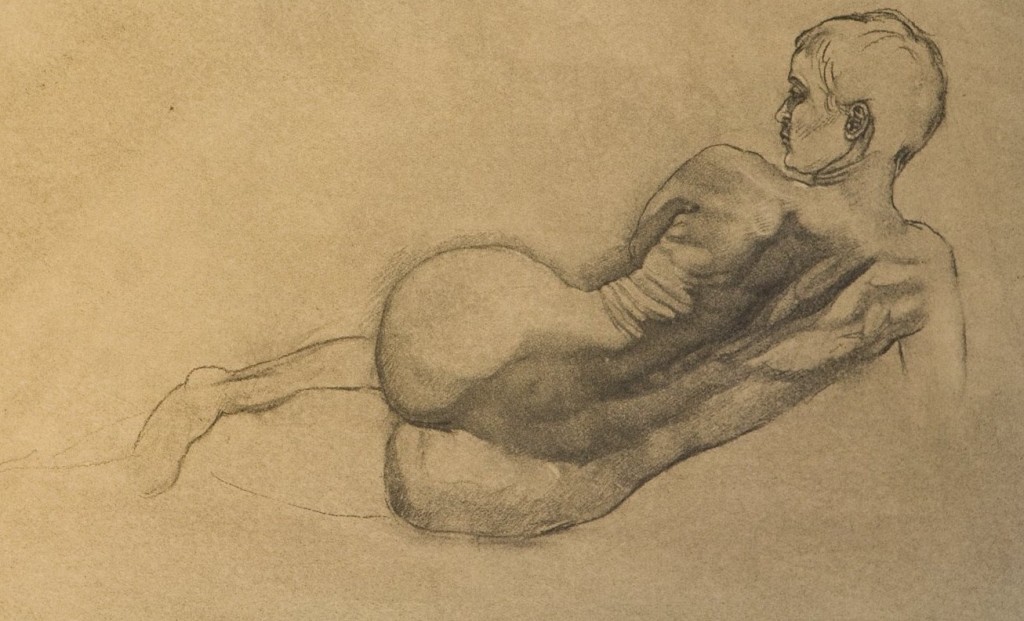

Theodor Kalide – Bacchante with the Panther Joking – Justine Nagler –
Theodor Kalide – Monograph and catalogue raisonné of the Berlin sculptor (1801–1863)
Theodor Kalide Bacchante with the Panther Joking
Justine Nagler
Theodor Kalide
Monograph and catalogue raisonné of the Berlin sculptor (1801–1863)
Hardcover with linen cover and dust jacket. partly four-colour, 500 pages, 368 illustrations, 240 x 310 mm, 60 colour and 308 black-and-white illustrations
December 2018
Immediately available ISBN 978-3-86732-314-7
Price 70,– €
Order book
With her monograph on the sculptor Theodor Kalide (1801–1863), Justine Nagler closes a sensitive gap in Berlin art historiography. For the first time, a complete catalogue raisonné and a comprehensive analysis of his oeuvre are available. The biography, freed from legends, exemplifies the circumstances of the success and failure of a brilliant artist.
As a student of Schadow and Rauch, the promising Kalide developed a highly individual desire for innovation, which inspired open-minded art connoisseurs, but remained incomprehensible to some contemporaries. With exceptional works such as the monumental “Peace Vase” for Frederick William III, which testifies to his fascination with Schinkel, he broke through traditional genre boundaries. In his own studio on Pariser Platz, Kalide completed statues and monuments for his Silesian homeland – successes that he was no longer able to build on in the capital of Prussia. Nevertheless, groups of humans and animals, which testify to a hitherto unknown body reproduction and great mastery in coping with increased movement, have found their way into parks worldwide.
His main work, sculpted in marble by his own hand, the bold “Bacchante with the Panther Joking”, conceived on Michelangelo studies, which had come to the Berlin National Gallery via detours, has survived only as a torso.
© Kati Kohl GNM
Justine Nagler
Justine Nagler, Dr. phil., born in Gliwice, lives in Nuremberg and works at the Germanisches
Nationalmuseum.
After completing her master’s degree in art history, Christian archaeology and Slavic studies at the Friedrich-Alexander
University in Erlangen, she specialised in German graphic art after Dürer, book art as well as sculpture and sculpture of the 19th century. She began her research on potash as a scholarship holder of the Foundation House of History of the Federal Republic of Germany.
He sculpted his mistress – see the most controversial work by T. Kalide
27/06/2013
“Bacchae on the Panther” was Theodor Kalide’s most controversial work, almost a “slap in the face” for the official audience of the time, adhering to academic tastes.
The atmosphere of indignation around Kalide’s work was fuelled by, m.in others, defenders of morality.
The artist’s model was his mistress.
Theodor Kalide, m.in., because of “The Bacchae” lost the opportunity to receive lucrative, even royal commissions. The plaster model of the sculpture was created around 1844 as intended to be made in marble.
Bacchae – 1st in the myth. Gr. priestesses of Bacchus, his companions dancing in unbridled excitement; maenads. 2. trans. participants of revelry,
Kalide was an innovative artist for his time. Although he was a student of the academy, he did not lose his sense of observing the changing nature. His works are characterized by realism and freedom of expression ? from moodiness to expressiveness. The most famous models of sculptures by Kalide include the “Vigilant Lion” and the “Dying Lion”.
The Museum in Gliwice invites you to the Caro Villa, where you can see the famous, although little known to the public, sculpture of Kalide “Bacchae on a Panther”. Its presentation is related to the celebration of the Year of Theodor Kalide ? It is the 150th anniversary of the artist’s death. The initiator and organizer of the project is the Association for the Cultural Heritage of Gliwice “Gliwice Metamorphoses”, and the Museum in Gliwice actively participates in this project.
The sculpture “Bacchae on a panther” is little known to the public. In the 90s of the twentieth century, for a short time, it was exhibited in the Artistic Casting Department of the Museum in Gliwice on the premises of GZUT S.A. at Robotnicza Street.
For the first time, viewers will be able to admire it for several months, for which the Museum in Gliwice would like to thank the owner.

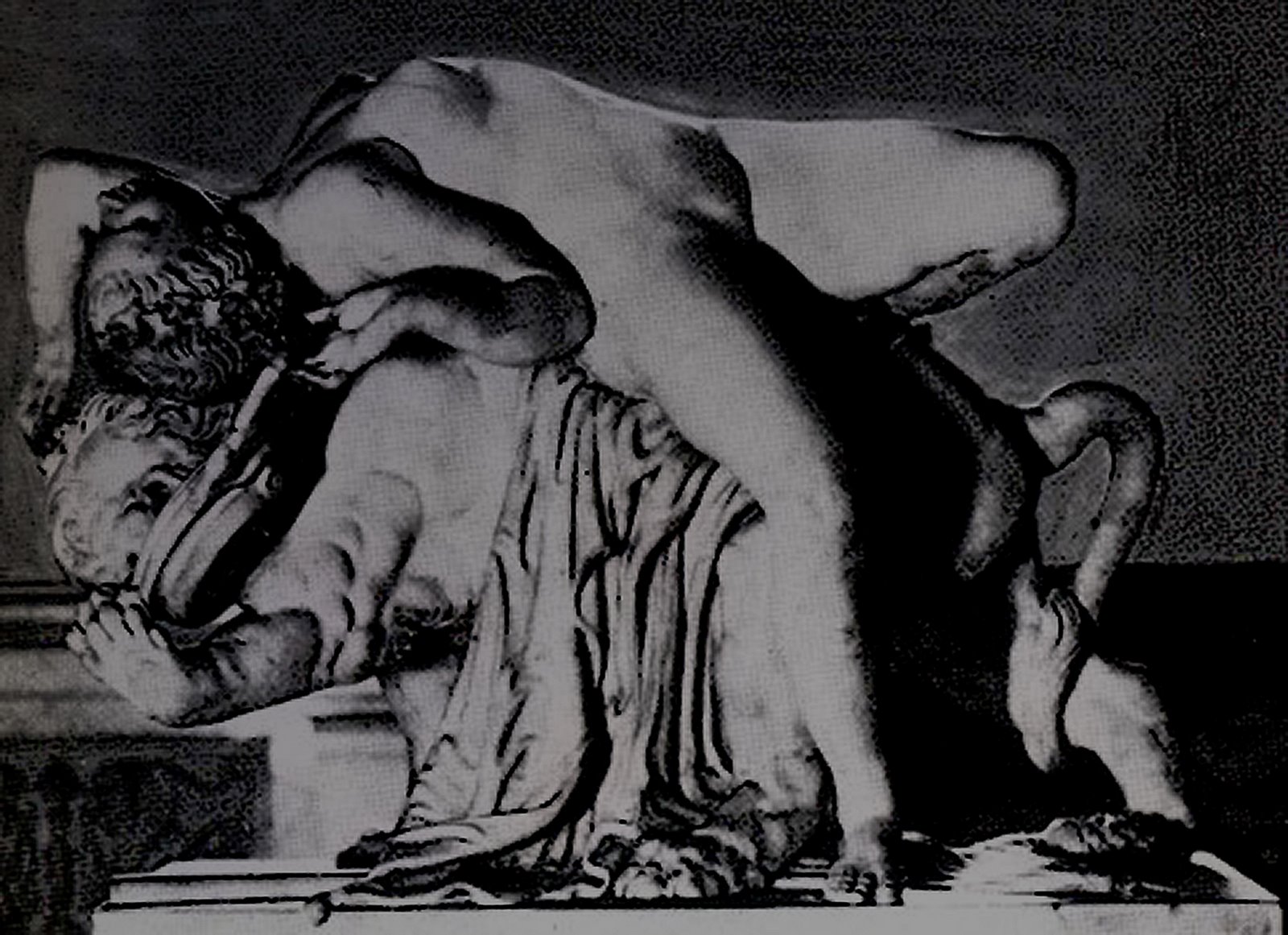
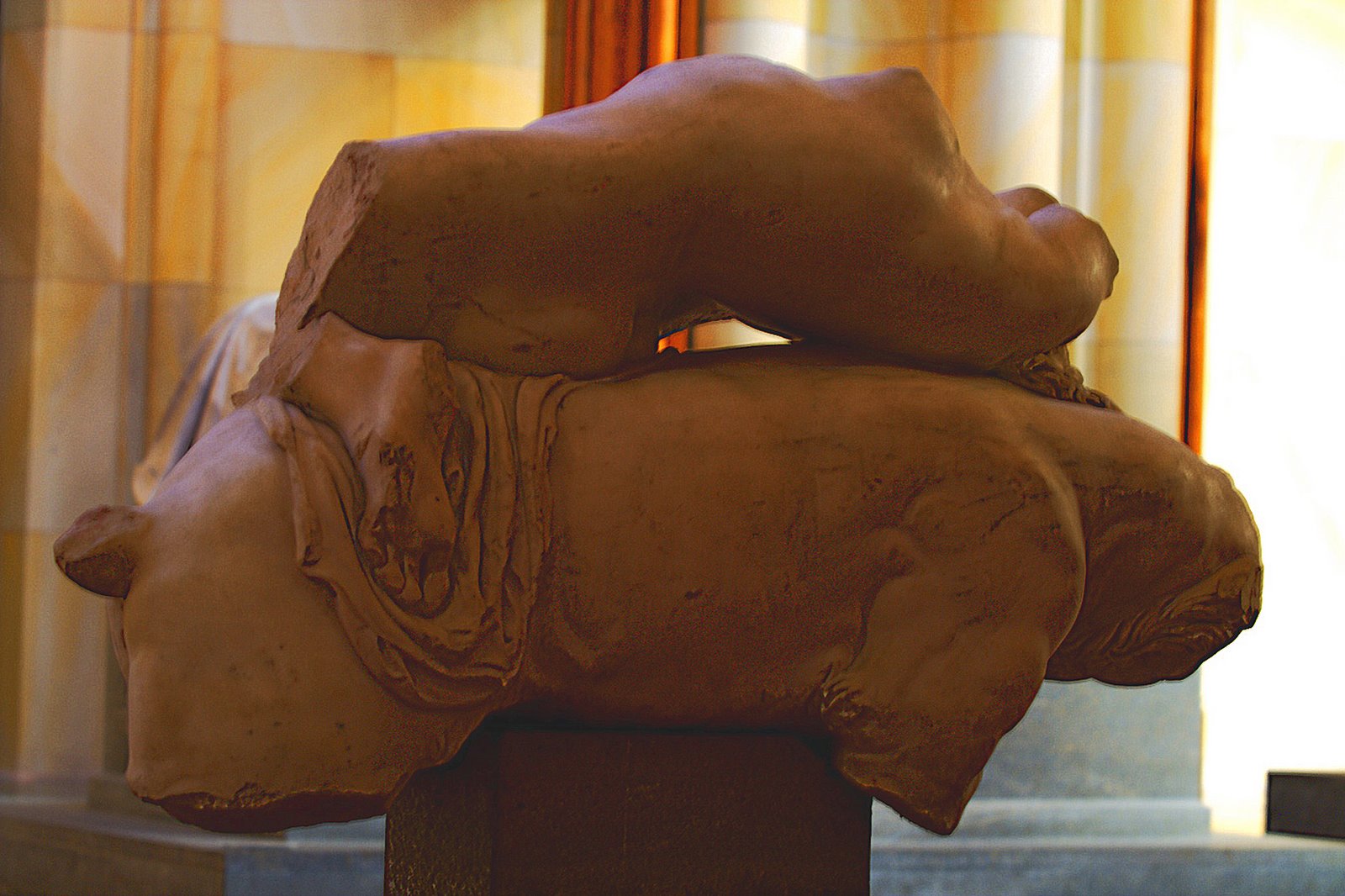
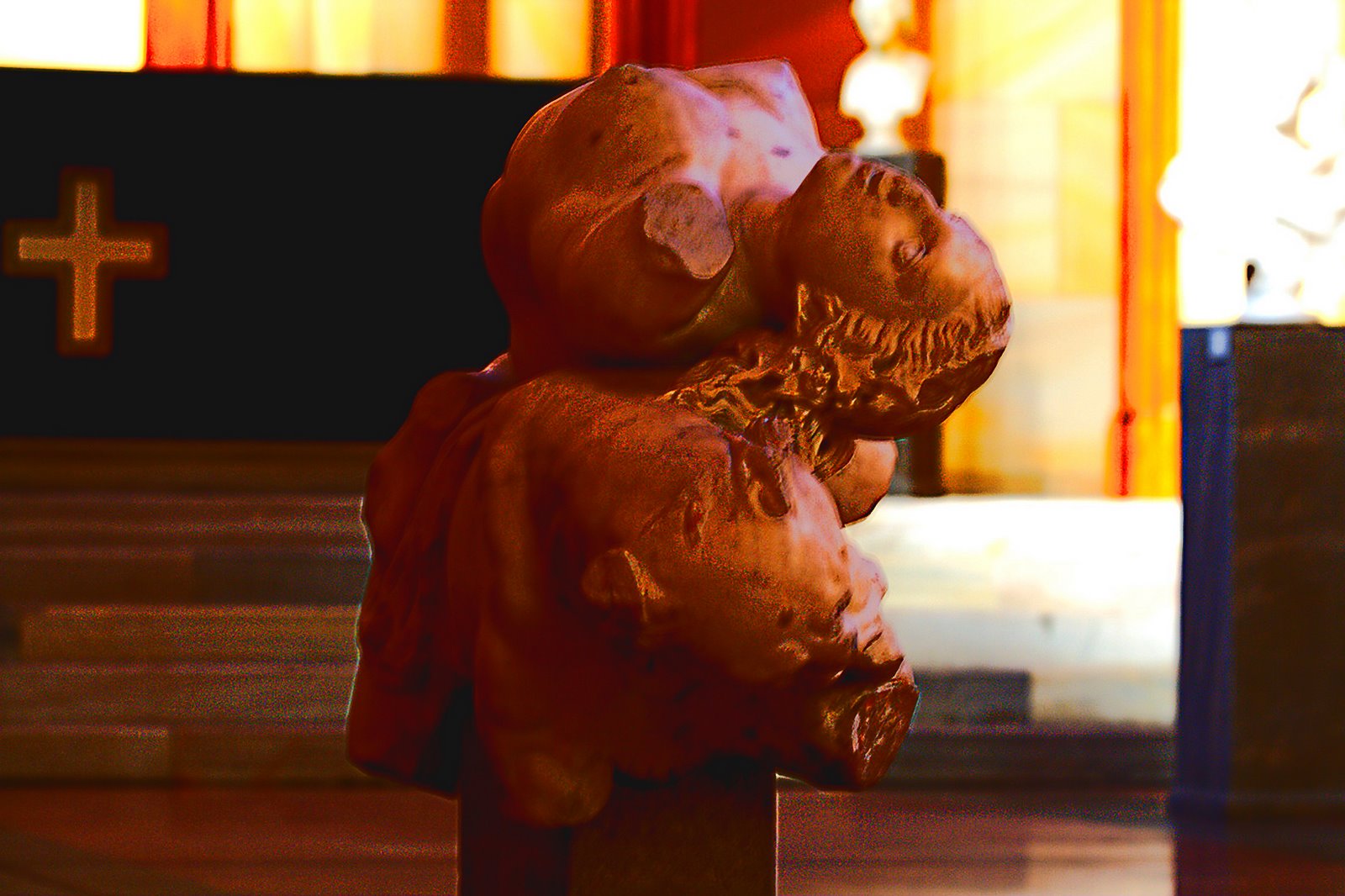
Theodor Erdmann Kalide – Bacchantin auf dem Panther,
Neo- Hellenistic, – Berlin artist (1801-1863). (b Königshütte, Upper Silesia [now Chorzów, Poland], 8 Feb 1801; d Gleiwitz [now Gliwice, Poland], 23 Aug 1863).
–
German sculptor. At the age of 15 he was apprenticed at the Königliche Eisengiesserei in Gleiwitz, where he soon began sculpting cast-iron plaques. In 1819 Johann Gottfried Schadow summoned him to Berlin, where he was instructed in chasing by Coué and worked in the Berlin Eisengiesserei. In 1821 he transferred to the studio of Christian Daniel Rauch. Following Rauch’s example and under his influence, Kalide produced such large animal sculptures as the Resting Lion and the Sleeping Lion (several casts, e.g. zinc, 1824; Berlin, Schloss Kleinglienicke). From 1826 to 1830 Kalide worked on equestrian statuettes, including those of Frederick William II (zinc), after the model by Emanuel Bardou (1744–1818), and Frederick William III (e.g. cast iron; both Berlin, Schloss Charlottenburg, Schinkel-Pav.). In 1830 he became a member of the Berlin Akademie. His most popular works included the life-size bronze group Boy with a Swan (1836), which was installed on the Pfaueninsel in Berlin as a fountain (several casts, all untraced). Kalide achieved wide recognition and aroused violent controversy with his almost life-size marble figure Bacchante on the Panther (1848; Berlin, Schinkelmus., badly damaged). This work transgressed the accepted boundaries of classical art, above all in the figure’s provocative pose, and was perceived as shocking. In its uninhibited sensuality and its blending of the human and the animal, it offended the conservative Berlin public, and consequently Kalide received few new commissions. He had no success with competition designs and became increasingly embittered. He spent his last years at Gleiwitz, where he died. After a theory in the iron foundry Gleiwitz got the well-known artist Gottfried Schadow the young Kalide into its workshop to Berlin. From there Kalide changed later into the then more popular workshop of Christian Daniel Rauch. Solved from the classically determined influence, its own artistic temper developed Schadows and Rauch more for the expression of powerful movements. Its largest artistic acknowledgment found Kalide 1836 with the well figure “The boy with swan”, which received 1851 on the Londoner world exhibition price medal and which Friedrich William IIITH for the lock park Charlottenburg acquired. (verschollen). Theodor Kalide (1801-1864) shows here a trunkene, naked woman, who räkelt herself on the back of a Panthers and gives by an adventurous setting the Raubtier from their bowl to drink. This group released a scandal after its demonstration on the citizens of Berlin academy exhibition of 1848. Kalide accused it hurts the Decorum (behaviour), by showing humans and animal on a stage. During Kiss into its Amazone still the noble fight between humans and Raubtier makes it represented here in animalisch, driveful omittingness common thing. This group of figures is natureful in their to see dionysischen beginning in greatest possible distance from the apollonischen people ideal of the classicism and can as “splendourful proclamation anti-classical Unmen” Bloch / Grzimek 1978, 137) be quite designated. After the presentation of this work Kalide kept no more orders in Berlin and had in the native Schlesien, withdraws, in order to be able to continue to work than sculptors. The Bacchantin on the Panther is received, there only as Torso in the citizens of Berlin national gallery it in to 2. World war was heavily damaged.

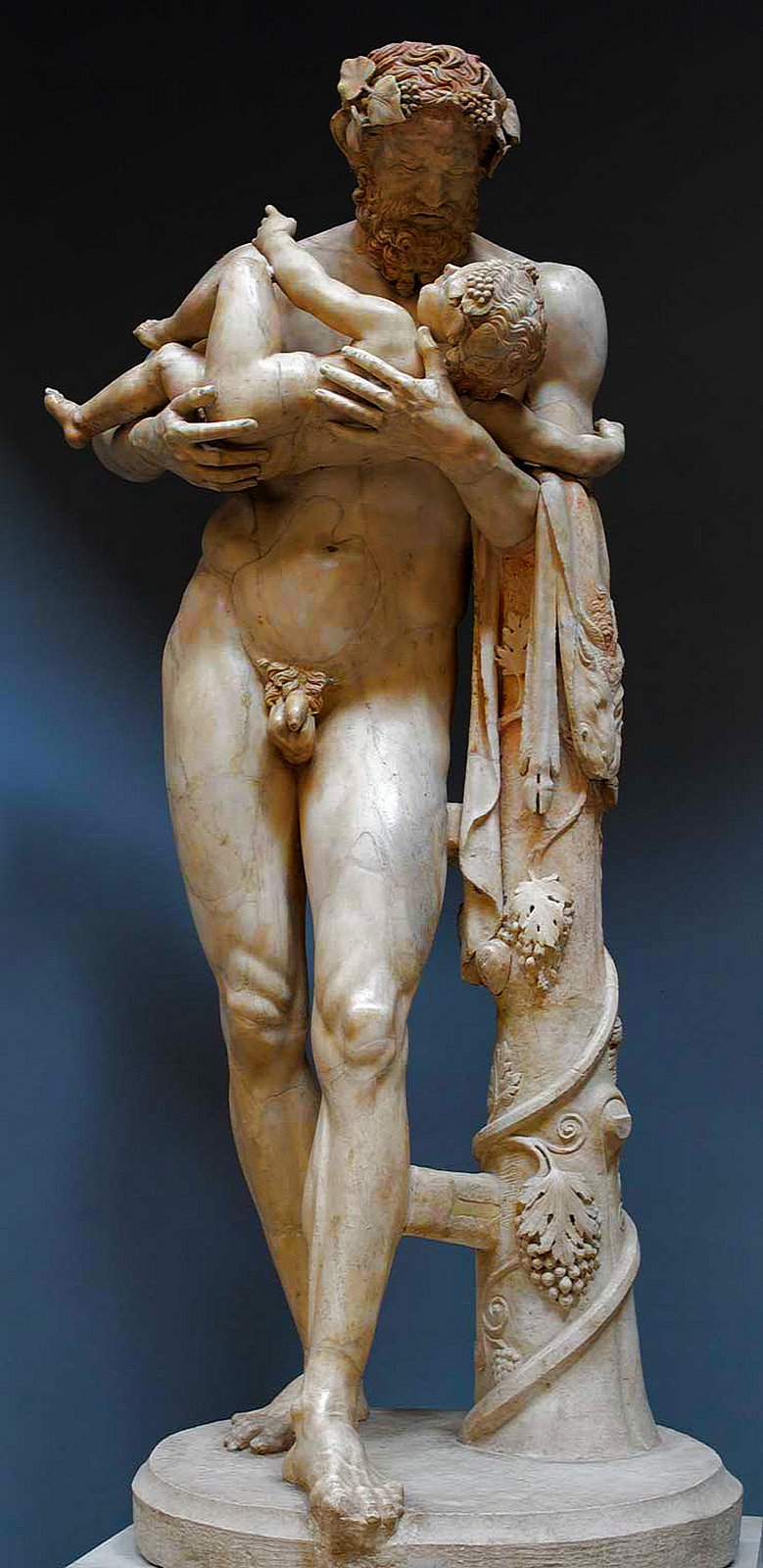
Copy of the Lysippean school, Silenus with the child Dionysus.
Copy of the Lysippean school, Silenus with the child Dionysus.
Marble, Greek sculptor hired during Roman rule copy of the middle 2nd century AD after a Greek original by Lysippos (ca. 300 BC). Location: Location Braccio Nuovo, Musei Vaticani, State of the Vatican City, Rome, Italy
–
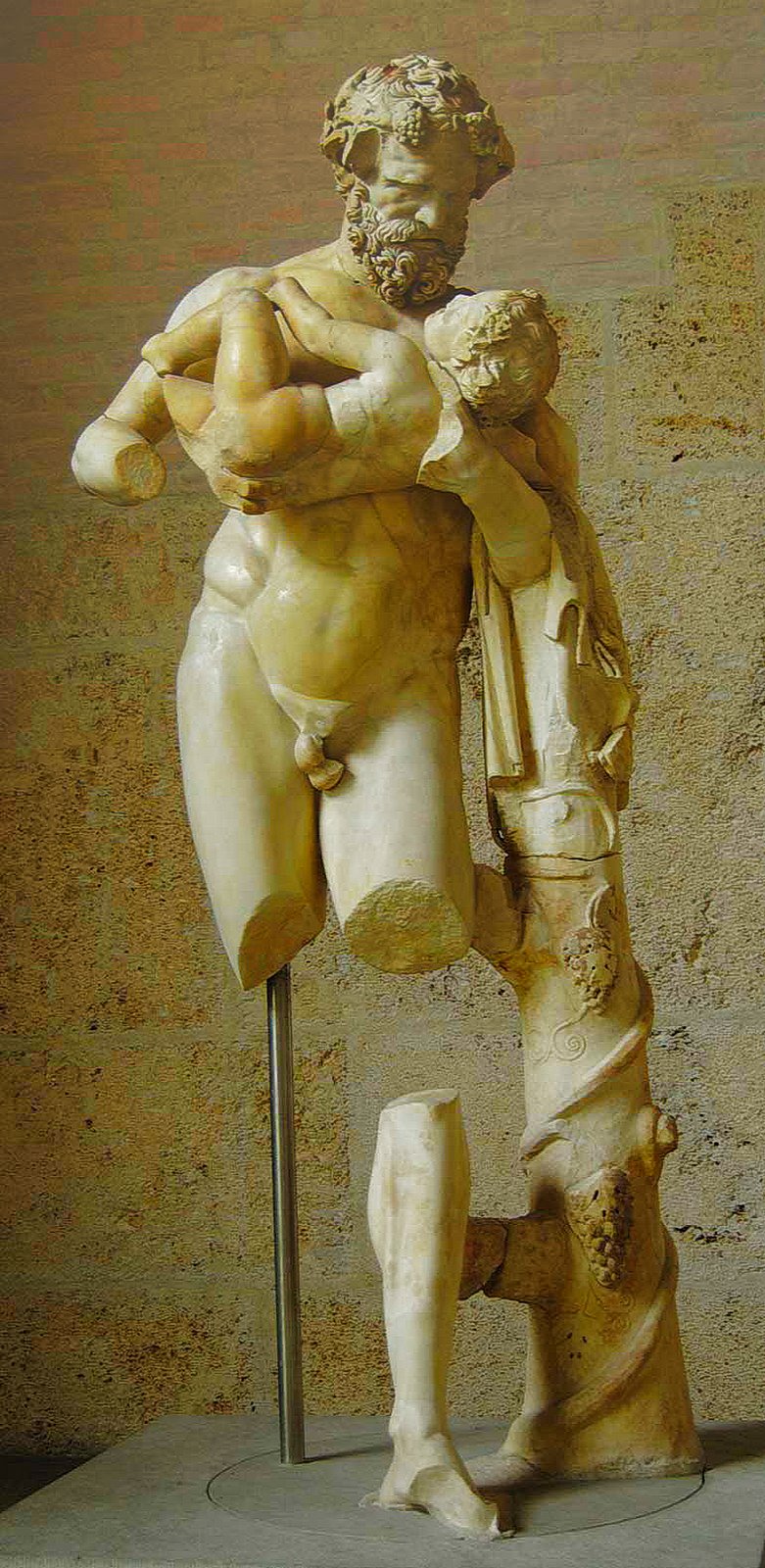
original by Lysippos?, Silenus bearing the child Dionysos.
The young god, son of Zeus, will grew up in a wild mountain. Maybe a copy of a statue of Lysippos (310–300 BC). Dimensions H. 187 cm, Glyptothek, Munich, Germany.
Formerly in Palazzo Gaetani, then Palazzo Ruspoli (both in Rome). Acquired in 1812 for Munich
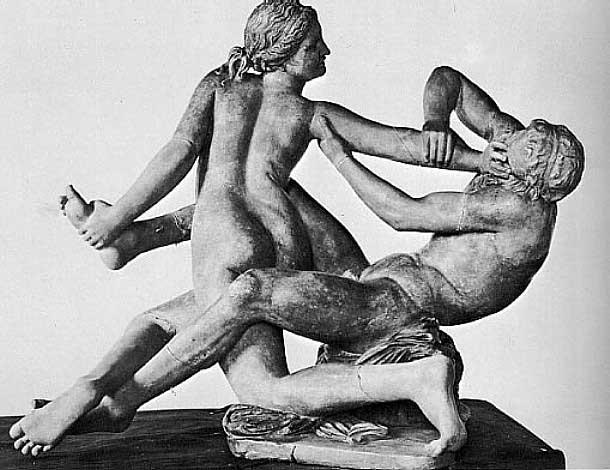
Hermaphrodite and Satyr,
Greek scuptor hired to make a copy or varient during the Roman period of a Hellenistic sculpture : 150/140 BC., Dresden, Germany
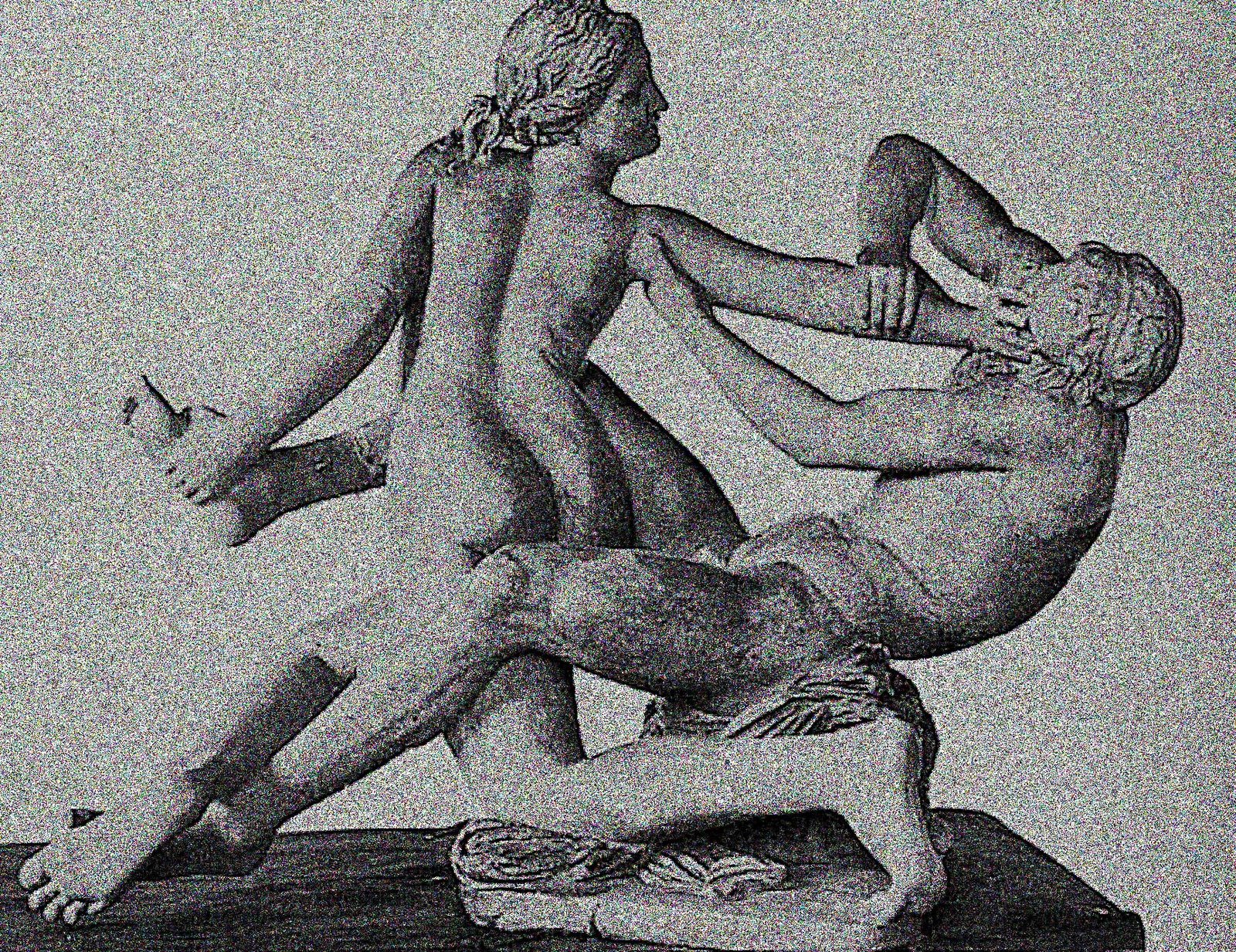
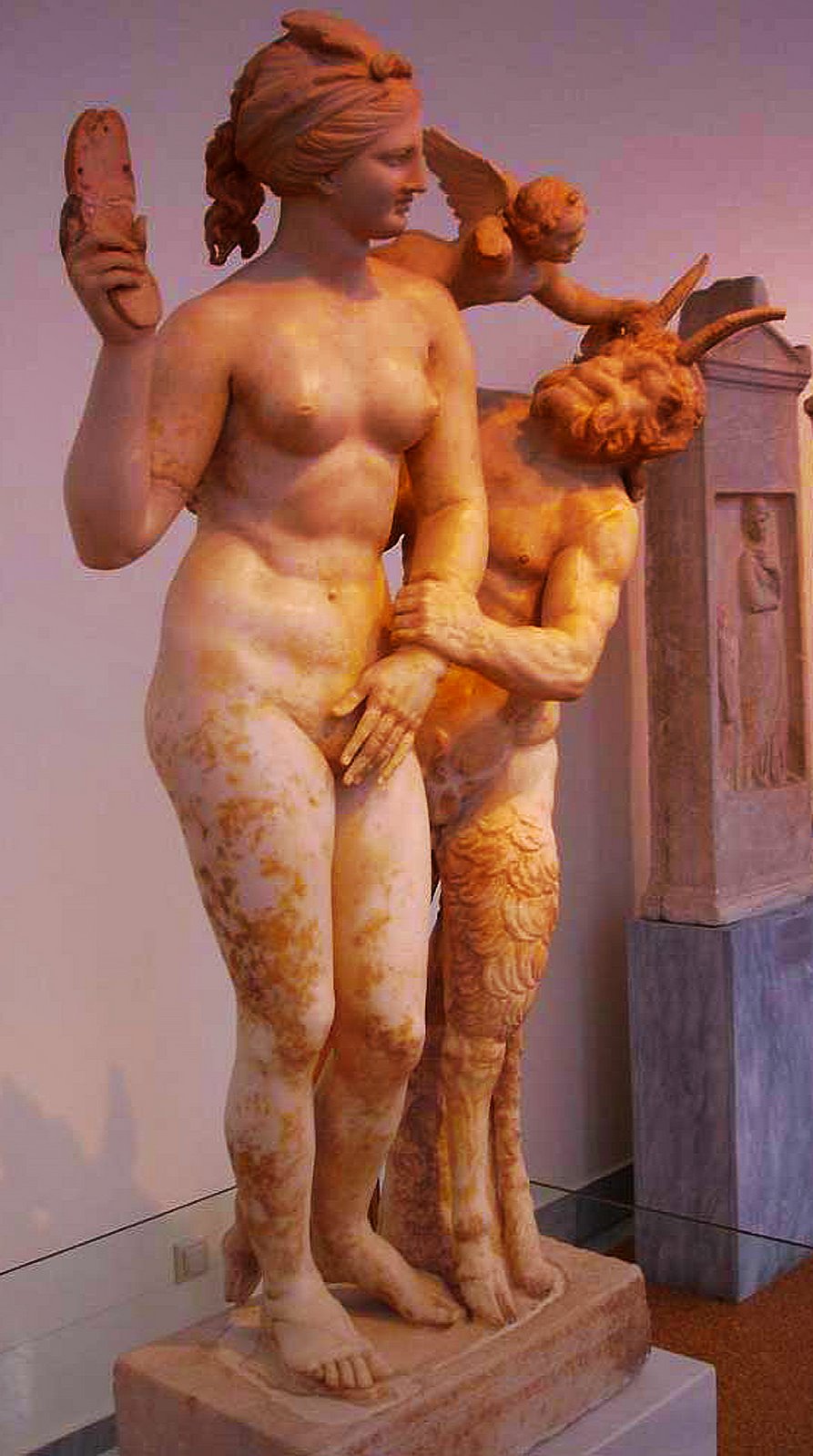

Aphrodite, Eros and Pan,
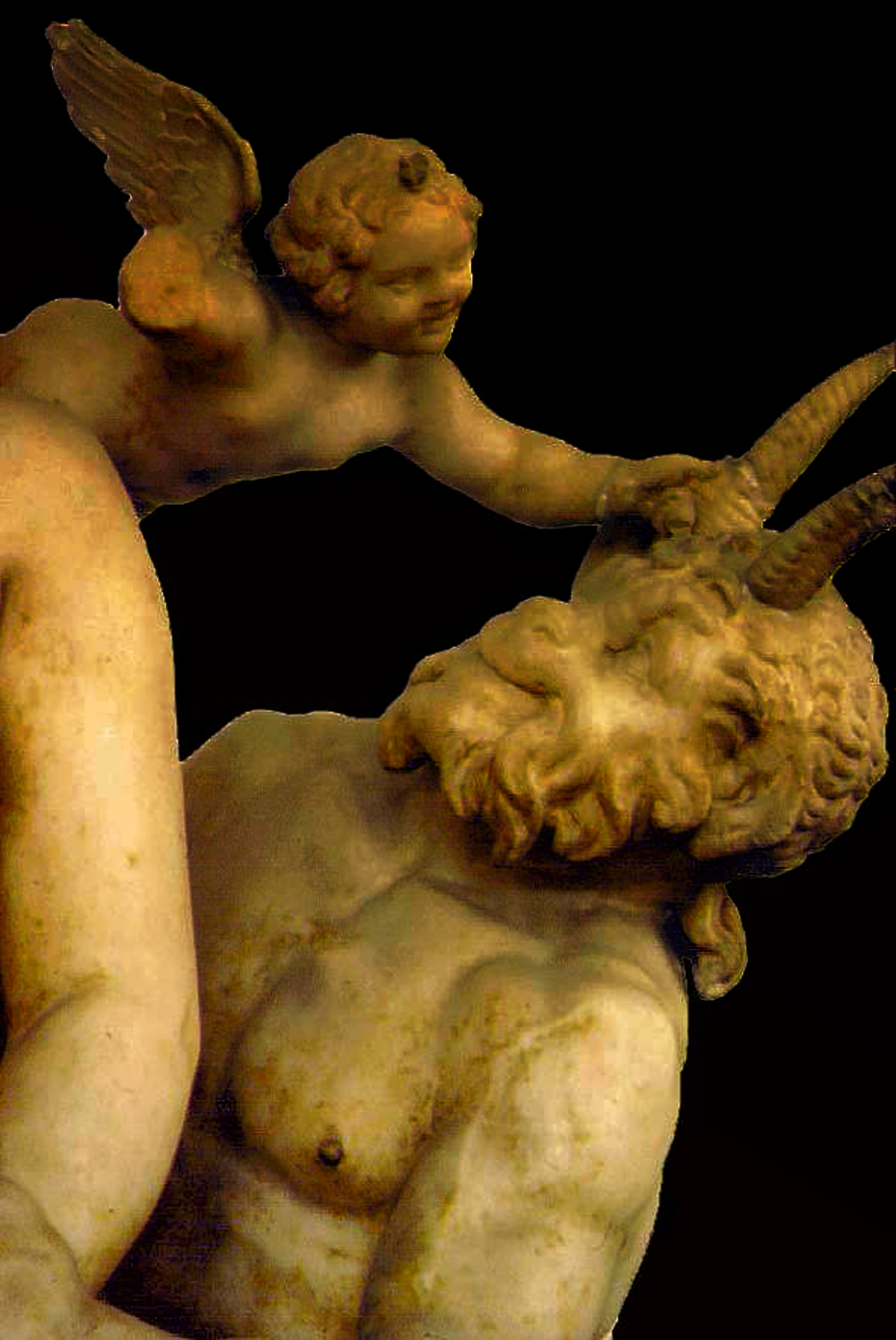
Aphrodite, Eros and Pan,
c 100 B.C., Delos, Marble c 130 cm, National Museum Athens (Ethniko Mouseio), Greece. Inscription: Dionysios, son of Zeno, son of Theodoros of Berytus, benefactor, (dedicate this) on behalf of himself and his children to the ancestral gods.
c 100 B.C., Delos, Marble c 130 cm, National Museum Athens (Ethniko Mouseio), Greece. Inscription: Dionysios, son of Zeno, son of Theodoros of Berytus, benefactor, (dedicate this) on behalf of himself and his children to the ancestral gods.

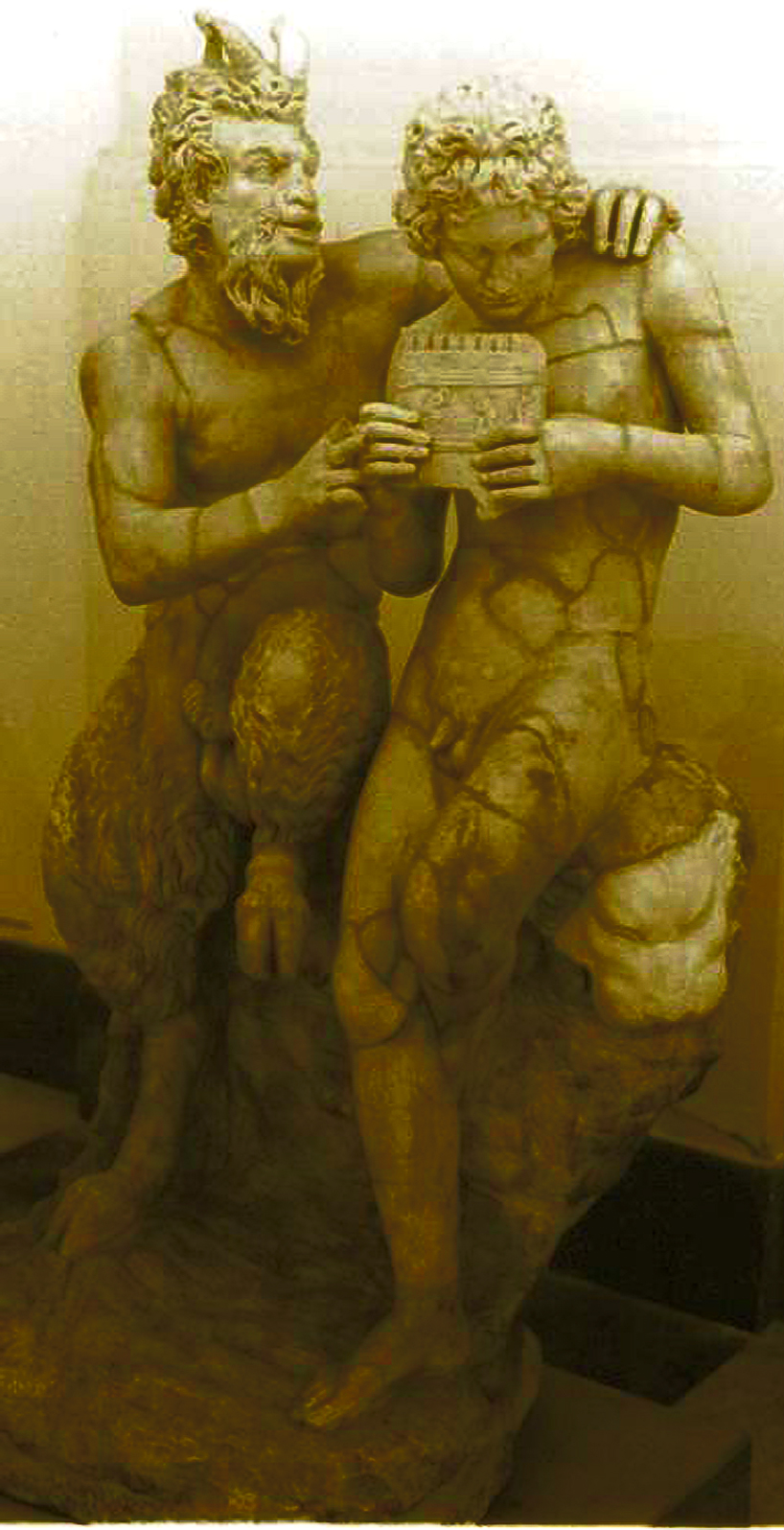
Pan and Daphnis.
Greek Hellenistic during Roman occupation after Hellenistic Greek bronze of 3rd. – 2nd. century B.C., Naples National Archaeology Museum, Naples, Italy, – Lustful man-goat Pan gives shepard Daphnis musical lesson.
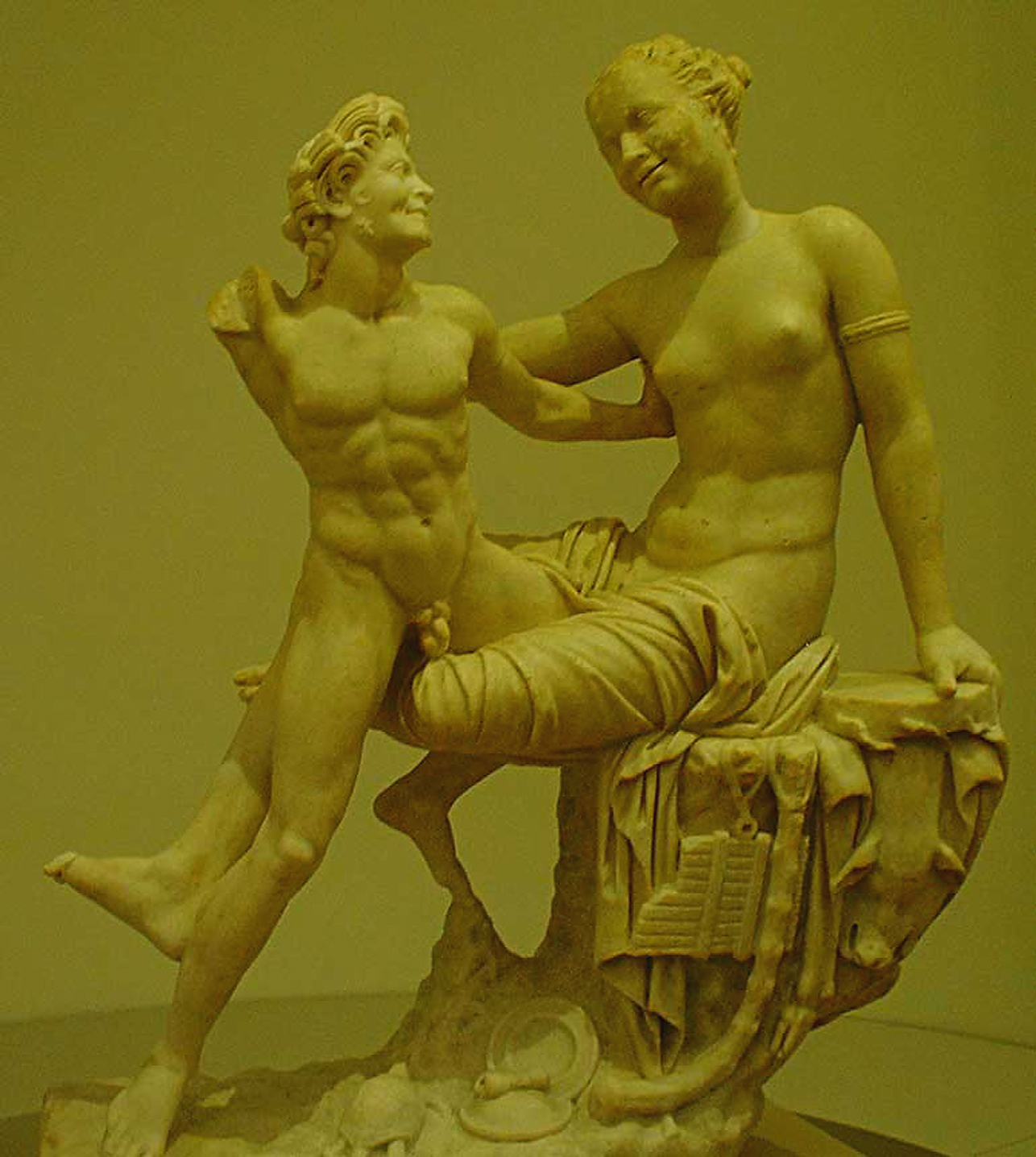
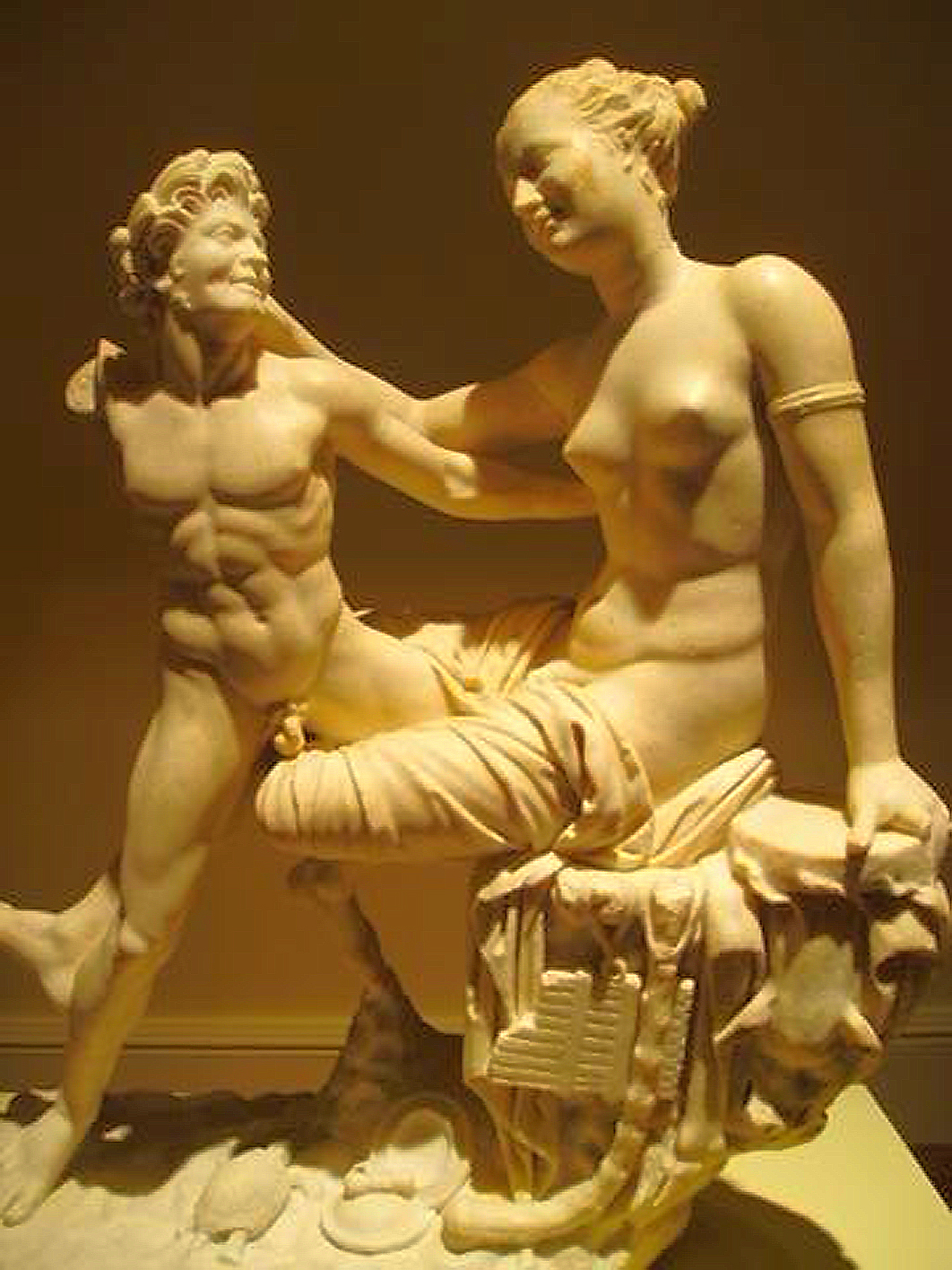
Satyr und Hermaphrodite, Annäherung


Schlafender Satyr oder Barberini Faun,
marmorne Kopie eines brozenen Originals, ca. 200 v. Chr. Höhe: 2,15 m. Von Römern geplündert, wurde sie im Castel Sant’Angelo gefunden, von der Familie Barberini gekauft und in ihrem Palast in Rom aufgestellt. Heute ist sie eine Hauptatraktion der Glyptothek München (Inv. 218).

“Der Schlafende Satyr” – The French sculptor Edme Bouchardon (1698-1762) created this marble copy of his own presentation statue which was considered in 1892 for the Louvre.
“Der Schlafende Satyr” – The French sculptor Edme Bouchardon (1698-1762) created this marble copy of his own presentation statue which was considered in 1892 for the Louvre.
Der Barberinische Faun ist eine hellenistische Skulptur eines schlaftrunkenen Satyrs, der um 220 v. Chr. geschaffen wurde. Sie wurde vermutlich von Praxiteles (ca. 390 v. Chr. – ca. 320 v. Chr.) unter Verwendung einer bronzenen Vorlage gehauen. Die Figur ist nackt und stellt seine Männlichkeit offen zur Schau.
Der marmorne, 2,15 Meter hohe Skulptur wurde von den Römern aus Griechenland geplündert und wurde im 17. Jahrundert in der Engelsburg gefunden. Es fehlten das rechte Bein, Teile der Hände und des Kopfes.
Kardinal Maffeo Barberini beauftragte den berühmten italienischen Künstler Gian Lorenzo Bernini (1598-1680) mit einer Restauration, wobei auch die fehlenden Teile ersetzt wurden. Ferner änderte er die Figur in Richtung eines barocken Stils sowie einer mehr sexuellen Ausrichtung. Anschließend war die Skulptur Teil der Sammlung der Barberini in deren Palast.
Sie wurde 1810 von Rom nach München über die Alpen geschafft, nachdem Ludwig I., König von Bayern, sie gekauft hatte. Es wird vermutet, daß die Anschaffung durch seine homosexuelle Neigung motiviert war.
Der Faun ist seit den 1830er Jahren auf Wunsch des Königs in der Glyptothek in München ausgestellt (Inv. 218).
Der Franzose Edme Bouchardon (1698-1762) schuf auf dieser Vorlage eine eigene Statue, die seit 1892 im Louvre befindet.
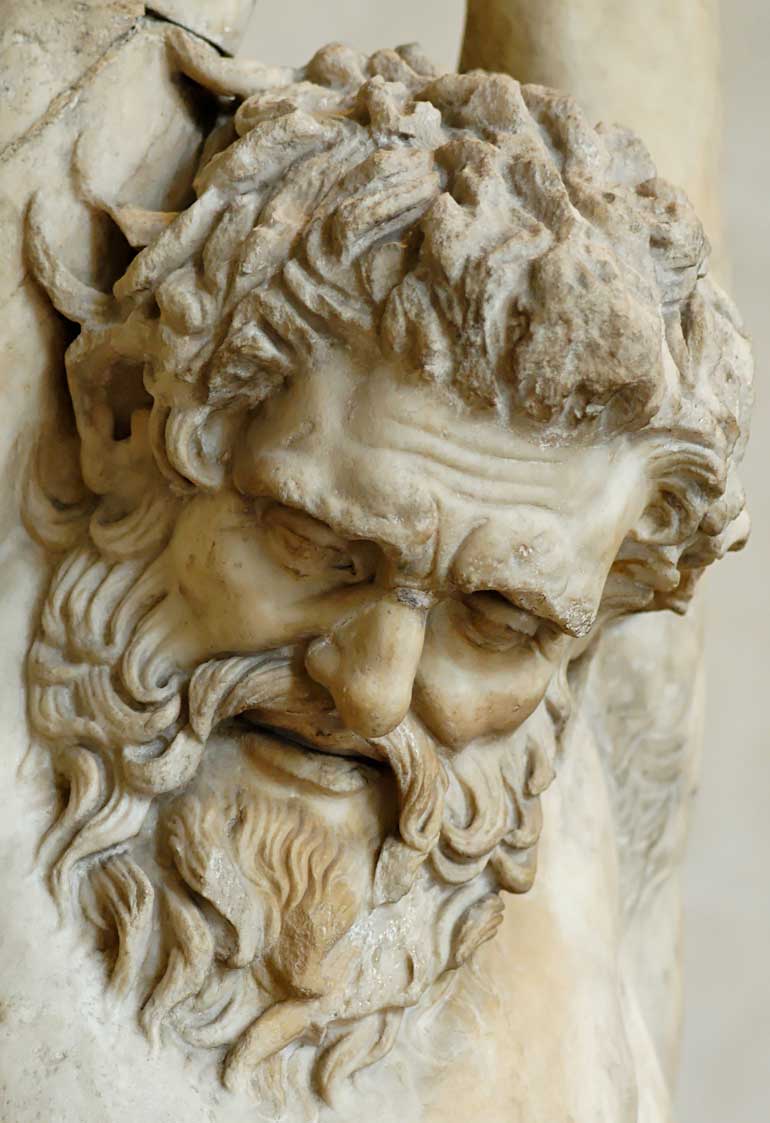
Musée du Louvre, Paris
Künstler unbekannt Marsyas hängt an einem Baum
Marmor, Römische Kopie vom 1 bis 2 Jh nach einen Hellenistischen
Musée du Louvre, Paris
Künstler unbekannt Marsyas hängt an einem Baum
Marmor, Römische Kopie vom 1 bis 2 Jh nach einen Hellenistischen Original. Gefunden in Rom, Italien.
Dimension H. 2.56 m (8 ft. 4 ¾ in.)
Credit line Borghese Collection; purchase, 1807
Accession number Ma 542 (MR 267)
Department of Greek, Etruscan and Roman antiquities, Sully, ground floor, room 17
–
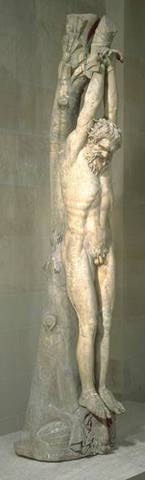

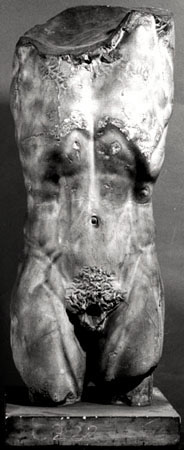
Marsyas, the Phrygian Satyr who challenged Apollo, Roman copy of 3rd C. BC original, Tarsus, Marsyas under Apollo’s punishment – İstanbul Archaeology Museum, Turkey, all three above pictures above, Musée archéologique d’Istanbul Alexander the Great Musée Archéologique, Area related : Tarsus (Turkey), Marsyas, the Satyr, found a flute, which had been thrown away by Athena. She had tried to play it but, but realizing how ugly she looked with protruded mouth, had immediately given it up. When Marsyas found that he could play nice music with the flute he challenged Apollo and claimed to make sweeter music with his flute than Apollo with his lyre. Marsyas was the loser and Apollo first hanged him from a pine tree and then flayed him.
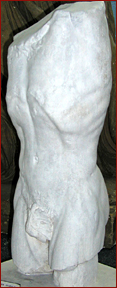

Plaster of Marsyas Torso, ‘Flaying of Marsayas Group’, from the first half of the 2nd century BC., Berlin, Antikensammlung, Pergamon Museum, Berlin, Germany
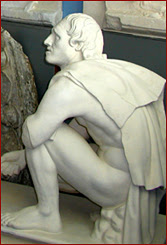
Scythian, marble, after Hellenistic Greek, during Roman period, Greek sculptors hired to make copies in marble of previous bronze, or varients. original of 200 – 150 B.C., Ufizzi, Florence, Italy

The Drunken Silenus,
1628 Jusepe de Ribera
(Spanish, 1591–1652) , Etching with drypoint, engraving, and burnishing; plate 10 9/16 x 13 3/4 in. (26.8 x 43.9 cm)
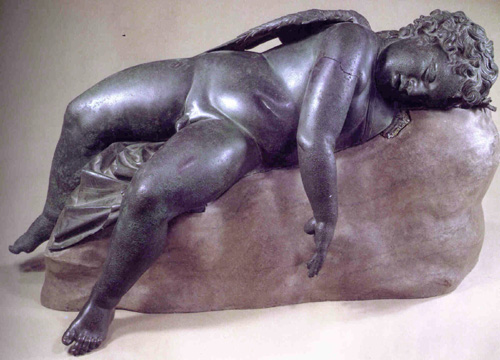
“Sleeping Eros” from the Hellenistic era / Greek copy
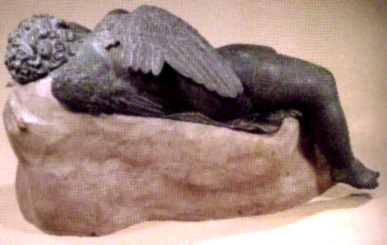
during Roman rule after Hellenistic Greek, Metropolitan Museum of Art, New York City, New York.
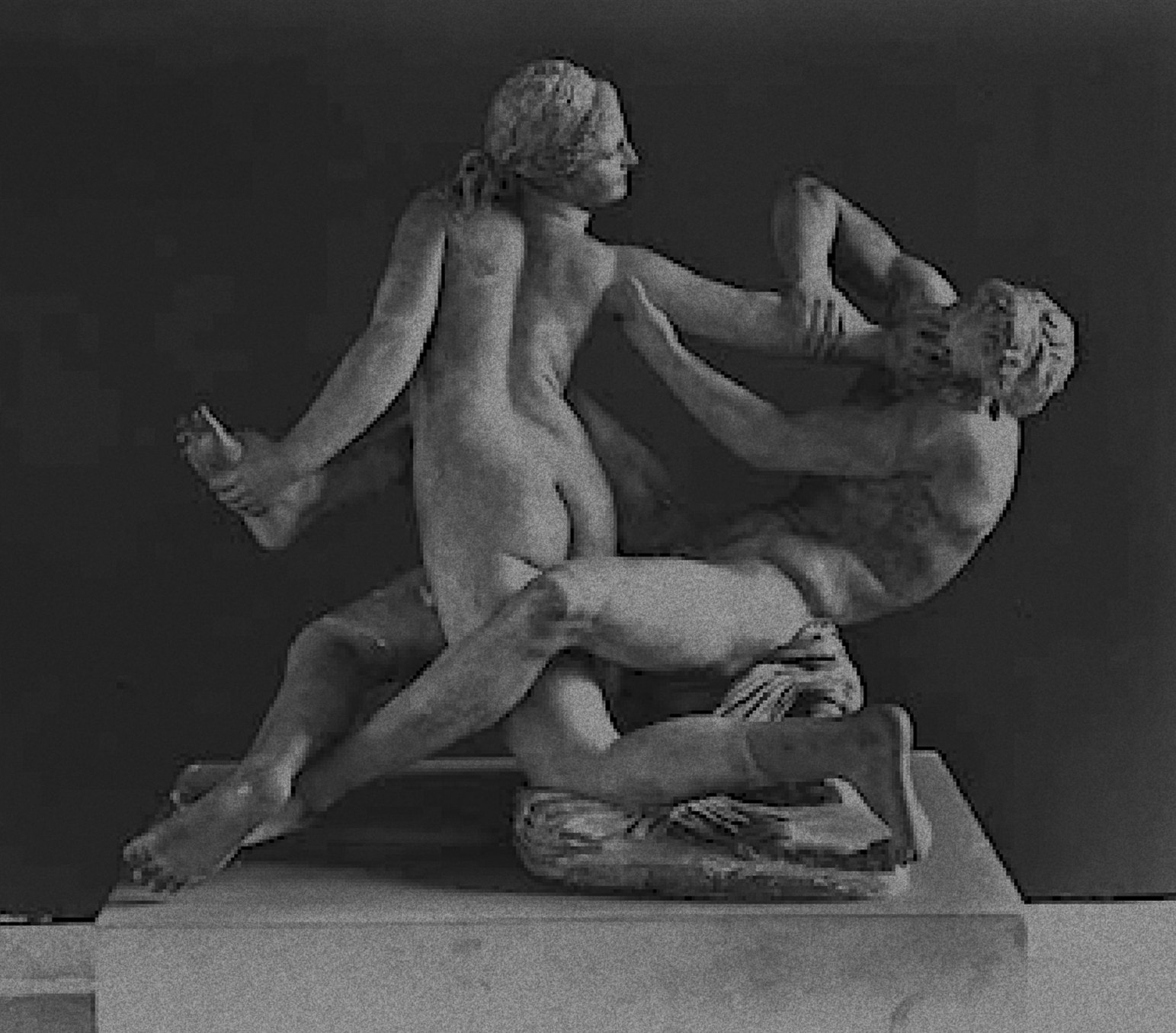
Staatliche Kunstsammlungen Dresden, Hermaphroditos, the son of Hermes and Aphrodite.
Salmakis plunges into a spring where he is bathing and surrounds the boy with her embrace. As she prays that they may never be parted, their bodies are fused into one, thereby creating a sexual hybrid, the hermaphrodite. In the Roman period, the myth was connected to the Carian city of a Halikarnossos, although it is not clear how widely this story was known. A Roman bilingual inscription from Halikarnossos, found in situ on a promontory known as Salmakis, relates a version of the myth and claims it for the city, citing this as one of Halikarnassos’ most noteworthy aspects. Vitruvius calls the spring at Halikarnassos by the name Salmakis, and Notes that it carried an undeserved reputation for infecting people with lewdness and making men effeminate and unchaste. Although these attributes seem fitting for the hermaphrodite myth, Vitruvius claims that the superstition was connected to the pacification of barbarians in the early days of colonization. In Greek and Roman art, the hermaphrodite is often portrayed alone and either nude, Semidraped, or draped. When paired with another figure, the companion is usually Dionysiac:
a satyr, Pan, Silenus.
Alexandra Retzleff
Depatment Of Classics
McMaster University
Canada
–
The Dresden Type Satyr-Hermaphrodite Group in Roman Theaters
Alexandra Retzleff
–
Alexandra Retzleff
Depatment Of Classics
McMaster University
Canada
‘
The Dresden type satyr-hermaphrodite group is known through more than 30 Roman replicas in various media. The meaning of the group has traditionally been derived from its discovery in domestic contexts, but replicas from the theaters at Daphne and Side raise different questions regarding viewer reception. The horizontal composition and small scale of the groups suggest they may have decorated the pulpitum (stage) of those theaters. At the Daphne theater, where two replicas were found, the groups were likely displayed as pendants, offering complimentary views of the same sculptural composition. In terms of subject matter, the Dresden type satyr-hermaphrodite group yields several nuanced interpretations associated with the theater, including connotations of paideia (Roman reverence for the Greek past), Dionysiac aspects, the reversal of norms, the objectification of the body, the sexual tryst, and the agon.
‘
Alexandra Retzleff
Depatment Of Classics
McMaster University
1280 Main Street West
Hamilton, Ontario L8S 4M2
Canada
–
Fragment Satyr and Hermaprodite – Hellenistic, –
Torso of a satyr from Daphne theater
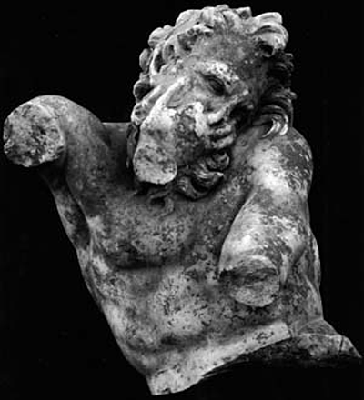
Alexandra Retzleff
Depatment Of Classics
Continued:
The group depicts a satyr and a hermaphrodite engaged in a struggle. The satyr, seated on a rocky outcropping, envelops the hermaphrodite from behind, holding it between his legs and grasping its arm with both hands (fig. 1,2). The hermaphrodite twists vigorously at the waist, pushing the satyr’s head back with one hand and grasping his foot with the other. Although the hermaphrodite shoes the satyr away, its right foot locks the assailant’s leg so that he cannot escape, implying that the Hermaphrodite does not truly intend to break away from the satyr’s advances. The intertwining limbs of the two figures are delicately balanced in a complex composition, with few points of contact with the base. Although likely based on a Hellenistic model, the composition is known only through Roman replicas in various scales and materials. Of the 30 sculptural replicas, 28 are marble and two are bronze miniatures. Eight of the marbles are of unknown provenance. Twelve were found in Rome or its environs (although the precise findspots are not known), one is thought to have been found in Tunisia, and one may have been found in Izmir, Turkey. Another is less precisely associated with the Villa of Quintilius Varus at Tivoli. The best-known and most complete replica, located in the Staatliche Kunstsammlungen in Dresden, is a small-scale marble ( ht. 91 cm, depth 61 cm ). Only five of the replicas have secure archaeological contexts: two from the theater at Daphne, one from the theater at Side, one found in situ at the Villa of Poppaea at Oplontis, and one ( a miniature ) from a Roman villa at Chiragan in Gaul. In addition to the sculptures, the composition is represented in wall paintings from Pompeii, mosaic pavements from Daphne, a terracotta seal from Cyrene, and on a gem in Munich. This study focuses on the sculptural replicas found in the theaters at Daphne outside Antioch and at Side in Pamphilia. The Dresden type satyr-hermaphrodite group is usually categorized with other sexually themed pairs as an “erotic group”. It is one of the groups that has been tentatively associated with the symplegma (“entanglement”) described by Pliny as a creation of the Hellenistic sculptor Kephisodotos: Praxitelis filius Cephisodotus et artis heres fuit. Cuius laudatum est Pergami symplegma nobile digitis corporiverius quam marmori inpressis. Described by Pliny as a creation of the Hellenistic sculptor Kephisodotos (Cephisodotus) The son of Praxiteles, Cephisodotus, inherited also his skill. His “entanglement” at Pergamon is highly praised, being notable for the fingers, which seem to sink into living flesh rather than into dead marble. Although Pliny does not specify the subject matter of Kephisodotos’ statue, the use of the term symplegma is often taken to indicate sexual themes. A line from one of Martial’s epigrams uses symplegma in a pornographic sense to denote a novel sexual position involving five people. Therein are novel erotic postures such as only a desperate fornicator would venture, what male prostitutes provide and keep quite about, in what combinations five persons are linked, by what chain are held more than five, what can go on when the lamp is put out.
‘
These literary passages suggest that Kephisodotos’ symplegma may have been a sculptural composition involving two or more people entangled in an erotic grouping. Inscribed statue bases from Ephesos, however, suggest that the term symplegma could also denote sculptural groups of a much different character. The Roman bilingual inscriptions describe subjects that are unlikely to have been sexual. One symplegma involves Athamas (the Boeotian foster parent of Dionysos) and another features Theseus. The connection between the Dresden type satyr-hermaphrodite group and a Hellenistic sculpture by Kephisodotos is highly speculative, and thedate of the original composition has been the subject of much discussion; proposals range from the early third B.C.E. to after 100 B.C.E. This paper does not pursue problems of Kopienkritik but rather treats the sculptural group as a product of the society that commissioned it. Eight marble fragments belonging to Dresden type satyr-hermaphrodite groups were discovered by the Princeton Archaeological Expedition in the theater at Daphne in April of 1935. The discovery of two satyr heads makes it clear that at least two replicas of the same group, both of very fine workmanship, were set up here. One of the heads, now in the Princeton University Art Museum and reassembled from six pieces, preserves the satyr’s forhead, horns nose, left eye, part of the nape of the neck, and parts of the hair and beard, as well as the base of the hand and two fingers belonging to the hermaphrodite. The dimensions of the head fragment ( ht. 23.6 cm, wdth. 18.4 cm, depth 18.3 cm ) show that the group was under-life-sized. The second satyr fragment ( ht. 48 cm ), now in the Hatay Archaeological Museum, was carved at the same scale. His head and torso are reserved down to the waist, the arms are broken above the elbows, and the hand of the hermaphrodite is preserved to the wrist. It is clear from the position of the hermaphrodite’s fingers on the satyr’s face that the two replicas were sculpted in the same position, not as mirror-reversals. The fragments have been dated to the second century C.E. on the basis of carving style. The theater at Daphne was probably built shortly after 70 C.E., during the rule of Vespasian. It was modified in the third century and extensively remodeled in the fourth century, following the earthquake of 363 C.E., before it went out of use in the sixth century. The precise find spots of the sculptures from the theater at Daphne are not noted in the catalogue of finds published by the Princeton Expedition, making it difficult for us to posit their original placement within the building. The fragment from the theater at Side was discovered by Turkish archaeologists in 1958 and is currently housed in the Side Museum. The torso of the hermaphrodite is preserved, as is the left arm as far as the elbow, the beginning of a leg, and a portion of the left thigh; the head and right arm are missing. A portion of the satyr’s calf is attached to the hermaphrodites abdomen. The replica from the Side (ht. 40cm, width 18.4 cm, depth 17 cm) was less than half-life-sized, even smaller than those from Daphne. The theater at Side was most likely constructed in the last quarter of the second century C.E., with a period of remodeling in the Late Roman period. The hermaphrodite fragment was found in front of gate C of the scaena.
Architectural Settings and Interpretations
The story of the hermaphrodite, as told by Ovid, begins when the nymph Salmakis falls in love with erotes. The interest of the Dresden type lies not only in the pairing of the hermaphrodite with the satyr but also in the complex interaction between the two figures. Previous scholarship has assigned various meanings to the group. Von Prittwiz und Gaffron has interpreted the group as a metaphor for love’s simultaneous pleasure and anguish. Ridgway has suggested that the figures represent the contradictions in the forces of nature. In the garden setting, the group would emphasize the “correlation between the well-ordered planting and the inherent wild essence of vegetation.” Gercke has equated the two figures to wrestlers engaged in a struggle that is agonistic rather than erotic. Ajootian has argued that all Hermaphroditos images, Greek and Roman, regardless of their setting, were perceived as guardians because of the function of the phallus as a weapon against the Evil Eye. Such an apotropaic use represents a more serious, potentially dangerous struggle than the erotic or agonistic one suggested by other scholars. While each of these interpretations has its merits, it ismy view that no single interpretation can be as the inherent meaning of the group. Rather, its meanings stem from the contexts of the statues’ display and the impressions of the viewers within those settings.
‘
Previous scholarship on the Dresden type satyr-hermaphrodite group has focused on the domestic sphere. Ridgway views “erotic groups”, including the Dresden type satyr-hermaphrodite group, as most appropriate in the luxurious gardens of the Roman villas. Smith suggests that the group belongs best in an outdoor, scenic context. He cites an example found in situ in the garden at the villa at Oplontis and a Pompeian wall painting that depict it in an open landscape. Indeed, the subject is well suited in many respects to the decoration of private gardens. The position of the group next to a tree-lined pool at Oplontis might even have been a deliberate reference to the Hermaphroditos myth, which takes place at a spring. Most of the replicas of this group are however, of unknown or questionable sculptural group that was displayed in antiquity in quite disparate settings.
Both Cicero and Lucian reveal some of the intentions behind villa decoration. In Cicero’s letters, we find a request for statues that are gymnasiode, which would be suitable for his Academy. However, the provisions remain general and no particular statue type is stipulated. It seems that choices were made to compliment the function of a space within the villa. In Lucian’s description of the house of a wealthy man, the focus is on the fame of the masterpieces that were represented in the collection of replicas in the statue gallery. With in certain limits of aesthetic propriety, the selection of statuary in a private villa may therefore be interpreted as the personal choice of an individual and a reflection of that person’s tastes and preferences. Vetruvius notes that the principal of propriety (decorum) applied to public spaces. He reports that, according to the mathematician Licymnius, the inhabitants of Alabanda were judged as unintelligent (insipientes) because of their inappropriateness ( indecentia ). They set up statues of men pleading cases in the gymnasium and statues of athletes in the forum. Vitruvius claims that the inappropriate disposition of the statues brought the state as a whole into disrepute. His implication is that the subject matter of statuary must be accordant with its envirement, and that poor choices would reflect badly on the state as well as the benefactor.The benefactor must then have been involved in decisions that led to the production and / or obtaining of the statuesfor a particular architectural setting.
These literary sources suggest that the principal of decorum provided guidelines for the types of art that should be displayed in various settings without prescriptions for any particular requisite works. Statues helped to define the space in which they were situated and, in turn, were defined by the meanings ascribed to them in that space, so that a range of associations with or aspects of a single piece of art could make the same composition appropriate in radically different settings. The Dresden type satyr-hermaphrodite group likely acquired different meanings, or at least different nuances, in the private and the public spheres. A focuson the context, including the architectural setting and the interest of the benefactors and viewers, urges us to treat statues as polysemic objects. The Dresden type satyr-hermaphrodite group was represented at Daphne not only in the statues from the theater but also in two mosaic panels from the third-century House of the Boat of Psyches, 200 m south of the theater. The mosaics show the group from two opposing viewpoints: one shows the hermaphrodite from the front, the other shows it from the back (figs. 6, 7). Theater and performance themes composed a significant part of the decoration of elite houses at Antioch and Daphne, but the occurrence at Daphne of satyr-hermaphrodite groups in two distinct media is notable and raises the possibility that there was a connection between them. The mosaics of the House of the Boat of Psches included other theatrical imagery, notably masks. The satyr-hermaphrodite group mosaics were located in the colonnaded portico (area 4 ), between a nymphaeum and a series of three large rooms. The orientation of the panel mosaics in the portico suggests that they were meant to be seen by viewers facing west as they were walking from the large rooms toward the nymphaeum. While architectural elements such as colonnades and nymphaea in the third-century house sat Daphne and Antioch seem to have been designed to evoke public spaces such as colonnaded streets and public fountains, it stands to reason that aspects of their decorative programs also referred to the public sphere. The mosaic quotations of public statuary may have signaled to visitors that they were entering a public area of the house, and the theatrical theme would reflect favorably on the social status of the homeowners by demonstrating their cultivated taste. The location of the house relative to the theater and the location of the mosaics within the house suggest that they are an artistic reference to the statues set up in the theater.
Sculptural Display In Theaters
The ornamentation of the stage and the beauty of the interior space were
important components of the experience of attending the theater. In a discussion of sense perception, Lucretius makes special note of the beautiful effect of the colored awnings stretched over the theater. Later, he refers to a sort of sensory overload induced by attending the theater for days on end and alludes to the audience and the diverse theater decorations along with the entertainment itself. If anyone has given his whole attention constantly to the games for many days in succession, we generally see that, although he has stopped receiving these [images] through the senses, channels remain open in his mind by which these same images of things may come to him. So for many days the same images move before his eyes, so that even if he is awake he seems to see dancers stirring their supple limbs, to perceive in his ears the fluent song of the lyre and its speaking strings, to see the same audience and the different beauties of the stage shine brilliantly.
‘
This passage emphasizes the repetitiveness of the surroundings, which is an important consideration with regard to the effect of the statuary in a theater in contrast to other architectural contexts. In a villa or bath building, for example, a visitor could move freely from one space into another, experiencing the statuary from different angles and in intentional sequences. In a theater, however, the impact of the statuary was unchanging, delivered in a single tableau. Statues in theaters normally were concentrated in the stage area, displayed in the niches or the intercolumniations of the scaenae frons or on the pulpitum. Small statues, altars, fountains, and candelabra might also be set up in the niches across the front of the pulpitum. Most of the time, the spectator occupied a fixed position in the cavea in relation to the statues, which served as constant pointsof reference. Some varying angles might be glimpsed as the spectator entered and exited the theater or milled about during the show, but there would remain a fundamental divide between the stage and the cavea. The location of the seat occupied by the spectator thus would have affected the visibility of the sculpture. While some iconographic details might have been clear to those seated in the orchestra or the lowest tier, the ima cavea, their visibility must have diminished in the upper tiers of seats. With the Dresden type satyr-hermaphrodite group, which relies on anatomical details such as the satyr’s horns and the hermaphrodite’s genitalia to complete its meaning, the precise subject would surely have been lost on much of the audience. It was toward the educated elite, who would have been seated in the orchestra and ima cavea, that the nuances of the statuary were aimed.
‘
That two replicas of the Dresden type satyr-hermaphrodite grouped were found in the theater at Daphne suggests they were set up as pendants. The intentional pairing of statues aimed at creating a special meaning through juxtaposition was not uncommon in the Roman sphere. In some cases, the pendant pieces were virtually identical, as at the Baths of Caracalla in Rome, where two replicas of the Farnese Hercules appeared on either side of the entryway to the Great Hall. A series of four replicas of a Pouring Satyr from the theaterby the Domitianic villa at Castel Gandolfo may have Been displayed in a deliberate repetitive composition. Pendant statues could also be carved as mirror images to compliment a particular architectural setting. In several Roman theaters in the western empire, for example, sculptures of sleeping Silenoi were set up in mirror-reversed pendant groups, presumably because it suited the symmetrical layout of the fountains they adorned.
Pendant display would have been particularly effective for the Dresden type satyr-hermaphrodite group because of the complexity of its composition. The group has figured prominently in discussions of sculptural planes in Hellenistic sculpture, and arguments have been made for one, two, or multiple intended views (Einansichtigkeit, Zweiansichtigkeit, Vielansichtigkeit). The various contexts in which the grouphas been found, however suggest that Roman taste accepted its presentation with open and restricted views. In the garden at the villa at Oplontis, the viewer would be able to appreciate the element of surprise in the composition by walking around the statue and seeing it from various angles; the context there seems to invite contemplation from multiple angle views. In a theater, however, the opportunity for interaction with the statues on the pulpitum and scaenae frons was more limited.
‘
The two principal horizontal views of the composition are a “front view” presenting the hermaphrodite’s back, and a “back view” presenting its chest. While the hermaphrodite’s genitalia are visable to some degree from both standpoints, they are only truly emphasized from an intermediary point, which Haüber has termed the ¨hermaphrodite view¨. In the context of the theater, where the hermaphrodite view was unlikely, the element of surprise may nevertheless have been captured through the use of pendants representing the twohorizontal views. These preserved the composition’s inherent sense of reversal in a two-dimensional setting, with one view emphasizing the satyr’s advances and the second showing the hermaphrodite in control. It seems likely that the two statues from the theater at Daphne depicting the same configuration(not mirror reversals) were set up to show the front and back views, as in the mosaics from the House of the Boat of Psyches. Although evidence for only one Dresden type satyr-hermaphrodite group was found at the theater at Side, the rough finish on the back of the torso suggests that it was carved to display the back view. While there may originally have been a second replica presenting the front view set up in the Side theater, it is also possible that there was only one replica. The depiction of the satyr-hermaphrodite group on Roman gems and seals demonstrates that it could also be depicted singly in a two-dimensional format.
‘
Although it is not certain where the groups were set up in the theaters at Daphne and Side, the findspot of the Side fragment in front of one of the scaena doors suggest a location in the stage area. While the rough finish on the back of the hermaphrodite torso from Side implies its placement against a wall or in front of a niche, the two satyr fragments from Daphne are fully carved on all sides. The horizontal composition of the Dresden type satyr-hermaphrodite group is not common in theater statuary, however, and does not lend itself readily to a location in the intercolumniations or niches of the scaenae frons. The small scale of the groups also raises the problem of their visibility and their aesthetic compatibility with the larger, vertically oriented statues that dominated the decoration of Roman theaters. The statue type with a horizontal composition that is most common in Roman theaters is the reclining or sleeping Silenus, which was usually a fountain figure. It is notable that the Silenoi were often displayed as pendants, and usually associated with the outer niches in the front of the pulpitum. On the basisi of composition and scale, the pulpitum may be proposed as a possible location for the Dresden-type hermaphrodite groups from Side and Daphne.
Context And Meanings
The possibilty of pendants raises broader questions about how the meaning of the Dreden type satyr-hermaphroditegroup was informed by the subject matter of other statues in the same venue. In any context, a statue gains a shade of meaning through its relationship to other figures in its sculptural setting. Zanker has suggested that the messages conveyed by individual statues in the scaenae frons were less important than those established through the viewing of the assemblage as a whole and the relationships between statues. We have sen that the impact of theater decoration lay in its capacity to be viewed all at once; some attempts at reconstructuring specific and coherent “sculptural programs” in theaters have yielded convincing results. However, most theater assemblages contain a number of eclectic elements that are difficult toreconcile as components of a single deliberate message.
‘
The programmatic approach to interpreting statuary in its context presents two immediate challenges: the first relates to the archaeological record, the second relates to building chronology. First, it must be admitted that only a percentage, however large or small, of the total assemblage from the theater has been preserved and recovered through excavation, and in many cases, archaeological records are inexact about the find spots of individual statues. At Side, where the findspots in most cases are precisely recorded, only five other fragmentary statues were found in the theater excavations. At Daphne, more statues were recovered from the theater, but the find spots are rarely specified. Second, the long history of many Roman theaters argues against a unified reading of their sculptural assemblages. Stylistic criteria suggest a rather wide range of dates for the statuary recovered from many theaters, making it unlikely that they were all conceived as components of a single program. Rather, the sculptural assemblages in theaters are usually additive in nature, reflecting different phases of construction and centuries of accumulated benefactions. Although the aesthetic and conceptual interconnections between the statues displayed together on the pulpitum and scaenae frons, even if they were set up at different times, did become a decorative program, the messages of the individual statues schools also be considered on their own terms.
‘
One of the objectives in setting up a replica of the Dresden type satyr-hermaphrodite group in a Roman theater may have been to refer to art of the Greek past, at least in a general way. The mythical subject matter and ideal form were fundamentally suitable for the theater, which itself was a cultural venue derived from the Greek past and functioned as a setting for some activities that were Greekin origin. Sculpture of this sort may have served as a form of diplomacy through which a city might create a visual encomium celebrating its membership in the culture of the wider Hellenic world of the Roman empire. Paideia may be seen as an important driving force behind the mass production of replicas. In some cases, benefactors seem to have relied on cliche’s, deliberately choosing works that were familiar and immediately recognizable. At the same time, it seems unlikely that the ancient viewer would be expected or able to identify the replicas of most individual statues in a given setting or that the identity of the original was a significant criterion in the selection of the statue type. The Dresden type satyr-hermaphrodite group must have functioned in the theater on the basis of specific, albeit nuanced, meanings that were particular to that context.
‘
A late Hellenistic marble relief depicting a hermaphrodite dancing with a mirror was found in the Theater of Dionysos in Athens, suggesting that already in the Hellenistic period, there was a point of connection between hermaphrodites and the theater. Perhaps the hermaphrodite’s sexually ambiguous nature was seen to reflect the blurred gender identities of the stage, where costume and role-playing allowed traditional boundaries to be crossed. On the Greek stage, male actors played all parts, including those of women. The Roman pantomime, too, was a male performer, often characterized by ancient sources as effeminate, who acted all the roles in the story, both male and female. The Dresden type satyr-hermaphrodite group may have been specifically more appropriate for theater decoration because of the mythical identities of the participants-both are hybred creatures. As companions of Dionysos, satyrs are intimately connected to the theater. Most frequently, they are portrayed in groups, often in scenes of excess or transgression, endlessly engaged in efforts to consummate their desires. Through their transformation of vlaues, satyrs inversely represent a society’s standards and morals. As such, they mirror the social inversions produced on the stage. Tragedy and comedy offered opportunities to reflect on social norms and even inculcated a questioning of the very basis of those norms. While there was a deliberate preservation of social stratification in the cavea of a Roman theater, the stage offered the exploration of reversal through fantasy. Tensions within th e culture could be explored on the stage while real social structure was safely maintained. The pairing of the hermaphrodite with a satyr emphasizes the former’s sexuality and resonates with the charaacterization of the theater as a place of sexual license. Roman mimes could be sexually explicit. Valarius Maximus for example, talks about women stripping on the stage as early as the Republican period. Because Roman acctors were infamis, they were legally vulnerable to all forms of abuse, and the theater became a place where the body was regularly objectified. Cicero’s defence of Gnaeus Plancius, with the notorious assertion that the alleged rape of a mimula (diminutive of female mime) should hardly be considered a crime, is a chilling reminder of the vulnerablity and exploitation of those with infamia within the theatrical realm. The Dresden type satyr-hermaphrodite group may be construed as a visual metaphor for this form of social tension between Roman citizens and actors. The satyr, who is in the position of power, echoes the role of the male viewer. He controls the hermaphrodite, who struggles but ultimately submits to him, as an actress would be obliged to submit to a Roman citizen. As a component of a theater’s decorative scheme, the satyr-hermaphrodite group was afitting backdrop to the relationship between those on the stage and those occupying the good seats in the lower portion of the cavea and the orchestra.
‘
The sexual energy of the satyr-hermaphrodite group may also be read as a metaphor for social dynamics among the viewers in the cavea. The theater repeatedly figures in Latin love poetry as a place where men and women go to ogle and flirt. Propertius comments on his sexual attraction to women in the theater, apparently to those on the stage and those seated around him. His lover, Cynthia, even establishes in the terms of their make-up that he should not crane his neck to the upper tiers of the theater where the women sit. Ovid freely admits to the same habit of spying on the upper tiers and shares advice on how to behave around women at the theater to woo them. He recommends, for example, applauding in particular any mimes playing the role of a lover. Ovid encourages women to go to the theater, which he considers a favorable place for showing oneself. To men, he suggests that the theater is a good place to meet women and forge all types of relationships. The theater, he proposes, is among the public placces that pose a challenge to a woman’s guardian. The Dresden type satyr-hermaphrodite group would have been well suited to the decor of the theater as portrayed by poets as a locale for romantic trysts. Another point of connection to the theater might be found in the group’s agonistic theme. Both Daphne and Side were host to agones, one of the principal activities that took place in Roman theaters in the Greek East. Daphne was one of the sites for the many festivals held by Antioch. Epigraphic evidence attests to the presence of members of the Guild of the Artists of Dioysos (technitai) at Side, thereby confirming that actors gathered there and competed for prizes. A sculptural group depicting the engagement of two figures in a struggle, particularly one in which there are surprises and reversals, might have been appropriate for the setting of theatrical agones. It may also have reflected some of the theatrical content. New compositions in comedy and tragedy as well as revivals of old plays were presented at festivals in the Greek East. The stories of the Greek tragedies were also performed on Roman stages as pantomimes. The agon itself was a common formal motif in old comedy and Greek tragedy. Most plays of Euripedes, in particualr, have some kind of conflict as a central theme. In its simplest form, the agon is made of a pair of opposing speeches of approximately equal length. Some agnistic dialogues, however, are more complex, oscillating between several movements. The initial aggressor might find himself on the defensive when the adversary, overcoming his surprise, takes up the role as aggressor. This type of dynamic tension is found between Eteocles and Polynices in Euripides’ Phoenissae (2.594-624), between Admetus and Pheres in Euripides’ Alcestis (2.708-29), between Teucer and Menalaus in Sophocles’ Ajax (2.1120-141), and between Teiresias and Creon in Sophicles’ Antigone (2.1048-63). The tension between the roles of aggressor and prey makes the sculptural group an apt visual metaphor for the struggle presented in a tragic agon.
Conclusion
The Dresden type satyr-hermaphrodite group thus offers various nuanced meanings that may have made it a suitable choice for theater decoration: the conotations of paideia, the Dionysiac associations, the reversal of norms, the objectification of the body, the sexual tryst, and the agonistic motif. The danger in exploring these nuances, however, is that we may erroneously imbue the ancient viewer with the knowledge of all antiquity. There is also a danger of generating a universal and generic viewpoint when, in fact, the “viewer” encompassed a broad range of identities. The spectators in a Roman theater came from a variety of social classes and cultural backgrounds, and it is necessary to distinguish between the cultivated, educated response and the popular, raw response, and recognize that there were many possible interpretations between these two extremes. Many users of Roman public buildings were uneducated and not familiar with a broad range of art and thus incapable of or uninterested in making arcane associations. To some of them, the Dresden type satyr-hermaphrodite group may simply have been a statue that helped create certain ambience that had come to be expected in a theater. But to benefactors who were responsible for making “appropriate” choices for a decorative scheme, and to audience members from a higher stratum of society, these kinds of associacions may have been important and exciting. Some of these nuances may have motivated the benefactor’s artistic selection, while others may only have become apparent against the backdrop of theatrical activity and in juxtaposition with other visual elements. My intention has not been to suggest that any single viewer grasped all the meanings investigated here but rather to explore possible responses to the group within the aesthetic, social, and cultural setting of the Roman theater.
Alexandra Retzleff
Depatment Of Classics
McMaster University
1280 Main Street West
Hamilton, Ontario L8S 4M2
Canada

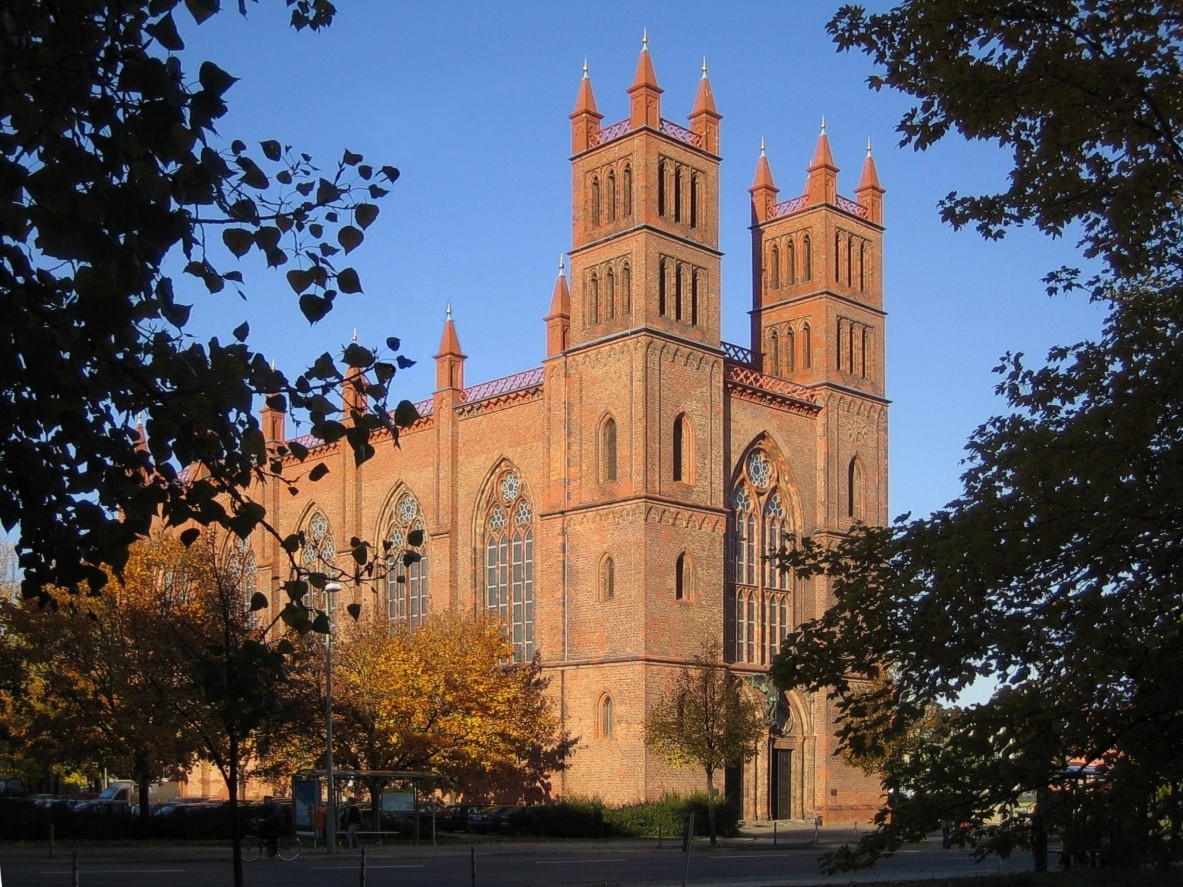
Theodor Erdmann Kalide – Bacchantin auf dem Panther,
(1844-1848) marble, Staatliche Museen zu Berlin, Nationalgalerie, Karl Friedrich Schinkel Museum, Friedrichswerdersche Kirche in Berlin-Mitte, Berlin-Tempelhof, Bodestraße 1-310178 Berlin; Theodor Erdmann Kalide, – Neo- Hellenistic, – Berlin artist (1801-1863). (b Königshütte, Upper Silesia [now Chorzów, Poland], 8 Feb 1801; d Gleiwitz [now Gliwice, Poland], 23 Aug 1863).
{ This is quite an impressive piece of sculpture, that fits comfortably within a type of Hellenistic sculpture. Perhaps not quite up to the complex internal forms of the best Hellenistic sculpture – but nothing demonstrates that standard in the whole output of European sculpture. The subject matter also would fit in the Hellenistic as of complete merit. {This group of figures is natureful in their to see dionysischen beginning in greatest possible distance from the apollonischen people ideal of the classicism and can as “splendourful proclamation anti-classical Unmen” Bloch / Grzimek 1978, 137)} Dionysian subject matter was on the same level of importance as the Apollonisian in the Greek Hellenistic Period, in terms of the sculptural quality of the surviving work. Of the sculptures that would be totally offensive without rhyme or reason – there are no examples of Hellenistic Greek sculpture of techinically superior output entering the domain of Kitsch. There are some Hellenistic Greek sculptures of degenerate subject matter and appearence of the work – but these are also of low quality in the technique and complexity of the content of sculptural issues. These would have been produced by amateurs that were of low esteem in their talent as well as education in the tradition of the training.
This sculpture composition is of the type seen in similar subjects of Satyr and Hermaphrodite – Albertinum, Dresden, Germany; Nymph & Satyr, – Consrvatori, Rome; Naples Natl Archaeology Museum, Naples, Italy, etc… Nymph & Faun, Nymph & Dolphin, Naples Natl. Archaeology Museum; etc… of the Dionysian subjects of the Greek Hellenistic.

![Theodor Erdmann Kalide – Neo- Hellenistic, – Berlin artist (1801-1863). (b Königshütte, Upper Silesia [now Chorzów, Poland], 8 Feb 1801; d Gleiwitz [now Gliwice, Poland], 23 Aug 1863).](https://blogger.googleusercontent.com/img/b/R29vZ2xl/AVvXsEgMIE4DOL4PhCfSX142sB24d0na4Zm9z6Tj3MoW1qbsHGtI_GbMzNTFIQCE3Lm6LbfqYt5g_Nn1jI9EKll3XklD1ghnCQZHsIZv4-_2lnxfqiBTtYq258mvThG0NPo1ols4QlP1i5DEHO8/s1600-h/Kalide+A1+BacchantinaufdemPnther76cd.jpg)


