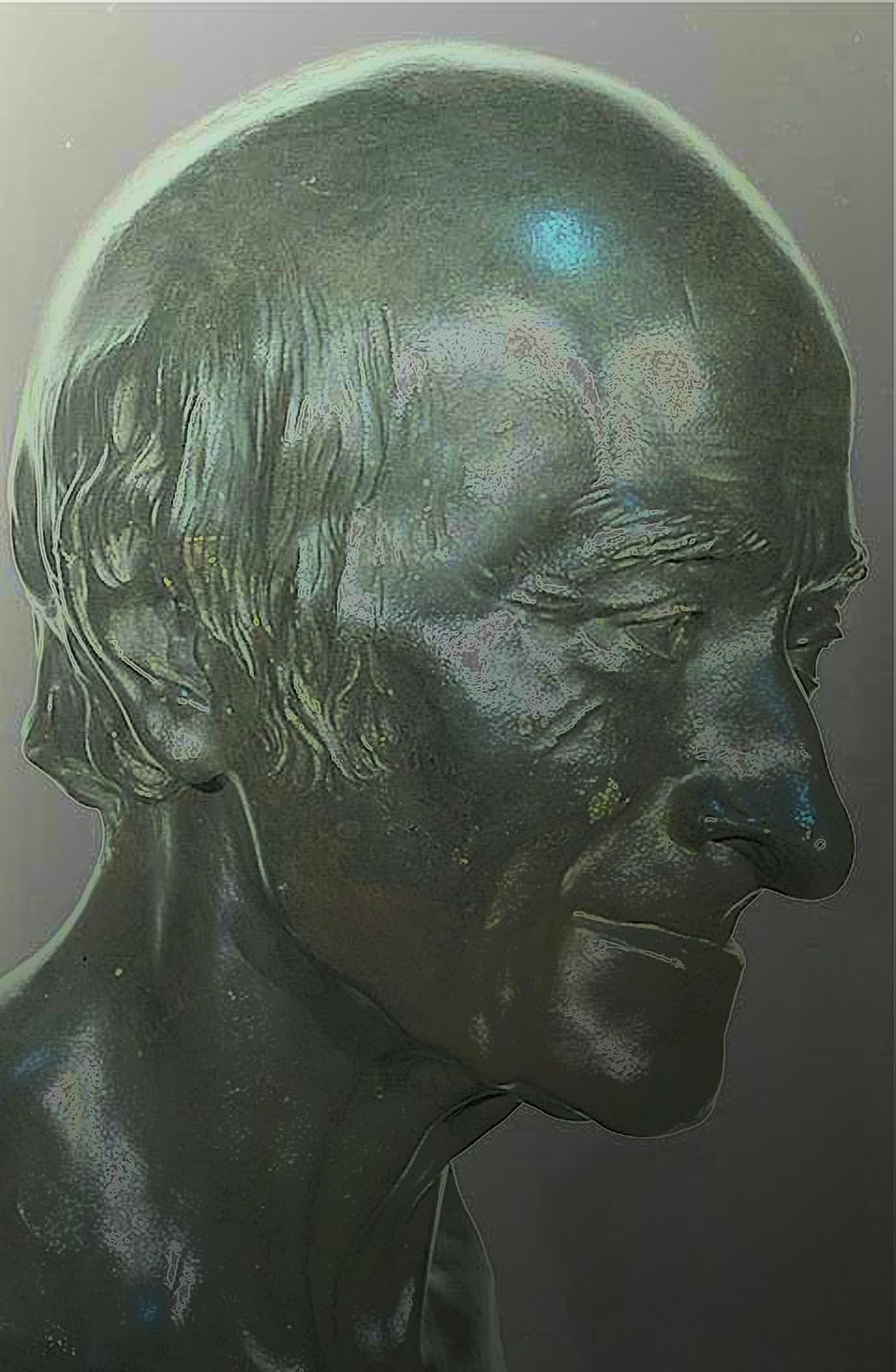

Houdon – Marie Sebastien Charles Francois Fontainede Bire – Marble Bust, Getty Museum.

Houdon – Marie Sebastien Charles Francois Fontainede Bire – Marble Bust, Getty Museum

Houdon – Marie Sebastien Charles Francois Fontainede Bire – Marble Bust, Getty Museum
Marie-Sébastien-Charles-François Fontaine de Biré
French, 1785 Marble 2003.102 The J. Paul Getty Museum
Marie-Sébastien-Charles-François Fontaine de Biré (1727–1803) was a financial administrator during the reign of Louis XVI. Houdon’s marble was likely commissioned to commemorate de Biré’s new position. As a financial minister to the king, de Biré endured much scrutiny during the Revolution—he was removed from his official post and endured several arrests and imprisonments—but managed to survive with his head intact.
–
Bust of Marie-Sébastien-Charles-François Fontaine de Biré
French, Paris, 1785 Marble 2 ft. 2 5/8 in. x 1 ft. 9 5/8 in. x 1 ft. 1 11/16 in.
–
Through exacting realism, Jean-Antoine Houdon convincingly captured the skin’s texture, and the underlying bone and musculature of this eminent figure. The sitter’s attire and hair–styled with a long ponytail at the back–indicate his status as a high-ranking French government official. But Monsieur de Biré’s personality also shows through in the bust’s subtle features. The wrinkles around his eyes and the soft jowls that brush his scarf reveal advanced age. Yet his sparkling eyes and the upturned corners of his lips, which hint at a smile, convey a warm disposition. To accurately render Biré’s likeness, Houdon measured his head and face with calipers, and probably made a plaster “life mask” for reference. He probably modeled the bust first in clay, and then made a plaster cast. From those initial studies, Houdon would have produced this final marble version, which he gave to the sitter. Biré may have commissioned the bust to celebrate his newly appointed position as a treasury official under Louis XVI.
‘
Jean-Antoine HOUDON – Versailles, 1741 – Paris, 1828
Condorcet (1743 – 1794) Vers 1785 Terre cuite H. : 0,59 m. ; L. : 0,49 m. ; Pr. : 0,31 m. Le buste est le modèle du marbre daté de 1785 (Philadelphie, Philosophical Society). Marie Jean Antoine Nicolas de Caritat, marquis de Condorcet, philosophe et mathématicien, entra à l’Académie des Sciences en 1769, et en devint le secrétaire. Il participa à la rédaction de l’Encyclopédie. Sous la Révolution, il fut député à l’Assemblée législative et à la Convention. Arrêté sous la Terreur comme girondin, il mourut en prison.
–
Jean-Antoine HOUDON – Versailles, 1741 – Paris, 1828
Condorcet (1743 – 1794)


Jean-Antoine Houdon (Versailles, 1741-Paris, 1828) Buffon (1707-1788)


Jean-Antoine Houdon (Versailles, 1741-Paris, 1828) Buffon (1707-1788) Probably the marble shown at the 1793 Salon
Jean-Antoine HOUDON – Versailles, 1741 – Paris, 1828
Buffon (1707-1788)
Buffon, botanist and man of the Enlightenment, was in his time as famous as Voltaire. Houdon portrays him in the antique style, with a rounded truncation of the naked torso, a type he had inaugurated with his bust of Diderot. He imbues his portrait with a vivacity that emphasizes the 74-year-old man’s intellectual and physical vigor
–
A scientist famous throughout Europe
‘
The naturalist Georges Louis Leclerc, Count de Buffon (he received the title from Louis XV in 1771), was appointed Keeper of the Jardin du Roi, the king’s botanical garden (which later became the Museum of Natural History), in 1739. From 1744 to 1788, he wrote his monumental Histoire naturelle, genérale et particulière, which covered the whole of the mineral world and the animal kingdom. A man of the Enlightenment, he believed scientific knowledge should be based on experimentation. The publication of his Epoques de la nature in 1779, written in a clear, noble style, won him the admiration of educated circles all over Europe, including several kings. Empress Catherine II of Russia considered Buffon the equal of Newton, and she commissioned Houdon to sculpt a marble bust of the naturalist. The German writer Melchior Grimm, a friend of Diderot who kept European courts informed of intellectual developments in Paris, acted as her intermediary. In 1782 the portrait was sent to Saint Petersburg and installed in the Hermitage Museum. Buffon, too old to make the journey, delegated his son to take it there for him. A marble copy, probably the Louvre sculpture in veined marble, was presented at the 1783 Salon.
‘
A prodigious output
‘
The great portraitists of the time had already portrayed the scientist: the painter François-Hubert Drouais in 1761, the sculptor Jean-Baptiste Defernex in 1772, and above all Augustin Pajou, First Sculptor to the King, in 1776. The latter received a commission from the Directorate of the King’s Buildings for a monumental full-length statue. He depicted Buffon in the antique style, as a draped nude looking down over the animal kingdom. He made three busts from it, in various costumes, including one in the “French style,” i.e., in contemporary costume (Louvre).
‘
An old man full of vigor
‘
Houdon also portrayed Buffon in the antique style, with a naked torso whose rounded truncation cuts off the shoulders. He had already used this habitual way of portraying philosophers for his busts of Voltaire and Diderot (Louvre). But whereas Pajou sought to convey Buffon’s genius, Houdon shows the man. Although he has not idealized the 74-year-old scientist, his powerful face and neck give him a vigorous air. He is not wearing a wig, and his natural hair is curled at the temples and tied in a bow. The complete absence of accessories allows one to concentrate on the face. The scientist’s authority and superior intellect are conveyed by the almost haughty way he holds his head, his noble, prominent forehead and his keen eye. The bust is animated: the head is pivoting to the left (accentuating the neck tendon) and the lips are half open, as if he were about to speak. The work met with such success that Houdon reproduced it in different materials, including one in the “French style,” with his shirt open at the neck.
–
Houdon and the European Courts
‘
Houdon held the title of sculpteur du roi (sculptor to the king) during the reign of Louis XVI. Although he received very few French royal commissions, Houdon’s fame spread throughout Europe through enthusiastic recommendations of Enlightenment thinkers and visits made to his Paris studio by traveling aristocrats, diplomats, and royalty who commissioned their portraits from him.
Jean-Antoine HOUDON – Versailles, 1741 – Paris, 1828
Robert Fulton
French, 1803–4

–Jean-Antoine HOUDON – Versailles, 1741 – Paris, 1828
Robert Fulton
French, 1803–4 Marble Detroit Institute of Arts, Gift of Dexter M. Ferry Jr.
Robert Fulton (1765–1815) was an American engineer, inventor, and artist. With Robert R. Livingston, Fulton developed the first commercially successful steamboat in America.
–
Hair
‘
Houdon distinguished himself from other 18th-century sculptors in his manner of carving hair. He fashioned it as a unit, sculpting it in masses, instead of trying to carve each strand. De Biré is depicted here with his hair dressed as if it were a short wig, and a queue (ponytail) tied with a ribbon lying down his back.
Houdon makes it clear that de Biré wears his own hair. Compare this with Houdon’s portrait of Voltaire (below), who is depicted with an actual wig, which was fashionable at the time. A sharp line distinguishes the wig from the skin around the face, and the ordered lines in the smooth curls create an unnatural, clumped appearance.
–
Houdon and America
‘
During the American Revolutionary War era, Houdon sculpted many prominent heroes of the fledgling republic. His statue of George Washington stands in the capitol building in Richmond, Virginia—a commission awarded at the recommendation of his friends Benjamin Franklin and Thomas Jefferson. Houdon’s portrait of Jefferson was chosen in 1938 for the
American nickel, still in circulation today.

Jean-Antoine Houdon, French, 1741–1828
François-Marie Arouet, called Voltaire

Jean-Antoine Houdon, French, 1741–1828
François-Marie Arouet, called Voltaire
French, 1780 Marble Berlin-Brandenburgische Akademie der Wissenschaften Archiv
–
Jean-Antoine HOUDON – Versailles, 1741 – Paris, 1828 Voltaire (1694 – 1778) 1778
“One of the finest attributes of the very difficult art of statuary is to preserve shapes accurately and render nearly imperishable the image of the men who have brought their country glory or happiness.” Houdon’s definition applies perfectly to his portrait of Voltaire, who was a veritable icon of the Enlightenment. He reproduced it many times, but Voltaire never lost his sardonic smile or the twinkle in his eye.
‘
Voltaire and Houdon
‘
Voltaire symbolizes the spirit of the Enlightenment par excellence. These days he is known as a philosopher and a champion of tolerance, but he was also a famous playwright, poet, and historian. After twenty years in exile in Ferney (Switzerland), he returned to Paris in February 1778, at the age of eighty-three and in poor health, and was given a triumphal welcome. When he attended a performance of his play Irene at the Comédie-Française, his statue was crowned with laurels and the patriarch was given a standing ovation. Houdon, who had not met him before, managed several sittings before Voltaire died on 30 May 1778. Of the many busts made of Voltaire, only the bare-headed one by Houdon wholly pleased the great man. Houdon also molded Voltaire’s funerary mask. He used all this material to produce several types of bust, two of which are represented in the Louvre, and reproduced them in various media (marble, bronze, terracotta, plaster).
‘
Voltaire in a Wig
‘
This bust shows the philosopher in contemporary clothing and wearing a wig, which is incidentally rather outmoded. It portrays a man rooted in his times, prepared to fight for his ideas, such as the rehabilitation of the unjustly condemned Protestant Calas. Houdon tried to capture Voltaire’s physical appearance and psychological presence, but did not seek to idealize him. He made no attempt to mask the signs of age: the rings under his eyes, the wrinkles and deep folds on his cheeks, the impression of withered skin . . . But the portrait radiates with intelligence and mischief: the eyes twinkling under the bulging brow and the compressed lips suggest ironic wit. The Louvre’s marble bust comes from the sale after the sculptor’s death in 1828. In another version, Voltaire’s jacket is swathed in draperies (Comédie-Française).
‘
Voltaire Bare-headed
‘
Another type of bust uses the iconography initiated for Diderot. Bare-headed, with neither jacket nor drapery, with the torso cut off, he is shown in the manner of the ancient philosophers, giving an impression of timelessness. The old man’s fragility is more apparent. The wrinkles on s face are deeper. There are no clothes to hide the stringy tendons in his neck. His bald head suggests a skull. But his eyes and lips have lost none of their vivacity: behind the domed forehead, the philosopher’s mind is just as sharp. The bust in the Louvre, a gift from Countess Biver, is of outstanding quality which proves it was executed by Houdon himself. The marble has been worked with great delicacy, particularly noticeable in the rendering of a few wisps of hair on his temples. The Louvre also has a lost-wax bronze cast of the same type of bust. A third type of bust, with the philosopher’s scarf wrapped around his head, is derived from the seated statue of Voltaire sculpted for the Comédie Française (in situ). On the pedestal there are two low-relief masks symbolizing tragedy and comedy. Although Voltaire was represented by the greatest artists, painters or sculptors, Houdon’s portrait dominates as the quintessential image not only of the writer but of the philosophic spirit of the 18th century.
–
François-Marie Arouet, dit Voltaire, (Paris, 1694 – Paris, 1778) 1778 Bronze, fondu à la cire perdue H. : 0,35 m. ; L. : 0,20 m. ; P. : 0,21 m. Variante sans perruque ni indication de vêtement, ce buste fut découvert en 1871 par le sculpteur Adolphe-Victor Geoffroy-Dechaume (1816-1892), « dans les décombres d’un monument public » incendié lors de la Commune de Paris.

François-Marie Arouet, dit Voltaire, (Paris, 1694 – Paris, 1778) 1778 Bronze, fondu à la cire perdue H. : 0,35 m. ; L. : 0,20 m. ; P. : 0,21 m.


François-Marie Arouet, dit Voltaire,
(Paris, 1694 – Paris, 1778) 1778 Bronze, fondu à la cire perdue H. : 0,35 m. ; L. : 0,20 m. ; P. : 0,21 m.
–


Jean-Antoine HOUDON, – Versailles, 1741 – Paris, 1828, Voltaire, (1694 – 1778) 1778,
–
François-Marie Arouet, called Voltaire
French, 1780 Marble Berlin-Brandenburgische Akademie der Wissenschaften Archiv
–
Jean-Antoine HOUDON –


Versailles, 1741 – Paris, 1828 Voltaire, (1694 – 1778) 1778
Jean-Antoine HOUDON, (1741-1828) Voltaire
‘
(François-Marie Arouet),
‘
known as; 1694-1778), writer 1778

Thomas Jefferson
French (Paris), 1789,
Jean-Antoine Houdon, French, 1741–1828
54.5 cm (21 7/16 in.) Stone; marble
Signed: Signed and dated “houdon f 1789”.
Museum of Fine Arts, Boston
–

Thomas Jefferson
French (Paris), 1789,
Jean-Antoine Houdon, French, 1741–1828
54.5 cm (21 7/16 in.) Stone; marble
Signed: Signed and dated “houdon f 1789”.
Museum of Fine Arts, Boston

Thomas Jefferson
French (Paris), 1789,
Jean-Antoine Houdon, French, 1741–1828
54.5 cm (21 7/16 in.) Stone; marble
Signed: Signed and dated “houdon f 1789”.
Museum of Fine Arts, Boston

Thomas Jefferson
French (Paris), 1789,
Jean-Antoine Houdon, French, 1741–1828
54.5 cm (21 7/16 in.) Stone; marble
Signed: Signed and dated “houdon f 1789”.
Museum of Fine Arts, Boston

Thomas Jefferson
French (Paris), 1789,
Jean-Antoine Houdon, French, 1741–1828
54.5 cm (21 7/16 in.) Stone; marble
Signed: Signed and dated “houdon f 1789”.
Museum of Fine Arts, Boston

Thomas Jefferson
French (Paris), 1789,
Jean-Antoine Houdon, French, 1741–1828
54.5 cm (21 7/16 in.) Stone; marble
Signed: Signed and dated “houdon f 1789”.
Museum of Fine Arts, Boston
Thomas Jefferson French (Paris), 1789 Jean-Antoine Houdon, French, 1741–1828, 54.5 cm (21 7/16 in.) Stone; marble
Signed: Signed and dated “houdon f 1789”.
Classification: Sculpture
The best-known likeness of the man who would be elected president in 1800, this bust captures the keen intelligence of the sitter and demonstrates Houdon’s superb talent for characterization. In 1785 Thomas Jefferson (1743-1826) succeeded Benjamin Franklin as American minister to France. Jefferson immersed himself in the artistic and cultural life of Paris, studying firsthand neoclassical architecture and actively collecting books, prints, and works of art. Houdon, described by Jefferson as “perhaps the foremost artist in the world,” executed this startlingly lifelike bust in Paris shortly before Jefferson returned to the United States to assume the position of secretary of state.
Saravezza marble on gray and white marble base. Head turned slightly to right. Contemporary costume coat with standing collar, waistcoat with buttons, stock. Long hair tied at nape of neck; part of bow knot missing.
Museum of Fine Arts, Boston
George Nixon Black Fund, 1934 Accession number: 34.129
Provenance/Ownership History: Please note: The history of ownership is not definitive or comprehensive, as it is under constant review and revision by MFA curators and researchers. By the late 18th century, Count Antoine-Louis-Claude Destutt de Tracy (b. 1754- d. 1836), Château de Paray, Melun, France [see note 1]; 1839, by descent to Jacques Louis Leopold de Chateauvieux (d. 1868), Melun; 1868, by inheritance to his son, Ferdinand Le Clercq de Chateauvieux [see note 2]; 1916, by inheritance to his son, P. Le Clercq de Chateauvieux; 1928, sold by Le Clercq de Chateauvieux to Jean L. Souffrice, Neuilly-sur-Seine [see note 3]; 1934, sold by Souffrice, through the Marie Sterner Gallery, New York, to the MFA for $35,000. (Accession Date: April 5, 1934)
–

Bust of John Paul Jones French (Paris), 1780 Jean-Antoine Houdon, French, 1741–1828
Paris, France Plaster
Museum of Fine Arts, Boston
–

Bust of John Paul Jones French (Paris), 1780 Jean-Antoine Houdon, French, 1741–1828
Paris, France Plaster
Museum of Fine Arts, Boston
–
–Jean-Antoine Houdon, French, 1741–1828
Bust of John Paul Jones French (Paris), 1780 Jean-Antoine Houdon, French, 1741–1828, Paris, France Plaster
Provenance/Ownership History: 1786, probably given to Thomas Jefferson, Monticello, Charlottesville, VA by John Paul Jones. 1827, sold from Monticello to Joseph Coolidge [see note 1]; Jan 17 1828, deposited by Coolidge to the Boston Athenaeum [see note 2]. May 1903, Joseph/ Moses Kimball auction, sold to a second hand store; 1903, sold by the store to Charles H. Taylor, Boston (?) [see note 3]; June 22, 1910, lent by Taylor to the MFA; 1931, gift of Taylor to the MFA. (Accession Date: October 8, 1931)
Museum of Fine Arts, Boston
–

George Washington (1732 – 1799) 1786 Terre cuite H. : 0,43 m. ; L. : 0,32 m. ; Pr. : 0,26 m.

George Washington (1732 – 1799) 1786 Terre cuite H. : 0,43 m. ; L. : 0,32 m. ; Pr. : 0,26 m.
George Washington (1732 – 1799) 1786 Terre cuite H. : 0,43 m. ; L. : 0,32 m. ; Pr. : 0,26 m.
–
George Washington (1732 – 1799) 1786 Terre cuite H. : 0,43 m. ; L. : 0,32 m. ; Pr. : 0,26 m. Houdon exécuta en 1785 aux Etats-Unis un buste en terre cuite du général représenté dans une nudité héroïque (conservé à Mount-Vernon). L’oeuvre du Louvre, plus tardive, reprend la composition à l’antique du premier portrait, bien qu’ici Washington soit vêtu d’une tunique.
–

Benjamin Franklin
French, dated 1779 Marble Philadelphia Museum of Art. Purchased with a generous grant from The Barra Foundation, Inc., matched by contributions from the Henry P. McIlhenny Fund in memory of Frances P. McIlhenny, the Walter E. Stait Fund, the Fiske Kimball Fund, and with funds contributed by Mr. and Mrs. Jack M. Friedland, Hannah L. and J. Welles Henderson, Mr. and Mrs. E. Newbold Smith, Mr. and Mrs. Mark E. Rubenstein, Mr. and Mrs. John J. F. Sherrerd, the Women’s Committee of the Philadelphia Museum of Art, Marguerite and Gerry Lenfest, Leslie A. Miller and Richard B. Worley, Mr. and Mrs. John A. Nyheim, Mr. and Mrs. Robert A. Fox, Stephanie S. Eglin, Maude de Schauensee, Mr. and Mrs. William T. Vogt, and with funds contributed by individual donors to the Fund for Franklin (1996-162-1)
Benjamin Franklin (1706–1790) was a printer, writer, scientist, and statesman. His famous kite experiment, which demonstrated that lightning is an electrical discharge, brought him international acclaim. As a statesman, Franklin held a seat in the Pennsylvania Assembly. In 1776, he won financial aid from France for the American Revolution. He helped negotiate the peace treaty with Great Britain, signed in Paris in 1783.

–
Louis-Léopold Boilly French, 1803–4 Oil on canvas Ville de Cherbourg-Octeville, Musée d’Art Thomas Henry
–
Houdon and America During the American Revolutionary War era, Houdon sculpted many prominent heroes of the fledgling republic. His statue of George Washington stands in the capitol building in Richmond, Virginia—a commission awarded at the recommendation of his friends Benjamin Franklin and Thomas Jefferson. Houdon’s portrait of Jefferson was chosen in 1938 for the American nickel, still in circulation today.

Houdon’s teacher Jean-Baptiste Pigalle, (1714-1785), Mercure attachant ses talonnières /
‘
Mercury Attaching his Wings
Houdon’s teacher Jean-Baptiste Pigalle, (1714-1785), Mercure attachant ses talonnières /
‘
Mercury Attaching his Wings
‘
Pigalle’s Mercury (approved in 1741) was executed for his admission to the Academy in 1744. The sculptor presented a significantly larger plaster model of this subject at the Salon of 1742, paired with a Venus; both statues were made in marble for the king, and presented in 1750 to Frederick II of Prussia.
‘
A twisted position
‘
Mercury, the messenger of the gods, is sitting on a rock, ready to leap up. He is attaching the winged sandals which, together with his petasus (winged cap), will enable him to take flight. The god’s twisted position and the play of his limbs make the composition interesting to observe from every angle. Mercury is not looking at his talaria (winged sandals) as he attaches them, but his gesture is accentuated by the convergence of both arms and one leg. His crouched position, the upward slant of his limbs and shoulder line, and his face turned to scan the horizon, give an impression of dynamism — that Mercury is about to soar into the sky. The position of his left leg, with his weight on his toes, also suggests that the messenger god is ready for take-off. This pose was perhaps inspired by the Mercury and Argus by Jacob Jordaens (a 17th-century Flemish painter), popularized by engravings. But the play of diagonals and the multiple viewpoints afforded by sculpture in the round enabled Pigalle to add a vitality that transformed the figure of the god into an allegory of speed. Mercury’s torso is a variation on the Belvedere Torso (in the Vatican); this antique marble fragment of a muscular seated figure has a strength that fascinated Michelangelo — and has continued to fascinate artists and art lovers. It was left incomplete, which was unusual for the 18th century, and thus became a metaphor for Time that destroys the creations of Genius. It symbolized sculpture, as it does in Jacques Buirette’s 1663 reception piece, the bas-relief entitled The Union of Painting and Sculpture (in the Louvre).
‘
The Academy reception piece
‘
When Pigalle returned to Paris in 1741 after a stay in Rome (1736–39), he presented his terracotta model of Mercury for approval by the Royal Academy of Painting and Sculpture; according to an anecdote, he had almost left the work as a pledge of payment for his accommodation when passing through Lyon. Instead of imposing another subject, the Academy asked him to transpose the model into marble for his admission piece, and he was accepted on 30 July 1744. Mercury was originally designed as an isolated figure, but in 1742, Pigalle added a matching piece: Venus Giving a Message, which illustrates an episode from the Golden Ass, a collection of tales by Latin author Apuleius (c. 125–170). In 1746, the Royal Administration commissioned Pigalle to produce a life-size marble sculpture of each figure; these works were completed in 1748, and presented by Louis XV to King Frederick II of Prussia for the park of the Sans-Souci castle near Berlin.
‘
An instant and lasting success
‘
The work was an instant success. In The Century of Louis XIV (1751), Voltaire compared it to the finest works of Greek antiquity. Many replicas were acquired by artists, and it featured in a number of paintings: the painter Chardin, a friend of Pigalle, used it to symbolize sculpture in his works The Drawing Lesson (1747, Vanas) and The Attributes of the Arts (1766, Minneapolis). A smaller version in biscuit porcelain was produced by the Sèvres manufactory as of 1770.
–
Exhibition at the J. Paul Getty Museum, Los Angelos; the National Gallery of Art, Washington, D.C.; and the Réunion des musées nationaux, Paris, and l’Etablissement public du musée et du domaine national de Versailles. This exhibition is supported by an indemnity from the Federal Council on the Arts and the Humanities. – Below:
Overview
Crowding Houdon’s studio are models of his sculptures, including Voltaire, Benjamin Franklin, and Winter, all on view in the exhibition.
The portraits of Jean-Antoine Houdon (French, 1741–1828), capture the character of the men and women who defined the Enlightenment, a period of revolutionary political and social change in France and America. The Enlightenment challenged traditional beliefs about the world and led to extraordinary efforts to transform it. Houdon’s genius lay in his ability to evoke these new ideas in three-dimensional media. His startlingly lifelike portraits of leading figures of the day—including Denis Diderot, Voltaire, Jean-Jacques Rousseau, Louis XVI, Benjamin Franklin, George Washington, and Napoleon—vividly recall the Enlightenment.
Born in Versailles in 1741, Houdon was educated in Paris and Rome under French royal sponsorship. His classical training included studies in ancient art and anatomy, in which he showed an unusual interest and talent. Houdon established his reputation with portrait busts that were lauded for their beauty and technical sophistication. During the tumultuous years leading up to the French Revolution, Houdon executed some of his finest, most compelling work. Although formal portraiture was his mainstay, Houdon was also recognized for the innovation, intimacy, and naturalism of his busts of children, and his sensual mythological and allegorical figures.


Houdon’s teacher – Jean-Baptiste Pigalle, (1714-1785), Mercury Attaching his Wings, 1744 , Louvre

Jean Antoine Houdon, – France, b. 1741 Versailles – d. 1828 Paris, sculptor, Diana, Plaster, (LifeSize sculpture), Gotha, Thuringia, Germany, Jean-Antoine HOUDON – Versailles, 1741 – Paris, 1828, Diane chasseresse, 1790
Diana – scandalous nudity

Gotha Schloss, Gotha, Thüringen, Germany ‘Duke Ernst II of Saxe-Gotha” Plaster Cast – Diana, Houdon
Houdon presented a life-size plaster of Diana in his studio during the 1777 Salon. The finished sculpture was to be executed in marble (Gulbenkian Foundation, Lisbon) for Duke Ernst II of Saxe-Gotha, as compensation for a commission lost by the sculptor. The bronze version is now in the Louvre. The sculpture was acclaimed for its beauty worthy of classical statuary. The impression of swiftness is accentuated by Diana’s slim figure. Yet her unabashed beauty caused a scandal. Diana was habitually portrayed in a short tunic belted at the waist, in the manner of the often-copied Artemis the Huntress (Louvre), a classical marble acquired by Francis I. The goddess’s nudity was deemed acceptable only when she was depicted bathing. The same year as Houdon, Christophe Allegrain showed – also outside the Salon – his buxom Diana, surpised by the huntsman Actaeon while bathing (Louvre). Yet during the Renaissance, the goddess of hunting was often represented in the nude. The Diana the Huntress of the School of Fontainebleau (Louvre) and the large marble group from the Château d’Anet (Louvre) – in which the nude Diana, accompanied by her dogs, reclines, her arms around a stag – are two well-known examples.
‘
Antiquity revisited
‘
Houdon’s wonderfully reconciles the aesthetics of antiquity and the Renaissance. From antiquity, Diana has retained her triumphant nudity, whose elegance and distinction inspires respect rather than temerity. The goddess’s noble, even haughty bearing; serene, idealized face reflecting no emotion; and distant gaze render her impersonal and inaccessible. The elongation of the female body, firm anatomy, and linear purity belong to the Renaissance of the School of Fontainebleau. Her slender body, leaning slightly forward on one foot, gives the statue an ethereal and dynamic allure and affords multiple points of view. It evokes the daring balance of the flying Mercury by Giovanni da Bologna (1529-1608), a Florentine sculptor of Flemish origin who exercized considerable influence on European sculptors. But Houdon’s Diana is also a full-bodied creature of the flesh. Her naked pubis, considered too realistic, was filled in and flattened in 1829.
‘
A technical tour-de-force
‘
The glory of the great masters of French sculpture (Girardon, Coysevox, Lemoyne, Bouchardon, Pigalle) rests on their bronze statuary, but they seem to have known little about the technical aspects of casting. Houdon, who had a passion for the art of casting, cast two large bronzes of Diana himself at the Roule foundry in Paris: an eight-piece one in 1782 (San Marino, California) and a five-piece one in 1790 (the statue now in the Louvre was purchased at auction by Charles X after the sculptor’s death in 1828).
–
Jean-Antoine Houdon studied in Paris under such sculptors as Jean-Baptiste Lemoyne and Jean-Baptiste Pigalle. As a winner of the Prix de Rome, he worked in Rome from 1764 to 1768. There he was influenced by ancient artifacts, including those recently unearthed in Herculaneum and Pompeii, and works of Renaissance masters, especially Michelangelo. He created his important anatomical study of a standing man, known as the Écorché, or “flayed” figure, which later was replicated and used in most art schools. The Écorché displays a continuing characteristic of his art: classicism combined with a merciless realism. Skilled in marble, bronze, plaster, and clay, Houdon became a member of the Académie Royale in 1771 and a professor in 1778. He made his reputation with his portraits, producing a veritable “Who’s Who” of his era’s royalty, artists, and philosophers. Patrons appreciated his ability to give marble the effect of living flesh as well as his knack for capturing his sitter’s personality. In 1785, at the request of Thomas Jefferson and Benjamin Franklin, Houdon crossed the Atlantic. He spent fourteen days at Mount Vernon executing a statue of George Washington. After narrowly escaping imprisonment during the French Revolution, Houdon returned to favor under Napoleon Bonaparte and finally retired in 1814.
Jean Antoine Houdon, – France, b. 1741 Versailles – d. 1828 Paris, sculptor, Diana, Plaster, (LifeSize sculpture), Gotha, Thuringia, Germany
Jean-Antoine HOUDON – Versailles, 1741 – Paris, 1828 Diane chasseresse 1790
Diana, Plaster, (LifeSize sculpture), Gotha, Thuringia, Germany
“All the text above here on this Post of J. A. Houdon is from the Getty Museum exhibition”
Hubert Gerhardt, – sculptor, Munchen, Bavaria, Germany; St Michael Slaying the Devil, 1588Bronze, larger than life-size, Michaelskirche, Munich

Hubert Gerhardt, – sculptor, Munchen, Bavaria, Germany; St Michael Slaying the Devil, 1588Bronze, larger than life-size, Michaelskirche, Munich
In the centre of Marienplatz there is the Marien’s column (Mariensäule). It counted as a zero to all distance measurements of Munich. It was put up 1632 under elector Maximilian I. in return for the fact that the Swede’s king Gustav Adolf has spared Munich and Landshut during the Thirty Years’ War (1618-1648). On top of the column of red marble there is a stately madonna, a work of the famous sculptor Hubert Gerhard. The madonna carries to the sign of her rule an imperial orb, a sceptre and a crown, she stands on a crescent with the Jesus’s child in the arm.
Originally Hubert Gerhard had created the statue for the tomb Herzog Wilhelm V. in the church Michaelskirche. At the foot of the column four glyphs of unknown artists fight against the vices of the humanity: the dragon symbolises the hunger, the lion symbolises the war, the basilisk symbolises the plague and the snake symbolises the unbelief. The originals of these bronze figures are to be seen in the city museum.


U-Bahn: U3, U6 bis MarienplatzS-Bahn: S1 – S8 to Marienplatz
Biography
The artist, born between 1540 and 1550 at Hertogenbosch, belongs to the generation of Dutch sculptors who introduced into the German courts and international style that, fused with traditional local elements, paved the way for the great flowering of Baroque art.
Gerhard worked in the workshop of Giambologna in Florence until 1581 when he was called by Hans Fugger to southern Germany to execute the first Italian style fountain at the north of the Alps in the garden of his castle at Kirchheim. After a period of work in Augsburg, where he executed the Augustus fountain for the city (1594), Gerhard joined the court of the Dukes of Bavaria. Under the direction of Friedrich Sustris, like Gerhard a native of the Low Countries, he participated in the program of decoration for the Jesuit college church of St Michael in Munich.
The High Altar
The former Jesuit church of St Michael in Munich is the largest Renaissance church north of the Alps. It was built by Duke William V between 1583 and 1597 as a spiritual center for the Counter Reformation.
It was erected in two stages. In the first stage (1583-88) the church was built by the model of Il Gesù in Rome and given a barrel-vaulted roof by an unknown architect, the vault being the largest in the world apart from that of St Peter’s in Rome, spanning freely more than 20 meters. When the church was built there were doubts about the stability of the vaulting. But it was the tower that collapsed in 1590, destroying the just completed choir. Duke William V took it as a bad omen and so planned to build a much larger church. Therefore, in a second phase of construction lasting until 1597, Friedrich Sustris built on to the undamaged nave a new choir and a transept not envisaged in the original plan. The facade is impressive and contains several statues of members of the Wittelsbach dynasty. Hubert Gerhard’s large bronze statue between the two entrances shows the Archangel Michael fighting for the Faith and killing the Evil in the shape of a dragon.
The church contains the tomb of Eugène de Beauharnais, which was erected by Bertel Thorwaldsen in 1830. Eugène was the son of Josephine de Beauharnais, Napoleon’s wife and her first husband, general Alexandre de Beauharnais. He married a daughter of king Maximilian I of Bavaria in 1806 and was created Duke of Leuchtenberg in 1817. In the right transept is a cross monument of Giovanni da Bologna. The crypt contains among others the tombs of these members of the Wittelsbach dynasty:
Duke William V
Elector Maximilian I
King Ludwig II
King Otto
Having suffered severe damage during the Second World War the church was restored in 1946-48. Finally, between 1980 and 1983, the stucco-work being reinstated. Gerhard worked in the workshop of Giambologna in Florence until 1581 when he was called by Hans Fugger to southern Germany to execute the first Italian style fountain at the north of the Alps in the garden of his castle at Kirchheim. After a period of work in Augsburg, where he executed the Augustus fountain for the city (1594), Gerhard joined the court of the Dukes of Bavaria. Under the direction of Friedrich Sustris, like Gerhard a native of the Low Countries, he participated in the program of decoration for the Jesuit college church of St Michael in Munich.
Hubert Gerhardt, -sculptor, Munchen, Bavaria, Germany; St Michael Slaying the Devil, 1588 Bronze, larger than life-size Michaelskirche, Munich

Museums and Public Art Galleries:
Detroit Institute of Arts, MichiganHebe Museum of Fine Arts, Boston Sculpture collection online Cleveland Museum of Art, Ohio Sextus Tarquinius Threatening Lucretia Courtauld Institute of Art, London, UK Pieta Frick Collection, New York City Triton and Nereid, bronze, ca.1620 Professional Tools:
Artprice (You need to register for access to some research tools. Click “Free express check-in” on the login panel.)
•
Art auction prices for Hubert Gerhard. Up-to-date record of works sold at art auctions worldwide (payment is required in order to see the actual selling price).
•
Other features: Be informed of upcoming auctions of works by an artist. Detailed art market analysis by artist. Access to images and documentation from 270,000 sale catalogues.Pictures from Image Archives:
Hubert Gerhard in the Web Gallery of Art Bildindex der Kunst und Architektur (in German) Articles:
Grove Dictionary of Art Online (excerpt)Union List of Artist Names (Getty Museum) NEW! Reference sheet with basic information about the artist and pointers to other references.
Mariensäule – Marienplatz

Hubert Gerhardt, Crucifiction, sculptor, Augsburg, Bavaria, Germany
Pajou, Jacques-Augustin, 1759. The Princess of Hesse-Homburg as Minerva (at the Altar of Immortality),1761 Marble, height 100 cm, The Hermitage, St. Petersburg –

Pajou, Jacques-Augustin, 1759. The Princess of Hesse-Homburg as Minerva (at the Altar of Immortality),1761 Marble, height 100 cm, The Hermitage, St. Petersburg –
Augustin Pajou, Psyche Abandoned, 1790 Marble, height 180 cm Musée du Louvre, Paris

Augustin Pajou, Psyche Abandoned, 1790 Marble, height 180 cm Musée du Louvre, Paris
Augustin Pajou
Psyche Abandoned, 1790 Marble, height 180 cm Musée du Louvre, Paris
–
Leopold Doel, – “Crouching Athena Figure”, sculptor, Gotha, Thuringia, Germany

Leopold Doel, – “Crouching Athena Figure”, sculptor, Gotha, Thuringia, Germany
–
Ferdinand von Miller,- master sculptor casting, Bayerisches Armeedenkmal an der Feldherren, sculptor – Ludwig Michael Schwanthaler, later ennobled as Ritter von Schwanthaler (26 August 1802 – 14 November 1848), was a German sculptor who taught at the Academy of Fine Arts, Munich.

Ferdinand von Miller,- master sculptor casting, Bayerisches Armeedenkmal an der Feldherren, sculptor – Ludwig Michael Schwanthaler, later ennobled as Ritter von Schwanthaler (26 August 1802 – 14 November 1848), was a German sculptor who taught at the Academy of Fine Arts, Munich.
Munchen,Bavaria,Germany
Ferdinand von Miller,-sculptor, , (* 18th October In 1813 in Fürstenfeldbruck; † 11th February In 1887 in Munich).
Miller worked in the royal ore foundry at first under his uncle as an assistant. Fast Stiglmaier recognized the talent of its nephew and made possible for the talented boy of attendance of the academy of arts ( Kunstakademie in München ) in Munich and Paris, where he made acquaintance with Alexander of Humboldt. This told it by a new project king of Ludwig I., with that a survive-large figure, which should be poured „Bavaria “. Miller returned to Munich, transferred the royal ore foundry to follow-up of its uncle as a first supervisor and worked from now on on the project „Bavaria “. It needed and processed whole eight years for the 15 meters high head of the figure 87,360 kg ore. The gigantic work was finally revealed 1850 solemnly. 1878 it acquired the ore foundry of the Bavarian state.
The general’s hall whose architectural model is the ” loggia dei Lanzi ” in Florence was established in 1841 to 1844 by order king Ludwigs I. of Bavaria according to drafts by Friedrich von Gärtner. With the construction Ludwig I. of the Bavarian army and her victorious general wanted to put a monument.
The bronze statues of count Tilly and prince Wrede were poured according to draft by Ludwig von Schwanthaler from melted cannons. The “army monument” in the middle of the hall let in 1892 prince’s regent Luitpold put up. This monumental bronze group of Ferdinand von Miller the younger reminds in the German French war in 1870/71. Wilhelm Ruemann created the marble lions to sides of the stair rising in 1905.
; http://www.muenchen.citysam.de/muenchen-foto/2/bayern.htm
Die Feldherrnhalle, deren architektonisches Vorbild die “Loggia dei Lanzi” in Florenz ist, wurde 1841 bis 1844 im Auftrag König Ludwigs I. von Bayern nach Entwürfen von Friedrich von Gärtner errichtet. Mit dem Bau wollte Ludwig I. der bayerischen Armee und ihren siegreichen Feldherren ein Denkmal setzen.
Die Bronzestandbilder von Graf Tilly und Fürst Wrede wurden nach Entwurf von Ludwig von Schwanthaler aus eingeschmolzenen Kanonen gegossen. Das “Armeedenkmal” in der Mitte der Halle ließ 1892 Prinzregent Luitpold aufstellen. Diese monumentale Bronzegruppe von Ferdinand von Miller der Jüngere erinnert an den den Deutsch-Französischen Krieg 1870/71. Die Marmorlöwen zu Seiten des Treppenaufgangs schuf Wilhelm Ruemann 1905.
Befreiungshalle Kelheim, Bavaria, Germany – Ludwig Michael Schwanthaler, later ennobled as Ritter von Schwanthaler (26 August 1802 – 14 November 1848), was a German sculptor who taught at the Academy of Fine Arts, Munich.

Befreiungshalle Kelheim, Bavaria, Germany – Ludwig Michael Schwanthaler, later ennobled as Ritter von Schwanthaler (26 August 1802 – 14 November 1848), was a German sculptor who taught at the Academy of Fine Arts, Munich.


Befreiungshalle Kelheim, Bavaria, Germany – Ludwig Michael Schwanthaler, later ennobled as Ritter von Schwanthaler (26 August 1802 – 14 November 1848), was a German sculptor who taught at the Academy of Fine Arts, Munich.
Walhalla (wie Parthenon) im Auftrag von König Ludwig I. bis 1842 erbaut. Ehrenhalle zur Würdigung deutschsprachiger Frauen und Männer, bei denen man verdienstvolles Wirken zum Anlass der Ehrung macht – ausgestellt sind Büsten und Gedenktafeln. Nahe Donaustauf, Bayern


Statue of King Ludwig I (no. 63, 1890), builder of the hall – Ludwig Michael Schwanthaler, later ennobled as Ritter von Schwanthaler (26 August 1802 – 14 November 1848), was a German sculptor who taught at the Academy of Fine Arts, Munich.
The Walhalla memorial is named for the Valhǫll of Norse Paganism. It was conceived in 1807 by Crown Prince Ludwig I of Bavaria in order to support the gathering momentum for the unification of the many German states into the German Empire. Following his accession to the throne of Bavaria, construction took place between 1830 and 1842 under the supervision of the architect Leo von Klenze. The memorial displays some 65 plaques and 130 busts covering 2,000 years of history, beginning with Arminius, victor at the Battle of the Teutoburg Forest in the year 9 AD.
The entire system including the substructure is 125 meters long and 55 meters high, the shape of complex is a Greek temple in the style of a Doric Peripteros. The roof is supported by an iron structure that was ultra-modern for the time. The length of the classicist temple building is 66.7 meters, the width is 31.6 meters, and the height is 20 meters. The fully sculptural gable field on the north side, designed by Christian Daniel Rauch and executed by Ludwig von Schwanthaler, shows on the left the Germanic tribes under Arminius in the battle in the Teutoburg Forest against the Romans attacking from the west right. The southern gable represents Germany’s liberation in 1814, in the middle Germania, from the left and right the German states and federal fortresses approach in homage, in the spandrel the border rivers Rhine and Moselle are symbolized. Inside, Walhalla is 48.5 meters long, 14 meters wide and 15.5 meters high. The surrounding frieze by Martin von Wagner depicts the early history of the Germanic peoples, their departure from the Caucasus and their immigration into Central Europe. The final stage is the conversion to the Christian faith by Saint Boniface. In addition to its decorative function, the history frieze also serves as a visual separation between the lower bust zone and the upper panel zone. There are also twelve marble armchairs in the interior, which were created by the sculptor Ernst Mayer, and eight marble candlesticks.
By the time of Crown Prince Ludwig’s coronation as King Ludwig I of Bavaria in 1825, 60 busts had been completed. In 1826 Ludwig commissioned the construction of a memorial above the Danube River, near Regensburg, modelled after the Parthenon in Athens. The southern pediment frieze features the 1815 creation of the German Confederation; the northern pediment frieze features scenes from the Battle of the Teutoburg Forest of 9 AD.[2] According to Pictorial Travels Continentally Described (circa 1892), the construction of the building cost £666,666.
At Walhalla’s inauguration on 18 October 1842, there were 96 busts, plus 64 plaques for persons or events of which no portrait was available on which to model a sculpture. When the memorial was opened in 1842, Guido von Lessner authored a poem about Germany’s greatness which was set to music by Joseph Hartmann Stuntz.[4]
Since being “of the German tongue” was the main selection criterion for the original 160 persons representing the 1,800 years of German history, the king included individuals of the wider Germanic sphere, including ancient Germanic notables as well as people from the Holy Roman Empire. Whereas the Valhalla of Norse mythology served as home to those gloriously slain in battle, Ludwig intended his Walhalla not only for warriors but also for scientists, writers, and clerics, and specifically included both men and women. Decades before the foundation of the modern German state in 1871 or the clear formation of a modern German identity, “German” was initially understood as “Germanic” and included all ancient Germanic peoples as well as medieval Dutch, Swedish, Russian, and modern Austrian and Swiss figures.
Leo von Klenze’s plans reveal the purpose of the subterranean level set within the foundation, the entrance to which is visible from the Danube River. The Central Aisle leads to the Hall of Expectations (Halle der Erwartungen), which was meant to house busts of individuals considered worthy of joining Walhalla, but who were still living at the time of their busts’ creation. These busts would be ceremoniously carried into Walhalla following the deaths of the subjects. The Hall of Expectations was abandoned owing to changes in criteria for induction into Walhalla.
The first addition to the collection was the bust of Martin Luther. Ludwig, a devout Catholic, had hesitated to include Luther. Several of the sculptors, including Ohnmacht and Schadow, had urged the king to include Luther, as did Johannes von Müller. Ludwig finally commissioned Luther’s bust in 1831 from Ernst Friedrich Rietschel. It was not included at the inauguration of Walhalla in 1842, but added in 1848 by Ludwig himself. Luther’s bust was placed just after the last of the original busts (Goethe’s), disregarding the chronological arrangement by year of death.
Four further additions were made during Ludwig’s lifetime: Archduke Charles, Duke of Teschen (died 1847, added 1853), Josef Wenzel Graf Radetzky von Radetz (died 1858, added in the same year), Friedrich Schelling (died 1854, added 1860) and Ludwig van Beethoven (added 1866).

Statue of King Ludwig I – Reiterstandbild (equestrian statue) of King Ludwig I of Bavaria at Odeonsplatzig Schwanthaler is often connected as the designer/concept source “by Widnmann, after/design by Schwanthaler,” the executed statue on the square is Widnmann’s work. cast in the Miller royal bronze foundry (Ferdinand von Miller / Erzgießerei Miller for the casting). Ludwig I is shown crowned, holding a scepter, with attendants and a sculptural “virtues + interests” program around the base (allegorical corner figures). It anchors the ceremonial axis at Odeonsplatz, framing the start of the Ludwigstraße—very much a “state-image” placement, not a quiet garden monument.
The monument was dedicated in 1862 (inscriptions on the base reference the date and dedication by the city).

The Statue of Bavaria, known as “die Bavaria” in German, is a colossal bronze statue that stands at 18.52 meters (60 feet 9 inches) tall and weighs approximately 87.36 tons. It was commissioned by King Ludwig I of Bavaria and designed by the architect Leo von Klenze and sculptor Ludwig Schwanthaler. The statue was cast between 1844 and 1850 and inaugurated in 1850. It is notable for being the first colossal statue made entirely of bronze since antiquity, representing a significant engineering achievement of the 19th century.
Design and Symbolism
The statue depicts a female figure personifying Bavaria, adorned with a bearskin, a sword, and an oak wreath, symbolizing strength and honor. A lion, representing the state of Bavaria, crouches beside her. The oak wreath is a traditional symbol of honor, while the sword signifies the state’s fortitude.
The Statue of Bavaria is located at the Theresienwiese, the site of the famous Oktoberfest. It is part of a larger ensemble that includes the Ruhmeshalle (Hall of Fame), which features busts of notable Bavarians. Visitors can access the statue and even climb an internal staircase to a viewing platform in the head, offering panoramic views of Munich and the Theresienwiese.


Statue of King Ludwig I – Reiterstandbild (equestrian statue) of King Ludwig I of Bavaria at Odeonsplatzig Schwanthaler is often connected as the designer/concept source “by Widnmann, after/design by Schwanthaler,” the executed statue on the square is Widnmann’s work. cast in the Miller royal bronze foundry (Ferdinand von Miller / Erzgießerei Miller for the casting). Ludwig I is shown crowned, holding a scepter, with attendants and a sculptural “virtues + interests” program around the base (allegorical corner figures). It anchors the ceremonial axis at Odeonsplatz, framing the start of the Ludwigstraße—very much a “state-image” placement, not a quiet garden monument.
Robert Dorer and the Bronze Allegory of Geneva and Switzerland


Robert Dorer and the Bronze Allegory of Geneva and Switzerland
A sculptor at the hinge of eras
Robert (Eugen) Dorer (1830–1893) belongs to that generation of Swiss sculptors whose careers were shaped by two forces moving at once: the consolidation of modern Swiss federal identity after 1848, and the continuing authority—almost the gravitational pull—of German academic classicism. His work sits in the long afterglow of the late-Neoclassical atelier tradition, when the discipline of the life class, the canon of antique form, and the prestige of monumental public commissions still defined sculpture as a civic art. At the same time, the Switzerland for which he produced commemorative monuments was increasingly conscious of itself as a modern confederation, eager to translate political union into visible symbols in stone and bronze.
Dorer’s most widely recognized work today is the National Monument in Geneva’s Jardin Anglais: the bronze group of Geneva and Helvetia, two allegorical women joined in an embrace that visualizes the bond between the formerly independent Republic of Geneva and Switzerland. Inaugurated in 1869, the monument commemorates Geneva’s entry into the Swiss Confederation on 12 September 1814 and was conceived as a fiftieth-anniversary statement of union and loyalty. That group—confident, classical, public-facing—also offers a window into the sculptor who made it: his training in major German centers, his “patriotic” subjects, his participation in a culture of competitions, and his repeated turn toward allegory as the language of national self-description.
What follows is a full historical account of Dorer’s life, training, and known work, with a sustained focus on the conception, symbolism, and artistic character of Geneva & Helvetia.
1. Origins in Baden (Aargau): family, early promise, and the pull of the academy
Dorer was born on 13 February 1830 in Baden, in the canton of Aargau, and died there on 13 April 1893. He came from a locally prominent family: his father, Ignaz Eduard Dorer, is identified as a writer and a political figure (Landammann of Aargau) in the biographical accounts summarized in German reference literature. That background matters because Dorer’s later career—so anchored in public monuments, civic ornament, and patriotic themes—makes more sense when seen against the horizon of civic life and political identity rather than purely studio ambition.
The decisive turn in his development was early entry into the German academic system. According to a 19th-century artist lexicon excerpt preserved by Retrobibliothek, Dorer came to the Academy in Munich as early as 1844, becoming a pupil of Ludwig Schwanthaler. (Later scholarship and encyclopedic summaries present a slightly later start date—mid-1840s rather than 1844—reflecting the typical small discrepancies between early compendia and later archival reconstructions. ) But the core point is consistent across sources: Munich was the first great institutional shaping force on him, and Schwanthaler—a leading monument sculptor within a strongly classicizing idiom—was his formative master.
2. Munich: Schwanthaler’s workshop and the discipline of academic monumentality
In the mid-19th century, Munich’s Academy and its connected workshops were among the most powerful engines of European monumental sculpture. Training there meant more than technique: it meant a worldview about sculpture’s purpose. Public monuments were conceived as moral instruction and civic representation—virtue made visible. A student in Schwanthaler’s orbit absorbed a vocabulary of clear silhouette, legible attribute, classical drapery logic, and a preference for “readable” allegory.
Geneva’s official tourism history of the monument underscores this point by explicitly linking Dorer’s Munich period to a workshop context: he was admitted to the Academy of Fine Arts in Munich in Schwanthaler’s workshop. This model of learning—workshop within academy—was typical: drawing and modeling from the antique and life, combined with practical experience on large commissions under a master’s supervision.
Even in Dorer’s later Geneva group, one can feel the residue of this Munich schooling: the monument is conceived not as a private psychological scene but as a public emblem. It aims for immediate intelligibility at a distance: two figures, distinct attributes, a shared gesture, a forward gaze.
3. Dresden: under Ernst Rietschel and Ernst Hähnel
If Munich gave Dorer a classicizing public language, Dresden refined it. Multiple sources agree that he moved to Dresden and continued his training under Ernst Rietschel and later Ernst Hähnel. Rietschel in particular represented a high point of German sculptural humanism—monuments that seek both ideal form and a restrained emotional gravity.
The Retrobibliothek lexicon notes that Dorer had already been active on major work connected to Rietschel—specifically, assisting on the Goethe–Schiller monument for Weimar—before making independent works. Wikipedia’s biographical summary corroborates that he worked on Rietschel’s Weimar monument. This apprenticeship model is crucial: many sculptors of the period learned by participating in monumental production, developing the skills of scaling, compositional clarity, and finishing procedures that later allowed them to compete for commissions on their own.
In Dresden, Dorer also produced (or at least modeled) a work that became a recurring biographical marker: a larger-than-life “dying warrior” (sterbender Krieger, often glossed in French as Guerrier mourant). Contemporary and later descriptions treat this piece as an emblem of the patriotic and heroic tone in his output—an early sign that he was drawn to themes of sacrifice and national virtue rather than purely decorative or mythological sculpture.
4. Italy and Rome (c. 1860–1863): antiquity as a “second academy”
After Rietschel’s death, Dorer traveled to Italy and spent a substantial period in Rome, where he studied antiquity. This step was almost obligatory for sculptors who wished to claim a serious classical pedigree: Rome functioned as a living archive of antique form, Renaissance reinterpretation, and the continuing international conversation about the canon.
The accounts emphasize that his Roman period involved “studying the antique,” not merely traveling. In practical terms, this typically meant intense drawing and modeling after antique sculpture, close observation of drapery systems, contrapposto balances, and the logic of attribute. Such study reinforced what German academies already taught, but with the authority of direct contact: the antique becomes not an idea but a physically measured source.
This helps explain why the Geneva–Helvetia group, although political in meaning, is classical in grammar. Its drapery is not “costume” in a modern narrative sense; it is a sculptural device—fold systems that organize light and shadow and maintain dignity at monumental scale.
5. Return to the German-speaking art world and then Switzerland: competitions, civic commissions, and architectural sculpture
After Rome, Dorer’s professional identity formed in the space between German atelier culture and Swiss civic demand. He spent time again in Dresden, including association with Hähnel’s atelier, and entered the competitive arena of monument design.
By the later 1860s and 1870s, his work increasingly included architectural sculpture and commissions to decorate public buildings—especially in Swiss cities such as St. Gallen and Bern. Wikipedia’s summary lists a series of building-decoration projects in St. Gallen, including allegorical crowning and niche figures for the building of the insurance company Helvetia (1876), as well as figures for other civic structures. This is not peripheral: architectural sculpture was one of the main ways classicism entered daily civic life, and it suited sculptors trained to think in public symbols.
A striking related episode is Dorer’s connection to Winterthur’s Semper Stadthaus. Multiple Winterthur-focused sources state that the Vitodura—a city personification installed as a gable figure—was made after a model by Robert Dorer (1868), executed by another sculptor (Ludwig Keiser). Here we see Dorer working exactly where his strengths lie: creating a classical allegorical figure designed to crown architecture and embody civic identity.
6. The culture of monument competitions: prize systems and public taste
Dorer’s career unfolded in a period when monuments were often decided by public competition, with prize rankings and subsequent revisions. The Retrobibliothek lexicon captures this competitive reality vividly: it notes that Dorer received second prizes in various monument competitions for his homeland, but also that he won first prize for the Geneva national monument project that he later executed. Geneva’s tourism narrative likewise emphasizes that he participated in many competitions and, in 1863, won the prize for Geneva’s National Monument.
Competitions shaped the form of public sculpture. They rewarded clarity, emblematic strength, and the ability to satisfy committees with diverse ideological expectations. A monument had to represent a political idea without inflaming division; it had to be legible, dignified, and compatible with the setting. Dorer’s Geneva group meets those criteria almost perfectly: it is not a dramatic scene, but a calm, unmistakable image of union.
7. Geneva & Helvetia: the National Monument in the Jardin Anglais
7.1 Historical purpose and civic setting
The National Monument stands in Geneva’s Jardin Anglais and was inaugurated in 1869. Its purpose is explicit: it symbolizes Geneva’s entry into the Swiss Confederation on 12 September 1814 and was constructed to mark the fiftieth anniversary of that alliance, celebrated in the 1860s. The location—on the lakefront, within a highly visible public garden—turns the monument into a daily civic reminder rather than a remote ceremonial marker.
Geneva’s tourism description also highlights a key compositional choice: the figures hold a sword and a shield and gaze toward the lake “in the direction of Switzerland,” reinforcing the idea of outward allegiance and protective union.
7.2 The allegorical program: who is who, and why it works
The group presents two women, each with distinct identifying attributes:
- Geneva appears as a civic republic, indicated by a mural crown (city crown), and is associated with the arms of Geneva and martial symbols.
- Helvetia personifies Switzerland, crowned with oak leaves and bearing the gravity of national embodiment.
A concise description of the iconography is given by a statue-catalogue entry: Geneva has a mural crown, carries the shield of Geneva and a sword; Helvetia wears an oak-leaf crown; the two are depicted in a unifying posture. Geneva’s tourism account similarly identifies Geneva by her crenellated headgear and describes the two figures’ arms around each other’s waist.
What makes this program effective is its balance between difference and union. The figures are not merged into a single national body; they remain distinct, each with her own emblem. But they are also not staged as a hierarchy (Geneva kneeling to Switzerland, or Switzerland overpowering Geneva). Instead, the embrace implies mutual recognition: Geneva joins the Confederation not as a conquered city but as a partner.
7.3 Style: academic classicism as political language
The sculpture’s style is unmistakably academic-classical. Drapery falls in broad, controlled masses; the stance is frontal and stable; the expressions are elevated rather than anecdotal. This is not mere taste—it is rhetoric. Classicism offered a visual language associated with permanence, legitimacy, and civic virtue. In the 19th century, to cast a political union in classical form was to claim that the union was not temporary compromise but a durable, almost constitutional order.
Dorer’s training trajectory explains this: Munich under Schwanthaler, Dresden under Rietschel and Hähnel, then Rome’s antique study. The Geneva group reads like the outcome of that formation: public emblem, classical dignity, and a controlled symbolic vocabulary.
7.4 Gesture and psychology: the embrace without sentimentality
The embrace is the monument’s conceptual center. Yet it is not sentimental in the modern sense. The bodies remain upright and formal; the contact is firm, not intimate. This is allegory, not genre. The choice is intelligent: it avoids the risk of political melodrama. Switzerland and Geneva are represented as solemn guardians of a common future.
Their gaze, described as turned toward the lake and Switzerland, adds a directional narrative: the figures are not looking inward at one another (which would suggest private reconciliation), but outward toward the confederated landscape (which suggests shared destiny). The sword and shield reinforce the protective dimension: union is presented not as loss of sovereignty, but as strengthened defense and stability.
7.5 Naming and meaning: “Union de Genève à la Suisse”
The work is often catalogued under a title that states its political function directly: “Union de Genève à la Suisse” (Union of Geneva with Switzerland). This blunt naming is characteristic of 19th-century monument culture. The sculpture is not an ambiguous poetic image; it is a public statement, commissioned to communicate a clear idea across social classes and across time.
8. Other works and commissions: what survives in the record
Dorer’s oeuvre, as reconstructed from accessible reference summaries, can be grouped into three broad categories: (1) public monuments and competition designs; (2) architectural sculpture and allegorical decoration; (3) medallic work.
8.1 The “Dying Warrior” (sterbender Krieger / Guerrier mourant)
Both Geneva’s tourism narrative and German biographical summaries point to the “dying warrior” as a work that brought Dorer attention and expressed patriotic feeling. The prominence of this piece in biographical sketches suggests it was understood as a signature statement: heroic sacrifice framed in a classical manner.
8.2 Architectural and civic decoration in St. Gallen and elsewhere
Wikipedia’s account notes that in St. Gallen Dorer executed commissions for the decorative sculpture of buildings, including allegorical crowning and niche figures for the Helvetia insurance company building (1876), and also for other major civic structures. This is the kind of work that rarely becomes globally famous but often defines an artist’s real economic and professional standing.
8.3 Bern period and casino statues
The Retrobibliothek lexicon states that in 1872 Dorer moved to Bern and produced eight statues for the city’s new casino. This indicates sustained trust in him for large-scale public sculpture and suggests a mature phase oriented toward civic ornament and representation.
8.4 The Winterthur “Vitodura” model (1868)
Dorer’s authorship of the model for Vitodura—a personification of Winterthur installed as architectural sculpture—is well attested in Winterthur sources. This work is especially relevant to understanding his strengths: like Geneva & Helvetia, it uses the classical personification figure as a civic emblem.
8.5 Competitions for major Swiss memorials
Dorer participated in monument competitions for Swiss heroes and civic figures. Wikipedia lists involvement with designs connected to memorial culture—such as a competition entry for a Winkelried monument, and participation in other monument competitions (including Altdorf and Bern contexts). The Retrobibliothek lexicon adds that an award-winning design for an Uhland monument in Tübingen did not come to execution. These details reinforce how much of a sculptor’s creative labor in this period could be consumed by competition work that never reached bronze or stone.
8.6 Medals and minor works
Dorer is described not only as a sculptor but also as a medallist in the German biography summary. Medallic work was a parallel discipline requiring sharp relief modeling and compositional compression—skills that also inform monumental relief and architectural ornament.
9. Reading Dorer through Geneva & Helvetia: what the monument reveals about the artist
9.1 A Swiss sculptor with German academic formation
Dorer’s life is a textbook case of Swiss artistic ambition channeled through German academies. The biographical records repeatedly emphasize Munich and Dresden training—Schwanthaler, Rietschel, Hähnel—followed by Roman study. That path was not accidental: German academies offered scale, prestige, and a coherent monument tradition; Switzerland offered civic commissions in a nation eager for symbols.
9.2 Allegory as a tool of political reconciliation
Geneva & Helvetia is, at heart, an allegorical solution to a political question: how to represent a historical transition—Geneva’s entry into the Confederation—without depicting conflict, subordination, or partisan narrative. Allegory solves this by translating political entities into human forms that can express union as bodily harmony.
The embrace is the monument’s genius: it compresses a complex history into a single gesture, avoiding the need to narrate battles, treaties, or political disputes. The attributes keep the identities clear; the posture keeps the message dignified and stable.
9.3 The classical figure as civic “type”
Dorer repeatedly turns to the classical female personification—Geneva, Helvetia, Vitodura—suggesting a consistent artistic preference and a consistent market demand. In the 19th century, personification was not merely decorative; it was a moral language. Cities and nations represented themselves as women not because of literal gender claims, but because the figure could carry a dense load of symbolic meaning—crown, shield, cornucopia, wreath—while remaining universally legible.
10. Later life, death, and legacy
Dorer died in Baden in 1893. His career, when seen through the fragments that survive in accessible sources, suggests a sculptor who was well-known in his time—embedded in the Swiss system of civic commissions and competitions, trained to high German academic standards, and particularly capable in allegory and architectural sculpture.
Today, his Geneva monument endures as his clearest public signature. Its survival and continued prominence are not accidental. It answers enduring civic needs: it visualizes union without erasing local identity; it asserts loyalty without humiliation; it uses a language—classical form—associated with permanence. Geneva and Helvetia still stand in the Jardin Anglais as a calm, monumental reminder of how 19th-century Europe imagined political order: not as a transient coalition, but as a dignified bond worthy of bronze.
Notes on sources and what remains uncertain
Several rich scholarly resources on Dorer exist (including Swiss art lexica), but some modern databases require JavaScript or access conditions that prevented full retrieval in this session. Where accounts differ on early dates or the precise outcomes of competitions, I have stated only what is directly supported by the accessible citations above, and avoided turning uncertain claims into “facts.”
Essay I (approx.) — Robert Dorer: life, training, and the Geneva–Helvetia (National Monument) group
Eugen Robert Dorer (1830–1893) belongs to that mid-19th-century generation of Swiss sculptors who matured inside the great German academies and then returned home to supply a young federal state with images—heroes, allegories, civic virtues—fit for public squares, façades, and commemorative programs. He is often introduced today by one work in particular: the bronze National Monument in Geneva’s Jardin Anglais, a two-figure allegory of Geneva joined to Helvetia, created to commemorate Geneva’s entry into the Swiss Confederation. Yet the monument makes far more sense when read against Dorer’s formation under the Munich and Dresden traditions, his immersion in antique study in Rome, and his repeated participation in monument competitions that trained him in the “public language” of civic sculpture.
1) Origins and early direction: Baden (Aargau) to Munich
Dorer was born on 13 February 1830 in Baden (Aargau) and died there on 13 April 1893. His family environment mattered: he was the son of Ignaz Eduard Dorer, a writer and Landammann of Aargau, and grew up in a milieu where politics and letters were close at hand—useful preparation for an artist who would spend much of his career translating political identity into allegory and monument form.
By his mid-teens he was in Munich, entering the Academy of Fine Arts and studying sculpture with Ludwig Schwanthaler (and, in the practical sense, within Schwanthaler’s workshop orbit). Sources differ slightly on the exact enrollment year, but the core point is stable: Munich and Schwanthaler were foundational. Munich in the 1840s–50s offered a strongly organized academic pipeline—drawing discipline, modeling from the antique and the nude, and a cultivated fluency in allegory and state imagery. Schwanthaler’s own reputation—monumental programs, public commissions, a classicizing rhetoric compatible with romantic nationalism—set a tone that would follow Dorer back to Switzerland.
2) Dresden: Rietschel and Hähnel, and the “Weimar standard” of civic sculpture
In 1848 Dorer moved to Dresden, and from about 1850 trained under Ernst Rietschel, later continuing with Ernst Hähnel. This Dresden phase matters because it supplied a different kind of classicism than Munich: a cooler, more measured “civic idealism,” with exemplary handling of portrait authority and public decorum. In fact, Dorer took part in Rietschel’s Goethe–Schiller monument for Weimar—an experience that effectively apprenticed him to one of the era’s major templates for German public sculpture: paired figures, legible silhouette, controlled gesture, and a balance between individualized heads and generalized, emblematic bodies.
During this Dresden period, Dorer also produced—independently—an over-life-size “dying warrior” (sterbender Krieger). Even if one sets that work aside for the moment (Essay II returns to it), its very subject announces a recurring Dorer concern: patriotic sacrifice and the nobility of death rendered through classical figure rhetoric.
3) Rome: antique study as a method, not a style label
Around 1860–63 Dorer spent significant time in Rome studying antiquity. In 19th-century academic sculpture, “Rome” is not merely a travel line on a résumé; it is a technical method. One goes to correct proportions against ancient exemplars, to absorb the logic of contrapposto and drapery mechanics, to understand how ideal form can still carry a political message without becoming literal illustration. Dorer’s later monuments are not archaeological pastiche, but their calm structure, clean weight-bearing logic, and preference for emblematic clarity all sit comfortably within the Rome-tested academic toolbox.
4) Competitions and commissions: the Swiss civic marketplace for sculpture
Returning toward Switzerland, Dorer entered the competitive culture of monument proposals—an arena where sculptors learned to compress history into a readable public sign. He took part in competitions for a Winkelried monument, the Tell monument in Altdorf, a Heinrich Zschokke monument in Aarau, a Bubenberg monument in Bern, and a Joachim Vadian monument in St. Gallen, frequently receiving second prizes. In the Altdorf Tell competition, Wikipedia and related documentation note he received a second prize (the realized monument was executed by Richard Kissling).
This competitive record is not “failure”; it is professional formation. Monument competitions forced sculptors to solve the same recurring problems: what gesture reads at distance; how to organize narrative without clutter; what attributes identify a figure instantly; how to stage patriotism without sentimentality. These are exactly the problems the Geneva monument solves with striking economy.
5) The National Monument (Geneva–Helvetia): history, meaning, and design logic
Historical purpose and commissioning
The National Monument in Geneva’s Jardin Anglais commemorates Geneva’s entry into the Swiss Confederation (1814), with the bronze group unveiled in 1869 after Dorer won the design competition in 1863. Contemporary tourism and reference accounts consistently frame it as a “union” monument—Geneva joined to Switzerland—expressed through two allegorical female figures.
Allegorical identities
The iconography is straightforward and deliberately so:
- Geneva appears as the independent republic/city, typically signaled by a mural (city) crown—a crenellated headpiece that reads “civic sovereignty.”
- Helvetia personifies Switzerland, conventionally equipped with martial-protective attributes (notably shield/sword associations in many 19th-century Helvetia images), here functioning less as aggression than as guardianship and confederate strength.
The figures embrace—an arm around the waist/shoulder—turning political incorporation into a bodily bond. That “embrace” choice is more than sentiment: it’s compositional engineering. It produces a single, stable silhouette readable from multiple angles, while still allowing two identities to remain distinct through headgear, pose, and attribute emphasis.
The monument as “classical” without being antique imitation
Dorer’s group reads as classical in method:
- Clarity of stance: both figures stand as a pair of weight-bearing systems, not as swirling baroque diagonals.
- Hierarchy of signals: the most legible elements (heads, crowns, primary gestures, key attributes) sit at the top of the visual hierarchy; secondary detail (drapery cadence, surface finish) supports rather than competes.
- Moral tone: no theatrical grimace, no anecdotal narrative; it is a state idea presented through calm human form.
These are Dresden-and-Rome values applied to Swiss civic messaging.
6) Architectural sculpture and the “ornamental civic program” side of Dorer
Dorer’s reputation was not only monuments in plazas. He executed architectural and decorative commissions, especially in St. Gallen (allegorical crowning and niche figures for the Helvetia insurance building, the cantonal bank, and museum-related architecture) and undertook major façade programs in Bern, including eight sandstone statues for the city’s new casino / society museum building (today associated with the cantonal bank building context described in later summaries).
This matters for reading Geneva–Helvetia: an artist used to architectural sculpture thinks in clean silhouettes, strong “frontality options,” and legible attribute systems—exactly what a lakeside monument demands.
7) Legacy and institutional footprint
Late in life, Dorer served as a member of the Swiss Federal Art Commission (1888–1890) and continued participating in Swiss turnus exhibitions. His artistic estate was preserved in St. Gallen’s art museum context, indicating a recognized place within Swiss art history institutions, even if his international fame never matched the largest names of the period.
In sum: Dorer is best understood as a Swiss civic sculptor forged in Munich and Dresden, refined through Rome, and professionalized through competitions—an artist who learned how to make political belonging visible as calm, classical, public form. Geneva–Helvetia is not an isolated “tourist statue”; it is a distilled statement of an entire academic-monument system brought home to Switzerland.
Essay II (approx.) — Dorer’s “Dying Warrior” (Sterbender Krieger / Guerrier mourant): meaning, form, and the problem of identifying the object today
1) The title problem: “Dying Warrior” as a 19th-century type, not a unique label
Before we talk about Dorer’s Dying Warrior, we have to acknowledge a basic art-historical headache: Sterbender Krieger / Guerrier mourant is a highly generic title used across Europe for many different sculptures, memorials, and studies. Some modern search results for “Sterbender Krieger” refer to entirely different artists and sites (for example, memorial sculptures in Germany). So when you ask for “quality photos,” we can share images that circulate under the “Guerrier mourant” label, but attribution is not always explicit in the image source itself.
What is secure, from period and reference sources, is that:
- Dorer “created a dying warrior” as an independent work while in the Dresden/Rietschel context, and
- Dorer became “famous” through a work known as “Guerrier Mourant / Dying Warrior,” which is described as strongly patriotic in sentiment in Geneva tourism summaries.
2) Dorer’s Dying Warrior in the arc of his training
If we place the work where the sources place it—after apprenticeship work on Rietschel’s Weimar monument and before/around Rome study—its role becomes clearer. The Dying Warrior would have functioned as a statement piece: proof that Dorer could synthesize anatomy, classical pathos, and civic moral tone in a single heroic figure.
In the Dresden school, “noble death” is not melodrama; it’s ethical exemplum. The warrior’s body becomes a demonstration of:
- controlled torsion (so the pose reads as structurally plausible),
- intelligible musculature (legible at distance, not fussy),
- and an expressive economy (pathos through posture rather than facial contortion).
That profile fits what later made him suitable for Swiss commemorative competitions: he could give sacrifice a classical dignity rather than anecdote.
3) What the title “Guerrier mourant” suggests about intended reception
Geneva tourism language is blunt: the Guerrier Mourant “exalts patriotic sentiment.”
That phrasing is revealing, because it frames the work not as mythological decoration but as a national feeling-machine—the kind of sculpture that turns private emotion (pity, admiration, gratitude) into public virtue (loyalty, civic cohesion).
In Swiss contexts of the later 19th century, “patriotism” is often bound to:
- confederate unity,
- readiness to defend autonomy,
- and a moralized memory of sacrifice.
A “dying warrior” image embodies the cost of independence while avoiding the controversy of depicting a specific political event.
4) Formal analysis: how a “dying warrior” is built in academic sculpture
Even without a universally agreed, well-documented photograph of Dorer’s exact object in front of us, we can still analyze the type in terms that match Dorer’s training and later work.
a) The axis and collapse logic
A convincing dying pose requires a believable failure of support. Academic sculptors typically show:
- one leg losing its full extension (knee softens or buckles),
- a compensatory reach/brace (arm thrown back, hand searching support),
- and a torso that “spirals” as balance fails.
This is contrapposto under duress: the classical S-curve disrupted, but not destroyed.
b) Attribute economy
A warrior can be identified with minimal gear:
- a helmet,
- a sword hilt,
- a shield rim,
- or a broken spear.
The more “type-like” the piece, the fewer historical specifics—so the figure can stand for any citizen-soldier.
c) Surface and moral tone
In a patriotic “exalting” sculpture, the surface tends toward ideal clarity:
- muscles simplified into major masses,
- wounds minimized or absent,
- death read through posture, not gore.
That aligns with Dorer’s Geneva monument temperament: public virtue rather than private tragedy.
6) Why the Dying Warrior matters for reading Geneva–Helvetia
Conceptually, Dying Warrior and Geneva–Helvetia are two ends of one civic spectrum:
- Dying Warrior = sacrifice (the cost of political existence)
- Geneva–Helvetia = union (the political bond that sacrifice protects)
The first supplies the emotional gravity; the second supplies the constitutional image. That pairing is exactly how 19th-century monument culture builds a national narrative: death underwrites belonging.
Essay III (approx.) — Formal sculptural analysis of the Geneva–Helvetia group: contrapposto, drapery systems, silhouette logic, attribute hierarchy, and monument conventions
This essay stays inside form: how the group works as sculpture, not just what it “means.”
1) Two bodies, one monument: the primary structural trick
A paired allegorical monument has a built-in danger: two figures can look like two separate statues awkwardly placed together. Dorer avoids this by making the pair share a single stability system.
- The embrace is a structural bridge: it visually locks torsos together so the eye reads one unit first, two identities second.
- The heads remain individualized through crown/attributes and direction of gaze, but the bodies form a single “public silhouette.”
This is a classic monument solution: unity in outline, variety in detail.
2) Contrapposto as diplomacy: calm asymmetry, not theatrical twist
The group’s contrapposto is not the “serpentine” baroque kind; it’s diplomatic. Weight shifts stabilize the figures while keeping them ceremonially upright:
- One figure tends to carry the dominant weight-bearing leg, producing a calm hip set.
- The other responds with a complementary stance so the pair does not tilt into instability.
In public monuments, contrapposto is often used to humanize without dramatizing—to say, “these are living ideals,” but also, “these ideals are steady.”
3) Drapery systems: civic classicism, not costume
Drapery here functions less as clothing description and more as:
- mass organization (large folds that read at distance),
- axis reinforcement (fold flows that support the stance),
- modesty and timelessness (de-historicizing the figures so they can represent institutions, not individuals).
Academic drapery is a system of load-bearing rhythms: folds thicken where cloth would compress, open where it would stretch, and “announce” the underlying anatomy without literal exposure.
4) Silhouette logic: how it reads from across the water
A lakeside monument must read quickly. Dorer’s silhouette logic is typical of successful 19th-century civic sculpture:
- Two verticals (the bodies) forming a stable mass.
- A single, legible top contour (heads and crown shapes).
- An internal diagonal (the embrace/arm line) that keeps the mass from being static.
- Attributes kept close so nothing fractures the outline into spindly protrusions.
This creates “distance legibility”: you can understand the subject even when you can’t see facial features.
5) Attribute hierarchy: crown first, then bond, then arms/objects
The viewer’s reading sequence is guided:
- Crown/Head markers tell you “city vs nation” (Geneva’s mural crown is an immediate civic sign).
- The embrace tells you “union.”
- Weapon/shield associations (where present in description) tell you “defended unity,” not mere sentimentality.
That is attribute hierarchy at its most classical: identity markers high, relational meaning central, secondary instruments low.
6) Foundry-era monument conventions: why the bronze looks the way it does
Mid-19th-century outdoor bronze monuments generally obey a practical-aesthetic rule set:
- Simplified planes so weathering doesn’t destroy the reading.
- Durable undercuts (enough to model depth, not so much that the form becomes fragile or traps water).
- Surface finish calibrated for daylight: not too matte, not too mirror-like; the sculpture needs highlights to articulate folds and facial planes.
Even when we lack the foundry documentation in hand, the finished object’s logic matches the period’s conventions for public bronze: readability + durability + civic decorum.
7) The deeper formal point: allegory as a disciplined figure problem
Dorer’s real accomplishment is that he makes allegory feel like good figure sculpture first. The group would still “work” in a studio as a study in paired stance, connected torsos, and drapery rhythm—even if you removed the labels Geneva and Helvetia. That is exactly what academic training under Schwanthaler/Rietschel/Hähnel was designed to produce: the ability to build meaning on top of sound figure construction.
Catalogue-style list (from accessible references): known works and competition entries
Below is a reference-grounded list drawn strictly from the sources we can access cleanly in this session. (Some entries are described as proposals/competitions rather than executed monuments.)
Major executed works (public / architectural)
- National Monument (Geneva–Helvetia group), bronze, Jardin Anglais, Geneva; competition won 1863; unveiled 1869.
- Eight sandstone statues for the exterior of Bern’s “Gesellschaftsmuseum / Kasino” context (today referenced in relation to the cantonal bank building), depicting notable Bernese statesmen and warriors.
- St. Gallen architectural sculpture commissions: allegorical crowning and niche figures for the Helvetia insurance building (1876) and other public buildings (cantonal bank; museum context at Brühl).
Independent / studio work
- Over-life-size “Dying Warrior” (Sterbender Krieger / Guerrier mourant), described as an independent work and as the piece that brought him fame in later summaries.
Competitions / proposals (documented participation)
- Winkelried monument competition: Dorer produced an early major design; executed later by Ferdinand Schlöth (1865).
- Tell monument, Altdorf competition: Dorer received second prize (executed by Richard Kissling; inaugurated 1895).
- Swiss national monument fountain proposal for Bern (Bundeshaus): design set up in front of the Federal Palace but not realized; three male oath-takers above, with Germania/Gallia/Italia seated below (as described in older lexicon summaries and echoed in Wikipedia’s “Werke” list).
- Heinrich Zschokke monument (Aarau) competition participation (often second prize noted in summary biographies).
- Bubenberg monument (Bern) competition participation.
- Joachim Vadian monument (St. Gallen) competition participation.
Primary biographical reference pointers (useful for expanding the catalogue)
- Period lexicon biography (training + works + Bern fountain note).
- Wikipedia synthesis (training, Rome stay, St. Gallen work, competitions, commission dates).
- Geneva tourism description (popular but clear commissioning/training summary; confirms “Guerrier Mourant” fame claim).
Fridtjof sculpted by the German sculptor and art professor Max Unger (1854-1918) and was erected in July 1913.


Fridtjof sculpted by the German sculptor and art professor Max Unger (1854-1918) and was erected in July 1913.
“Kaiser Wilhelm II of Germany had a statue of Fridtjof raised in the village of Vangsnes in Vik in the county of Sogn og Fjordane, Norway. The Statue of Fridtjof (Fridtjof den frøkne) is a landmark which towers 22.5 metres (74 ft) over the hilltop. It stands in a park overlooking the Sognefjord. The statue was sculpted by the German sculptor and art professor Max Unger (1854-1918) and was erected in July 1913. Wilhelm II also ordered in 1890 that a coastal defense ship be named Frithjof after the Norse hero.”
Frithiof’s Saga had first been translated into Swedish in 1737. In 1820, Swedish writer Esaias Tegnér published a partial paraphrase in form of epic poetry in Iduna, the journal of the Geatish Society. In 1822, he composed five more cantos. In 1825 he published the entire poem Frithiof’s Saga. Even before it was completed, it was famous throughout Europe; the aged Johann Wolfgang von Goethe took up his pen to commend to his countrymen this alte, kraftige, gigantischbarbarische Dichtart (“old, mighty, gigantic-barbaric style of verse”), and desired Amalie von Imhoff to translate it into German. This romantic paraphrase of an ancient saga was composed in twenty-four cantos, all using different poetic forms.
Kaiser Wilhelm II of Germany had a statue of Fridtjof raised in the village of Vangsnes in Vik in the county of Sogn og Fjordane, Norway. The Statue of Fridtjof (Fridtjof den frøkne) is a landmark which towers 22.5 metres (74 ft) over the hilltop. It stands in a park overlooking the Sognefjord. The statue was sculpted by the German sculptor and art professor Max Unger (1854–1918) and was erected in July 1913.[3][4] Wilhelm II also ordered in 1890 that a coastal defense ship be named Frithjof after the Norse hero.[5]
Max Unger (1854–1918): Monument Sculptor of Imperial Berlin, and the Making of “Fridtjov the Bold” (1913)
Max Unger’s career belongs to a world where sculpture was not merely an object, but a civic instrument: a public language used to organize memory, loyalty, and hierarchy in stone and bronze. Late nineteenth-century Berlin—the capital of the Kingdom of Prussia and later the German Empire—was an ecosystem of ministries, municipal committees, imperial patronage, academy exhibitions, and foundries. In that ecosystem, the sculptor who could combine convincing figure invention, workshop discipline, and bureaucratic reliability became a cultural engineer. Unger was exactly that kind of sculptor: trained inside Berlin’s academic system, refined through private atelier experience and Italian study, established in a purpose-built Kreuzberg studio, and repeatedly entrusted with highly visible public monuments. His name remains especially fixed to a spectacular out-of-country commission: the giant Fridtjov/Fridtjof the Bold statue at Vangsnes on the Sognefjord, a gift associated with Kaiser Wilhelm II and erected in July 1913.
To understand Unger properly, it helps to see him in three overlapping identities:
- The academy-trained modeler who learned to make the human figure “read” with authority and restraint.
- The atelier professional who could scale, finish, and deliver monument work under time, budget, and public scrutiny.
- The institutional figure who carried the public title “Professor,” whether by appointment, honor, or both, and who moved comfortably inside official exhibition structures.
These identities are not separate chapters; they are the interlocked gears of his career.
1) Origins and the Berlin training pipeline
Max Unger was born 26 January 1854 in Berlin and died 31 May 1918 in Bad Kissingen. Berlin was not just his birthplace; it was his professional matrix. Berlin sculptors of this period typically moved along a pipeline: foundation instruction, academy or art-school study, apprenticeship or assistant work in a major sculptor’s workshop, then travel (often Italy), and finally the establishment of an independent studio capable of handling public commissions.
Unger’s training aligns closely with that pattern. The German biographical summary that anchors most later descriptions states:
- He learned sculpture at the Königliche Kunstschule in Berlin under Fritz Schaper,
- and worked 1874–1875 in the atelier of Albert Wolff.
The English-language summary frames the same formation in slightly different institutional wording, saying he studied at the Prussian Academy of Art under Schaper and worked in Wolff’s studios, again in 1874–1875. Taken together, the consistent core is what matters: Schaper was his principal teacher in formal study, and Wolff was the key workshop mentor in the practical “how monuments get made” world.
Fritz Schaper: the figure as controlled rhetoric
Fritz Schaper’s importance for Unger is structural. A teacher like Schaper did not just teach anatomy; he taught a visual rhetoric: how to make the figure express dignity without melodrama, power without chaos, and civic virtue without private intimacy. That discipline—call it “public composure”—is precisely what monument sculpture required.
Albert Wolff: the workshop as a production machine
If Schaper represents the academy’s grammar, Albert Wolff represents the workshop’s logistics. The Wolff atelier was where a young sculptor absorbed the realities of a monument commission: assistants, clay armatures for large figures, plaster casts, pointing and enlargement, foundry negotiation, contract deadlines, and the endless revisions demanded by committees. Unger’s later life as a reliable monument maker makes far more sense if you imagine him learning the mechanics of delivery in Wolff’s studio.
Italy: the traditional finishing school
After the Wolff period, Unger undertook a two-year study stay in Italy before returning to Berlin as a freelance sculptor with his own studio. That Italian interval was a near-ritual of formation for serious academic sculptors: it renewed the antique and Renaissance reference library in the mind and hand, and it provided a testing ground for taste—what the sculptor chose to admire, copy, resist, or translate into a modern public idiom.
2) The private atelier: Berlin-Kreuzberg, purpose-built
Unger’s return to Berlin was not a timid step into independence. The sources note that he became a freelance artist with his own atelier in Berlin-Kreuzberg, and that the atelier itself was built by the architects Peters & Sehring in the garden of Alexandrinenstraße 50.
This detail is revealing. A custom-built studio is a sign of professional maturity: you need height for large clay models, stable floors for heavy plaster work, light control for viewing surfaces, and space for clients and committees to inspect works in progress. It is also a sign of economic and social integration—someone building a studio like this expects continuing commissions.
The atelier address also appears in a digitized exhibition catalogue text (listing him “in Berlin, Alexandrinenstrasse 50”), reinforcing that this was a known professional base.
3) What Unger made: the logic of monument sculpture
Unger’s oeuvre is best approached by categories rather than a single chronological parade, because his output is deeply tied to the public functions of sculpture in his era.
3.1 Imperial and civic monuments
A representative early monument work listed in the standard summaries is the statue of Prinz Friedrich Karl Nikolaus von Preußen in Frankfurt (Oder) (often dated 1888).
The important point is not simply the subject; it is the commission type. Such works were visible tests of a sculptor’s ability to:
- produce a recognizable likeness or type,
- make uniform/insignia legible at distance,
- build a stable, “official” stance,
- integrate figure and pedestal into a single rhetorical unit.
3.2 Berlin’s “Siegesallee” participation: history as boulevard theatre
Unger is also recorded as a contributor to the Siegesallee project in Berlin—one of the emblematic state-sponsored sculptural programs of the period. Participation in that program wasn’t incidental; it placed a sculptor inside the thick of official taste, competition, and elite visibility.
3.3 Leipzig works: the Villersbrunnen
Among his works listed in the German summary is the Villersbrunnen in Leipzig (noting it was melted down in 1942 and reconstructed later). This illustrates a broader truth about Unger’s historical footprint: many monument-era works were later destroyed, moved, or recontextualized. His career is therefore partly a story of survival and reconstruction—physical and archival.
4) “Professor Max Unger”: where exactly was he professor, and what kind of title was it?
You asked the critical question the right way: Where, exactly, was Max Unger professor (institution + years), and was it a formal appointment or an honorary title?
Here’s what I can say with confidence from sources I can open and cite, and what remains unresolved.
4.1 What we can prove: contemporaries consistently styled him “Professor”
Digitized contemporary art press and exhibition infrastructure documents repeatedly call him “Professor Max Unger.” For example, Kunst-Chronik notes that the Verein Berliner Künstler elected him to the exhibition commission of the Große Berliner Kunstausstellung 1906, listing “die Bildhauer Professor Max Unger und Hans Dammann.”
Likewise, the periodical Die Kunst für alle reports on the unveiling of a monument, referring to it as created by “Professor Max Unger-Berlin.”
This is strong evidence that by the early 1900s he was publicly and institutionally recognized under that title, and that the title was used in semi-official contexts (exhibition commissions, press notices of monuments).
4.2 What we cannot yet prove from accessible rosters: a specific teaching chair with dates
In this pass, I did not retrieve an academy roster or state notice that clearly states something like:
“Max Unger appointed Professor of Sculpture at [institution] in [year], serving until [year].”
The open biographical summaries I accessed do not provide that precise appointment line either; they focus on his training (Schaper, Wolff, Italy) and his works.
4.3 The most likely interpretation (stated explicitly as interpretation)
Given how “Professor” functioned in the German art world around 1900, the safest inference is:
- Unger’s “Professor” styling may have been an honorary professor title (“Professorentitel”) conferred by the state or a high institution, rather than necessarily a full-time salaried teaching chair.
That interpretation is consistent with the pattern we can document for comparable Berlin sculptors: titles were sometimes granted in connection with prestige commissions and public recognition, and then used consistently thereafter. (I’m being careful here: this is a historically plausible interpretation, not yet pinned to a single official appointment document for Unger.)
4.4 What would definitively answer it (and what to look for)
To lock this down the way you want, the sources that typically contain explicit appointment lines are:
- Academy personnel lists (Hochschule / Akademie rosters),
- Prussian official gazettes (appointments and title grants),
- major lexica entries (e.g., Thieme-Becker / Vollmer) that often state “wurde Professor” with year.
In other words: yes, it’s doable, but it needs targeted retrieval of those documents. What we can honestly claim right now is “Professor” was a public, contemporaneously used title for him.
5) Fridtjov / Fridtjof the Bold (Vangsnes): commission, erection in July 1913, and monument logic
The Fridtjov statue is where Unger’s monument craft becomes landscape theatre.
5.1 The basic facts (firmly attested)
The Frithiof’s Saga reference notes:
“The statue was sculpted by the German sculptor and art professor Max Unger (1854–1918) and was erected in July 1913.”
Norwegian tourism sources add a precise ceremonial moment: Kaiser Wilhelm II gave/unveiled the statue on 31 July 1913, and they provide scale details (statue height and platform height).
5.2 What the monument is doing formally
A fjord-side colossus has different rules than an urban square monument. The figure must read across water, from oblique angles, and against shifting sky. That pushes sculpture toward:
- Simple, dominating silhouette: a clear outline that does not dissolve at distance.
- Hierarchical detail: concentrate articulation where it matters (head, hands, main attributes) and simplify secondary surfaces.
- Gesture as identity: the figure’s stance and arm logic must “name” the hero from far away.
This is not “classical subtlety” in the small; it is classical rhetoric scaled up into geography.
5.3 The politics of the gift
That Wilhelm II is tied to the commission and unveiling is not incidental. A monumental gift binds nations symbolically: it is an act of friendship, spectacle, and cultural positioning at once. The statue becomes not only a saga hero but also an engineered diplomatic landmark.
7) A concise, defensible summary of Unger’s formation and status
From the accessible, citable record we can state:
- Unger trained in Berlin under Fritz Schaper, worked in Albert Wolff’s atelier (1874–75), studied in Italy for two years, and then ran his own studio in Berlin-Kreuzberg at Alexandrinenstraße 50, in an atelier built by Peters & Sehring.
- By the early 1900s, contemporary sources style him “Professor Max Unger,” including in exhibition-commission contexts, indicating recognized institutional standing.
- He executed major public monuments (including Siegesallee participation and civic statues) and is widely remembered for the Fridtjov/Fridtjof statue at Vangsnes, erected in July 1913 and ceremonially unveiled 31 July 1913.
- The Munich Academy professor associated with the Mendebrunnen is Jacob Ungerer, not Max Unger.
Frederich Wilhelm Eugen Doel – sculptor, Vielsdorf, Thuringia 1750 – Gotha, Thuringia, 1816, Germany, – “Minerva handing Pegasus over to Bellerphon”, Marble Reief – Gotha

Eugen Doel – Minerva handing Pegasus over to Bellerphon, marble Relief

Valadier Copy of Eugen Doel – Rezeption Winckelmann bust, bronze.
FOLLOWING Frederich Wilhelm Eugen Doell, – “Johann Joachim Winckelmann” Bronze bust, poured in 1777/78 from Louis Valadier to Doells marble bust, H 48.2 cms, fas 446
Johann Joachim Winckelmann (1717-1768) lived since 1755 he lived Rome where a scholarship of the Dresden health resort prince allowed to him an independent scholar’s life. Later he became a librarian in the service of the cardinal Archinto and he reached in narrow touch with the Roman scholar’s world. After the death Archintos he began in 1759 as a librarian with the cardinal Alessandro Albani, the biggest antique collector in Rome in whose services he remained up to his death. In April, 1763 nightmare aniseed the office of an upper supervisor of all antiquities in and around Rome was transmitted to him by the mediation. In spring, 1768 he began a long planned trip to Germany which he exited, however, already in Regensburg and returned over Vienna to Italy. In Trieste he fell victim to a murder with robbery. Today Winckelmann becomes as‚ father ’ of the classical archeology designated. On many own preparations falling back he completed in 1764 the ” history of the art of the antiquity “. On this occasion, for the first time he developed a sequence of style epochs of the Greek and Roman art which was won immediately from the view by original plants. The Roman collections and also the discoveries in Pompeji and Herculaneum offered him a fullness of material which he described, sorted and under self-created artistic possible specifications valued.



BloggerMercuryAttachingWingsFface2v2.jpg)


